10 Best Third-Party Vendor Risk Management Software in India (2026)
Ten third-party vendor risk management tools for Indian companies, compared on DPDP processor duties, monitoring, assessments and price.

I'd start vendor risk management with one uncomfortable fact: you can choose your cloud, payroll and support providers carefully and still own the damage when one mishandles your customer data. Handing over the work does not hand over the accountability. In the 2026 Verizon Data Breach Investigations Report, third parties were involved in 48% of breaches, up 60% from the previous dataset.
If you're comparing third-party vendor risk management software in India, you want a shortlist. Below I compare ten tools for DPDP processor oversight, assessments, security monitoring and audit evidence. I've separated full third-party risk management platforms from enterprise risk suites and outside-in security ratings, because buying the wrong category leaves you with the same spreadsheet in a new interface. Use the reviews to spot questions; use a proof of concept on your own vendors to get your answer.

TL;DR
- Redacto — best for source-backed vendor reviews under Indian privacy and financial regulation. First but not scored.
- MetricStream — best for a large third-party inventory linked to wider enterprise risk.
- OneTrust Third-Party Management — best for combining supplier assessments with privacy and compliance work.
- ServiceNow Third-Party Risk Management — best for organisations already running ServiceNow risk and IT processes.
- UpGuard Vendor Risk — best for security ratings plus automated vendor assessments.
- KavachOne / ConsentiQo — best for an India-first processor assessment, DPA and sub-processor register.
- Privy by IDfy — best for combining third-party privacy reviews with DPDP privacy operations.
- LogicGate Risk Cloud — best for configuring a TPRM process without writing application code.
- SecurityScorecard — best for outside-in security monitoring across a large supply chain.
- SAP Risk Management — best for SAP-centred vendor surveys inside a wider enterprise risk programme.
Full disclosure: we build Redacto, so it's listed first but not scored.
The 10 vendor risk management tools compared
The ten tools do different jobs. “Assessments” means the product can collect evidence or answers, not merely display a rating. “Monitoring” distinguishes product evidence from a DPA renewal reminder. Public prices are scarce, so I don't fill the gaps with reseller estimates. KavachOne, Privy and Redacto discuss DPDP directly; a “configure” fit means your team must build the rules, records and legal review rather than buy a ready-made Indian legal verdict.
| Tool | Best for | DPDP processor fit | Assessments | Monitoring | Deployment | Published price (Nov 2026) |
|---|---|---|---|---|---|---|
| Redacto | Source-linked evidence reviews | India-focused records | Documents, questionnaires and requests | Re-rates on evidence or data changes | SaaS or private cloud | Quote-based |
| MetricStream | Enterprise TPRM | Configurable controls and evidence | Questionnaires, documents and due diligence | Fourth-party and risk signals | Cloud | Quote-based |
| OneTrust | Privacy and supplier risk | Privacy records can be configured | Supplier questionnaires and control sets | Risk signals and reassessments | SaaS or private cloud | Quote-based |
| ServiceNow | Existing ServiceNow teams | Configurable vendor records | Vendor tiering and assessments | Issue and risk signals | ServiceNow cloud | Quote-based |
| UpGuard | Cyber assessments and ratings | Configurable security checks | AI security profiles and questionnaires | Daily ratings and scans | Cloud or data-residency option | Standard: $1,750/month, billed annually |
| KavachOne / ConsentiQo | Indian processor oversight | Dedicated DPDP portal | DPDP vendor questionnaire | Incidents, DPAs and risk changes | Vendor to confirm | Quote-based |
| Privy by IDfy | DPDP privacy operations | Dedicated third-party privacy module | Third-party privacy assessments | Privacy risks and evidence | AWS-hosted SaaS | Quote-based; four AWS contract measures |
| LogicGate Risk Cloud | Flexible TPRM design | Configurable questionnaires and logs | Intake and assessment agents | Third-party intelligence | Vendor to confirm | Quote-based |
| SecurityScorecard | Large security-rating portfolios | External security evidence only | Questionnaires in Assess and TITAN OS | Outside-in signals and events | SaaS | Free self-score; paid TPRM by quote |
| SAP Risk Management | SAP enterprise risk with supplier surveys | Configurable risk and survey records | Vendor categories, surveys and risk | KRIs and risk responses | SAP deployment | Quote-based |
Third-party risk management software compared. Product scope, review evidence and pricing were rechecked on 6 Nov 2026; quote-based isn't a synonym for free.
Why vendor risk management matters more after DPDPA
Vendor risk management is the process of deciding which external parties deserve access to your systems or data, checking their controls, making a risk decision and revisiting it when the relationship changes. A third-party risk management programme covers security, privacy, financial health, concentration and continuity. VRM software gives that programme a system of record. What third-party risk management involves matters here because DPDP turns an informal vendor list into evidence you may need to defend.
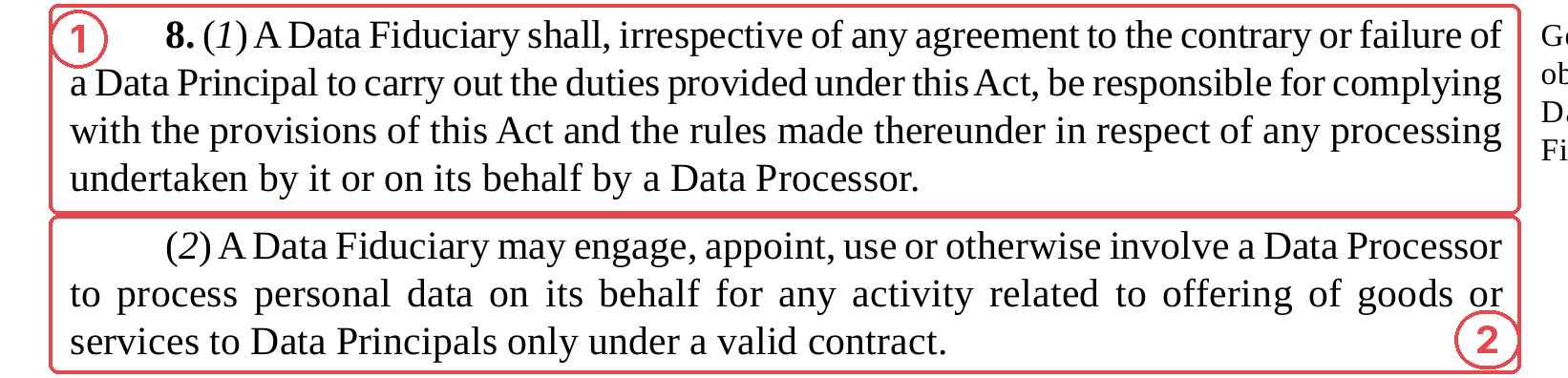
Section 8(1) of the Digital Personal Data Protection Act keeps the Data Fiduciary responsible for compliance when a Data Processor acts on its behalf. Section 8(2) permits that processing only under a valid contract. Section 8(5) also requires reasonable security safeguards, including for processing by the processor. To put “DPDP processor liability” plainly: you contract with the vendor; responsibility to the Board and affected people remains yours. A signed DPA does not transfer that responsibility away.
Treat data processors under the DPDP as a relationship to govern, not a box on an intake form. Your register should record the purpose, personal-data classes, locations, sub-processors, return or erasure terms and breach-notice route. The contract should match the actual service rather than repeat generic security language. Then collect enough evidence to decide whether the controls fit the exposure.
The DPDP Rules 2025 were notified on 13 Nov 2025. Several important operating rules, including breach-intimation mechanics, begin 18 months later: 13 May 2027. The DPDP Rules phased commencement matters when setting remediation dates; don't write “the law started today” without identifying the provision. Nobody has been notified as a Significant Data Fiduciary yet. India-hosted choices below are a procurement consideration, not a claim of blanket mandatory local storage.
If the government later designates you a Significant Data Fiduciary, the bar rises. Rule 13 adds an annual Data Protection Impact Assessment and audit, a Data Protection Officer answerable to the Board, and due diligence of algorithmic software used to process personal data, including checks on risks to Data Principals' rights. Ask each supplier for technical information about its models, training and sub-processors before that question becomes urgent. A vendor assessment can support that review but cannot supply your legal conclusion.
What to look for in third-party vendor risk management software
A good third-party risk management tool does not merely automate more email. It connects the vendor, processing purpose, assessment, evidence, decision, exceptions and next review. These six tests are the useful part of my selection process.

The important features of third-party risk management don't all carry equal weight: a bank should weight regulatory controls and outsourcing expectations; a small SaaS team should care more about evidence reuse and assessments than a giant feature list.
Vendor due diligence, intake and reassessment
Collect business purpose, personal-data access, hosting and sub-processors, then tier before choosing questions. A payroll processor need not face the office supplier's short form. Test a real intake and a change-triggered reassessment. Risk-based routing matters more than a giant questionnaire catalogue. Can you see the fourth party and the previous decision? If not, the vendor record is only a prettier intake form and won't support due diligence.
Assessment automation
Test whether the software reads audit reports and DPAs, drafts answers with page citations and returns missing evidence as supplier requests. Bring a report whose scope omits the service and see whether the assessment notices. Add an expired certificate and an ambiguous answer. Your existing questionnaire must fit, and a reviewer must be able to disagree with the draft. Faster email is not assessment automation; faster reading with a source is. For a shorter list, see AI tools for assessments.
DPIA and vendor mapping
A vendor screening score cannot explain your processing purpose. Link the supplier to activities, data categories, geography and downstream recipients; let that same record feed privacy impact assessment tools. Keep the starting score distinct from your remaining-risk decision after controls. Test a sub-processor change: does it reach the data map and require a fresh review? An assessor needs to question the service, not merely accept its security score. Add DPDP-specific DPAs to the scope now rather than reconstructing them after purchase.
Continuous monitoring
Ask exactly what refreshes: daily scans, breach reports, expiring evidence or contract dates. Security ratings help triage, not inspect a DPA or prove DPDP compliance. Test a disputed website, shared hosting and an acquisition, then follow the finding to assignment and closure. A feed without a reviewer and due date creates another inbox, not a better programme. Questionnaire intelligence needs the same check: AI assessment tools aren't exempt from false positives. Continuous does not mean human verification.
Cross-border transfers and records
For each transfer, record destination, hosting, onward transfers and sub-processors. DPDP is not blanket data localisation, but other rules or your contracts may shape choices. Ask for an entity/country data map and exportable history. Include exit terms and evidence: removed access, returned or erased data and supplier confirmation. A yearly spreadsheet won't show actual processing changes. For AI suppliers, include prompt retention and model-provider locations. Ask to see how a routing change reaches the next assessment, not just how a country field looks on a vendor card.
Audit logs and evidence
Export one high-risk supplier. Does the file show its answers, evidence versions, cited passages, exceptions, approvals and next review date? Findings need owners and deadlines; changes should be appended, never hidden by overwriting. Test whether the package keeps your reason for accepted risk. “Approved until next March after reading the audit scope” is useful; a green colour alone isn't. Include sub-processor approvals and remediation history. Audit logging should prove the decision chain for regulated reviews, not merely keep a timestamp for administrator logins.
How we chose
I started with the processor inventory and applied five tests: questionnaire and evidence handling, monitoring, India/DPDP fit, documented assessment features and price visibility. The list deliberately mixes focused TPRM products, privacy-led platforms, configurable enterprise-risk suites and two security-rating specialists. An ERM-qualified tool needed actual vendor surveys or third-party assessment functions; it did not qualify just for hosting a generic risk register.
I did not run these ten products side by side or assign implementation scores. The feature links show the basis for my claims, and the review dates identify the actual feedback quoted. Public pricing covers only what the vendor will publish. Your own vendor mix will alter both cost and fit.
Run the same proof of concept on three vendors: one high-risk processor with an old audit report, one vendor with a disputed website finding and one renewal with a changed sub-processor. Require an evidence export. If a score holds up only while the salesperson drives the demo, don't buy the score. Use this as your vendor management software checklist, and compare the narrower questionnaire-led options in vendor assessment software if outside-in monitoring isn't your priority.
Why BigID, Securiti and TrustArc aren't on this list
BigID, Securiti and TrustArc are useful around data privacy, discovery and governance, but I wouldn't treat them as like-for-like TPRM replacements without demonstrating vendor intake, third-party questionnaires, risk decisions and remediation together. BigID excels at finding and classifying data. Users on PeerSpot like BigID Next's discovery and custom classifiers and complain about UI bugs (27 Nov 2025); another review values scanning controls but reports intermittent scan failures (19 Dec 2025). My take: that's a data-visibility problem you may need solved before TPRM; it doesn't answer every supplier-control question. The Securiti alternatives guide and data discovery tools cover those separate buying decisions.
TrustArc is a privacy-management route rather than a security-rating substitute, and Securiti spans data security and privacy rather than just vendor reviews. That is a scope filter, not a negative judgement. Use the related guides when privacy discovery is the job, and TPRM when supplier-control evidence is the job.
Vendor management platform vs vendor risk management software
A vendor management platform and a vendor risk management software product overlap on the vendor record, but they answer different buying questions. Vendor management tools are usually procurement-led: who is the supplier, what did we buy, when does the contract renew and how much do we spend? A VRM or TPRM system asks whether the supplier should get the access, which controls were assessed, what changed after approval and who accepted the remaining risk.
| Vendor management platform | Vendor risk management software |
|---|---|
| Procurement and supplier-administration owner | Security, privacy, compliance or operational-risk owner |
| Supplier intake, vendor registration and purchasing | Risk intake, tiering and due-diligence scope |
| Quotes, purchase orders, contracts and renewals | Questionnaires, evidence reviews and control mapping |
| Spend, savings and supplier performance | Starting risk, findings, exceptions and residual risk |
| Catalogue, SLA and commercial changes | Security signals, reassessments and incident follow-up |
| Purchase and payment permissions | Risk acceptance, remediation and audit export |
| Offboarding closes purchasing access | Offboarding removes access and confirms data return or erasure |

The categories meet at intake and offboarding. A procurement approval can create the risk record, and a failed assessment can stop the purchase. A contract owner can supply renewal terms while legal reviews processing terms and security evaluates the evidence. Many enterprise suites cover both sides, but a vendor portal alone still doesn't determine risk.
I would treat the vendor risk management software checklist as a different document from a supplier platform RFP. If you need to reduce duplicate SaaS subscriptions, negotiate spend and manage supplier contacts, start with vendor management. If your customer audit asks for assessments, evidence and unresolved findings, start with TPRM. This is a vendor-risk list, not a list of procurement suites. Keeping that boundary prevents a familiar purchase: a nicer supplier database surrounded by the same unstructured security emails as before.
1. Redacto: best for source-backed vendor assessments in India

Features
Redacto reads vendor reports and contracts, drafts each questionnaire answer with its source, turns missing evidence into vendor requests and puts findings on the risk register. It covers intake, context-specific questions, re-rating and an offboarding checklist, with custom questionnaire import. Questionnaires map to areas RBI, SEBI and IRDAI reviews address, including vendor risk management for regulated teams. Every answer still needs a reviewer; evidence in a policy does not prove the whole service is in scope.
India/DPDPA fit: strongest in this list for linking DPDP processing context, vendor evidence and risk decisions, while openly treating regulatory coverage as a review aid rather than a compliance certificate.
Pricing
Quote-based.
Reviews
Full disclosure: we build Redacto, so I won't score it beside the others. Three customers, in their own words:
- Surya N, Director, Product Management, TimePay: “As a product team, we had one worry: would privacy compliance hurt the onboarding journey? It didn't. Redacto's consent flows fit into our app with very little engineering effort, and we change notices from the console instead of shipping a new build. Our users get a clear choice at every step, and we get a consent record we can stand behind.”
- Prem Kumar, Data Protection Officer, Pine Labs Group: “Privacy across a group of businesses is hard because every team has its own systems and its own idea of what personal data it holds. Redacto gave us one view of where personal data is collected, why we collect it and where it goes. When a customer request or an audit question comes in, I answer it with evidence, not a round of emails.”
- Saif, Head, Infosec Compliance & Privacy, Razorpay: “Our vendor security and privacy reviews used to live in spreadsheets and long email threads. With Redacto, every assessment, every piece of evidence and every follow-up sits in one place. When a customer sends us a security questionnaire, we answer it from that same record. We focus on the vendors that actually carry risk, and the paperwork no longer runs the week.”
Clients
By our own count we've done "40+ successful implementations". Redacto does not publish a public subscription price or independent G2 profile, so ask for a reference with your regulatory mix and run three of your own completed vendor reviews through the product.
Summary
“We focus on the vendors that actually carry risk, and the paperwork no longer runs the week” captures its purpose: check evidence once, reuse it and retain the source. Redacto has no independent G2 score and isn't a general ERM/GRC suite, so compare the exported record and that specific limit with the other finalists.
2. MetricStream: best for enterprise TPRM with linked risk records

Features
MetricStream Third-Party Risk Management maps suppliers, vendors, partners and dependencies, then applies risk-based tiering and due diligence. Its relationship view spans contracts, assessments, evidence, performance, incidents and issues. AI assistants help answer relationship questions and agents read evidence, monitor signals and guide remedies. It also handles fourth parties and supplier exit, which makes the product more credible than a questionnaire-only tool for large portfolios.
India/DPDPA fit: configure processor-specific questionnaires, retention requirements and DPA checks explicitly; don't assume wider GRC coverage already matches Indian law. Check support hours and hosting choices; neither follows automatically from a global GRC label.
Pricing
Quote-based.
Reviews
Users on its Gartner review profile like the ease of use and varied metrics for analysing third-party security posture (Gartner user reviews, Nov 2022). The visible review is product-specific, but only two ratings are visible and there is no readable critical text. I wouldn't turn that small, old sample into a consensus. Ask two current customers about year-two administration and whether the promised relationship view still needs specialist report building.
Clients
Ask for a reference that bought third-party management recently, with a vendor count similar to yours. The lack of a dedicated TPRM G2 page means an Enterprise Risk Management review cannot fill this evidence gap.
Summary
MetricStream fits large enterprises where vendor issues meet audit and enterprise controls. Test supplier self-service and report ownership with your own DPA; treat the product and its delivery services as one buying decision.
3. OneTrust: best for privacy-led supplier third-party management
Features
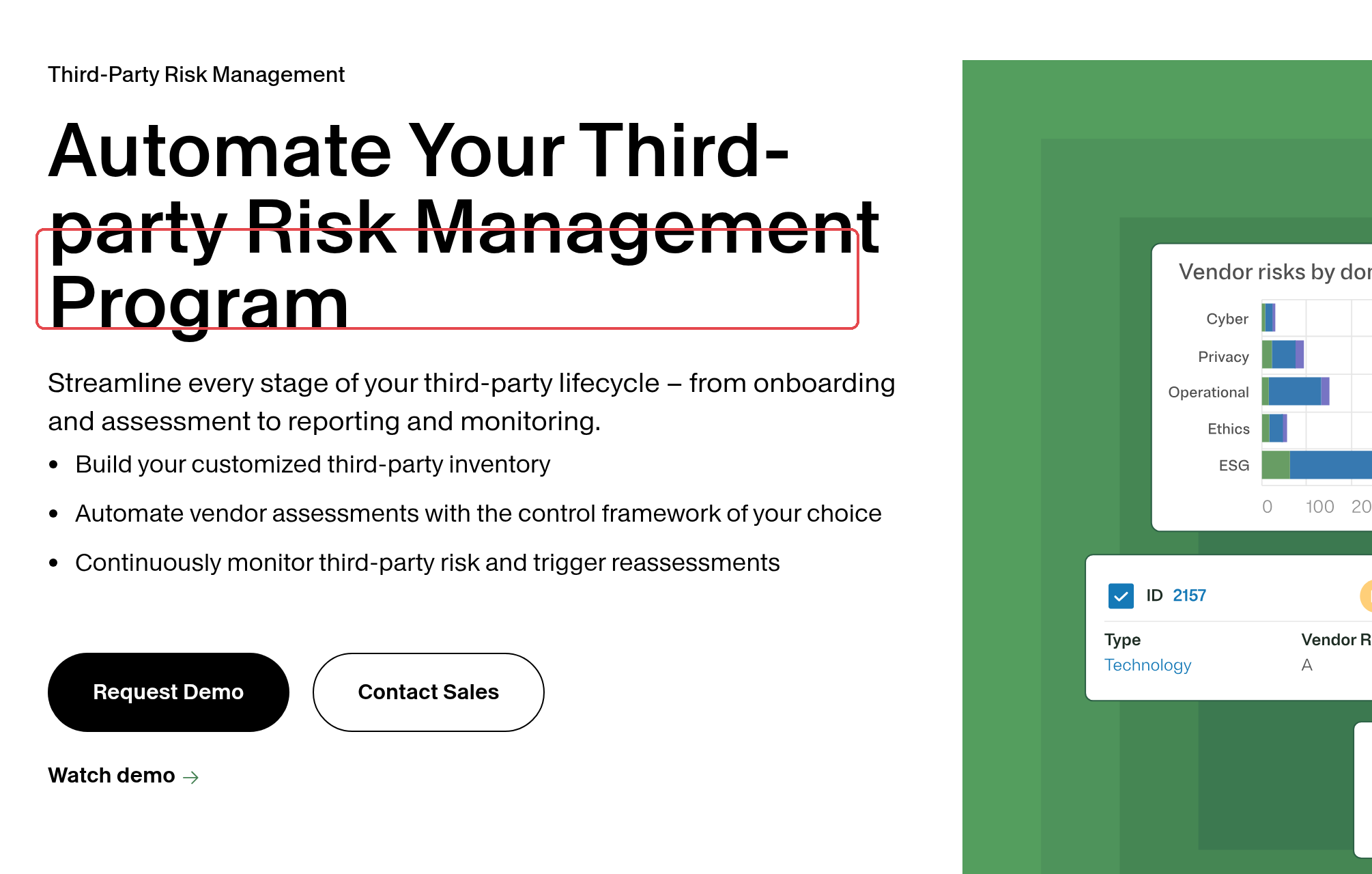
OneTrust Third-Party Management builds a supplier inventory, runs configurable assessments, watches risk signals and triggers reassessments. Its supplier portal and assessment templates support repeated data-collection tasks; regulatory and privacy records can sit alongside third-party risks. The useful draw is joining privacy due diligence to a wider compliance picture, not an assumption that every control template handles DPDP off the shelf.
India/DPDPA fit: use it when privacy and security assessors want one supplier record, then write DPA and sub-processor checks for your actual Indian processing activities. Test when signals cause a new review instead of merely creating an alert.
Pricing
Quote-based direct from OneTrust. Ask for Third-Party Management as a line item and split it from privacy, consent, data-discovery and external-intelligence options. Get the supplier count and assessment volume in writing.
Reviews
Users on G2 like supplier risk flagging and automation, and complain about supplier-access problems and email-template errors (G2, Sep 2026). The review is for Third-Party Management itself; I excluded an unrelated legacy carbon-accounting review on the same profile. My take: send your own invitation to a supplier using a basic browser and personal email address during the pilot. Reliability at that first email matters more than a perfect administrator demo.
Clients
Ask for a reference using Third-Party Management, rather than a customer of only privacy or consent modules.
Summary
OneTrust fits teams already committed to its privacy suite or needing legal and security beside one supplier record. Smaller buyers should check whether they need a narrower TPRM tool and a lower administration burden.
4. ServiceNow: best for third-party risk inside ServiceNow

Features
ServiceNow Third-Party Risk Management covers engagement through retirement, with tiering, inherent-risk assessments, due diligence, continuous intelligence, issue handling and risk posture reporting. Its strongest setting is an existing ServiceNow install where vendor issues can meet enterprise controls, assets and incidents. ServiceNow IRM is broader suite terminology; the tool assessed here is the current Third-Party Risk Management product, not a generic policy-management module.
India/DPDPA fit: map DPDP-specific DPAs and evidence expiry into vendor assessments, then verify that your purchased package includes the required third-party data and reporting. Existing ServiceNow access does not automatically mean TPRM entitlement.
Pricing
Quote-based.
Reviews
Users on G2 like having controls, assessments and risk tasks in one platform, but complain about the administrator learning curve and how configuration grows harder to maintain (G2, Oct 2026). This is the wider ServiceNow GRC profile, not a standalone TPRM sample. A separate Sep 2026 review expressly lists Vendor Risk Management assessments among its uses, and raises implementation cost, specialist staffing, licensing costs and upkeep. My take: proven existing ServiceNow ownership is an advantage, not a reason to shortcut the third-party demo.
Clients
Ask for a current reference buying Third-Party Risk Management, not simply ServiceNow IT or another GRC module.
Summary
ServiceNow fits organisations where IT and risk teams already share its data model. For a new buyer, prove the third-party package, licence cost and administrator effort before treating familiar infrastructure as a saving.
5. UpGuard: best for security ratings with AI-assisted assessments

Features
UpGuard Vendor Risk brings security ratings, continuous scans, AI-generated vendor security profiles, questionnaires, issues and third-party monitoring together. It can draft from vendor documents and scan for changed risk signals, closing the usual split between outside-in ratings and collected evidence. “AI writes the assessment” still needs your reviewer to confirm scope and reject false findings.
India/DPDPA fit: good for the security side of processor due diligence and follow-up, but carry DPDP contract terms, data location and sub-processor records in either your questionnaire or a connected privacy record.
Pricing
Standard published pricing starts at $1,750 per month, billed annually. Professional, Corporate, Enterprise and Enterprise+ are quote-based. Confirm which vendor count and AI functions the Standard tier includes, plus any mandatory services.

Reviews
Users on G2 like the straightforward interface and automated questionnaires, and complain that findings need manual verification and reports need more customisation (G2, Oct 2026). My take: use disputed websites in the proof of concept and measure how quickly you can contest a finding. A clean rating matters less than an alert you can investigate and close with evidence.
Clients
Ask for a current Vendor Risk reference and confirm that it bought at the same tier you consider; a logo alone does not show fit for your planned scope.
Summary
UpGuard is a strong security-led choice when outside-in scanning and collected evidence must meet. Test disputed websites, source citations and tier limits; privacy and enterprise-risk records need a separate home or custom assessment.
6. KavachOne / ConsentiQo: best for an India-first DPDP processor register

Features
ConsentiQo TPRM Software includes a vendor DPDP assessment portal, DPA clause and renewal tracking, starting and remaining risk scoring, a sub-processor registry and reassessment alerts. The separate KavachOne third-party service includes assessments, monitoring, policies and contractual support. Keep that division visible: buying a service is not identical to licensing the product. KavachOne DPDPA TPRM is a clear product direction, but you still need a real demonstration of monitoring inputs.
India/DPDPA fit: the clearest narrower alternative for a DPDP processor register without buying a wider privacy or enterprise-risk suite, subject to verifying the promised monitoring and supplier portal.
Pricing
Quote-based.
Reviews
Ask for a customer reference using this exact TPRM module. Have them demonstrate how they detect a new sub-processor and whether their last DPA renewal triggered a reassessment.
Clients
Request an Indian reference using the TPRM software as distinct from ConsentiQo's consent manager or KavachOne's consulting services.
Summary
KavachOne/ConsentiQo has unusually direct Indian product evidence for processor assessments, DPA renewal and sub-processor tracking, but little independent feedback. Require a customer reference and show exactly which security signals its monitoring receives, rather than infer them from its consulting offer. The KavachOne alternatives post covers consent selection separately.
7. Privy by IDfy: best for privacy-led third-party reviews under DPDP
Features
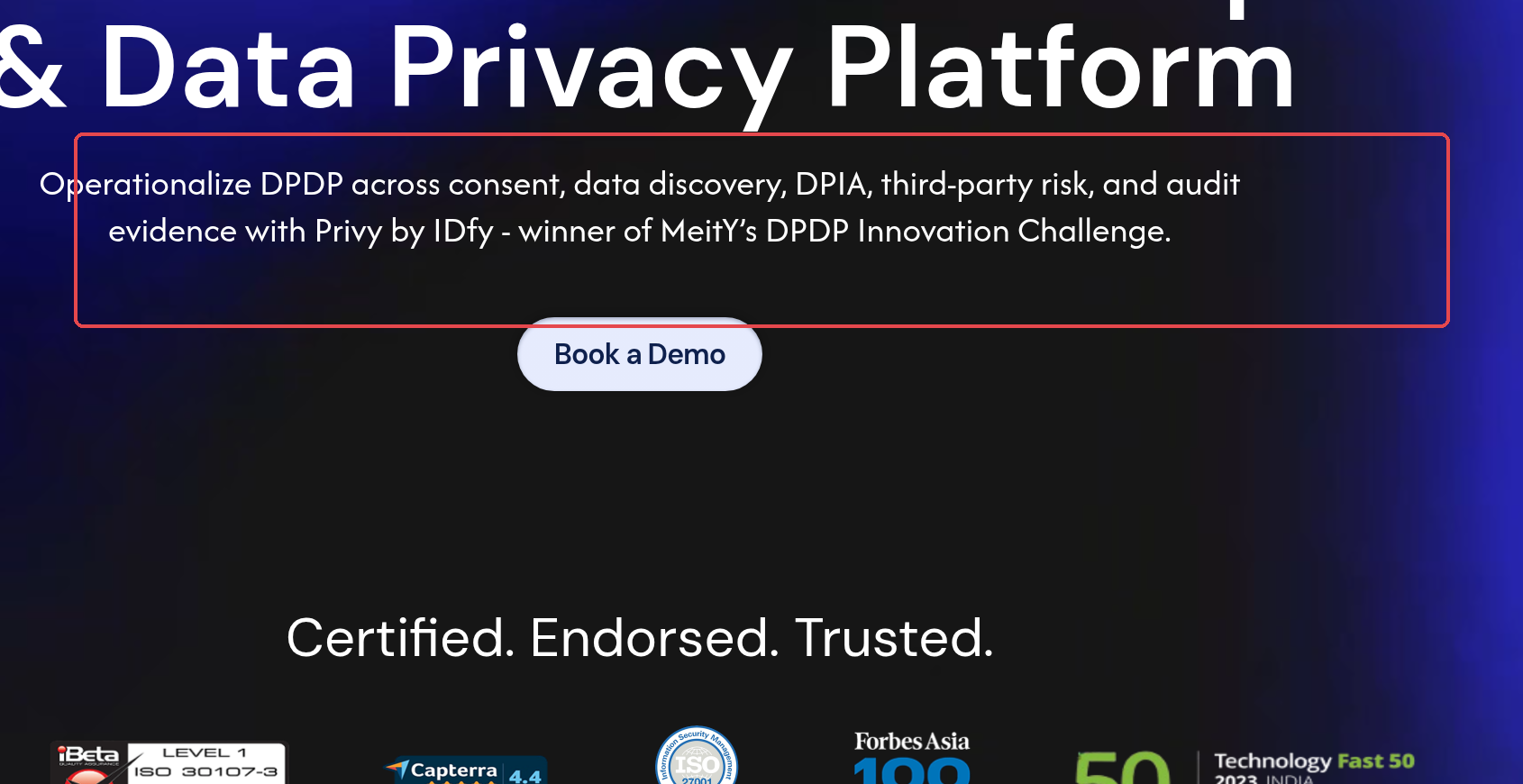
Privy by IDfy puts third-party risk alongside privacy impact assessments, consent, discovery, rights requests, incident handling and audit records. That makes it relevant where processor checks need the same processing record as the rest of a DPDP privacy programme. The harder test is depth: ask for its questionnaire, evidence review, reassessment and supplier-remediation details, rather than assume a complete privacy suite means a security-ratings product.
India/DPDPA fit: direct DPDP orientation makes it a candidate for privacy-led processor oversight; keep dedicated cyber monitoring and security finding validation on your checklist.
Pricing
Publishes no direct subscription total. Its AWS Marketplace listing offers a 12-month contract with four usage measures: active data principals, cookie domains, data classification GBs scanned, and a Risk & Compliance licence fee. Overage applies to the first three, not the licence dimension. Ask how active people are counted and which exact third-party functions belong to the Risk & Compliance tariff.
Reviews
Nobody has reviewed Privy yet on G2, so your reference call is the review; no IDfy KYC review is used here. Ask two privacy customers to walk through their last third-party assessment and what changed when a supplier's processing scope changed.
Clients
Customer testimonials and named logos cover the wider Privy platform, not proof of each TPRM function. Request a reference licensed for third-party risk, ideally with your sector's data-access pattern.
Summary
Privy is a privacy-led DPDP choice, not an external cyber-ratings replacement. My Privy review covers its wider modules and billing details; here, put a supplier assessment through it and ask which charges scale with your programme.
8. LogicGate Risk Cloud: best for configurable third-party risk processes

Features
LogicGate Risk Cloud combines a supplier intake agent, assessment agent, third-party intelligence, standard questionnaires and an external assessment portal. Findings link to remediation and every action has an audit log. Its no-code application builder helps when a risk team wants field and process changes without waiting for engineering, but self-service should not mean uncontrolled configuration.
India/DPDPA fit: configure DPDP questions and vendor evidence explicitly, including contracts, locations and onward processing. This is a flexible risk platform rather than a prewritten Indian processor-compliance service.
Pricing
Quote-based.
Reviews
Users on G2 like the no-code builder and linked risk processes, and complain about restricted visual report customisation and awkward single-column records (G2, Oct 2026). A separate review on the same full page covers third-party findings and warns that multiple administrators can cause inconsistent changes. My take: set a change/test routine before spreading administration, and ask your assessors to build—not merely watch—a real supplier process.
Clients
Ask for a current Risk Cloud customer using TPRM every week, including an administrator who handles configuration and a security assessor who owns findings.
Summary
LogicGate is best when a risk team owns its process design and has disciplined administrators. Otherwise broad configuration can reproduce the same spreadsheet problems. Test role permissions and have your analyst build a real supplier assessment without the salesperson.
9. SecurityScorecard: best for monitoring a large vendor portfolio

Features
SecurityScorecard divides its TITAN packages into Watch for security ratings and intake, Assess for questionnaire templates, review agents and risk scoring, and Secure for response automation, fourth-party concentration mapping and an event feed. TITAN OS adds questionnaire handling separately from Watch. This separation matters: you're not buying the same assessment depth at every package level.
India/DPDPA fit: use continuous third-party security monitoring as one evidence source, but keep the Data Fiduciary's legal, contractual and risk-acceptance decisions in your own programme or connected privacy tool.
Pricing
A free account includes your own-domain scorecard and questionnaire response, not a free vendor-monitoring programme. Watch, Assess and Secure paid packages require a quote, with usage based on monitored or managed organisations. Ask what defines a managed organisation and whether partial monitoring or third/fourth-party discovery costs extra.
Reviews
Users on G2 like clear third-party visibility, ratings and continuous monitoring, and complain that findings can lack business-impact context and need manual verification (G2, Nov 2026). My take: ratings are triage, not a compliance verdict. Test your own websites and an acquisition, with shared hosting deliberately included, then measure the finding-dispute path before the dashboard reaches your board.
Clients
No exact-package customer metric is claimed here. Request a reference that bought the same Watch, Assess or Secure scope you intend to buy, especially if fourth-party mapping is central to your plan.
Summary
SecurityScorecard fits a large external vendor portfolio, not a DPA register or full legal review. Choose Watch, Assess or Secure only after seeing what that package contains and checking disputed alerts with your own suppliers.
10. SAP Risk Management: best for SAP-centred risk with vendor surveys

Features
SAP Risk Management 12.0 work-centres guide supports vendor categories, survey templates and recipients, risk assessments, calculated risk, risk indicators and responses. That is an enterprise-risk product with vendor-assessment functions, not SAP Ariba Supplier Risk. The separate Ariba Supplier Risk guide covers supplier engagement and procurement context; don't substitute one product's licensing or features for the other.
India/DPDPA fit: suitable only after you configure vendor controls, evidence rules and processor-specific surveys. Its SAP business context can help large enterprises, but it does not cover the same job as an Indian security-monitoring service.
Pricing
Quote-based.
Reviews
Users on G2 like central risk tracking and automation, and complain that the interface is hard for non-technical staff and the methodology is not very customisable (G2, Mar 2026). My take: choose it for SAP-centred risk governance with vendor surveys, not as a drop-in third-party cyber-ratings substitute. Ask your implementation partner to complete an entire vendor category, survey and risk calculation in front of you.
Clients
Request a reference for SAP Risk Management itself and keep Ariba references separate.
Summary
SAP belongs on a shortlist when enterprise risk already runs near SAP processes. If you need cyber ratings or fast security questionnaire setup, a focused TPRM tool could be simpler; a joint legal, procurement and security trial will make the trade-off clear.
How to choose, by situation
The best third-party risk management software for your organisation depends more on ownership and evidence than on the number of logos on a vendor page. I'd start with the job that is currently late: due diligence, questionnaire responses, a regulator's evidence request or daily monitoring. Then check which system holds your contract, processing record and incidents today. Buying a second incompatible system can help analysts collect answers while making the answer itself harder to trust.
You're a bank, NBFC or insurer
Start with Redacto, MetricStream, OneTrust and ServiceNow for a regulated-outsourcing review; the BFSI vendor-risk comparison covers sector expectations and the AI assessment guide covers answer review. Add UpGuard when continuous cyber visibility matters, and test regulatory control mapping, incident escalation, fourth-party evidence, exits and an audit export that survives staff turnover. Treat DPDP marketing as no substitute for RBI, SEBI or IRDAI evidence: require every score to reach its source and an unresolved finding's owner. ### You're mid-sized with a small team
Shortlist Redacto, KavachOne/ConsentiQo and Privy for DPDP-led work, plus UpGuard when security scanning leads. Run one intake-to-report assessment using your existing staff, and get limits on vendors, templates, AI reading and reviewer seats. A lighter, fully used programme beats an enterprise quote you lack the staff to configure; begin with questions proportional to data access rather than assessing every supplier at maximum depth. ### You're a large enterprise or SDF candidate
MetricStream, ServiceNow and LogicGate suit procurement, privacy, IT and enterprise teams needing separate paths through one record. Build for SDF-level DPIA, audits, model review and accountability, with entity reporting, permissions, source citations and exportable histories. Test who owns configuration changes and decide whether private hosting, regional residency or SSO matters before negotiating the licence. ### You already run ServiceNow or SAP
ServiceNow or SAP can reduce duplicated supplier and control data when the existing contract already includes the needed functions; otherwise price each extra module and service explicitly. ServiceNow suits shared control and incident records; SAP Risk Management suits SAP-centred risk with vendor surveys. Neither automatically supplies external ratings, so retain a security-monitoring specialist where that remains the unresolved job. ### You only need security ratings
Pick SecurityScorecard or UpGuard to discover external problems, prioritise suppliers and watch changes. A grade cannot tell you whether processing is authorised, sub-processors are covered by contract or residual privacy risk has an owner, so pair it with a short assessment and a named decision owner. Judge its dispute path as carefully as the dashboard when false positives consume analyst time. For another category answer, use the vendor risk management software guide and this article's comparison table together. I would run three of your own vendors through each finalist and score only what the system lets you prove. That turns a long list into a defensible shortlist.