Third-Party Risk Management Framework: Components, Data Model and Template
Build a third-party risk management framework: tiering, a vendor data model with fields, NIST CSF 2.0 and DPDP mapping, and a template.

Here's the question I least want from an auditor: why did one vendor get a 300-question review and another get none? If you own third-party risk, you've probably felt that one coming while new vendors arrive faster than your team can review them.
That gap is getting harder to defend. The 2026 Data Breach Investigations Report, published on 19 May 2026, found a third party involved in 48% of breaches, up 60% on the year before.
You searched for a third-party risk management framework, so I'll assume you want something you can adopt this quarter, not another definition. In this guide I'll walk you through the five parts, the fields your vendor record should carry, the standards I'd map your controls to and, if you work in India, the DPDP clauses your processor contracts now need. I'll finish with a template outline, a worked example and the calls I'd make in your seat.
TL;DR
A third-party risk management framework is the written set of rules for how you choose, assess, contract with, watch and exit the outside companies that touch your data and systems. It has five parts: a policy that sets scope, a tiering rule, assessment criteria, a vendor record (the data model that holds the evidence) and named owners.
- Run every vendor through the same five stages: plan, due diligence, contract, monitor, exit.
- Tier first. The tier decides how deep you assess and how often you come back.
- Your vendor record needs about 40 fields across nine entities.
- Map your controls to NIST CSF 2.0 (GV.SC-01 to GV.SC-10), NIST SP 800-161 Rev. 1 and ISO/IEC 27001:2022 Annex A 5.19 to 5.23, then add the DPDP processor clauses from section 8 and Rules 6 to 8.
- If you need the definition first, start with what third-party risk management is. This post is the how-to.
Why TPRM frameworks fall apart at the first audit
A typical third-party risk setup has a policy, a questionnaire and a spreadsheet, with no rule connecting the three. The fix is a written chain: the tier sets how deep you assess, the assessment sets what goes in the vendor record, and the record holds the evidence.
What is a TPRM framework?
A TPRM framework is the documented structure behind third-party risk management: who is in scope, how you rate them, what you ask, what you record, who decides and what happens at each stage of the relationship. A third party management framework, a third-party risk framework, a vendor risk management framework and a 3rd party risk management framework all mean the same thing.
The TPRM framework is the design; the programme is the people, tools and calendar that run it. Keep them separate, because the design should survive a change of tool or team.
TPRM framework components: the five parts
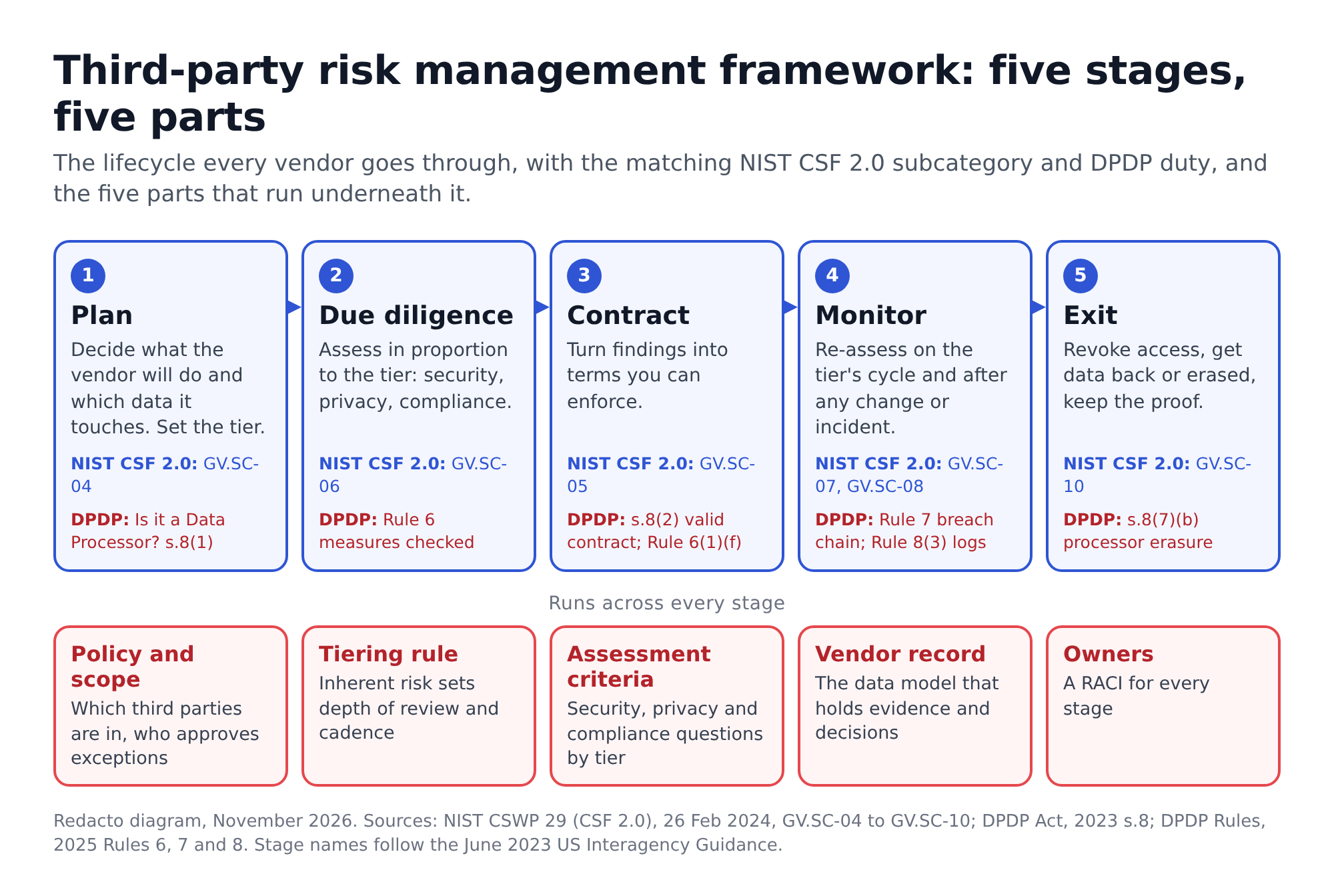
I borrow the lifecycle across the top from the June 2023 US Interagency Guidance, because bank regulators got the stages right: plan, due diligence, contract, monitor, exit. The tier decides how much work each step gets, and the five parts underneath make each stage repeatable.
1. Policy and scope (your policies and procedures)
Your third party risk management policies and procedures should be one short policy plus a procedure per stage. The policy names what counts as a third party, who approves exceptions and how often the board sees a report. Keep it under five pages; the procedures carry the detail.
2. Tiering and inherent risk
Tiering is where most of the value sits. Score each engagement on inherent risk before any controls: the personal data it touches and how much, the access it gets to your systems, how hard it would be to replace and whether a regulator cares about it. More in our post on inherent risk and its factors.
I use three tiers. More than four and people argue about the boundaries instead of doing reviews.
3. Assessment criteria
The questions and evidence you require per tier, covered next.
4. The vendor record
This is the data model: the fields that hold what you know about each vendor and what you decided. It gets its own section below, because it's where most setups are weakest.
5. Owners
A RACI that names who does each stage. Without one, contract terms get set by legal alone and nobody owns the exit.
Third-party service provider assessment framework: security, privacy and compliance
A third party risk assessment framework sets what you check about a vendor, how deep you go and what evidence counts, so two analysts reach the same answer on the same vendor. A third-party risk assessment, in plain terms, is one run of that check against one engagement.
For third party service providers, I assess three areas (security, privacy and compliance) and scale depth to the tier:
| Area | Tier 1 (high) | Tier 2 (medium) | Tier 3 (low) |
|---|---|---|---|
| Security | SOC 2 Type II or ISO 27001 certificate, full questionnaire, latest penetration test summary, access review | Certificate plus a short questionnaire | Intake questions only |
| Privacy | Data categories, sub-processors, data location, DPDP Rule 6 measures, breach notice times, erasure method, signed processor terms | Data categories, sub-processors, processor terms | Confirm no personal data |
| Compliance | Sector rules (RBI, SEBI, IRDAI where they apply), sanctions and adverse media, financial health, continuity plan | Sanctions and adverse media, continuity plan | Sanctions screen |
| Review cycle | Yearly, and after any incident or change in scope | Every two years | At renewal |
The cycles are my defaults, not a rule from any regulator. RBI, for example, only asks banks for a risk-based approach to how often they review a service provider.
The third-party service provider assessment questionnaire
Don't write your own questionnaire from scratch. Start from a standard set such as the SIG, trim it per tier and add your DPDP questions. Our complete guide to SIG questionnaires covers the versions. For supply chain scoping, NIST's fillable SCRM Assessment Scoping Questionnaire (Table 26 of SP 800-161 Rev. 1, added December 2025) is a fair starting point; I'd use it for tier 1 only.
To run a supplier risk assessment: tier, send that tier's questionnaire, read the evidence, log findings, decide.
Third-party vendor risk management data model: schema and fields
A third party vendor risk management data model is the schema behind your vendor register: the entities (vendor, engagement, data category, assessment, finding, contract, sub-processor, incident, exit) and the fields each one holds.
The best public starting point is NIST's supplier inventory control, SR-13, new in SP 800-161 Rev. 1. For each tier one supplier (a direct supplier such as a prime contractor, not your highest risk tier), record the contract or order, what they supply, which programme or system uses it and its criticality. Those four fields are the minimum; everything else in the model below builds on them.

Indian banks have a matching duty: RBI's November 2025 outsourcing directions require an inventory of outsourced IT services, including the important entities in their supply chains, and a map of the bank's dependency on third parties (para 77). If you're a bank, build the register once to satisfy both.

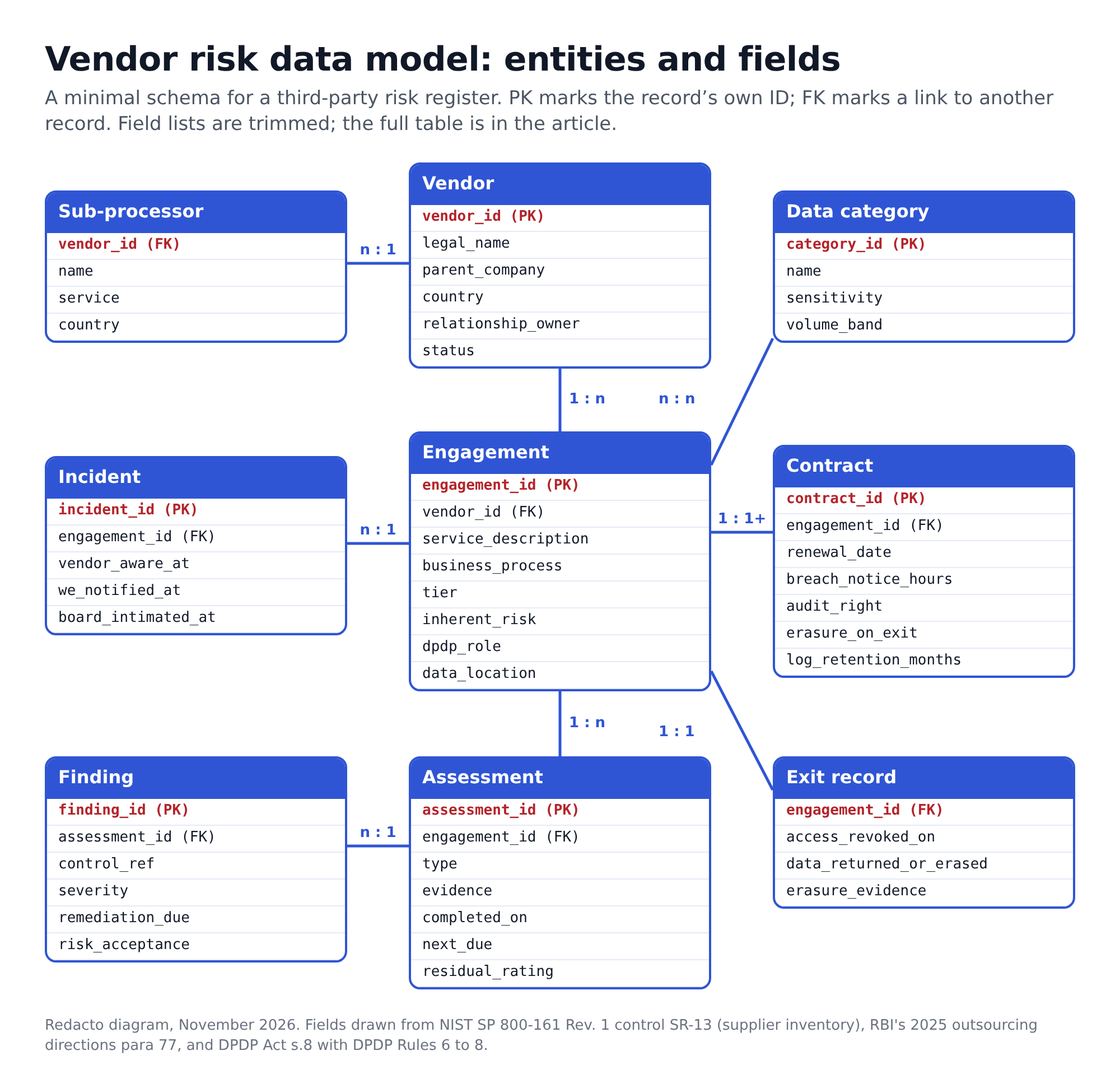
The design choice that matters most: separate the vendor from the engagement. One cloud provider can host your marketing site (tier 3) and your customer database (tier 1). If the tier sits on the vendor, you either over-review the first or under-review the second.
| Entity | Field | Type | Why it matters |
|---|---|---|---|
| Vendor | vendor_id | text | One ID per legal entity |
| Vendor | legal_name, country | text | Sanctions checks and contract parties |
| Vendor | parent_company | text | Ownership changes alter risk; record them |
| Vendor | relationship_owner | person | Someone has to answer for the vendor |
| Vendor | status | list: proposed, active, exiting, exited | Sets which reviews are due |
| Engagement | engagement_id, vendor_id | text | One row per service, linked to the vendor |
| Engagement | service_description | text | SR-13: what is supplied |
| Engagement | business_process | text | SR-13: which programme or system uses it |
| Engagement | tier | 1, 2 or 3 | SR-13 criticality; CSF GV.SC-04 |
| Engagement | inherent_risk | score | Why it got that tier |
| Engagement | dpdp_role | list: Data Processor, separate Data Fiduciary, none | Decides whether s.8 applies |
| Engagement | data_location | list of countries | Lets you act fast if transfers to a country are restricted under s.16 |
| Engagement | access_type | list: none, read, write, admin | More access, bigger blast radius |
| Data category | name, sensitivity, volume_band | text, list, list | Feeds the tier and breach impact |
| Sub-processor | name, service, country | text | Your processor's processors are your exposure too |
| Assessment | type | list: intake, periodic, event-based | Shows why the review ran |
| Assessment | evidence | files with dates | SOC 2 period, ISO certificate number and expiry |
| Assessment | completed_on, next_due | dates | next_due comes from the tier |
| Assessment | residual_rating | list | Risk after controls; what you accept |
| Finding | control_ref | text | E.g. ISO A.5.20 or DPDP Rule 6(1)(c) |
| Finding | severity, remediation_due, status | list, date, list | Turns findings into tracked work |
| Finding | risk_acceptance | person and expiry date | Exceptions must end |
| Contract | contract_id | text | SR-13: the contract or order |
| Contract | renewal_date | date | Your best moment to fix weak terms |
| Contract | breach_notice_hours | number | Must fit inside your own Rule 7 clock |
| Contract | audit_right, subprocessor_approval | yes/no, list | What you can enforce |
| Contract | erasure_on_exit, log_retention_months | yes/no, number | s.8(7)(b) and Rule 8(3) |
| Incident | vendor_aware_at, we_notified_at, board_intimated_at | timestamps | Proves you met the 72-hour Board deadline |
| Exit | access_revoked_on | date | The step teams forget |
| Exit | data_returned_or_erased, erasure_evidence | list, file | Proof for s.8(7)(b) |
If I could only keep four fields accurate, they'd be tier, dpdp_role, next_due and the risk_acceptance expiry.
The control set, mapped to NIST CSF 2.0, SP 800-161 and ISO 27001
These are the ten controls I'd put in any third-party risk management framework, with where each one maps.
| Control | What it requires | NIST CSF 2.0 | SP 800-161 / 800-53 | ISO 27001:2022 | DPDP |
|---|---|---|---|---|---|
| TP-01 Policy | Approved TPRM policy and procedures | GV.SC-01 | SR-1, PM-30 | A.5.19 | s.8(4) |
| TP-02 Roles | Named owners inside and at the vendor | GV.SC-02 | SR-1 | A.5.19 | s.8(1) |
| TP-03 Inventory | Vendor record per engagement | GV.SC-04, ID.AM-04 | SR-13 | A.5.19 | s.8(1) |
| TP-04 Tiering | Inherent risk sets the tier | GV.SC-04 | RA-9 | A.5.19 | |
| TP-05 Due diligence | Tier-based assessment before signing | GV.SC-06 | SR-6 | A.5.19, A.5.21 | Rule 6 |
| TP-06 Contract terms | Security, breach notice, audit, erasure | GV.SC-05 | SR-3, SR-8 | A.5.20 | s.8(2), Rule 6(1)(f) |
| TP-07 Monitoring | Re-assess per tier and after change | GV.SC-07 | SR-6 | A.5.22 | s.8(5) |
| TP-08 Incidents | Vendors in your incident plan and tests | GV.SC-08 | SR-8 | A.5.24 | s.8(6), Rule 7 |
| TP-09 Cloud | Rules for buying and leaving cloud services | GV.SC-05 | SA-9, SA-9(5) | A.5.23 | s.8(5), s.16 |
| TP-10 Exit | Access removed, data returned or erased | GV.SC-10 | SA-9, AC-2, MP-6 | A.5.11, A.5.20, A.8.10 | s.8(7)(b), Rule 8(3) |
NIST CSF 2.0: the GV.SC category
CSF 2.0, published 26 February 2024, moved supply chain risk into the new Govern function as Cybersecurity Supply Chain Risk Management (GV.SC), with ten subcategories. Use them as a lifecycle checklist: GV.SC-04 is your tiered supplier list, GV.SC-06 your pre-signing due diligence and GV.SC-07 your risk handling across the whole relationship.

The two I'd check first are GV.SC-05 (requirements in contracts) and GV.SC-10 (what happens after the contract ends). Both are cheap to fix at renewal and painful to fix after an incident.
NIST SP 800-161 Rev. 1
There is no single NIST TPRM framework. NIST covers third parties in CSF 2.0's GV.SC category and in SP 800-161 Rev. 1. CSF tells you what outcome to reach; SP 800-161 Rev. 1 tells you how, in 325 pages split across three levels (enterprise, mission and business process, operational). You don't need all of it on day one: take the supply chain controls in Appendix A and the policy and plan templates in Appendix D, and leave the rest until an auditor asks.

ISO/IEC 27001:2022 Annex A
ISO/IEC 27001:2022 covers suppliers in Annex A controls 5.19 (Information security in supplier relationships), 5.20 (Addressing information security within supplier agreements), 5.21 (Managing information security in the ICT supply chain), 5.22 (Monitoring, review and change management of supplier services) and 5.23 (Information security for use of cloud services). If you're certified or heading there, map your controls to these first. Our post on ISO 27001 for third-party risk management has the detail.
Pros and cons of different risk assessment frameworks
In short: CSF 2.0 is free and short but says what, not how; SP 800-161 has depth and templates but runs long; ISO 27001 is certifiable but brief on suppliers.
My take: map to CSF 2.0 and ISO 27001 for the outside world, borrow SP 800-161's structure and templates, and put Indian law on top. If you're comparing broader risk management frameworks for security programmes, our roundup of nine cybersecurity standards covers the wider set.
DPDP processor clauses your TPRM framework needs
Under the Digital Personal Data Protection Act, 2023, you stay responsible for what your Data Processors do with personal data "irrespective of any agreement to the contrary" (s.8(1)), and you can only use a processor "under a valid contract" (s.8(2)). The DPDP Rules, 2025 fill in what that contract must cover. These duties apply from 13 May 2027.
Put these clauses in every processor contract, and a matching field in the vendor record:
- Security: reasonable security safeguards, including encryption or masking, access control, logs and backups (s.8(5), Rule 6(1)(a) to (d)), written into the contract (Rule 6(1)(f)).
- Logs: keep personal data, traffic data and processing logs for at least one year, then erase (Rule 8(3)).
- Breach notice to you within hours. You must tell the Board without delay and send a detailed report within 72 hours of becoming aware of a breach (Rule 7(2)(a) and (b)), so a vendor clause of "without undue delay" is too loose.
- Erasure: erase data you made available when you have to erase it (s.8(7)(b)), with written proof.
- Sub-processors: your prior approval, and a current list you can pass on when someone asks who you shared their data with (s.11(1)(b)).
- Audit and cooperation: access to evidence, and help with Board inquiries.
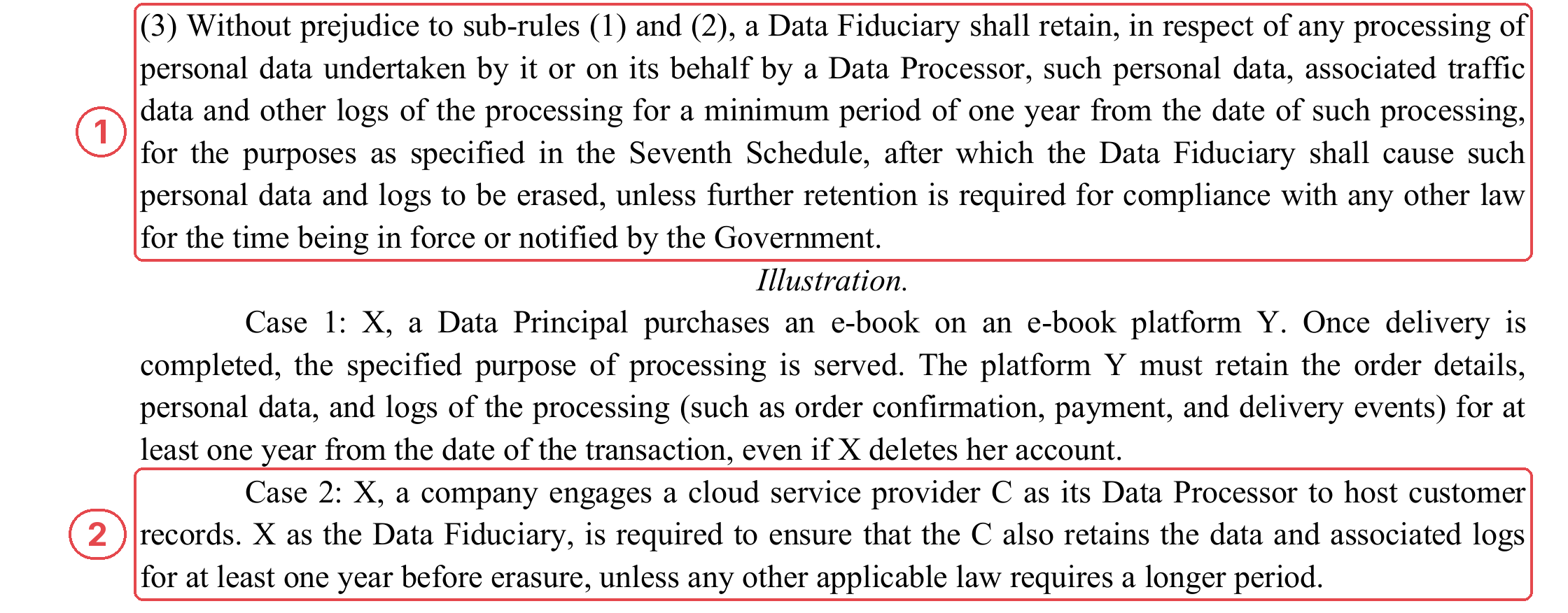
Rule 8(3) is the clause I'd check first. A contract that says "delete on termination" clashes with a one-year retention duty, so fix it at renewal. Failing to take reasonable security safeguards, including over your processors, can cost up to ₹250 crore (s.8(5), Schedule item 1). Our guides on Data Processors under the DPDP Act, the DPDP Rules and the full DPDP Act compliance requirements cover the rest.
Third-party risk management framework template
Here's the outline I'd use for a third-party risk management framework template. If you're doing third party framework development from scratch, copy it into your policy tool and fill each heading.
- Purpose, scope and definitions (what counts as a third party; Data Processor per DPDP s.2(k))
- Roles and RACI
- Tiering rule and inherent risk scoring
- Assessment standard per tier (questions and evidence)
- Minimum contract terms (security, breach notice, audit, sub-processors, log retention, erasure)
- Monitoring cycle per tier, plus events that force a re-review
- Findings, remediation and risk acceptance with expiry
- Exit procedure
- Records: the vendor data model above
- Reporting to management and the board, and yearly review of this document
Download the third-party risk management framework template (XLSX): the vendor record sheet built from the data model above, the register columns and this outline.
A third-party risk management framework example
Here's a worked example (made up for this post, not a real vendor). You add a payroll SaaS provider. It holds salary, bank and PAN details for every employee and acts as your Data Processor. Inherent risk is high, so it's tier 1.
Due diligence asks for its SOC 2 Type II report, its sub-processor list and its data locations. You log one finding: its contract says "delete on termination", which clashes with Rule 8(3). The fix goes in at signing: one-year log retention, then erasure with a certificate, and breach notice to you within 24 hours. next_due is set twelve months out. At exit, access_revoked_on and erasure_evidence close the record.
Who owns what: a RACI for third-party risk
R = responsible, A = accountable, C = consulted, I = informed.
| Activity | Business owner | Procurement | Security | Privacy / DPO | Legal | Risk committee |
|---|---|---|---|---|---|---|
| Plan and tier | A | C | R | R | I | I |
| Due diligence | C | I | R | R | C | I |
| Contract terms | A | R | C | C | R | I |
| Monitoring | A | I | R | R | I | I |
| Risk acceptance | R | I | C | C | C | A |
| Exit | A | R | R | C | C | I |
The line I'd defend hardest: the business owner is accountable. If security owns the vendor, the business stops caring once the contract is signed.
TPRM framework vs programme: how to operationalise it
To operationalize a third party risk management program, you take the design above and give it a calendar, tools and people: an intake form wired to procurement, a register, review reminders, a findings tracker and a quarterly report. Our guide to building a third-party risk management programme covers that rollout step by step. This post stays on the design.
New to the subject? Start with what vendor risk management is. The key steps to mitigate third-party vendor risks are short: know them, tier them, contract tightly, watch the top tier and plan the exit. The top vendor risk management challenges post covers where this usually goes wrong.
What to do, by situation
You're a small or mid-sized business with overseas suppliers
Small and medium-sized businesses can assess and manage third-party supplier risks, including overseas ones, with a two-tier version of this setup. Rely on certificates (SOC 2, ISO 27001) instead of site visits, record data_location and sub-processors for each supplier, and put breach notice and erasure terms in the contract. Transfers out of India are allowed unless the government restricts a country under s.16 or a sector rule such as RBI's is stricter (s.16(2)), so the record of where data sits is what protects you if that changes.
You're a bank or other RBI-regulated entity
Your outsourcing directions already require most of this, including an inventory, risk-based periodic review and an exit strategy (paras 75, 77 and 79 to 82 of the November 2025 directions for commercial banks, in the IT outsourcing chapter). Build one set of controls and one register that meet RBI and DPDP together, not two parallel registers.
You're choosing a TPRM platform
To evaluate different third party risk management platforms, whether sold as TPRM software or as a vendor risk management platform, test them against the data model and controls above, not their demo. Can it hold your data model, including engagement-level tiers and DPDP fields? Does it compute next_due from the tier? Does it expire risk acceptances? Can you export everything? Our comparisons of third-party vendor risk management software and the features a TPRM tool must have will help you shortlist the best vendor risk management tools for your size.
Final thoughts
A TPRM framework earns its keep when someone asks "why did this vendor get this review?" and you can answer from the record in a minute. Tier on data and access, record decisions as fields, map once to CSF 2.0, ISO 27001 and DPDP, and spend review time on tier 1.
If you'd rather not build the register yourself, see how Redacto handles vendor risk.