What Is Third-Party Risk Management (TPRM)? Meaning, Lifecycle and DPDP Duties
What TPRM means, the five-stage third-party risk lifecycle, the six risk types, and what India's DPDP Act requires for your vendors.

TL;DR
Third-party risk management (TPRM) is the process of finding, assessing, contracting for and monitoring the risks that come from outside organisations you rely on: suppliers, service providers, software vendors, data processors and partners. It runs from the day you plan to use a vendor until the day you exit.
- TPRM means third-party risk management. Vendor risk management is the same work applied to vendors you pay.
- Third parties were involved in 48% of breaches in Verizon's 2026 DBIR.
- The lifecycle has five stages: planning, due diligence and selection, contract negotiation, ongoing monitoring and termination.
- Under India's DPDP Act, you stay responsible for what your processors do with personal data, and you need a valid contract with each one.
- Tier vendors by risk and spend your effort on the top tier. Equal effort for every vendor is how programmes stall.
Why third-party risk keeps getting worse
Every SaaS tool, payment partner and outsourced call centre you add is another company holding your data or your customers' trust. You can't patch their systems, and you usually find out about their problems last.
The numbers back that up. Verizon's 2026 Data Breach Investigations Report found a third party involved in 48% of breaches, a 60% jump on the previous year.

If you searched for what TPRM means, you probably need a clear definition, the steps that make up a programme and, if you work in India, what the DPDP Act now expects. This guide covers all three, plus the mistakes that make TPRM programmes expensive and slow. There's also a short DPDP checklist you can use on your next vendor.
TPRM meaning: what is third-party risk management?
TPRM means third-party risk management. You'll also see it written as 3PRM or 3rd party risk management. In business it means a repeatable way to decide which outside parties you can trust with your data, systems and customers, on what terms, and how you will know if that changes.
A third party is any organisation you have a business relationship with that isn't you: vendors, suppliers, cloud and SaaS providers, outsourced service providers, data processors, consultants, distributors, fintech partners and, more and more often, AI model providers. The US banking agencies define a third-party relationship as "any business arrangement" between a bank and another entity, by contract or otherwise. That width is on purpose.
TPRM vs vendor risk management: vendor risk management (VRM) covers the suppliers you pay. TPRM also covers partners and others you don't pay, such as a co-lending partner or a referral agent. In practice most teams use the terms interchangeably, and our guide to what vendor risk management is treats VRM in more depth.
A TPRM policy is the board-approved document that sets the rules: which vendors are in scope, how you tier them, who approves exceptions and how often each tier is reviewed. Without one, every assessment is a negotiation.
Types of third-party risk
Most vendors carry more than one type of risk. I tier a vendor on its worst one, because that's the one that will hurt.

The cybersecurity example is real. In August 2025, Google's Threat Intelligence Group reported that an actor it tracks as UNC6395 used compromised OAuth tokens for the Salesloft Drift app to export large volumes of data from numerous companies' Salesforce instances from as early as 8 August to at least 18 August, then searched that data for secrets such as AWS credentials and Snowflake tokens. Salesforce itself wasn't breached; GTIG says the issue didn't come from a vulnerability in the core platform. The way in was a third-party app the victims had connected.

AI vendors deserve their own line. When you send personal or confidential data to a third-party AI or LLM provider, assess it like any processor: how it handles and retains your data, whether it trains on it, its security controls, its certifications and what the contract lets you enforce. Test scores and API price tell you nothing about risk.
The TPRM lifecycle in five stages
The clearest description of the TPRM process I know comes from US bank regulators. The Federal Reserve, FDIC and OCC's June 2023 Interagency Guidance splits the third-party relationship life cycle into five stages, with governance running across all of them. It was written for banks, but it fits any sector.


1. Planning
Before you sign, decide what the vendor will do, what data and systems it will touch and what happens if it fails. That answer sets the risk tier, and the tier sets everything after it.
2. Due diligence and selection
Assess the vendor in proportion to its tier. Third-party due diligence (TPDD) for a top-tier vendor means reading its SOC 2 or ISO 27001 evidence, its privacy practices, its sub-processors, its financial health and its incident history. A low-tier vendor might need a short questionnaire. Our guide to building a TPRM programme covers tiering in more detail.
3. Contract negotiation
The contract is where risk becomes an obligation: security requirements, breach notification to you, audit rights, sub-processor approval, data location, return and erasure at exit. If it isn't in the contract, you can't enforce it.
4. Ongoing monitoring
Re-assess on a schedule set by the tier, and also whenever the service, the data or the vendor changes. A yearly questionnaire alone misses most of what matters, so add news alerts, certificate expiry dates and the vendor's own incident notices.
5. Termination
Plan the exit at the start. When the relationship ends, revoke access, get your data back or erased, and collect evidence that it happened. This is the stage teams forget most often.
For a fuller build-out, see our third-party risk management framework guide. Standards that cover the same ground include ISO/IEC 27001:2022 controls A.5.19 to A.5.22 and the supply chain category in NIST CSF 2.0.
DPDP third-party risk management: what Indian businesses owe
If you run third-party risk management in India, or vendor risk management under DPDP, this is the part that changes your contracts. The Digital Personal Data Protection Act, 2023 never says "third-party risk", yet it keeps you, the Data Fiduciary, responsible for personal data your processors handle.
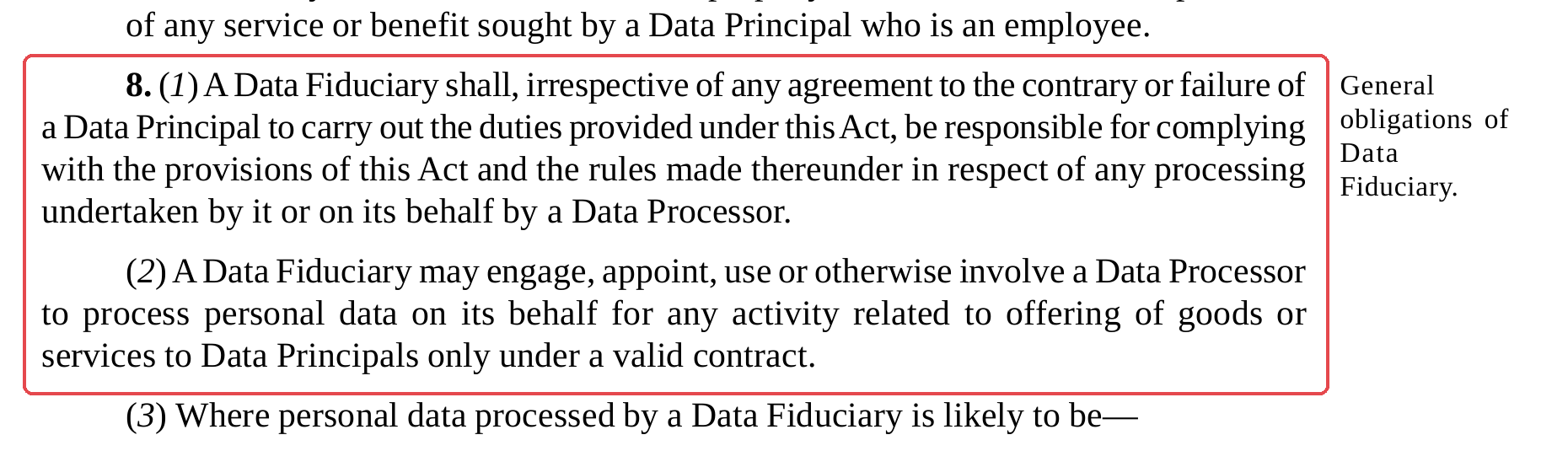
Section 8(1) makes the Data Fiduciary responsible for complying with the Act "irrespective of any agreement to the contrary" and for any processing "undertaken by it or on its behalf by a Data Processor". Section 8(2) allows you to engage a processor only under a valid contract.
The DPDP Rules, 2025 add detail. Rule 6(1) requires reasonable security safeguards for processing done by you or by a processor, and Rule 6(1)(f) requires your processor contracts to include them. Section 8(7)(b) requires you to make your processors erase data when you must erase it. A failure to take reasonable security safeguards can draw a penalty of up to ₹250 crore, and processor failures count against you. Most of these duties apply from 13 May 2027, under Rule 1 of the DPDP Rules.
The breach chain matters too. Under Rule 7, you must notify the Data Protection Board and affected people. If your processor has the breach, you only meet that duty if your contract makes it tell you fast. GDPR Article 28 sets similar processor terms in Europe, so a contract written for both laws is easy to maintain.
Regulated entities have a second layer. RBI's November 2025 Managing Risks in Outsourcing directions for commercial banks require board-approved policy, due diligence, contracts, at least yearly reviews of service providers and a termination plan. RBI's 2026 cybersecurity directions for commercial banks add a vendor risk assessment process proportionate to risk and materiality (para 126) and hold the bank accountable for security in outsourced and partner arrangements (para 127).

For more on the processor side, read our guide to data processors under the DPDP Act.
A TPRM DPDP checklist
Use this for every vendor that touches personal data:
- Confirm whether the vendor is a Data Processor for you, and list the personal data it receives.
- Tier it on the volume and sensitivity of that data and how critical the service is.
- Check its security against Rule 6: encryption or masking, access control, logging kept for a year, backups.
- Sign a valid contract with Rule 6 security terms, breach notice to you within hours, sub-processor approval, audit rights and erasure on instruction.
- Record where the data is stored and accessed, in case the government restricts transfers under section 16.
- Re-assess top-tier processors at least once a year and after any incident.
- At exit, get written confirmation of erasure or return, and revoke every credential.
State and local TPRM: the public sector view
Many readers of this page are looking for state and local TPRM, so a short note. In the US, federal agencies assess cloud vendors through FedRAMP. State, local and education governments have their own route: GovRAMP, a nonprofit that lets them reuse one standardised, NIST-based security assessment of a cloud provider across procurements instead of repeating reviews contract by contract.

Reusing one assessment of a vendor across many buyers is the same logic behind SOC 2 reports and trust centres in the private sector.
In-house TPRM vs TPRM services
TPRM services usually means one of three things: a consultancy that runs assessments for you, a managed service that runs the whole programme, or a platform your team uses itself. Third-party risk management solutions and systems mostly sit in the third group.
My view: keep the decisions in-house and outsource the volume. Tiering, risk acceptance and contract terms need someone who knows the business. Chasing questionnaires and reading a vendor's SOC 2 report for the tenth time is work a service or a tool can carry. AI is already changing that work; our piece on how AI is changing vendor security reviews and questionnaires looks at what it means for reviewers. Reviews of the big-name TPRM platforms make the same point from the other side: users praise templates and central records, and complain that process flows take careful planning and an admin to maintain. Budget for that person.
A tool earns its cost once you have more vendors than your team can review each year. Before that, a well-kept register and a tiering rule will do. When you get there, our posts on third-party vendor risk management software and the features a TPRM tool must have compare the options.
Redacto's Vendor Risk Management drafts each questionnaire answer from the reports and contracts a vendor has already sent, cites the source, and maps questionnaires to the areas RBI, SEBI and IRDAI reviews ask about.

Common TPRM mistakes
These are the patterns I see most often when a TPRM programme stalls:
- Treating every vendor the same. A 200-question questionnaire for a catering supplier burns goodwill and hides the vendors that matter.
- Stopping at vendor intake. Most risk changes after the contract is signed, through new data flows, new sub-processors or an acquisition.
- Ignoring connected apps. An integration's tokens can reach your core systems long after anyone last reviewed them, as the Salesloft Drift case showed.
- Leaving the contract to legal alone. Security and privacy terms need the people who assessed the vendor.
- Forgetting the exit. Data left with a former vendor is still your data under DPDP.
The top vendor risk management challenges post goes deeper on each.
Final thoughts
Third-party risk is the part of your attack surface you can't patch, so TPRM is how you manage it through choices: which vendors, on what terms, watched how closely. Write the policy, tier the vendors, fix the contracts for DPDP, and spend your review time where the data is.
If your vendor reviews are already behind, see how Redacto handles vendor risk.