9 Cybersecurity Frameworks Compared: Which One Fits Your Organisation
Nine cybersecurity frameworks compared, from NIST CSF 2.0 and ISO 27001 to PCI DSS and the CRI Profile: who each fits and how they overlap.

TL;DR
Pick one as your base, prove it with one certificate or report, then add what your sector forces on you. That covers almost everyone reading this.
- NIST CSF 2.0 is the best base for most organisations. It is free, voluntary and gives the board a language for risk.
- ISO/IEC 27001:2022 is the certificate global buyers recognise. SOC 2 is the report US buyers ask for.
- CIS Controls v8.1 is where a small team with no security function should start.
- PCI DSS v4.0.1 is not optional if you store, process or transmit card data.
- The CRI Profile is the financial-services version of CSF 2.0, and the closest thing to a replacement for the FFIEC CAT, which was retired on 31 August 2025.
- COBIT, NIST SP 800-53 and the CSA Cloud Controls Matrix suit narrower jobs: board-level IT governance, US federal work and cloud services.
- Indian banks, NBFCs and brokers start with their regulator: RBI's 2026 cybersecurity directions for commercial banks, SEBI's CSCRF and CERT-In's 2022 Directions.
Why choosing one feels harder than it should
Ask five consultants where to start and you'll get five acronyms, each with a gap assessment attached. Your auditor wants one thing, your biggest customer's questionnaire asks for another, and your regulator has its own list. Meanwhile, the cost of getting security wrong keeps rising, and it rises fastest in finance. In IBM's Cost of a Data Breach Report 2026, the average breach in India cost INR 25.5 crore, and financial services had the highest average of any sector at INR 40.9 crore.

If you searched for a cybersecurity framework list, you probably want three answers: which ones are worth knowing, which one fits your organisation first, and how to avoid doing the same work three times when a second standard arrives.
This guide gives you all three. It covers the nine that matter in 2026, with what each covers, who it fits, the effort and whether you can be certified. It then answers the question most banks, NBFCs and fintechs reading this are asking: which security frameworks are most relevant for financial services technology companies. It ends with a way to choose by situation and a control map that lets one control count across four standards.
What are cybersecurity frameworks?
A cybersecurity framework (often called an IT security framework) is a structured set of outcomes, controls and practices that an organisation uses to manage security risk and show others that it does. Some only describe what good looks like. Others are standards you can be certified against, and a few are contractual or regulatory requirements.
It helps to separate three things that lists usually mix up:
- Guides such as NIST CSF 2.0 and COBIT give structure and a common language. Nobody certifies you against them.
- Standards and audit reports let a third party check you. ISO/IEC 27001 leads to a certificate; SOC 2 leads to an auditor's report.
- Regulations are law or regulator instructions, such as the DPDP Act, the RBI's directions, SEBI's CSCRF or HIPAA. They tell you what you must achieve and often borrow from the guides above to say how.
That distinction is why GDPR and HIPAA are not on this list, even though older versions of this post included them. They are laws. The entries here are what you use to meet them. If you need the wider picture of regulations and how to start a programme, our guide to cyber security compliance basics covers it.
People also search for "data security frameworks" as if they were a separate family. They mostly aren't. Data security sits inside every entry here: CSF 2.0 has a data security category under Protect, ISO 27001 has controls for classification, masking and data leakage prevention, and CIS Control 3 is data protection. What sits alongside them is privacy. The NIST Privacy Framework and ISO/IEC 27701 cover how personal data is used, not only how it is protected, and that is the side India's DPDP Act regulates.
These standards cut cybersecurity risk in a dull way that works. They make you write down what you own, decide which risks matter, assign owners and keep evidence. Most breaches I've read about start with a gap one of these would have flagged: an unpatched system, an unreviewed admin account, a vendor nobody assessed.
The 9 cybersecurity frameworks compared
| Name | Type | Best for | Effort | Maps to |
|---|---|---|---|---|
| NIST CSF 2.0 | Voluntary guide | Any organisation building or explaining a programme | Medium | ISO 27001, CIS, SP 800-53 |
| ISO/IEC 27001:2022 | Certifiable standard | Selling to global enterprises; proving an ISMS | High | CSF 2.0, SOC 2, CSA CCM |
| CIS Controls v8.1 | Prioritised actions | Small and mid-sized teams that need a do-first list | Low to medium | CSF 2.0, ISO 27001, PCI DSS |
| SOC 2 | Audit report (CPA firm) | SaaS and service firms selling to US customers | Medium to high | ISO 27001, CSA CCM |
| PCI DSS v4.0.1 | Contractual mandate for card data | Anyone storing, processing or transmitting card data | High in scope | ISO 27001, CSF 2.0 |
| COBIT (now COBIT 7) | Governance model (licensed) | Large enterprises tying IT to board governance | High | ISO 27001, CSF 2.0 |
| NIST SP 800-53 Rev. 5 | Control catalogue | US federal systems, their contractors, mature teams | Very high | CSF 2.0, ISO 27001 |
| CRI Profile v2.2 | Financial-sector profile of CSF 2.0 | Banks, fintechs, insurers, payment firms | Medium to high | CSF 2.0 and regulator expectations |
| CSA CCM v4.1 | Cloud control set | Cloud providers and cloud-native SaaS | Medium | ISO 27001, NIST, PCI DSS and others |
Effort is my judgement of the work for a mid-sized company starting from a basic security function. The "maps to" column lists the official or widely used mappings each body publishes.
How we chose
I started from the question a CISO actually faces: what will an auditor, a customer or a regulator ask me to show? An entry made the list if it meets three tests.
- It is current and maintained, with a version published or updated by its owner in the last three years. That rule removed the FFIEC Cybersecurity Assessment Tool, which was retired in August 2025.
- It is used to make decisions or to prove security to someone else. Reading lists of 20 acronyms is easy; few of them ever show up in a contract.
- It is a voluntary standard or guide, not a law. Laws appear in the situational and financial services sections, where they belong.
I also gave extra weight to financial services, because that is where most readers of this page work and where Indian regulators are most specific. In payments, the first documents bank partners and auditors usually ask for are the ISO 27001 certificate with its scope statement and the PCI DSS Attestation of Compliance. CSF is the easiest way to explain the programme to a board. Writing controls is the quick part. Getting evidence out of the teams that run the systems is what takes the time.
Versions and prices come from each standard's owner and link to them below; standards bodies change both, so confirm before you budget.
1. NIST CSF 2.0

What it covers
The NIST Cybersecurity Framework 2.0, released on 26 February 2024, organises security outcomes into six functions: Govern, Identify, Protect, Detect, Respond and Recover. Govern was new in 2.0 and covers strategy, roles, policy and supply chain risk, which earlier versions left implied. CSF says what outcome to reach, such as "assets are inventoried", and leaves the how to you. NIST publishes mappings to other standards, profiles for specific uses and quick-start guides.
Who it fits
Almost anyone. It is the best choice when you need to describe a security programme to a board that doesn't speak in control IDs, or when you report to several regulators and want one structure under all of them. It is the base most other standards now map to, which is why I'd start here even if you'll certify against something else.
Effort and cost
CSF itself is free. The work is the current-state and target-state profiles: deciding, for each outcome, where you are and where you need to be. In my experience a first profile for a mid-sized company takes a few weeks of interviews and evidence. Turning the gaps into controls is where the real cost sits.
Certification
There is none. Anyone who sells you a "NIST CSF certification" is selling their own assessment. CSF 2.0 is voluntary for private organisations unless a contract or regulator says otherwise.
Summary
Use CSF 2.0 as your organising language. Don't expect a customer to accept it as proof on its own; pair it with ISO 27001 or SOC 2 when someone asks for evidence.
2. ISO/IEC 27001:2022

What it covers
ISO/IEC 27001:2022 specifies how to run an information security management system (ISMS): scope, risk assessment, risk treatment, leadership, internal audit and continual improvement. Annex A lists 93 controls in four themes (organisational, people, physical and technological). You pick the ones that treat your risks and justify the rest in a Statement of Applicability. The 2022 edition has one amendment, published in 2024, which added climate change considerations to the context clauses. Our explainer on what ISO 27001 certification involves walks through the audit stages.
Who it fits
Companies that sell to large enterprises, especially outside the US, and companies that want a management system rather than a checklist. In Indian BFSI, an ISO 27001 certificate is often the first document a bank's vendor team asks for, which is why it sits at the centre of most ISO 27001-based third-party risk programmes.
Effort and cost
High at the start. You need a scoped ISMS, a risk method, policies, an internal audit and a management review before the certification audit. The standard itself costs CHF 155 from iso.org (list price, October 2026); that's the cheap part. The certification body's fees and your own staff time are the real cost.
Certification
Yes, by an accredited certification body. Certificates run for three years with surveillance audits in between. The transition from the 2013 edition ended on 31 October 2025 under IAF MD 26, so any 2013 certificate still being shown to you has lapsed.
Summary
The most portable proof of security you can buy. It answers "do you have a security programme?" well. It answers "is this specific control working?" less well, which is where SOC 2 Type 2 or customer audits come in.
3. CIS Controls v8.1

What it covers
The CIS Critical Security Controls v8.1 are 18 controls broken into 153 numbered actions, ordered so you do the most protective work first. Version 8.1 matched the controls to NIST CSF 2.0, including the Govern function, and revised asset classes and action descriptions. The actions are grouped into three Implementation Groups. IG1, 56 actions, is what CIS calls "essential cyber hygiene".
Who it fits
Small and mid-sized organisations, and any team that needs to know what to do on Monday. CSF tells you the outcome; CIS tells you to inventory your assets, control admin privileges, patch and keep backups, in that order.
Effort and cost
Low to medium for IG1. The controls and mappings are free to download after registration. IG2 and IG3 add more actions for larger, more exposed environments.
Certification
No formal certification. Some assessors offer CIS-based assessments, and CIS publishes mappings to NIST, ISO and PCI DSS so the work carries over.
Summary
The best starting point for a company with no security function. I'd rather see a small fintech complete IG1 well than produce a 200-page ISMS nobody follows.
4. SOC 2

What it covers
SOC 2 is an auditor's report, part of the AICPA's System and Organization Controls suite, on a service organisation's controls against the Trust Services Criteria: security (always in scope), availability, processing integrity, confidentiality and privacy. A Type 1 report looks at the design of controls at a point in time. A Type 2 report tests whether they operated over a period, often six to twelve months. Our guide to SOC 2 report types and principles has more detail.
Who it fits
SaaS and service companies selling to US customers, whose procurement teams often ask for a SOC 2 Type 2 before they'll sign. If your enterprise customers send SIG questionnaires, a current SOC 2 report answers a large share of them.
Effort and cost
Medium to high. You need controls that work every day, because a Type 2 auditor samples evidence across the whole period. Expect a readiness phase before the first audit window starts.
Certification
Not a certificate. A licensed CPA firm issues a report with its opinion, and you share it under NDA. There is no SOC 2 "pass", only a clean or qualified opinion and a list of exceptions.
Summary
Get SOC 2 when US buyers ask for it. If your customers are mostly Indian or European, ISO 27001 usually goes further for the money.
5. PCI DSS v4.0.1

What it covers
The Payment Card Industry Data Security Standard protects cardholder data. Version 4.0.1, published in June 2024, is the current version, and the requirements that were future-dated in version 4.0 became mandatory on 31 March 2025. It has 12 principal requirements, from network security controls and secure configuration to logging, testing and policy.
Who it fits
Any merchant or service provider that stores, processes or transmits card data, or can affect its security. That includes payment aggregators, payment gateways and many fintech apps. It is not a law; card brands and acquiring banks enforce it through contracts.
Effort and cost
High inside the cardholder data environment, which is why the first and best move is to shrink that environment through tokenisation and scope reduction. Every system you take out of scope is a system you don't have to test.
Certification
Large merchants and service providers are assessed by a Qualified Security Assessor and receive a Report on Compliance. Smaller ones complete a Self-Assessment Questionnaire. Your acquirer tells you which applies.
Summary
Mandatory if you handle cards. Keep it as a tightly scoped overlay on top of ISO 27001 or CSF, and run the rest of the estate under those.
6. COBIT

What it covers
COBIT is ISACA's model for governance and management of enterprise IT. It ties IT aims to business goals, defines who decides what, and gives auditors a structure for testing. COBIT 2019, the version most people know, set out 40 "governance and management objectives". COBIT 7 is now ISACA's current, actively maintained version, and new users should start there rather than with an earlier one (ISACA licensing).
Who it fits
Large enterprises and banks whose boards and internal auditors want an IT governance model, and audit teams that already use it. It is the least useful entry on this list for a 50-person startup.
Effort and cost
High. COBIT 7 is delivered only through ISACA's publishing platform, and using it inside an organisation needs an enterprise licence, separate from an individual subscription. Budget for that before you plan a rollout; it's easy to miss if you only price the standard itself.
Certification
No organisational certification. ISACA certifies individuals, and assessors use COBIT to rate how well each process performs.
Summary
Use COBIT when governance is the problem: unclear ownership of IT risk, weak reporting to the board. Use CSF or ISO 27001 when security controls are the problem.
7. NIST SP 800-53 Rev. 5

What it covers
SP 800-53 Revision 5 is NIST's catalogue of security and privacy controls, organised in 20 families from access control to supply chain risk management. Release 5.2.0, issued on 27 August 2025, added and revised controls on software updates, patching and development practices. It is detailed in a way CSF chooses not to be.
Who it fits
US federal agencies, for whom it is mandatory under FISMA, and the contractors and cloud providers that serve them. Outside that world, mature security teams use it as a reference library when they need an exact control statement.
Effort and cost
Very high if you try to adopt it whole. It is free to download, and the baselines in SP 800-53B help you pick a subset by system impact level.
Certification
No certification of its own. US federal authorisations, such as FedRAMP for cloud services, assess against it.
Summary
Keep it as a reference library unless you sell to the US government.
8. CRI Profile

What it covers
The CRI Profile, maintained by the Cyber Risk Institute, is a version of NIST CSF built by and for the financial sector. It is mapped to CSF 2.0 and condenses more than 3,500 regulatory expectations into 318 diagnostic statements. Version 2.2 is the current release. An impact-tiering questionnaire decides which statements apply, so a small firm answers fewer of them than a global bank.
Who it fits
Banks, payment companies, insurers and fintechs, particularly those with US or multinational supervisors. It is the closest thing to a replacement for the retired FFIEC CAT, and the FFIEC named it among the resources institutions could use instead.
Effort and cost
Medium to high, but often less than mapping each regulator's rules separately, which is the point. The Profile and its mappings are free to download.
Certification
None. Firms use it for self-assessment and to show supervisors how their controls meet the expectations.
Summary
If you're a financial institution already using CSF, the CRI Profile is the quickest way to show regulators coverage. Indian institutions will still need to map RBI and SEBI requirements on top, since those aren't its focus.
9. CSA Cloud Controls Matrix

What it covers
The Cloud Security Alliance's Cloud Controls Matrix v4.1, released in January 2026, has 207 controls across 17 security areas, written for cloud services. It says which party, provider or customer, owns each control and maps to standards including NIST and ISO. The companion CAIQ v4.1 questionnaire is what providers submit to the CSA STAR registry.
Who it fits
Cloud and SaaS providers that want a cloud-specific control set, and customers assessing them. Among cloud security standards, it is the one buyers recognise by name.
Effort and cost
Medium. If you already hold ISO 27001, much of the CCM maps across. Publishing a STAR Level 1 self-assessment is free; Level 2 adds third-party STAR Certification or STAR Attestation.
Certification
Yes, through CSA STAR Level 2, which builds on ISO 27001 certification or a SOC 2 report.
Summary
Add CCM when you sell cloud services and customers want to see shared-responsibility splits. It works best on top of an ISO 27001 certificate you already hold.
Which security frameworks matter most for financial services and fintech?
Financial services technology companies don't get to pick freely. The regulator decides the floor, customers decide the proof, and voluntary standards fill in how you organise the work. Here's how I'd sequence financial services cybersecurity in 2026.
In India: start with the regulator
Indian regulated entities should read their regulator's instructions before anything on the list above.

- For commercial banks: on 31 July 2026 the RBI issued the Commercial Banks Cybersecurity, Technology: Risk, Resilience and Assurance Framework Directions, 2026, repealing earlier cybersecurity and IT governance instructions for commercial banks. Among other things, it requires a CISO who doesn't report to the head of IT, vulnerability assessments of critical systems at least every six months and penetration tests at least every 12 months, and reporting of cyber incidents to the RBI within six hours of detection. The RBI issued matching 2026 directions for small finance banks, payments banks, NBFCs, urban co-operative banks, all-India financial institutions and credit information companies, so read the one for your entity type on the Master Directions page.
- For market intermediaries: SEBI's Cybersecurity and Cyber Resilience Framework (CSCRF), issued on 20 August 2024 and clarified in August 2025, applies to brokers, depositories, mutual funds and other SEBI-regulated entities, with requirements scaled by entity category.
- For every organisation in India: CERT-In's Directions of 28 April 2022 require reporting specified cyber incidents within six hours and keeping ICT system logs for 180 days within India.
- For personal data: Rule 6 of the DPDP Rules, 2025 lists the reasonable security safeguards every Data Fiduciary must take, from encryption and access control to logs kept for a year. It comes into force on 13 May 2027.

Once the regulatory floor is mapped, NIST CSF 2.0 or the CRI Profile gives the programme its structure, ISO 27001 gives clients their proof and PCI DSS v4.0.1 covers card data. If you're also choosing tooling for the privacy side, our guide to DPDPA compliance software for BFSI compares the options.
In the US: the FFIEC CAT is gone
The OCC's Bulletin 2024-25 confirmed that the FFIEC would sunset its Cybersecurity Assessment Tool on 31 August 2025 rather than update it for NIST CSF 2.0 and CISA's Cybersecurity Performance Goals. The FFIEC's own page points institutions to CSF 2.0, the CISA goals and industry resources including the CRI Profile and CIS Controls.

Non-bank financial companies in the US also fall under the FTC's Safeguards Rule under GLBA, which requires a written information security programme, a qualified individual to run it and, since May 2024, notice to the FTC of breaches affecting 500 or more consumers. For a fintech selling into US banks, SOC 2 Type 2 is usually the report procurement asks for, and PCI DSS v4.0.1 applies to anything touching cards.
Where AI security fits
Financial firms deploying AI models now get asked a new question: which standard covers AI? None of the nine was written for it. Two are worth adding. The NIST AI Risk Management Framework, released in January 2023, is voluntary and structured like CSF, with Govern, Map, Measure and Manage functions. ISO/IEC 42001:2023 is a certifiable AI management system standard built the same way as ISO 27001, so a company with an ISMS can extend it. Neither replaces your security controls; they add model inventory, data provenance, testing and accountability for AI decisions. Map the AI controls back to CSF 2.0 rather than running them as a separate track, so your regulators and auditors see one programme.
How to choose, by situation
You're a startup selling to enterprises
Start with CIS IG1 so the basics are real, then get the proof your buyers ask for. Indian and European buyers usually accept ISO 27001; US buyers usually want SOC 2 Type 2. Don't do both in year one unless a contract pays for it.
You're a regulated Indian bank, NBFC or broker
Your regulator's directions come first, and they are not optional. Use CSF 2.0 or the CRI Profile to organise the evidence, and ISO 27001 if clients or group policy want it. Which cybersecurity standards should fintech companies follow after that? For a fintech with 50 to 500 people, my order is: map your regulatory obligations, adopt CSF 2.0 as the structure, put CIS IG1 in place for the basics, get ISO 27001 (or SOC 2 for American buyers), and scope PCI DSS as tightly as you can, adding the CRI Profile when a bank partner or supervisor asks. Vendor risk is where I've seen these programmes struggle most under inspection, so build your third-party risk management framework alongside the security programme.
You handle card payments
PCI DSS v4.0.1 applies. Scope it down with tokenisation, then put the rest of your estate under ISO 27001 or CSF so the card environment is not your only controlled zone.
You're a cloud-native SaaS company
ISO 27001 plus the CSA CCM gives buyers a clear view of who owns which control in the cloud. Add SOC 2 when US customers ask, and publish a CAIQ to save your sales team from answering the same security questions every week.
You're in US healthcare
The HIPAA Security Rule is the law you must meet. Use CSF 2.0 to structure the programme and consider HITRUST or ISO 27001 if partners want certification.
How the nine overlap
Most controls appear in every standard here under a different name. Access reviews, logging, incident response and backup show up in CSF 2.0, ISO 27001, CIS and SOC 2 alike. The cheapest programme builds each control once and tags it to every standard it satisfies.

The map is indicative. For audit work, use NIST's Informative References for CSF 2.0 and the CIS mapping files, which show control-level relationships.
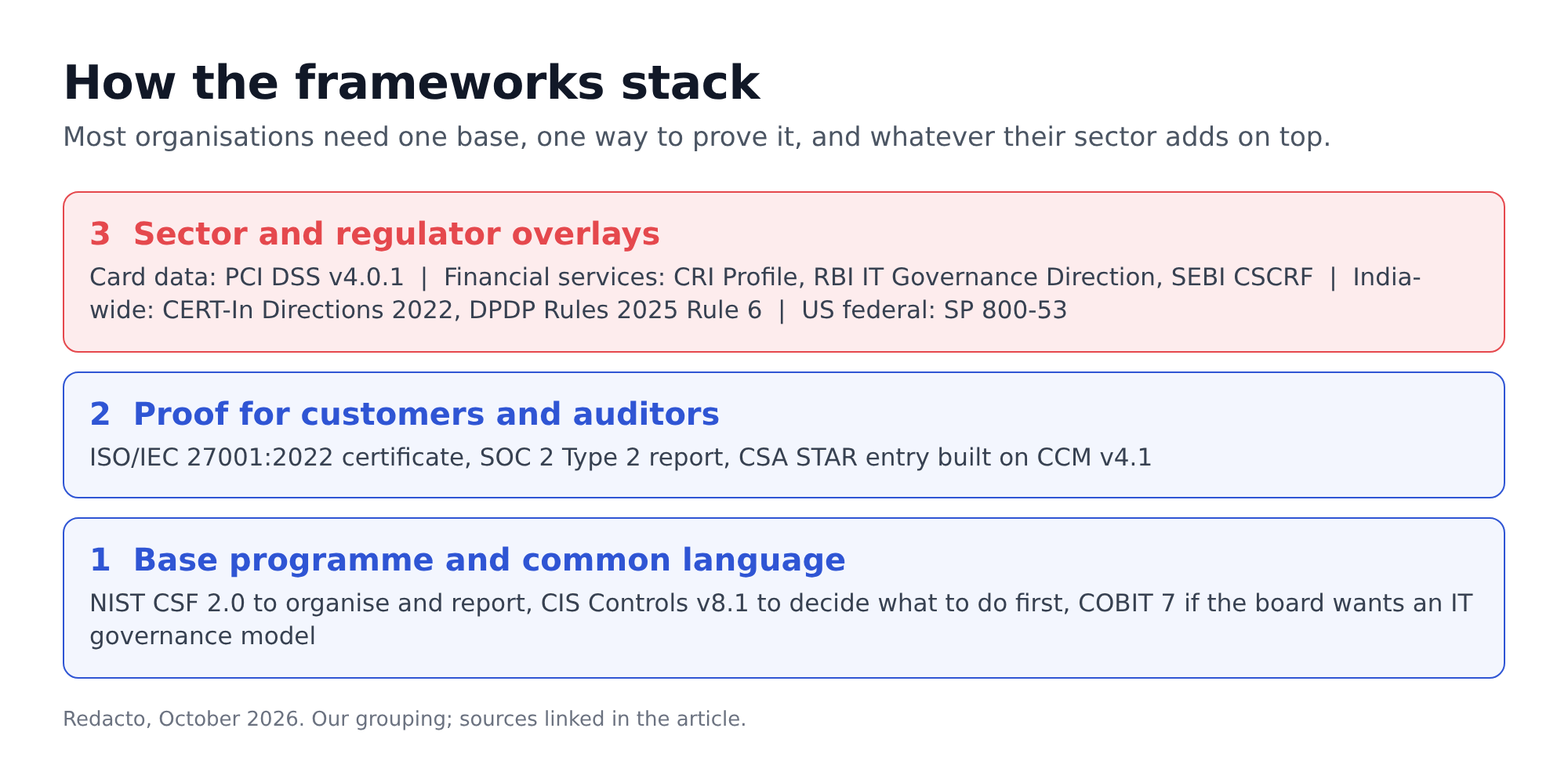
Thinking in layers keeps scope sane. The base gives you the language, the proof layer satisfies customers and auditors, and overlays add only what your sector demands. When a new requirement lands, you add a tag to existing controls instead of a new project. A GRC and risk assessment tool helps once you track more than two standards; Redacto's GRC and ERM module keeps one control library mapped across DPDP, ISO 27001, SOC 2 and sector rules, with evidence attached to each control.
Mistakes I see when teams adopt one
- Buying the certificate before the controls. An ISO 27001 certificate over a scope that excludes the systems customers care about protects nobody, and a good vendor assessor will ask for the scope statement first.
- Running each standard as a separate project. Two teams collecting the same access-review evidence for ISO and SOC 2 is the most common waste I see. One control, many tags.
- Treating the gap assessment as the deliverable. A 150-row gap list with no owners and dates changes nothing.
- Forgetting vendors. Every entry here now has supplier controls. If your vendors hold your data, their controls are part of your scope.
- Quoting retired standards. If a policy still references the FFIEC CAT or ISO 27001:2013, update it before an auditor notices.
Final thoughts
There is no single best cybersecurity framework. There is a best first choice for your situation, and for most organisations it is NIST CSF 2.0 as the base with CIS Controls to get moving. Add ISO 27001 or SOC 2 when customers ask for proof, and let your regulator and your card exposure decide the overlays. If you'd like to see how one control library can carry DPDP, ISO 27001, SOC 2 and RBI requirements at once, book a Redacto GRC demo.