8 Best Privacy Impact Assessment Tools for Indian Companies (Judged on DPDP Fit)
PIA and DPIA tools for Indian companies, compared on DPDP Rule 13 fit, data-flow mapping, audit-ready reports and price, with who each suits.

Most PIAs I've seen stall long before anyone scores a risk. A product team wants to launch next month, privacy sends over a 60-row spreadsheet, and then two weeks go on chasing engineering for data fields, the vendor for its sub-processors and legal for a retention period. By the time the sheet is done, the design has changed, and nobody can say which version was approved.
Most of that delay is finding the data, and few Indian companies have mapped it yet. In EY's January 2026 survey of nearly 150 Indian professionals, only 43.9% of organisations had started identifying their personal data processing activities, and 37.8% had started data discovery and classification. You can't assess the impact of processing you haven't mapped.

If you're searching for privacy impact assessment software in India, you want three things: a tool that ends the spreadsheet chase, a data map you don't have to rebuild for every assessment, and a file that holds up when an auditor or the Data Protection Board asks for it. You also want to know which tools understand DPDP and which just relabel a GDPR form.
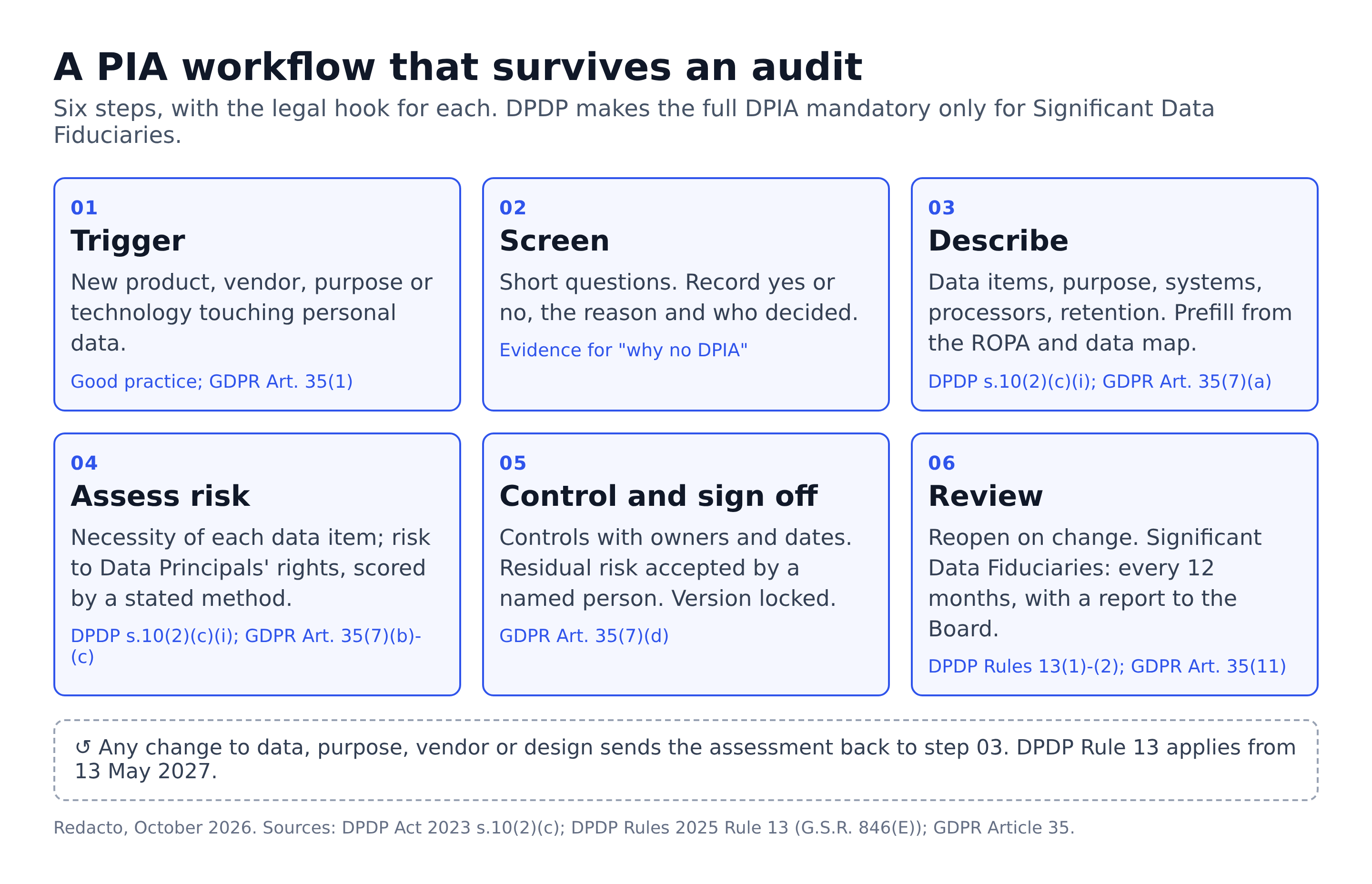
Below are eight PIA tools: what each automates, how it handles data flows and audit-ready output, its price and who should skip it, plus a five-step way to run a DPIA under Rule 13 to test them against.
TL;DR - 8 Best Data Privacy Assessment Tools
A data privacy assessment tool is worth paying for when it does two things a spreadsheet can't: it pulls the facts about a processing activity from records you already keep, and it produces a dated, signed-off file an auditor can follow. All eight below can run a questionnaire. They differ on whether they prefill it from your data map, how much they know about DPDP, and what their AI actually does.
- Redacto: Best for Indian data fiduciaries that want each PIA opened by a change and prefilled from their ROPA, data map and vendor file.
- OneTrust: Best for global groups already running privacy on OneTrust that want DPDPA-mapped controls next to GDPR.
- TrustArc: Best for teams that want a large library of maintained templates (PIA, DPIA, TIA, AI risk) out of the box.
- Securiti AI (Veeam): Best for large estates that want assessments to update when data discovery finds something new.
- Privy by IDfy: Best for Indian BFSI and fintech teams buying PIA together with consent, discovery and vendor risk.
- Consentin by Leegality: Best for teams that already sign DPAs in Leegality and want DPIAs built off the ROPA.
- Privado: Best for engineering-led companies that want data maps built from code rather than interviews.
- BigID: Best for enterprises already using BigID discovery that want PIAs tied to the data it finds.
If you're only here for the law: under DPDP, a DPIA is mandatory only for Significant Data Fiduciaries, once a year from 13 May 2027. Everyone else should run PIAs because they're the cheapest way to prove the rest of their compliance. Our PIA vs DPIA guide covers where the two differ.
The 8 Privacy Impact Assessment Tools Compared
Data privacy assessment tools compared on DPDP fit, data flows and the file you end up with:
"Quote-based" means the vendor explains how it prices but shows no number. Every feature cell is the vendor's own claim, linked in its section below.
How we chose
Many data privacy tools bundle assessments with everything else, so I held each one to four tests:
- It ships a real assessment module. Templates, conditional questions, risk scoring and sign-off, not a form builder with a privacy label.
- The claim is public. Every feature below is something the vendor puts its name to, linked where it appears.
- It's relevant to an Indian buyer. Built in India, sold with a DPDP offer, or a global platform Indian enterprises already shortlist.
- It's safe to send data to. A vendor whose site fails a basic security check doesn't make the list.
I've judged these tools the way I'd judge them for my own team: demos, product documentation, published pricing and what teams running them report, read against how PIAs actually get done inside a regulated company. Use the five steps below as your pilot script. I've run and signed off PIAs where an auditor asked for the approved version and proof the controls went live, and those two requests shape every judgement here.
The numbers are for navigation, not a ranking, and nothing here is a paid placement. Instead of star ratings, which mix modules, each Reviews section gives what users like and complain about, linked.
Why these aren't on the list
- Digital Anumati has a PIA and DPIA module built for DPDP that launches on set events, with RoPA linkage, sign-off and exportable reports. It would pass my tests, but this list stops at eight, so it isn't ranked; I'd add it to a demo shortlist if you want another Indian option.
- dcomply offers a 12-question DPIA scored by Claude AI with a PDF report. It cites "Section 10(2)(a)" for the DPIA duty, which sits in Section 10(2)(c)(i) of the Act, so check the legal mapping in the demo.
- Privasapien is India-built and pitches an "Agentic DPIA", but it doesn't show a finished assessment or export in public, so I can't judge the output. Worth a demo, and before you book one, read our PrivaSapien vs Redacto comparison.
- Lightbeam now leads with AI agent security, away from privacy assessments.
For the wider DPIA market, including tools judged on GDPR depth, see our comparison of DPIA software.
When a PIA is actually required under DPDP
Only one group has to run one: Significant Data Fiduciaries. Section 10(2)(c)(i) of the DPDP Act defines the DPIA as "a process comprising a description of the rights of Data Principals and the purpose of processing of their personal data, assessment and management of the risk to the rights of the Data Principals". The government decides who counts as a Significant Data Fiduciary, using factors such as the volume and sensitivity of data and the risk to Data Principals, and nobody has been notified yet.

Rule 13 of the DPDP Rules, 2025 adds the mechanics. These are the Rule 13 duties for Significant Data Fiduciaries:
- 13(1): once in every twelve months from being notified, "undertake a Data Protection Impact Assessment and an audit".
- 13(2): whoever carries out the DPIA and audit gives the Board a report of significant observations.
- 13(3): due diligence that algorithmic software it uses isn't likely to pose a risk to Data Principals' rights.
- 13(4): personal data the Central Government specifies, on a committee's advice, and its traffic data stay in India. No such list exists yet.
Rule 13 comes into force on 13 May 2027, with most of the operational Rules, and each cycle counts from the date a company is notified, not from 13 May. MeitY has floated a shorter window for some Significant Data Fiduciary duties, but no amendment has been notified. A Removal of Difficulties Order has since changed "audit" to "data audit" in Section 10(2)(c)(ii); Rule 13 still reads "an audit".
If you're not a Significant Data Fiduciary, the DPDP Act doesn't make you run a PIA today. I'd run them anyway. You still have to show that your notices match what you collect, that your security measures are reasonable and that your processors are under contract, and a PIA done at design time is the one document that ties those together. My rule: any new product, new vendor touching personal data, new purpose or new technology gets a short screening, and anything that profiles people, involves children's data or crosses borders gets the full assessment.
Two vendor claims to ignore. Privy writes that "Under the DPDP Act, organizations must conduct PIAs proactively", and that DPIAs carry "mandatory consultation with data protection authorities in certain cases". The first is true only for Significant Data Fiduciaries. The second is GDPR's Article 36 prior consultation, which has no DPDP equivalent.
For the long version, read our guide to the DPIA under the DPDPA.
How to run a DPIA under DPDP Rule 13, step by step
Make every tool walk through these five steps in the demo.
- Scope the processing. Name one processing activity or system, its purpose and its owner. Screen it with a short set of questions. If you decide a full DPIA isn't needed, write down why and who decided, because that record is what an auditor asks for first.
- Pull the ROPA and the data flows. Start from your record of processing activities, not a blank form: data items, purpose, systems, processors, transfers and retention. If you don't have that record yet, start with our guide to ROPA software. Where consent is the basis, check that withdrawal is comparable in ease to giving it.
- Score the risk to Data Principals. Score each risk on likelihood and impact to the people, not to the company, with a method you can explain. Our guide to privacy risk assessments covers the scoring.
- Agree mitigations and owners. Every risk gets a control, an owner and a due date. Necessity sits here too: why you need each data item for the stated purpose.
- Record the approval and the evidence. A named person accepts the residual risk on a date, the approved version is locked, and evidence that each control went live is attached. For a Significant Data Fiduciary, that file feeds the yearly audit and the report of significant observations under Rule 13(2).
What audit-ready PIA documentation looks like
The platforms that produce audit-ready documentation from completed assessments keep a signed, versioned record: Redacto logs every version and keeps each reviewer sign-off as evidence, Consentin stores each screening decision with a written reason, and TrustArc, Privy and BigID export reports or evidence. Ask every vendor to show you the exported file and check it shows who approved which version.
When an auditor or the Board asks about a processing activity, here's what I'd want to hand over within an hour:
- A description of the processing that matches your ROPA entry.
- The screening decision, with the reason and who made the call.
- Necessity: why you need each data item for the stated purpose.
- The risks to Data Principals, each scored with a method you can explain.
- The controls for each risk, with an owner, a due date and evidence they went live.
- Residual risk, accepted by a named person with the authority to accept it, on a date.
- A version history showing what changed after sign-off and why.
- A review rule: what reopens this assessment, and when it was last reviewed.
In the PIA reviews I've sat through, auditors open with two requests: show me the version that was approved, and show me evidence the controls went live. Item 5 is where files most often come up short. Teams record the control they chose but not proof it went live, so the risk looks treated on paper and stays open in the system.
What PIA automation does (and doesn't)
The best tools for automating privacy impact assessments and DPIAs do four jobs:
- Open the assessment. A new feature, vendor, data category or technology starts a screening, instead of someone remembering to.
- Prefill it. Answers come from the ROPA, the data map, discovery or the vendor file, with the source shown, so your team checks rather than retypes.
- Route and chase. Questions go to the right owner, and reminders do the chasing.
- Reopen it. A change to the data, a vendor or a feature sends the assessment back for review.
What automation doesn't do is decide. It can't accept residual risk, judge whether a purpose is necessary or tell you a control works. Software drafts; a named person decides. AI scoring is useful only if the score links back to the answer and the record behind it.
Does it map data flows for you, or do you?
This is where PIA tools differ most. Some build the map automatically (Privado from code, BigID and Securiti from discovery scans, OneTrust from its data and activity map). Others pull scope from a ROPA you already keep (Redacto, Consentin, Privy). Template-first tools leave it to you. Consentin and Digital Anumati both sell "DPIA from your ROPA", which is only as good as the ROPA, so test one thing: change a ROPA entry and see whether the related DPIA reopens without anyone telling it to.
If the PIA's data section is typed by hand, it drifts away from reality within months. That's why I'd weigh prefill from a live map above the size of a template library. Our guide to data-flow mapping under DPDP explains how to build the map, and our comparison of automated data mapping tools covers the tools that keep it current.
Running a PIA on an AI system
An AI feature doesn't need a different PIA. It needs a few extra questions:
- What personal data trained or fine-tuned the model, and was it collected for that purpose? Section 6(1) limits consent to the specified purpose.
- What goes into prompts and comes out, and how long does the model provider keep both?
- Does the output decide something about a person, such as credit, hiring or price, and who reviews it?
- Does the tool vendor train its own models on your data? TrustArc, for example, promises customer data is never used to train AI models. Get that promise into every contract.
For a Significant Data Fiduciary, Rule 13(3) makes this a duty. Everyone else should still run it for any model that scores or profiles people, and you'll need to know where the training data came from first; our list of data discovery tools helps there.
Keep two features apart in demos: templates for assessing AI (BigID, TrustArc, OneTrust) and AI that helps fill in a PIA (Privado's agents, TrustArc's Arc Intelligence, Privy's suggestions).
1. Redacto
Full disclosure: we build Redacto, so I won't score it beside the others.
We built it for the team whose PIAs start from a blank sheet even though the answers already sit in the ROPA. Pilot it as hard as the others: bring a PIA your team finished by hand and see how many answers we prefill, and from which source.
Features
Redacto's PIA automation opens an assessment when a new product, vendor or technology appears, and prefills it from what the record already knows.
- Answers arrive prefilled from the ROPA, data discovery and the vendor file, each with its source, so a reviewer checks rather than retypes.
- Follow-up questions appear only when an earlier answer calls for them.
- Threat modelling maps privacy threats to each data flow in the design, with a mitigation for every one.
- Residual risk is scored on one sheet with suggested controls, and each reviewer's sign-off becomes evidence, with every version logged.
- You can bring your existing assessment template; we rebuild it question for question.
Our rule for the product: "Redacto handles the trigger, the prefill and the first score. People decide."
Pricing
Quote-based.
Reviews
Three customers, in their own words:
Surya N, Director, Product Management, TimePay: "As a product team, we had one worry: would privacy compliance hurt the onboarding journey? It didn't. Redacto's consent flows fit into our app with very little engineering effort, and we change notices from the console instead of shipping a new build. Our users get a clear choice at every step, and we get a consent record we can stand behind."
Prem Kumar, Data Protection Officer, Pine Labs Group: "Privacy across a group of businesses is hard because every team has its own systems and its own idea of what personal data it holds. Redacto gave us one view of where personal data is collected, why we collect it and where it goes. When a customer request or an audit question comes in, I answer it with evidence, not a round of emails."
Saif, Head, Infosec Compliance & Privacy, Razorpay: "Our vendor security and privacy reviews used to live in spreadsheets and long email threads. With Redacto, every assessment, every piece of evidence and every follow-up sits in one place. When a customer sends us a security questionnaire, we answer it from that same record. We focus on the vendors that actually carry risk, and the paperwork no longer runs the week."
Clients
By our own count we've done "40+ successful implementations". For a PIA reference in your sector, ask us in the demo.
Summary
Pick Redacto if you're an Indian data fiduciary with a ROPA or data map you trust and want PIAs that start from it. Prefill is only as good as that record, so if your ROPA is thin, expect to fix it first. If you need a large public review base or a self-serve plan, look at the global suites below.
2. OneTrust
OneTrust is the default for multinationals; if your group already runs GDPR assessments on it, adding India is easy. Bought fresh for an Indian company, it's a lot of platform to configure for PIAs. Before you commit, load the DPDPA content and check whether the questions cover Indian concepts (Data Principal rights, Section 7 legitimate uses, the Rule 3 notice) or are GDPR questions with the words swapped.
Features
- Built-in controls mapped to the DPDPA, which helps if you report the same processing against GDPR and DPDP.
- Privacy Operations maps data flows and manages risk assessments in one place.
- Privacy Automation runs privacy impact assessments with mitigation steps and maintains "an automated, evergreen data and activity map".
- An AI DPIA sits among its standards, useful if your PIAs now cover AI features.
Pricing
Quote-based. Privacy Automation is priced on users and privacy asset inventory, so a large data estate raises the bill even if you run few assessments. Ask who builds your first assessment and whether that's in the licence.
Reviews
Users on G2 like how it handles RoPAs and DPIAs and complain that bulk-uploading an existing template is tricky (G2, Jun 2026). An earlier reviewer wants clearer help inside RoPA and DPIA work (G2, Jul 2025). If you're migrating spreadsheet PIAs, that import is the step I'd test first.
Clients
OneTrust counts 14,000+ customers across its platform, with no PIA breakdown.
Summary
Pick OneTrust if your group already runs privacy on it and you want one assessment record across regions. Skip it if you're an Indian company starting from scratch with a small team; our OneTrust alternatives has lighter options.
3. TrustArc

TrustArc is a template company at heart. If you want someone else to maintain your DPIA, TIA and AI risk questionnaires as laws change, that's what you're paying for. Ask for the DPDP DPIA template and the executive summary it generates, and judge the summary by whether your Board would read it.
Features
- Assessment Manager ships 10+ ready-made assessments, including DPIAs, PIAs, transfer impact assessments, vendor and AI risk reviews, kept current by TrustArc's in-house privacy team.
- Arc Intelligence suggests answers from your Evidence Library, past assessments and documents, so you stop answering the same question twice.
- Reports include executive summaries, status reports and detailed assessments.
- Its India DPDP offer includes templates to conduct and document DPIAs, PIAs and TIAs.
Data-flow mapping is a separate product, so check what you're buying if prefill matters to you.
Pricing
Quote-based. TrustArc promises predictable pricing with modest and consistent renewals; put a renewal cap in the contract to hold it to that.
Reviews
Users on G2 like how it brings PIAs and data mapping into one place and complain that revalidating a PIA doesn't pick up the latest template version and that data mapping can feel like doing the job twice (G2, May 2025). Revalidation is the feature that keeps a PIA programme honest, so test it with a template you've just changed.
Summary
Pick TrustArc if you want maintained templates across many laws and are happy to keep data mapping as a separate step. Skip it if you want assessments prefilled from a live data map.
4. Securiti AI (Veeam)

Securiti makes sense when the PIA is the last step of a data programme that starts with discovery. Veeam completed its acquisition of Securiti AI in December 2025, so ask about product plans before you sign a long deal. Then make them show you what happens when a data element changes in a connected system: if the related assessment doesn't flag itself for review, the discovery link isn't doing its job.
Features
- Assessment Automation covers RoPA reports, PIAs and DPIAs, with ready templates, imported ones or your own, and updates assessments as things change.
- One assessment can map requirements to several regulations at once, which saves time if GDPR and DPDP both apply to the same system.
- Its DPDP offer maps DPIA automation to Section 10(2)(c)(i) and Rules 13(1) and 13(2).
- Data-flow tracking comes from the wider platform, which claims 1,000+ integrations.
Pricing
Quote-based. Securiti sells modules by use case, so price only the modules you'll use in year one.
Reviews
Users on G2 like its centralised data discovery and complain that new data sources take trial and error to configure and that failed scans don't explain why (G2, Aug 2026). That matters here: automatic assessment updates are only as good as the scans feeding them.
Summary
Pick Securiti if you're a large enterprise buying discovery, data security and assessments together. Skip it if PIAs are the only problem you're solving; our Securiti AI alternatives has lighter options.
5. Privy by IDfy
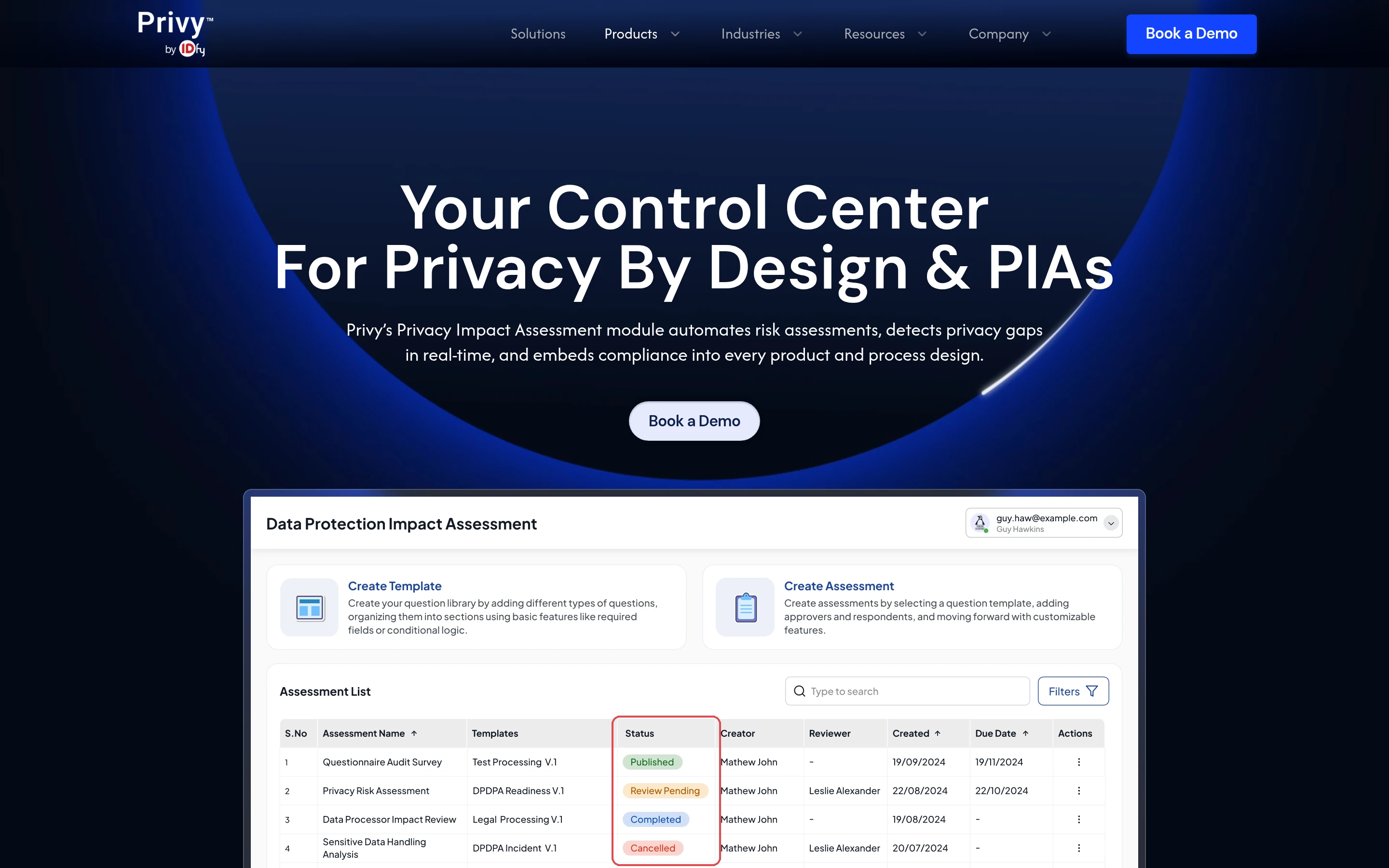
Privy is the closest India-built suite to Redacto in scope, with PIA as one module of a DPDP stack, so I've set the two side by side in our Redacto vs Privy comparison. In a trial, change a purpose in the RoPA and time how long the alert takes to reach the assessment owner, then export the "one-click" report and read what's actually in it.
Features
- The PIA module launches assessments from ready templates and offers AI suggestions for risks and mitigations.
- It alerts you when the RoPA, data lineage or processing purposes change, and escalates high-risk PIAs to DPIAs by rules you set.
- Custom risk scoring produces heat maps, and reports are "audit-ready… in one click".
- PIAs link to Privy's discovery, consent and third-party risk modules.
Pricing
Not published.
Reviews
Nobody has reviewed Privy on G2 yet, which is normal for a suite sold through enterprise deals. Treat a reference call with a customer in your sector, about the PIA module in particular, as the review.
Clients
Privy counts 50+ enterprises and carries an Axis Bank quote. More in our Privy review.
Summary
Pick Privy if you're an Indian BFSI or fintech company buying a full DPDP suite from one vendor. Skip it if you only need assessments.
6. Consentin by Leegality

Consentin's best idea is the screening step: a short set of questions, a recorded yes or no and a written reason. It's the record an auditor will want whenever you decided not to run a full DPIA. Screen three processing activities, including one you expect to skip, and check you can pull up each decision and its reason months later.
Features
- The DPIA module builds each assessment off the ROPA, so the records in scope enter without anyone retyping the data map.
- Questions tagged to an entity appear on their own, so a lending DPIA asks lending questions.
- Preliminary screening stores a yes/no decision with a mandatory written justification in Result History.
- Responders attach evidence against the question it answers, and risks are scored and flagged.
- If you sign a DPA in Leegality, the assessment on that processor runs from the same flow.
Pricing
Consent packs are published, including 3,000 consents a month free. Assessment pricing isn't, so ask.
Reviews
Consentin has no G2 listing yet, so your reference call is the review. Judge it on the screening test above.
Summary
Pick Consentin if you already have a ROPA and use Leegality for contracts. Skip it if you need software to discover your data first.
7. Privado
Privado comes at the problem from engineering. It scans code, apps and SaaS to see what personal data is collected and where it goes, which maps what your software actually does rather than what someone remembers. Point it at one repo for a product you've already assessed and compare its map with the one in your last PIA.
Features
- Data maps, continuously updated as data flows change, from scanning code, websites, apps and third-party software.
- AI agents populate PIAs, DPIAs and RoPAs by scanning your documents.
- It syncs data maps, populated assessments and risks into OneTrust and TrustArc, so you can keep your existing assessment tool and feed it better data.
Ask whether it ships a DPDP template or you build one yourself.
Pricing
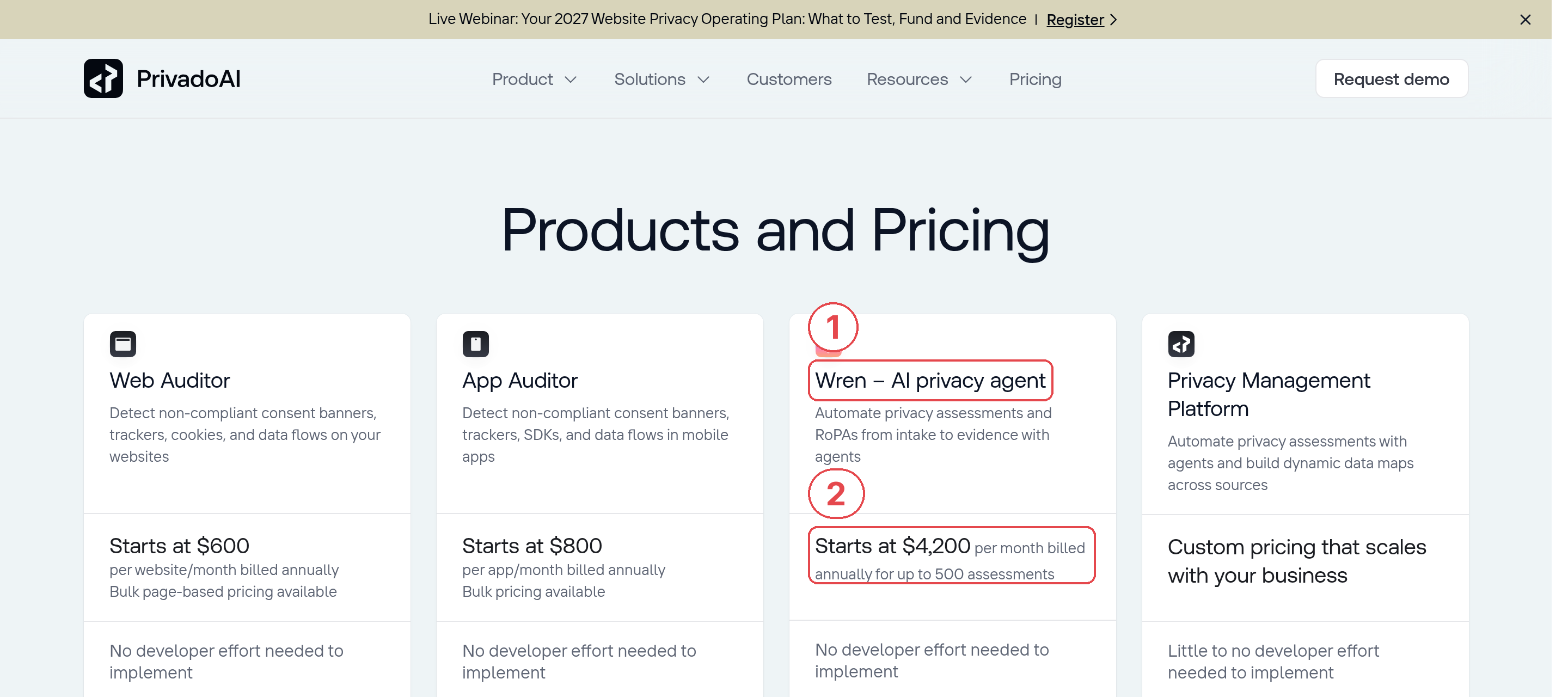
The only list price here. Wren, the AI privacy agent, starts at $4,200 a month, billed annually, for up to 500 assessments. Web Auditor and App Auditor start at $600 per website and $800 per app a month.
Reviews
Users on G2 like that its agents prefill compliance forms from technical documents and that data maps update on their own, and complain about false positives, the engineering effort to set it up and missing tools such as deletion portals (G2, Jan 2026). Budget triage time.
Summary
Pick Privado if most of your personal data flows through software you build. Skip it if your risk sits in vendors and business processes rather than code.
8. BigID
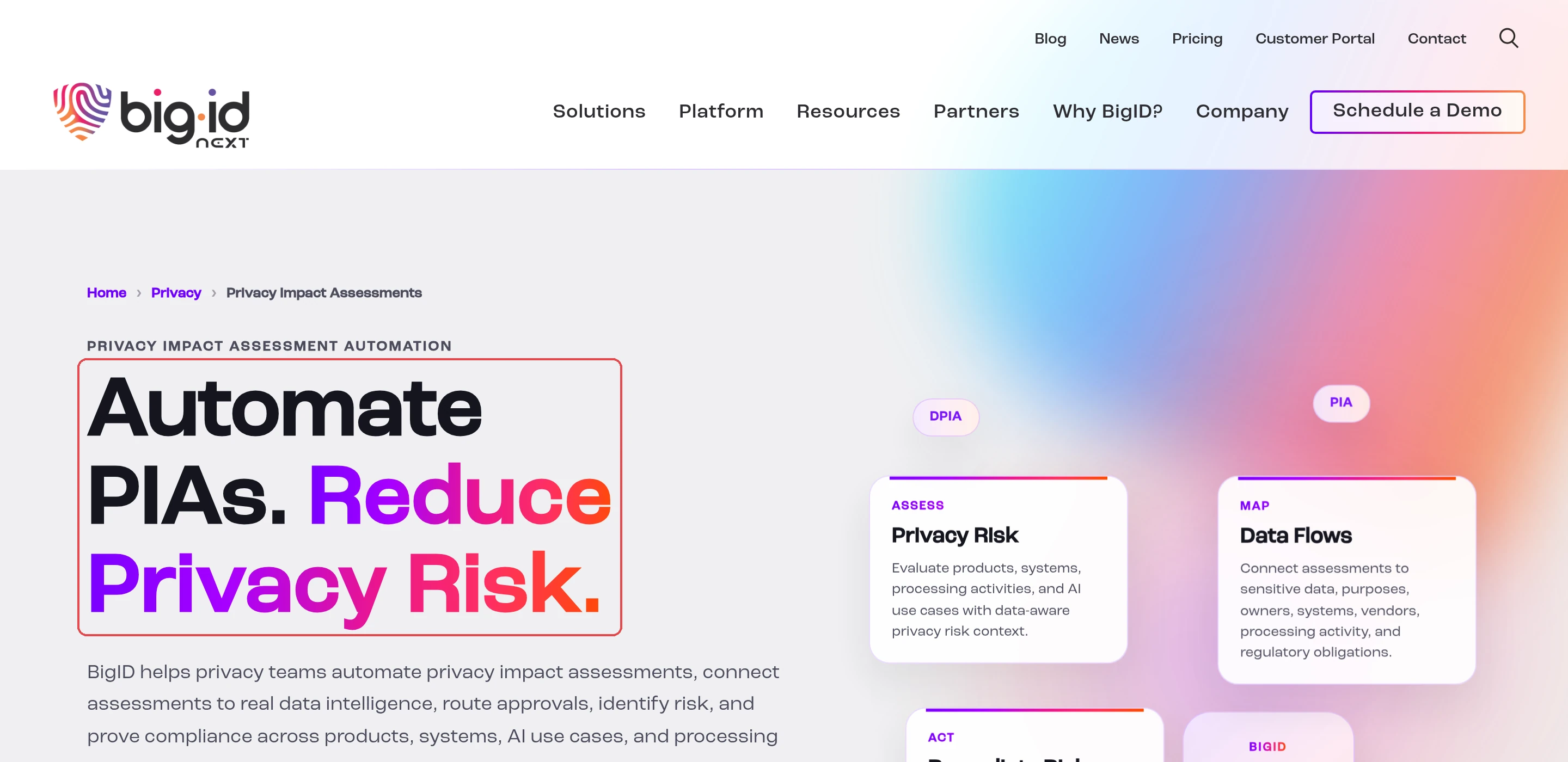
BigID is a discovery platform first. Its PIA app is worth it if you already pay for BigID to find personal data, and hard to justify on its own. Open a PIA for a system BigID has already scanned and see whether the data section matches the scan, including data you didn't know was there.
Features
- PIA Automation adds discovered data, processing activities, owners and business context to each assessment.
- Data-flow mapping links assessments to business processes, data stores, transfers, systems and RoPA records.
- Risk routing opens follow-up assessments based on AI use, sensitive data, transfers or rights impact, and AI-specific assessments cover training data, prompt inputs and model usage.
- Remediation tracking assigns owners and exports evidence.
Pricing
Not published; BigID sells through demos.
Reviews
Users on Gartner Peer Insights like its sensitive data discovery and complain that integrations need polish (Gartner, May 2026). A critical reviewer adds slow technical support and reporting built for technical teams rather than management (Gartner, Jul 2025). If the Board reads your PIA summaries, check the reporting before you sign.
Summary
Pick BigID if it already runs your discovery. Skip it if you need PIA software without a discovery platform underneath.
How to choose, by situation
Before any demo, decide where the facts in your PIAs will come from. If the answer is "a person filling in a form", the template library matters most. If it's "our data map", prefill and change alerts matter most. For the wider stack, see our roundup of DPDP compliance software.
Whichever tool you pick, the same four problems sink rollouts:
- Messy source data. Prefill from a stale ROPA spreads the errors faster. Clean the record before you connect it.
- Integration with old systems. Ask which of your systems connect out of the box and which need custom work.
- Teams used to spreadsheets. Start with one product team and one template, and let them see their assessment finish faster.
- No owner for the review rule. Decide who reopens an assessment, and on what change, before go-live.
You're a Significant Data Fiduciary (or expect to be)
You'll need a yearly cycle, a Board-ready report of significant observations and a separate data audit, all from 13 May 2027. Pick a tool that can schedule revalidation, keep every version and produce a Board summary. Indian-built or global, the deciding factor is whether the tool can prefill from a data map you trust.
You're a SaaS or product company

For product privacy assessments, the PIA has to live where product work happens. A new feature, vendor, data category or technology should open a short intake the product manager fills in, the product and engineering team completes the assessment, and privacy reviews and signs off. Product teams can complete most of a PIA without waiting on legal, as long as the screening questions are clear and legal reviews only what the screening escalates.
Look for intake that connects to your ticketing tool, prefill from a data map that follows your code or your ROPA, and a review rule that reopens the assessment when the feature changes. Privado fits engineering-heavy teams that want maps from code; Redacto, Privy and Consentin fit teams that already keep a ROPA.
You have EU or UK exposure
GDPR Article 35 is stricter on content: a systematic description, a necessity and proportionality test, the risks and the measures to address them, with Article 36 prior consultation when high risk remains. Run one assessment that meets both laws rather than two. OneTrust, TrustArc and Securiti have the deepest EU template sets. If you use the UK ICO's DPIA advice as a reference, the ICO marks it as under review after the Data (Use and Access) Act.
You run PIAs in spreadsheets today
Don't buy the biggest platform. Fix the data first: build a ROPA, then pick a tool that reads from it. Consentin and Redacto both start the assessment from the ROPA, and Privado will build the map from code if you're software-heavy.
In the spreadsheet PIA programmes I've seen, most of the time goes on chasing facts that already sit in someone else's system: the data fields in engineering's schema, the sub-processors in the vendor file, the retention period in legal's notes. A tool that reads those records removes that part of the work, and that's the saving to look for in a demo.
Final thoughts
Every tool here can run a questionnaire. What separates them is where the answers come from, and whether the finished file shows who approved which version.
Before you sign, run one PIA your team finished this year through each shortlisted tool and compare what each prefilled, missed and would show an auditor. If you want to see how much of your last assessment the record already knew, book a Redacto PIA demo.