Privy by IDfy Review: Features, Pricing, Pros and Cons (2026)
A practitioner's review of Privy by IDfy: what it covers for DPDP, how it's priced, what users say, and which teams should look elsewhere first.

You've got a DPDP vendor shortlist, a demo booked for Thursday and nothing independent to read before it. Vendor sites claim the same modules, review sites are empty, and the "reviews" that do turn up are often about a different product from the same company.
That's a real risk. In EY's January 2026 survey of Indian organisations, only 37.8% had started data discovery and classification, the step every consent and rights module depends on.
This review gives you my verdict, the questions I'd press in the demo, what the price depends on, and who should look elsewhere first.
TL;DR
- Privy by IDfy is IDfy's DPDP compliance suite: consent, cookie consent, Data Principal rights, data discovery and lineage, PIAs, third-party risk, incidents and an AI co-pilot, sold as one platform.
- Who it suits: regulated enterprises, especially banks, NBFCs and insurers, that want consent, rights, discovery, DPIAs and vendor risk from one Indian vendor. For a startup that only needs a banner, Privy is more than you need.
- Price: Quote-based. Its AWS Marketplace listing prices 12-month contracts on active data principals, cookie domains, GBs scanned and a risk and compliance licence.
- Reviews: nobody has reviewed Privy on G2, Capterra or PeerSpot yet, so your reference call is the review.
- My take: the most complete DPDP-first suite from an Indian vendor, with the gaps you'd expect from a young product: no public price, no independent reviews and a rollout that needs a plan.
Full disclosure: we build Redacto, which competes with Privy.
What is Privy by IDfy?
IDfy is a Mumbai-based identity verification company. Privy by IDfy is its separate DPDP compliance and data privacy platform, so if you came looking for KYC tools with built-in consent, note that IDfy's verification products and Privy are separate purchases.
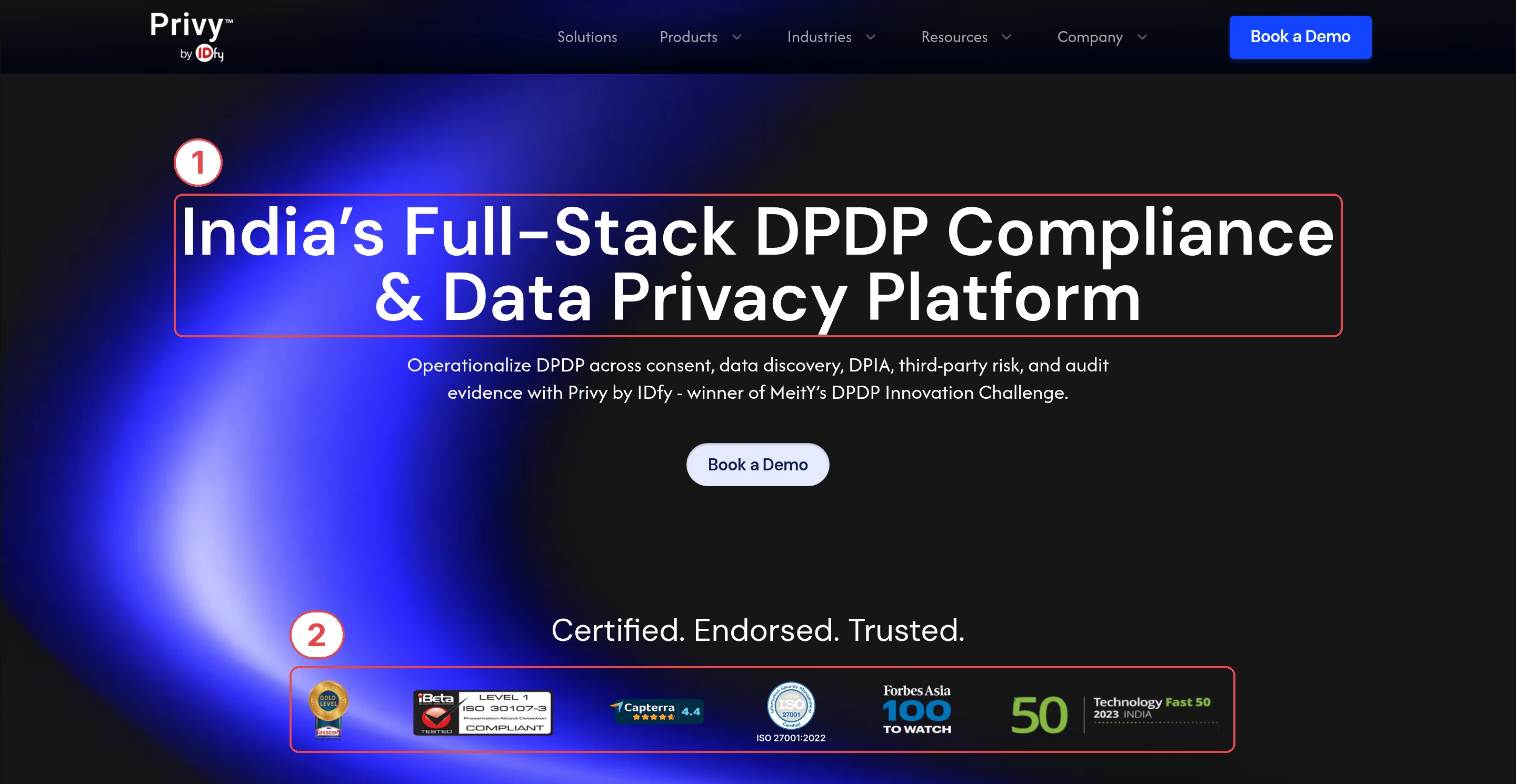
Privy groups its 10 modules into three pillars:
- Consent lifecycle management: Consent Governance Platform, Data Principal Rights Management (DPRM) and Cookie Manager.
- Continuous compliance and risk management: Privacy Impact Assessment, Third-Party Risk Management and Incident Management.
- Personal data discovery and governance: Data Discovery and Classification, Automated Data Lineage, Data Security Posture Management and Privacy-Enhancing Technologies.
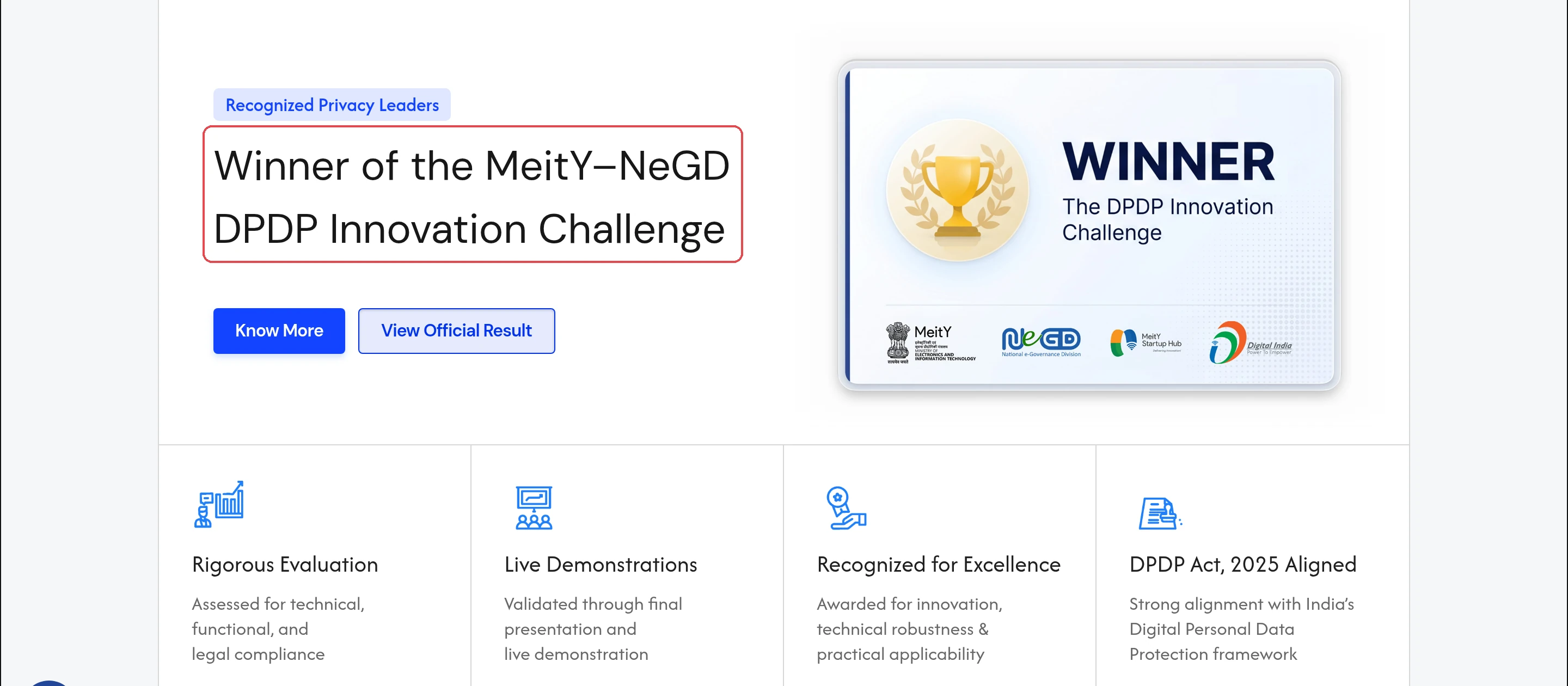
An AI Compliance Co-pilot sits across all three.
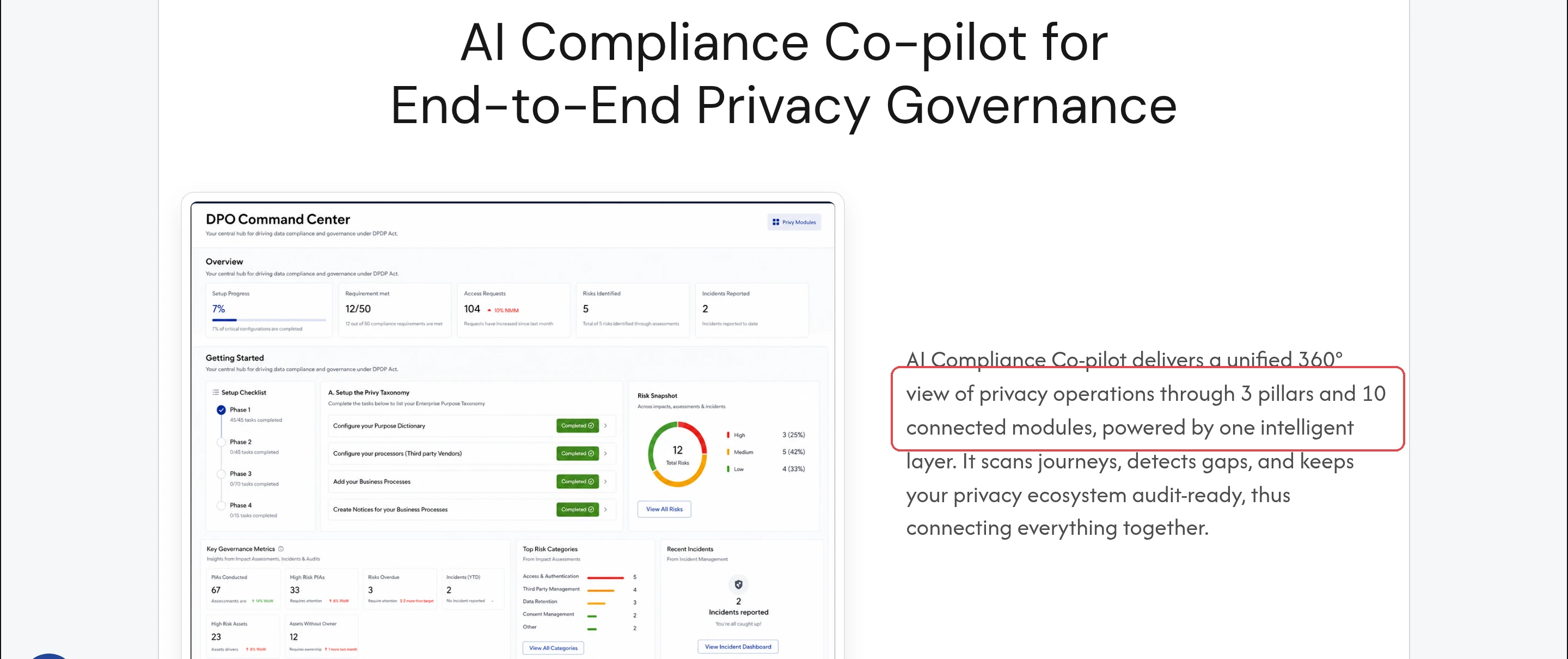
Privy's consent system won the MeitY–NeGD DPDP Innovation Challenge; the official result lists IDfy's legal entity, Baldor Technologies, as the winner. The challenge assessed working consent management systems through design, live demonstration and a final presentation, so it's evidence the consent layer works in a controlled test. It isn't evidence about the other nine modules.
The IDfy connection matters most at procurement. Many Indian banks and NBFCs already buy verification from IDfy, so Privy may arrive through a vendor that's already approved, with a security review on file. That shortens procurement, but don't let the KYC relationship stand in for a privacy review of a different product.
Privy's approach to compliance and security
Privy's approach to compliance and security is to run the platform close to your data: discovery scans run agentlessly across cloud and SaaS, with lightweight agents on endpoints, and Privy offers on-premise and VPC deployment so environments are scanned in place "without raw data ever leaving your secure technical perimeter". Every consent, withdrawal and request is logged as an immutable record for audit.
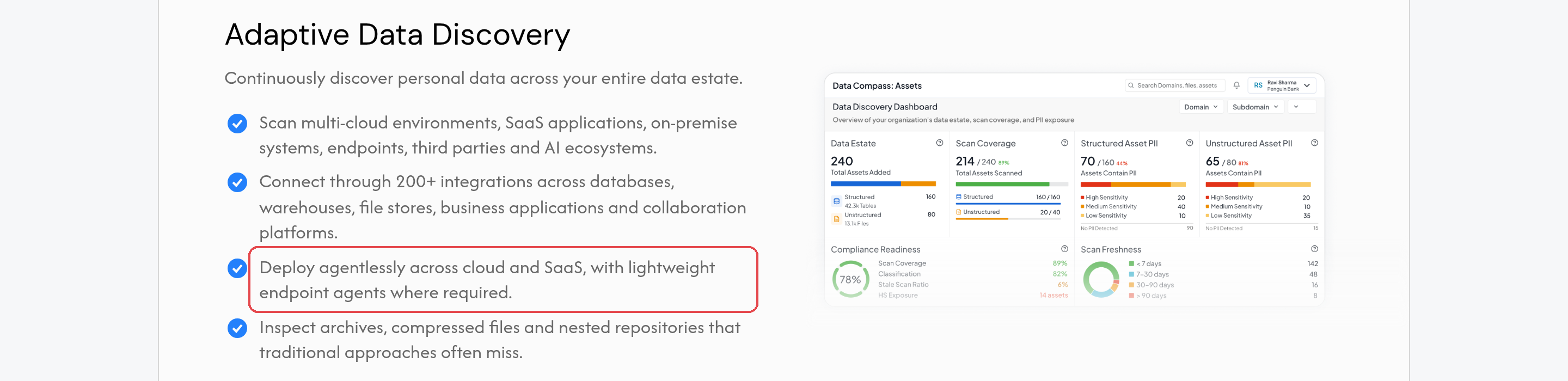
That design is right for a bank whose security team won't let customer data leave its network. It also means deployment is a project: someone on your side provisions the environment, opens the connections and owns the agents.
Privy also leans on credentials. Regulators don't endorse vendors, so before you repeat "trusted by RBI, SEBI, and IRDAI" to your Board, ask what that phrase refers to. The badge row shows ISO 27001:2022 and ISO 30107-3, a liveness-detection standard from IDfy's verification side. It also shows a Capterra 4.4 badge, yet Privy's Capterra listing has no reviews, so ask which IDfy product that rating belongs to.
The four questions I'd press in the demo:
- Certifications: which certificates and SOC reports cover the Privy environment itself, not just IDfy, and what are the report dates?
- Consent artefacts: where are consent records stored and hosted, who can read them, and can you export them in a format your auditor accepts?
- Subprocessors: the full list, including AI model providers behind the Co-pilot, and where each processes data.
- Breach terms: how fast Privy notifies you of an incident affecting your data, in the contract, not the sales deck.
Privy features for DPDP compliance
Here's each part of the suite, what it means in practice and what I'd test.
Consent Governance Platform and Cookie Manager
The Consent Governance Platform builds multilingual, purpose-specific notices, records each consent as an artefact, checks whether a consent is active, revoked or expired before you act on it, and handles guardian approval for children's data. Withdrawal runs through a self-serve portal, with updates routed to internal systems and processors. The Cookie Manager scans sites for first- and third-party cookies, blocks all but strictly necessary ones until consent and supports IAB TCF.
The Act requires withdrawal to be comparable in ease to giving consent, and the hard part isn't the portal. It's what happens next. In the demo, withdraw a marketing consent and ask to see it reach your CRM, your SMS vendor and your analytics tool, with a record that each one acted. For a wider view of the market, see our guide to consent management platforms in India.
Can Privy handle GDPR and email consent?
Partly, as far as anything public shows. The Cookie Manager supports GDPR-style cookie consent and the IAB TCF standard, but the Consent Governance Platform is built around DPDP, and nothing public shows GDPR lawful-basis handling or email-channel consent such as double opt-in. GDPR compliance also isn't a listed Privy feature on Capterra.
If you sell into Europe, make this the first demo question: ask to see a GDPR consent record, a lawful basis other than consent, and an email subscription with its proof.
Data Principal Rights Management (DPRM)
DPRM gives Data Principals a self-serve portal in 22 Indian languages to raise access, correction, deletion and grievance requests. Requests route to the right team or processor with SLAs and reminders, and each one is checked against the consent history.
What I'd test: a deletion request that touches a processor. Ask how Privy proves the processor purged the data, not just that someone ticked a box. Our guide to handling deletion requests covers what that proof should look like.
Data Compass (discovery and mapping)
Data Compass, Privy's discovery layer, scans cloud, SaaS, on-premise systems, endpoints and third parties through 200+ integrations, and classifies personal data using context as well as format, including in low-quality scanned documents. Automated Data Lineage then traces individual fields, such as a mobile number or Aadhaar number, from source to the apps, vendors and AI systems that receive them.
This is where most rollouts slow down, and it's where the other modules get their facts. Pick your two messiest systems, usually a legacy core and a shared file store, and ask for a scan of a sample in the pilot. Count how many findings you'd dismiss.
PIAs, third-party risk and incidents
The PIA module offers templates, AI suggestions for risks and mitigations, alerts when the RoPA or processing purposes change, and rules that escalate a high-risk PIA to a DPIA. We compare it with other options in our PIA tools for India.
Third-Party Risk Management keeps one portal for processors and sub-processors, scans contracts for missing clauses, and tracks processor action on deletion and revocation requests with "purge artefacts". Incident Management routes incidents to infosec or the DPO, maps affected systems and Data Principals, and sends notifications. If vendor risk is your main purchase, compare it with dedicated vendor risk management software in India before you decide.
AI Compliance Co-pilot
The Co-pilot scans sites, apps and policies for PII collection, trackers, gaps between notices and actual processing, and dark patterns, and it can launch PIAs and vendor reviews when it flags a risk. Treat all of that as a vendor claim until you see it live. Ask it to scan your own app in the demo, then check one finding by hand: is the tracker really there, and is the notice really silent about it?
Privy pricing
Quote-based. Privy doesn't publish a price, and its AWS Marketplace listing shows only placeholder unit prices with a contact for custom pricing. What the listing does show is how you'll be billed.

Contracts run for 12 months, with overage billed on the first three dimensions. For a consumer business, active data principals will set the bill: every new customer you onboard grows it. Before you sign, get the price per thousand data principals in writing, ask how "active" is defined, and cap overage for the term. If discovery is in scope, agree which data stores count towards GBs scanned, and whether a re-scan counts again.
Privy reviews: what users say
Nobody has reviewed Privy on G2, Capterra or PeerSpot yet, so your reference call is the review. Ratings you may find for IDfy's identity verification products, such as KYC reviews on marketplaces, aren't about this suite.
The one independent opinion I can point to is a founder's post on r/IndiaBusiness, which calls Privy "Strong on consent and India-specific, yet it still feels heavy with too much setup and ongoing management that slows you down" (Reddit, 2026). It's one person's view, from a startup, and it matches what I'd expect from a suite this broad.
Privy's own customer quotes come from Axis Bank, Axis Finance, Tata Capital, TATA AIG, Shriram Finance, Housing.com, Khaitan & Co. and others. Shriram Finance's CISO and DPO puts it this way: "Our conversations with the Privy team demonstrated a practical understanding of these requirements and how they translate into enterprise environments."
Most of these quotes praise the team's grasp of DPDP, not a module in production. That's worth something, since people who've run DPDP rollouts are scarce, but it isn't the same thing. Ask for a reference customer who is live on the module you're buying, and ask them how long it took to get there.
Pros and cons
| Pros | Cons |
|---|---|
| The widest DPDP-first module set from an Indian vendor | No public price; you can't budget before a sales call |
| Consent layer won the MeitY–NeGD challenge | No independent reviews on G2, Capterra or PeerSpot |
| On-premise and VPC deployment for data that can't leave your network | Ten modules make rollout a planned project, not a quick switch-on |
| DPRM portal in 22 Indian languages | GDPR and email consent aren't shown publicly |
| Easy procurement if you already buy from IDfy | Customer quotes praise the team more than live product |
Who Privy suits, and who should look elsewhere
Privy suits:
- Banks, NBFCs, insurers and other regulated enterprises that want consent, rights, discovery, PIAs and vendor risk under one Indian contract.
- Groups that need data scanned on-premise or in their own VPC.
- Teams already buying from IDfy, where Privy can ride an existing vendor approval.
If you've seen Privy called unsuitable for financial institutions, I don't buy the premise: most of its public customers are banks, NBFCs and insurers. What a bank should test is narrower: whether consent and withdrawal reach your core banking and loan systems, whether the evidence holds up under RBI inspection, and whether the hosting terms satisfy your outsourcing policy. Our guide to DPDP software for banks and NBFCs covers that test in more depth.
Look elsewhere if:
- You only need a cookie banner or a consent tool. A focused CMP is quicker and cheaper; start with our list of consent management platforms in India.
- Your main exposure is GDPR, not DPDP.
- You want to see a price before you take a sales call.
On timing: the DPDP Rules 2025 were notified on 13 Nov 2025, Rule 4 on consent managers applies from 13 Nov 2026 and most duties apply from 13 May 2027. Nobody has been notified as a Significant Data Fiduciary yet, but large banks and platforms should plan as if they will be, which means a yearly DPIA and audit on top of everything above.
Privy alternatives
Redacto (our product)
Full disclosure: we build Redacto, so I won't score it beside Privy.
Redacto's privacy governance suite covers consent, rights requests, discovery, PIAs, breach response and vendor risk for Indian data fiduciaries. Three things we do differently:
- Consent reconciliation: we check that every withdrawal reached the systems that act on it and produce a Consent Reconciliation Statement you can show an auditor.
- Assessments from the record: PIAs start from the ROPA and data discovery, not a blank form.
- The breach clock: we track it from the first alert to the Board notice.
The cons are real too. We don't publish a price, and we're not on G2, Capterra or Gartner yet, so your reference call is the review.
Pricing
Quote-based.
Reviews
Three customers, in their own words:
Surya N, Director, Product Management, TimePay: "As a product team, we had one worry: would privacy compliance hurt the onboarding journey? It didn't. Redacto's consent flows fit into our app with very little engineering effort, and we change notices from the console instead of shipping a new build. Our users get a clear choice at every step, and we get a consent record we can stand behind."
Prem Kumar, Data Protection Officer, Pine Labs Group: "Privacy across a group of businesses is hard because every team has its own systems and its own idea of what personal data it holds. Redacto gave us one view of where personal data is collected, why we collect it and where it goes. When a customer request or an audit question comes in, I answer it with evidence, not a round of emails."
Saif, Head, Infosec Compliance & Privacy, Razorpay: "Our vendor security and privacy reviews used to live in spreadsheets and long email threads. With Redacto, every assessment, every piece of evidence and every follow-up sits in one place. When a customer sends us a security questionnaire, we answer it from that same record. We focus on the vendors that actually carry risk, and the paperwork no longer runs the week."
By our own count we've done "40+ successful implementations". The two side by side are in our Redacto vs Privy comparison.
Other routes
If you want a wider shortlist, our roundup of DPDP compliance software compares the India-first suites, and our consent platforms guide covers focused CMPs. For PIAs alone, use the PIA tools list above. If you're weighing global suites such as OneTrust and Securiti, start with our Securiti AI alternatives.
Whichever way you go, take the questions above into the demo, and don't sign until a customer who's live on your modules has answered them too.