11 Best Securiti AI Alternatives for Indian Enterprises (2026)
Eleven Securiti alternatives for Indian enterprises compared on DSPM, data discovery, privacy automation and consent, with pricing and dated user reviews.

I used to think a privacy-platform renewal was mostly a price conversation. Now I start with scope. A discovery engine can leave your rights requests manual, a consent tool can leave exposed files untouched, and a security console can mistake a completed inventory for proof that a person’s choice was honoured. Buying one label for all four jobs is an expensive mistake.
The budget pressure is real: 45.3% of respondents in EY India’s January 2026 survey named financial constraints as a main challenge in putting the DPDP Act and Rules into practice.

Below are 11 options, with pricing signals, dated user reviews and the limits a slick demo can hide, so you can split the jobs and test each one on your own data.
TL;DR
The best Securiti alternatives depend on which part of its platform you actually use. My shortlist is:
- Redacto: Best for India-first privacy governance with discovery and consent connected.
- OneTrust: Best for the broadest global enterprise privacy and consent suite.
- Cyera: Best for DSPM-led data security plus a growing privacy suite.
- BigID Next: Best for privacy-led discovery and classification across a hybrid estate.
- Transcend: Best for privacy automation and consent enforcement across downstream systems.
- Microsoft Purview: Best for Microsoft-first sensitive-data governance and compliance.
- DataGrail: Best for SaaS-rich companies running data maps, privacy requests and consent.
- Privy by IDfy: Best for Indian enterprises that need on-premises or VPC deployment.
- TrustArc: Best for assessment-led privacy governance with regulatory research.
- Sentra: Best for security-owned cloud and AI data-access posture.
- Varonis: Best for hybrid file access, permissions and data-security operations.
Full disclosure: we build Redacto, so it’s listed first but not scored. No placement was bought, and no tool was run side by side for this article.
Securiti’s four jobs, and which alternatives do which
Securiti sells a wide data and privacy platform. I’d split that purchase into four tests before comparing logos: find sensitive data, judge and reduce its exposure, carry out privacy work, and honour consent where data gets used. A product can do the first two very well and still need another system for the last two.
- DSPM (data security posture management) answers: what sensitive data do we hold, who or what can reach it, and what exposure should we fix?
- Discovery and classification inventories personal and sensitive information across structured records, documents, SaaS and cloud stores. It feeds the other three jobs.
- Privacy automation runs records of processing, assessments and rights requests from intake to evidence.
- Consent and preference management collects choices and applies them to tags, apps, CRMs and other downstream systems.
DSPM is not DLP, CMP or DSAR software
DLP watches or blocks data as it moves. DSPM examines sensitivity, permissions and exposure where data sits, often including who can reach it through an AI agent. A CMP records an individual’s choices; its useful test is whether those choices reach downstream processing, rather than whether a banner looks right. DSAR or DPRM software finds, verifies and closes requests for access, correction or deletion.
That means Sentra and Varonis are credible Securiti alternatives for a security-led purchase, but they are not consent replacements. Microsoft Purview can span several security and governance jobs, but it isn’t a universal CMP. Treating those distinctions as footnotes is how teams end up with two platforms and an unfinished DPDP project.
Why an enterprise replaces Securiti, and when not to
Users on G2 like automated sensitive-data discovery and connections to AWS S3, Snowflake, Jira and Slack, and complain about a steep setup, costly access for smaller teams and unclear scan-failure errors (G2, Aug 2026). I would test a failed connector before a happy-path demo: the error and its repair path will tell you more than another sales dashboard.
PeerSpot’s smaller corpus rates Securiti 4.1 out of 5 from 10 reviews. A May 2026 review praised discovery and mapping but found the platform slow in a large environment; a December 2024 reviewer said only 30% to 40% of their data was classified correctly without manual review. Those reports are individual environments, not a universal accuracy score. They are good reasons to bring your worst file share and largest data store to the proof of concept.
Ownership creates contract questions too. Veeam completed its $1.725 billion acquisition of Securiti on 11 Dec 2025, bringing 600 staff across and making Rehan Jalil its President of Security and AI. Veeam then announced its Leader placement in Gartner’s first Privacy UX Magic Quadrant on 15 Oct 2026. The report itself was published on 6 Oct 2026.

That doesn’t make a switch necessary. Don’t replace a functioning deployment just because the logo changed. Replace it when the quote covers modules you won’t use, your hardest connector remains manual, or privacy operations and consent need a different owner. If unified security, privacy and AI governance is the point, staying may be the better answer.
How the 11 alternatives compare
“Yes” means a named product covers that job, not identical depth across every data source. “Scoped” means a separate module, licence or setup discussion. “No” means I wouldn’t buy it for that job. DPDP gets its own column because GDPR or generic rights-request support is not proof of India-specific support.
| Product | Main environment | DSPM | Discovery | Privacy / rights | Consent | India / DPDP evidence | Public price signal | Independent review signal |
|---|---|---|---|---|---|---|---|---|
| Redacto | Databases, files, SaaS, cloud; hosted, VPC or on-prem | Exposure review | Structured, files, OCR | Yes | Yes | India-first product and identifiers | Quote | No independent corpus |
| OneTrust | Enterprise privacy suite and connected data | Scoped | Scoped | Yes | Yes | Ask for exact India pack | Quote; usage meters | Privacy Automation G2 |
| Cyera | Cloud, SaaS, DBaaS, on-prem, AI | Yes | Yes | Yes; DSR add-on | Yes | Not verified | Quote; AWS reference | Cyera platform G2 |
| BigID Next | Cloud, SaaS, on-prem, hybrid, mainframe | Yes | Yes | Yes | Yes | India page uses withdrawn-bill terms | Quote | BigID G2; PeerSpot |
| Transcend | Structured data and connected web/app stack | Not main scope | Structured | Yes | Yes | Not verified | Quote | Transcend G2 |
| Microsoft Purview | Microsoft 365 plus connected/partner sources | Yes | Scoped | Priva and records; scoped | No universal CMP | Not verified | ₹4,990 E5 bundle reference plus usage charges | DLP and lifecycle G2 |
| DataGrail | SaaS, cloud, hybrid and internal systems | Limited posture scope | Mapping and discovery | Yes | Yes | Not verified | Quote | DataGrail G2 |
| Privy by IDfy | Cloud, SaaS, on-prem, endpoints, processors | Security context; scope POC | Yes | Yes | Yes | India-first DPDP product | Quote | No independent product reviews |
| TrustArc | Privacy programme, content and consent | Not main scope | Inventory / mapping | Yes | Yes | Named DPDP solution | Quote | TrustArc G2 |
| Sentra | Cloud, SaaS, databases, on-prem, AI | Yes | Yes | Not main scope | No | Not verified | Quote by stored-data volume | Gartner Peer Insights |
| Varonis | Hybrid files, SaaS, multi-cloud, identities | Yes | Yes | Not main scope | No | Not verified | Quote by user count | Data Security Platform G2 |
| Securiti, reference | Hybrid multicloud, privacy and AI | Yes | Yes | Yes | Yes | Named DPDP solution | Quote by modules | Securiti G2; PeerSpot |
Two products can sit in the same row and solve very different buying problems. A “No” in consent doesn’t diminish a strong DSPM choice. It tells you which neighbouring contract your privacy team still needs.
For a wider privacy-only view, my data privacy management platforms guide and data discovery tools comparison cover neighbouring shortlists.
How to evaluate a replacement on your own data
Use the same proof of concept for each finalist, with a named engineer, privacy owner and security owner in the room. Score the output, not the presentation. I’d use these five tests.
- Discovery across three source types. Connect a structured database, an ugly unstructured share and one SaaS system. Include Indian identifiers and scanned KYC files. Count confirmed findings, misses and false positives, then test whether a new scan preserves the inventory’s owners and history.
- A rights request with evidence. Verify a test identity, assemble the person’s records, make a correction or deletion, and show processor updates and a final audit export. Ask which steps need engineering or a separate module.
- A withdrawal that travels downstream. Consent in a browser, change it in an app or preference centre, and prove the CRM, advertising destination and data pipeline stop using that choice. Record delays and systems that need custom code. Our consent management platforms in India guide has more buying criteria.
- One real exposure repaired. Find an open file with sensitive data, identify the identities that can reach it, restrict the exposure with approval and verify the audit log. Test rollback. If only a ticket is created, say so in your scoring sheet.
- An India data-flow map. Trace one flow from collection through processors, cross-border storage and retention. Test the DPDP notice version, purpose, consent evidence, grievance path and owner. Generic legal templates can help, but your configured product and contracts must do the work.
The DPDP Rules were notified on 13 Nov 2025. Rule 4 starts on 13 Nov 2026, and Rules 3, 5 to 16, 22 and 23 start on 13 May 2027. Nobody has been notified as a Significant Data Fiduciary yet. Don’t let a vendor classify your company as one without an official notification.
Ask who supplies implementation staff and how tenant permissions are granted. An agentless connector can still demand broad read access; local scanning can still send findings or metadata to a hosted console. Make the architecture diagram part of the contract review, not a sales-slide extra. A structured privacy impact assessment is a good place to record those decisions.
1. Redacto
Full disclosure: we build Redacto, so I won’t score it beside the others. It joins discovery, privacy governance, consent and vendor assessments around one record, with an India-first DPDP focus.

Features
Our discovery and classification product reads structured data, documents and scans through OCR, recognises PAN and Aadhaar as distinct categories, and attributes findings to a system and owner. Posture findings can suggest access, masking or deletion changes, which wait for a named reviewer. Hosted, private-cloud and on-premises deployment are available; scanning stays in your environment and only findings and metadata reach the hosted platform.
Privacy Governance connects ROPA, impact assessments and breach records. Consent Governance carries notices and choices into downstream systems. Test your exact processors, consent destinations and international regulatory content before treating it as a replacement for security-first DSPM.
Pricing
Quote-based.
Reviews
Three customers, in their own words:
Surya N, Director, Product Management, TimePay: "As a product team, we had one worry: would privacy compliance hurt the onboarding journey? It didn't. Redacto's consent flows fit into our app with very little engineering effort, and we change notices from the console instead of shipping a new build. Our users get a clear choice at every step, and we get a consent record we can stand behind."
Prem Kumar, Data Protection Officer, Pine Labs Group: "Privacy across a group of businesses is hard because every team has its own systems and its own idea of what personal data it holds. Redacto gave us one view of where personal data is collected, why we collect it and where it goes. When a customer request or an audit question comes in, I answer it with evidence, not a round of emails."
Saif, Head, Infosec Compliance & Privacy, Razorpay: "Our vendor security and privacy reviews used to live in spreadsheets and long email threads. With Redacto, every assessment, every piece of evidence and every follow-up sits in one place. When a customer sends us a security questionnaire, we answer it from that same record. We focus on the vendors that actually carry risk, and the paperwork no longer runs the week."
Nobody has reviewed us on G2 yet. These are customer quotes we publish, not independent ratings, so ask for a reference with similar systems and scale.
Clients
By our own count we’ve done "40+ successful implementations".
Summary
Choose Redacto if you want Securiti’s connected-data idea centred on Indian identifiers, DPDP operations and deployment in your own infrastructure. It isn’t a drop-in replacement for a security operations team buying deep multicloud controls, and its India-first material needs checking against your non-Indian obligations. No public price or independent product-review corpus is available. Start with one processing flow and insist on seeing its source-to-consent-to-evidence path.
2. OneTrust
OneTrust is the closest procurement comparison when your replacement must include privacy operations, consent, vendor work and regulatory research rather than centre on data scanning.

Features
Privacy Automation Base covers data and activity maps, assessments, vendor privacy work, DPAs and transfers; Suite adds DSR fulfilment and incidents. Consent starts at the CMP products, while Universal Consent & Preference Management handles profiles across customer touchpoints. DataGuidance supplies regulatory research with the privacy packages. Your discovery and consent scope must be written out separately; they are not one unlimited bundle.
Pricing
Quote-based. Privacy Automation is priced on users and privacy asset inventory. CMP is metered on average daily visitors, Universal Consent on profiles, and AI Governance on admin users and AI inventory. Ask for a three-year model using your likely asset, visitor and request growth. My OneTrust pricing guide breaks down those meters.
Reviews
Users on G2 like having DSARs, ROPAs and DPIAs in one place, and complain about cluttered navigation, slow configuration and the price (G2, Jun 2026). A January reviewer described weeks of setup and a steep learning curve. I’d appoint a trained platform owner from the start and test a bulk import before migrating hundreds of records.
Clients
More than 14,000 customers use OneTrust, and Iberia Airlines provides a named privacy-automation example. For this purchase, ask for an Indian customer using the same combination of discovery, privacy requests and consent products you intend to buy.
Summary
Choose OneTrust if you like Securiti’s breadth but want the privacy office and regulatory research at the centre. It is heavier than an India-only consent or rights project needs, and the modular meters can make an initially tidy quote grow with the estate. It won’t automatically match Securiti’s discovery depth, so test that source list before deciding. My OneTrust alternatives guide is useful if this suite is too much.
3. Cyera
Cyera now belongs near the top of a broad Securiti shortlist: its security platform has a current Privacy product with DSR and consent, so calling it security-only is out of date.

Features
Cyera combines DSPM and discovery across cloud, SaaS, databases, on-premises stores and AI systems. Privacy adds live processing inventories, PIAs and DPIAs, request intake and identity checks, fulfilment evidence and consent. DSR automation covers 2,400 integrations. Treat its published GDPR and CCPA consent examples as scope evidence, not proof of DPDP support, and have the privacy modules demonstrated under your actual licence.
Pricing
Quote-based. The official pricing page names DSPM and DLP plans, with Data Subject Request Automation and DataWatcher as optional add-ons. As a procurement reference, AWS lists 12 months at $50,000 for up to 25TB, $100,000 for 100TB and $250,000 for 250TB of its Cloud Data Security Platform. That isn’t a full direct Indian privacy-suite price.
Reviews
Users on G2 like agentless multicloud discovery and sensitive-data visibility, and complain about executive-level reporting, tuning and webhooks for remediation (G2, Oct 2026). I’d test whether your chosen remediation needs external SOAR work. The privacy products also need their own proof of concept because those G2 comments concern the security platform, not a long record of DSR deployments.
Clients
Named examples include Patelco Credit Union and WELL Health. Those are useful security references, but a privacy-suite buyer should ask for a customer using the newer DSR and consent modules at similar scale, including identity verification and processor completion.
Summary
Choose Cyera when data security owns the budget but the privacy team needs one vendor for discovery, rights and consent. It may keep more work under one roof than a pure DSPM purchase, but the newer privacy scope has less product-specific review history than the security platform. Nothing public shows India or DPDP support. Make DPDP terminology, consent propagation and local data handling explicit demo items.
4. BigID Next
BigID Next is closest to Securiti’s discovery-first roots. Its hybrid coverage and privacy suite make it a serious comparison, not merely a scanner to add beneath another CMP.

Features
Discovery covers structured, semi-structured and unstructured data across cloud, SaaS, on-premises, hybrid and mainframe sources. The privacy suite connects rights requests, consent, ROPA, PIAs, retention and cookie controls to that data. BigID also maps identities and access, including AI agents. Test the exact connectors and request fulfilment actions rather than treating the source list as universal coverage.
Pricing
Quote-based. Ask for the price at your full data volume, assets and chosen privacy modules, then list mandatory services and partner work. The useful comparison is the three-year cost of your whole replacement scope, not the licence attached to a small discovery pilot.
Reviews
Users on G2 like its data security, privacy and compliance breadth and clear dashboard, and complain about cost and occasional slowness (G2, Jul 2024), an older review; the cost and slowness points come from 2022. Treat both as dated. Newer PeerSpot answers mention intermittent scan failures in Dec 2025, UI bugs in Nov 2025 and consent/DPIA work needed in May 2024. I’d repeat a large interrupted scan and inspect its recovery.
Clients
Fiserv’s Ken Owens provides a named customer voice. That is vendor-published evidence rather than independent reporting. Ask for a reference running both discovery and privacy modules at your scale, preferably with unstructured Indian KYC records.
Summary
Choose BigID Next if hybrid discovery is your main Securiti use case and you want privacy processes fed by the same data. One caution is unusually concrete: its India page still uses “PDPB” and “critical personal data” from the withdrawn 2019 Bill, so your DPDP mapping needs fresh legal review. It can still belong on the shortlist; just don’t treat that page as current legal proof. Test consent and PIAs as carefully as classification.
5. Transcend
Transcend is strongest when a recorded privacy choice has to change what downstream systems do. Its structured discovery feeds requests and its consent products work across web, mobile and backend systems.

Features
Structured discovery classifies databases and feeds generated SQL for DSR fulfilment. Sombra keeps classification and API keys inside your infrastructure. Consent intercepts tracking events, resolves conflicts between anonymous and logged-in choices, and sends updates to connected systems. This is a privacy and permission-enforcement product, not a full replacement for security posture across hybrid files.
Pricing
Quote-based. The pricing route opens a contact page with no published package or rate. Price consent destinations, structured stores, request volume, Sombra hosting and integration engineering together, including any custom systems without a ready connector.
Reviews
Users on G2 like flexible consent and request integrations and support, and complain about integration time, documentation and cookie/data-flow triage (G2, Apr 2025); April’s reviewer also mentions template bugs, while the integration and price comments come from February and the triage complaint from December 2024. I’d insist on a dated plan with a cutover window and one deliberately awkward custom destination.
Clients
Named examples include Indiegogo, Jasper and MasterClass. Ask for a reference with a similar downstream app stack and for the exact effort required to keep consent changes synchronised with warehouses and processors.
Summary
Choose Transcend if Securiti’s consent, preference and rights operations matter more than replacing every DSPM control. Its architecture is especially relevant when local processing and downstream enforcement are deal-breakers. It is not proof of DPDP support on its own, and its product-specific documentation gets mixed user feedback. Test conflict resolution, failed destination updates and your engineers’ audit trail before cancelling the old system.
6. Microsoft Purview
Purview makes sense when the purchase starts with a Microsoft estate and existing licence discussions. The important distinction is which module and data source covers each job, not the family name on the proposal.

Features
Purview DSPM draws on DLP, Insider Risk Management, sensitivity labels and Data Security Investigations across Microsoft 365, Azure, Fabric and connected sources. Google Cloud, Snowflake and Databricks are available through partner or setup routes. Rights requests sit around Priva and related modules, not in one universal Purview CMP. Budget for tenant roles, network configuration and non-Microsoft connectors.
Pricing
Microsoft’s India page lists Microsoft 365 E5 at ₹4,990 per user/month paid yearly. This is a productivity, security and compliance bundle reference, not full-suite Purview pricing. Purview Suite is a separate add-on option, and non-Microsoft sources plus some other functions can use pay-as-you-go billing through an Azure subscription. Ask for a tenant-specific bill of materials.
Reviews
For Purview Data Lifecycle Management, users on G2 like the Microsoft integration and data lineage, and complain about confusing licensing, administration and non-Microsoft coverage (G2, Jul 2025); the lineage point comes from December 2023. This is lifecycle feedback, not consent feedback. I’d get the licence matrix signed off before asking administrators to build the controls.
Clients
Microsoft has no single public source proving that a customer runs every Purview module together. Ask for a reference using your tenant type, non-Microsoft sources and Priva requests. For security-only scope, ask which controls depend on partner feeds and what happens when that feed stops.
Summary
Choose Purview if Microsoft owns most of the estate and consolidating identity, labels, DLP and investigations will remove real administrative work. It is not a full Securiti replacement for universal consent or for an estate dominated by non-Microsoft systems. The biggest hidden cost is often licensing and administration rather than the advertised E5 figure. Run one non-Microsoft connector before treating the family name as coverage.
7. DataGrail
DataGrail is a privacy-operations choice for companies with lots of SaaS. Its mapping, requests and consent features are the buying reason; deep cloud security posture is not the comparison to force.

Features
Live Data Map detects systems, maps processing activities and connects ROPAs and assessments to discovered context. Consent covers web and mobile, script and cookie controls, banners and localisation. The platform also advertises internal-system connections through agent or agentless modes and a self-hosted AWS option for privacy data. Keep mapping and consent scope distinct from access-control remediation when comparing with Securiti.
Pricing
Quote-based. Ask for the full request-volume, data-map, consent and connector package, including implementation and any charges for your expected new SaaS systems. Verify whether the proposed architecture carries raw personal data, metadata or both, and which records can live in your own AWS environment.
Reviews
Users on G2 like automated DSARs, responsive support and an easy interface, and complain about API integration errors, bulk-request limits and unclear request errors (G2, Oct 2026); the integration and bulk/error points come from April and March reviews. I’d deliberately break a connector during the proof of concept and see who gets alerted before the request deadline.
Clients
Named examples include Major League Soccer and Life360, with MLS spanning 30 clubs. A multinational SaaS story is useful, but you still need a reference with your residency requirements, DPDP notices and Indian-language customer experiences if those sit in scope.
Summary
Choose DataGrail for SaaS-heavy discovery, privacy requests and consent where the privacy team wants an operational home rather than a security console. It does not reproduce Securiti’s deepest access-risk posture work, and nothing public shows DPDP support. Request-level error handling and the initial integration burden are worth testing early, especially during a tight migration window.
8. Privy by IDfy
Privy is the India-built alternative with on-premises and VPC deployment claims, broad DPDP privacy modules and a discovery product that recognises local identifier formats.

Features
Discovery spans cloud, SaaS, on-premises sources, endpoints and processors, with agentless connections and endpoint agents where needed. DPRM checks the requester’s identity, validates the request against historical consent and tracks processor deletion. Test those controls against your own identity risk and have the IDfy identity-verification integration shown live. 200+ integrations support discovery across these sources, with classification for Indian PII and documents. Consent, rights, cookies, assessments and third-party risk sit across the same DPDP suite. On-premise and VPC scanning is useful scope evidence, but require an architecture diagram showing exactly what leaves the perimeter.
Pricing
Quote-based. Price the deployment model, implementation partner, endpoint rollout and modules together. Ask whether scan volume, connector count, identities or requests change the quote, and what a future increase in connected sources costs.
Reviews
Nobody has reviewed Privy on G2 yet. Don’t borrow IDfy’s identity-verification reviews. I would require two customer references at similar scale: one on DPRM fulfilment and one on discovery in an on-premises or VPC environment.
Clients
Privy names Axis Bank, Tata Capital, Tata AIG, Shriram Finance and CP Plus on its site. These are first-party customer examples rather than independent product ratings. Use them to choose reference calls, then ask about connector failures, local identifier accuracy, upgrade timing and the effort needed to complete a processor deletion.
Summary
Choose Privy if your main goal is an Indian DPDP suite with local deployment and connected consent, rights and discovery. Its lack of independent product reviews makes the proof of concept and references carry more weight, and the security posture depth must be demonstrated rather than inferred from discovery coverage. My Privy review covers its current AWS contract terms and product details in more depth.
9. TrustArc
TrustArc is the assessment and regulatory-research choice. It fits a privacy team building repeatable governance across countries more than a security team trying to repair open permissions across a cloud estate.

Features
Assessment Manager handles DPIAs, PIAs, transfer, vendor and AI assessments, with conditional questions, approvals and remediation tasks. Nymity Research supplies legal research, templates and jurisdiction comparisons. Consent and consumer-rights products extend the operational side. Its DPDP solution lists controls, a cookie template, data inventory, rights requests and assessments. Discovery depth and access remediation need separate proof.
Pricing
Quote-based. The DPDP solution promises predictable pricing with modest and consistent renewals. Ask for that in the contract as a renewal cap, and price Nymity, assessment, consent and request seats or usage separately so you know which parts your team will actually receive.
Reviews
Users on G2 like centralised privacy work, regulatory expertise and cookie geofencing, and complain about heavy process mapping, navigation and occasional tool conflicts (G2, Oct 2026). One October reviewer described process mapping as a heavy lift; another reported a three-month tag-manager conflict. I’d build one assessment from your real data flows and test it alongside your existing tag stack.
Clients
DoubleVerify’s Beatrice Botti describes PrivacyCentral’s role in its privacy programme. That provides programme evidence, not an independent review. Ask for an Indian deployment using the same DPDP controls and templates, and find out how much configuration the customer had to supply.
Summary
Choose TrustArc if Securiti’s regulatory and assessment work matters more than its deepest scanning and access controls. Its research library and templates can reduce blank-page privacy work, but discovery isn’t its natural centre. More options for that scope are in my TrustArc alternatives guide. If you buy it, keep a separate test for exposure remediation rather than assuming the data map supplies it.
10. Sentra
Sentra belongs here for a security-owned DSPM purchase. It is a strong way to compare cloud and AI data-access posture, not a replacement for Securiti’s consent stack.

Features
Sentra discovers and classifies sensitive data, maps which people and AI systems can reach it, and supports access governance and remediation. Processing runs inside the customer’s environment without copying sensitive data outside it. That is useful for cloud, AI and identity exposure, but the purchase still needs another answer for consent collection, preference propagation and general rights-request operations.
Pricing
Quote-based. Sentra’s pricing is generally based on stored data at rest across IaaS, PaaS, DBaaS, SaaS and on-premises environments. Ask whether duplicated, archived and test data count, how new sources change the annual fee, and whether managed remediation or extra AI modules alter the quote.
Reviews
Gartner Peer Insights shows 4.9 out of 5 from 122 ratings, with one visible May 2026 review describing better visibility into what GenAI systems could access and new guardrails. Ratings are not the same as readable full reviews, and the visible account is favourable without a detailed negative. Sentra’s DSPM product has no G2 page of its own; reviews of other products named Sentra don’t count.
Clients
Named customer examples include Papaya Global, Global-e and Valenz Health, while BigBasket offers an Indian AWS reference. That makes a local reference call possible; it is not proof of DPDP product support. Ask to speak with a deployment using your data stores, and test the before-and-after access change rather than accepting a classification-accuracy percentage without your sample.
Summary
Choose Sentra when the SOC owns the Securiti replacement and the main outcome is finding sensitive data and reducing risky access across cloud and AI. Its local-processing architecture is attractive, but it is not a CMP and nothing public shows DPDP-specific support. Pair it with a privacy product only after deciding who owns requests and consent, otherwise your platform replacement will leave those jobs unfinished.
11. Varonis
Varonis fits the other security-led route: hybrid file shares, permissions, identity activity and security operations. It can reduce data exposure without pretending to be a privacy-consent suite.
Features
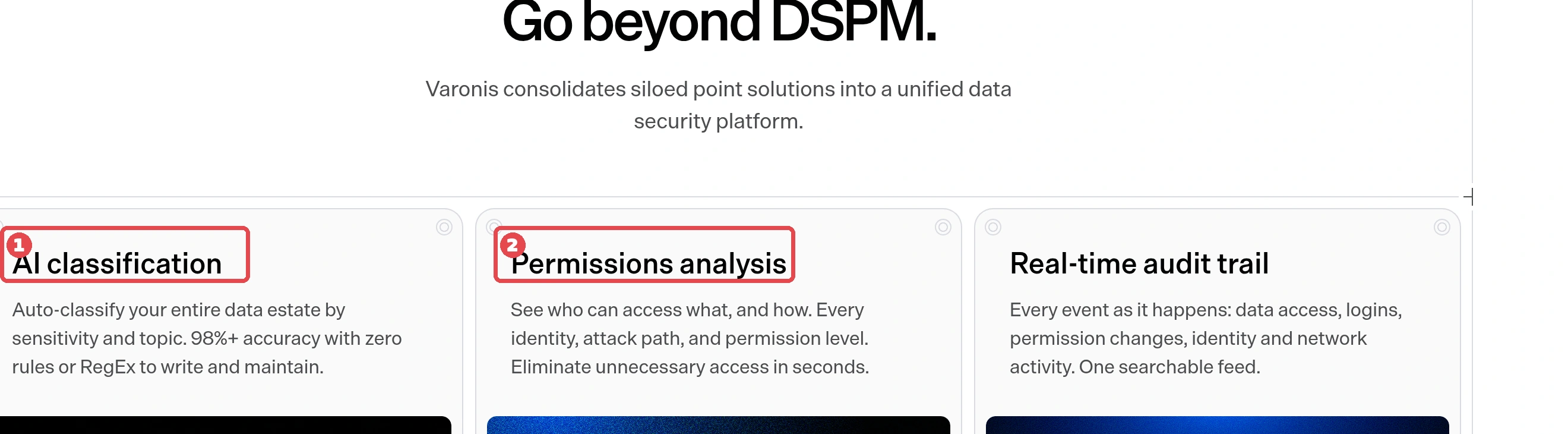
The platform discovers and classifies sensitive data, analyses permissions and activity, and supports remediation across hybrid files, SaaS and multi-cloud sources. DAM, Atlas AI security, Interceptor and managed detection and response are separate add-ons. This is useful scope for file-heavy and identity-heavy enterprises, but consent and general privacy request handling belong to another buying stream.
Pricing
Quote-based. Varonis licenses by user count rather than data volume, and advertises a 30-day trial. Define who counts as a user across employees, service identities and external accounts, and price every required add-on and managed service. Test the trial on the file share that creates the most permission noise.
Reviews
Users on G2 like visibility into sensitive data and access, responsive support and useful audit detail, and complain about cost, tuning and learning the platform (G2, Sep 2026); the tuning comments come from July and the cost comments from July and September. I’d test alert volume and permission rollback in a limited share before allowing automatic changes in production.
Clients
Wyndham Hotels & Resorts and more than 8,000 customers give a starting point for reference calls. Ask for a customer with your mix of Windows file shares, SaaS and cloud data, plus a clear account of the infrastructure and tuning effort needed during rollout.
Summary
Choose Varonis if file permissions, identity activity and security response are the Securiti jobs you need most. It is not a consent replacement, and nothing public shows DPDP-specific support. Its user-count model can be easier to compare with a data-volume quote, but only after counting service accounts and required add-ons. This is a security purchase first; give privacy operations its own explicit home.
Securiti vs OneTrust and BigID: the comparisons buyers ask for
These three overlap on discovery and privacy, but their centre of gravity differs. Securiti starts from the data graph, OneTrust from the privacy programme and BigID from enterprise discovery. If you need a complete four-part replacement, compare connected processes rather than a single feature checklist.
How does Securiti.ai compare to OneTrust for privacy governance?
OneTrust is the deeper privacy-programme product, while Securiti puts discovery and security posture closer to the centre. OneTrust carries assessments, records, vendor work and research into one operating model. Securiti starts from what it found in your data estate, which is useful when an accurate inventory is the hard part. A January 2025 PeerSpot comparison rated Securiti’s discovery strongly but wanted its assessment automation to catch up with OneTrust.
OneTrust and BigID both sit in the lower-right, Visionary section of Gartner’s 2026 Privacy UX placement, while Veeam (Securiti AI) is a Leader (Privacy Daily, Oct 2026). That is context about Privacy UX, not a score for DSPM or DPDP fitness.
Which offers better privacy automation, Securiti.ai or BigID?
I’d start with Securiti for privacy automation and BigID for a discovery-led replacement. BigID now has a real privacy suite, so the answer is not “BigID can’t do privacy.” Its older PeerSpot concerns about consent and PIAs make those products the ones to test first. Securiti’s own reviewer evidence is stronger for discovery than painless administration, so neither gets a free pass on setup.
Securiti vs OneTrust for AI governance and compliance
OneTrust has a named AI Governance product, while Securiti’s AI Security & Governance joins AI-system discovery to sensitive-data context. Compare the AI inventory, risk assessments, approval records and policy actions each produces, rather than treating an AI label as the same scope.
OneTrust vs BigID vs Securiti for data classification and discovery
BigID and Securiti are the natural first proof of concept for discovery across a mixed estate. OneTrust belongs when data mapping is part of a much wider privacy office purchase. Bring the same messy files, structured database and SaaS source to all three, and compare manual corrections and failed connector recovery.
For Securiti versus OneTrust on DSPM, Securiti is the more obvious starting point. OneTrust’s privacy inventory and mapping should not be confused with the same security posture depth. For AI risk assessment records, OneTrust is the more natural privacy-office comparison; for agent access to sensitive data, test Securiti and BigID.
Is Securiti easier to deploy than OneTrust?
I wouldn’t select either on ease of rollout. For AI risk assessment records, OneTrust AI Governance and TrustArc have named assessment products; for agent access to data, test Securiti and BigID explicitly. Securiti’s August G2 reviews mention configuration and error-messaging effort, while OneTrust’s January and June reviews mention weeks of configuration and tricky bulk upload. Ask both vendors to connect your hardest source in the pilot and price the administrator plus implementation support. That answer matters more than a claimed average setup time.
When staying with Securiti makes sense
Renew if unified discovery, data security, privacy and AI governance is still your scope, the connectors work, and your team can run the platform. The new Veeam combination is especially relevant if recovery and production-data security belong in the same purchase. Replacing a working tool creates migration work without removing the underlying obligations.
At renewal, ask four direct questions: what product investment is assigned to privacy; which functions move into Veeam bundles; whether licensing or support teams change; and what export and migration rights you keep. Ask for price protection and the contract entity change in writing. A well-run incumbent with a tolerable quote can beat an untried new platform with no working connector.
Use your own Securiti results as the yardstick. If discovery accuracy, request completion and consent updates already pass the tests above, you can negotiate from evidence rather than acquisition anxiety. Our DPDP Act compliance requirements guide is a useful checklist for that review.
How to choose, by situation
Your estate is Microsoft-first
Start with Purview when the main systems, identities and labels already live there. Treat the ₹4,990 E5 price as a bundle reference and model the extra modules and consumption charges. Choose Securiti if hybrid discovery matters more than Microsoft administration, or pair the winning security platform with a CMP.
The SOC owns data security
Shortlist Cyera, Sentra and Varonis for posture and access risk, with BigID when privacy-led discovery also matters. Cyera deserves a second look when the same deal must include DSR and consent. Sentra and Varonis need a separate privacy answer, so don’t force them into a four-column consent comparison.
A global privacy team owns the purchase
Start with OneTrust, Transcend, DataGrail and TrustArc. OneTrust is the suite and research choice, Transcend the downstream permission-enforcement choice, DataGrail the SaaS privacy-operations choice and TrustArc the assessments-and-research choice. Add Cyera or BigID if the security team needs discovery and access control in the same deal.
India’s DPDP Act and local deployment set the decision
Start with Redacto and Privy, then test Securiti and TrustArc’s named DPDP material against your process. Cyera, Transcend, DataGrail and Sentra require current official India evidence before crediting them with DPDP support in the evaluation. Local storage alone does not prove DPDP support, and generic GDPR rights fields don’t either. My DPDPA compliance tools guide covers the wider India-first field.
You have hybrid file shares and identity sprawl
Varonis and BigID are the natural comparisons, with Sentra for cloud and AI-heavy access posture. Purview belongs when the sources and identity controls centre on Microsoft. Test permission repair and rollback, not just inventory accuracy, and decide which team will handle rights requests separately.
SaaS privacy requests keep arriving from every team
DataGrail and Transcend are the first calls, with OneTrust for a broader programme. Break a connector, submit a bulk set of requests and watch how failed fulfilment gets surfaced. My DSAR automation tools guide compares that operational problem in more detail.
Procurement questions for every vendor
- What exactly moves the price? List users, assets, stored data, requests, profiles, traffic and AI systems. Ask for the minimum licence and a three-year model under your expected growth, including renewal caps and foreign-exchange assumptions.
- Which modules and services are mandatory? Put discovery, DSPM, privacy, consent, implementation and premium support on separate lines. Name add-ons that a demo includes but your quote does not.
- Where do raw data and findings go? Mark every scanner, relay, customer-hosted part, vendor console, processor and cross-border hop. Ask about egress charges, metadata retention and how deletion propagates to logs and backups.
- How long until real coverage? Require named engineers, source-specific dates and acceptance criteria. A login and an agentless connection do not count as a working rights request or a repaired exposure.
- Which connectors need custom work? Test the old database, ugly file share, home-grown app and niche SaaS system first. Get maintenance ownership for custom connectors and API changes in writing.
- Can the export survive an audit and an exit? Request sample evidence for consent, rights completion, access changes, assessments and approvals, including timestamps and source versions. Ask how you export the inventory, request history and configuration if you leave.
- What India support is actually included? Ask for DPDP configuration, notice and language support, India data handling if offered, local implementation help and reference customers. Don’t infer these from a generic GDPR feature list.
At the end of this process, you should know which jobs each contract covers, which ones remain with your team and which neighbouring tool is genuinely necessary. If your immediate problem is DPDP evidence across one real processing flow, you can trace that flow with Redacto.