How to Do a Privacy Risk Assessment: A Step-by-Step Method for DPDP and GDPR
A step-by-step privacy risk assessment method: scope, map, score likelihood and severity, choose controls and document it for DPDP and GDPR.

TL;DR
A privacy risk assessment asks one question: what could go wrong for the people whose data you process, how likely is it, and what are you doing about it? Run it in six steps: scope, map, identify, score, treat and document.
- Score risks to the person first, then the company. That is what DPDP, GDPR and regulators' DPIA templates look for.
- Use a 4x4 matrix with no middle score, so nobody can park a risk on "medium".
- Under India's DPDP Rules, Significant Data Fiduciaries must run a DPIA every 12 months. GDPR Article 35 requires one before high-risk processing. California's risk assessment rules took effect on 1 January 2026.
- One processing activity per assessment, one named owner per action, and a review date. Without those three, the document is decoration.
- A spreadsheet is fine for your first dozen assessments. Switch to a tool when you can't keep the reviews current.
Why most privacy risk assessments don't get done well
Every new feature, vendor and AI model creates processing someone should assess, and the people who do that work are getting fewer. ISACA's State of Privacy 2026 survey of more than 1,800 privacy professionals found the median privacy team shrank from eight people in 2025 to five in 2026, and 43% said their privacy budget was underfunded.

So assessments get skipped, copied from the last one or written after launch. If you searched for how to do a privacy risk assessment, you want a method that a small team can run on a real project and defend to a regulator. This guide gives you one, with a scoring matrix, a worked example and the documentation DPDP and GDPR expect. The last section turns it into a plan for this week.
What a privacy risk assessment is
A privacy risk assessment identifies what could go wrong for individuals because of how you process their personal data, estimates how likely and how severe each problem is, and records the controls you will use to bring it down to a level you can accept. NIST's Privacy Framework describes privacy risk the same way: the likelihood that individuals will experience problems from data processing, and the impact if they do.
How it relates to the terms you'll see elsewhere:
- A privacy impact assessment (PIA) and a data protection impact assessment (DPIA) are formal privacy risk assessments with a set format. DPIA is the term GDPR and the DPDP Act use. Our post on PIA vs DPIA covers the differences.
- Privacy risk management is the continuous programme around the assessments: the register, the review cycle, the reporting to leadership. Data privacy risk management requirements, in most laws, come down to doing assessments and keeping them current.
- A privacy maturity assessment scores your programme, such as whether you have policies, a register and trained staff. It tells you where to invest. A risk assessment tells you what could hurt people in one specific use of data. You need both; just don't confuse them.
- A data breach risk assessment is a narrower job: after an incident, you judge how likely the breach is to harm people, to decide on notification. Under DPDP every personal data breach must be reported to the Board and affected people, so the assessment there shapes what the notice says.
When you must do one
Legally, it depends on where you operate. In practice, I'd run one for any new processing that touches sensitive data, a new vendor with access to personal data, or a new AI use. When the law requires one:
India. The DPDP Act requires Significant Data Fiduciaries to carry out periodic DPIAs (section 10(2)(c)). Rule 13 of the DPDP Rules, 2025 sets the cadence: a DPIA and an audit once in every 12 months from the date of notification, with a report of "significant observations" to the Board. Rule 13 applies from 13 May 2027. Nobody has been notified as an SDF yet, but if you hold large volumes of sensitive data, I'd run the yearly DPIA now rather than wait. Our guide to PIAs under the DPDP Act covers the India detail.

EU and UK. GDPR Article 35 requires a DPIA before processing "likely to result in a high risk" to people's rights and freedoms, and names three cases: profiling that is "systematic and extensive" and produces legal effects or "similarly significantly" affects people, large-scale processing of special category or criminal data, and large-scale systematic monitoring of public areas. Article 35(7) sets the minimum content.

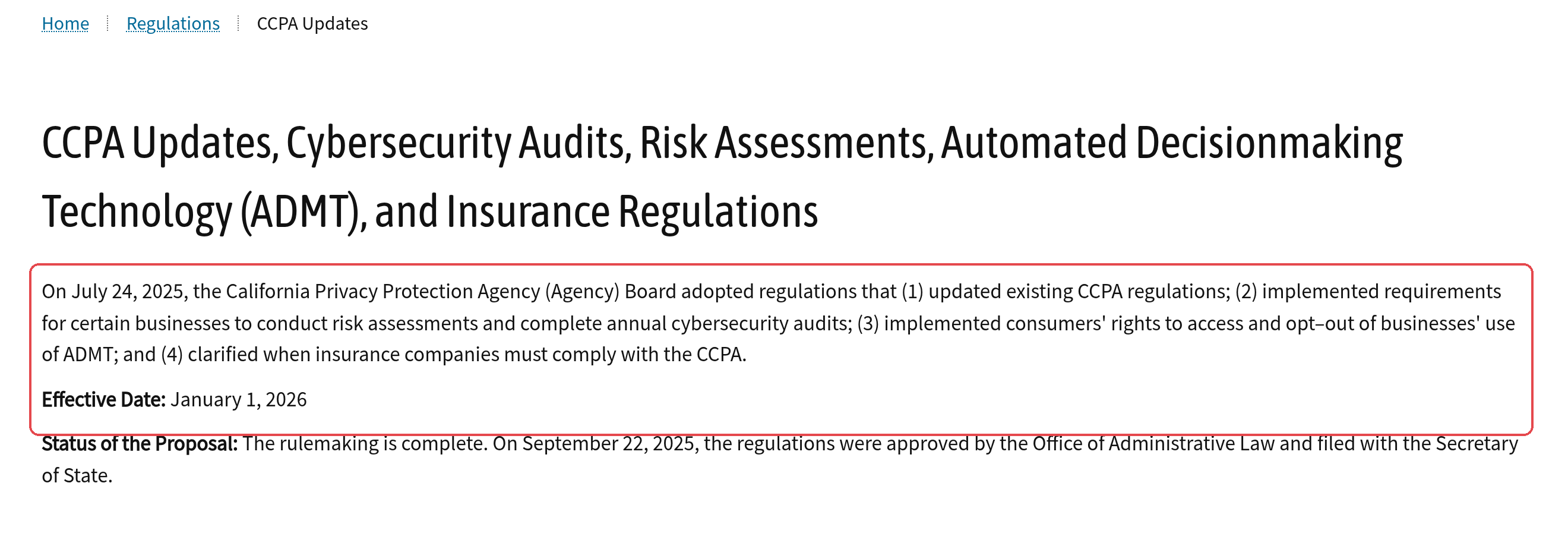
California. The California Privacy Protection Agency's regulations on risk assessments, cybersecurity audits and automated decision-making technology took effect on 1 January 2026. They require certain businesses to conduct risk assessments.
Healthcare. In the US, the HIPAA Security Rule has long required covered entities and business associates to run a security risk analysis on electronic protected health information.
The privacy risk assessment methodology, step by step
If you need a data protection risk assessment method to adopt, this is the one I use. It follows the structure of GDPR Article 35(7) and the CNIL's PIA methodology, and it works for a DPDP DPIA, a GDPR DPIA or an internal review of a new product feature.

Step 1: Scope the processing activity
Assess one processing activity at a time, such as "credit decisioning using bank statements", never "the lending app". Write down the purpose, the legal basis, the categories of people and data, the systems and the vendors. If you can't describe the purpose in one sentence, the scope is too wide.
Not every change needs the full six steps. I start with a one-page screening: does it involve sensitive or children's data, a new vendor, automated decisions, large volumes, data leaving the country, or a new purpose for data you already hold? Two or more yeses and it gets a full assessment. Otherwise a short record of the screening answers is enough, and that record is itself evidence that you thought about it.
Step 2: Map the data and its flows
Trace where the data comes from, where it's stored, who can access it, which vendors receive it, whether it leaves the country and when it's deleted. Pull this from your data inventory and data flow maps rather than interviewing from scratch.
Step 3: Identify threats to the person, and then to the company
The CNIL frames privacy risks around three feared events: illegitimate access to personal data, unwanted change to it, and its disappearance. Add the risks that come from your own legitimate processing: collecting more than you need, keeping it too long, reusing it for a new purpose, making automated decisions people can't challenge. Then ask what each would mean for the person: money lost, discrimination, embarrassment, loss of access to a service.
This is the step teams skip most. They list security threats to the company and stop, and a regulator reads the result as a security review.
Step 4: Score likelihood and severity
Score each risk on two scales: how likely it is, and how severe the effect on the person would be. I use the CNIL's four levels for both: negligible, limited, significant and maximum. Four levels force a choice. With five, everything uncertain lands on the middle score and the matrix tells you nothing.

Score severity from the person's point of view, and score likelihood on the controls already in place. CNIL calls that the initial risk; many risk teams call it inherent risk. Plot it on a privacy risk assessment matrix.

Step 5: Choose controls and calculate residual risk
For each risk above your acceptance line, choose controls. Typical privacy risk mitigation options, roughly in the order I'd reach for them:
- Don't collect it, or collect a derived value instead of the raw data.
- Delete it sooner, with an automated job rather than a policy.
- Restrict who and what can access it, and log that access.
- Mask, tokenise or encrypt it where people don't need the clear value.
- Bind vendors by contract: no secondary use, breach notice, deletion on exit, audit rights. Our third-party risk management guide covers the vendor side.
- Add a human: review of automated decisions, and a way for people to challenge them.
- Tell people clearly, so nothing about the processing surprises them.
Then re-score. The difference between inherent and residual risk is what the controls bought you. If a high residual risk remains under GDPR, Article 36 requires you to consult the supervisory authority before processing.
Step 6: Document, sign off and set a review date
Record the scope, map, risks, scores, controls, residual risk, who accepted it and when you'll look again. Name an owner for every action.
Sign-off should match who carries the risk. The business owner of the processing accepts the residual risk, because they benefit from it. The DPO or privacy lead confirms the assessment is complete and honest. Anything left at the top two severity levels goes to whoever owns enterprise risk, usually a risk committee. Keep the sign-off with the document.
The UK ICO has put its DPIA advice under review after the Data (Use and Access) Act, but don't wait for it: the ICO's core expectation hasn't changed. A DPIA is a living document you revisit when the processing changes.

Adapting the method for AI systems
An AI data privacy risk assessment uses the same six steps with extra questions at Steps 2 and 3. What personal data went into training or fine-tuning, and can you remove a person's data if they withdraw consent? Does the model provider keep prompts or outputs, and may it train on them? Can the output reveal personal data about someone else? Is the system making or shaping decisions about people, and can they get a human review? Under the DPDP Rules, SDFs must also check that algorithmic software they deploy isn't likely to pose a risk to Data Principals' rights (Rule 13(3)).
Worked example: a lending app adds bank-statement analysis
This example is illustrative, built to show the method, not taken from a client. A digital lender wants to analyse applicants' bank statements to decide credit limits, using an outside analytics vendor.
Scope: credit decisioning using bank statements, for loan applicants, with consent as the basis. Map: statements arrive through the app, go to the vendor's cloud, return as a score, and the raw files sit in the lender's storage.
Step 3 turns up five risks. The worst is R1: bank statements show far more than income, including medical payments, donations and family transfers, and every statement contains that detail, so likelihood is maximum. Collecting less is the fix that moves it most.

Two things to notice. R3, vendor reuse, stays at "significant" severity on the CNIL scale after controls, because a contract lowers likelihood but can't change the harm if it happens. That is normal. And the review date is tied to change events, so a new vendor or new data field reopens the assessment.
Tools vs spreadsheets: when to switch
A spreadsheet works for your first dozen assessments if you keep one template and one register. You'll know it's time for a privacy risk assessment tool when reviews fall overdue, when the same vendor is assessed three times by three teams, or when you can't tell leadership your top ten risks without a week of collation.
Tools help most with the parts that can be automated: pulling data maps from discovery, pre-filling questions from earlier assessments, scoring with a consistent rule, chasing owners and keeping review dates. They can't decide your purposes or accept risk for you.
If you want to automate privacy risk scoring, write the rule down before you buy anything. For example: severity starts at limited, goes up one level for sensitive or children's data, up one for automated decisions with legal or financial effect, and to maximum for anything that could cause physical harm. Likelihood starts from the controls in place. A rule like that gives consistent scores across assessors, and any decent tool can apply it.
If you want outside help instead, data privacy risk assessment services can clear a backlog, but keep the risk acceptance in-house. Our comparisons of PIA tools for India and GRC and risk assessment tools cover the options. Redacto's Privacy Impact Assessment opens an assessment when a new product, vendor or technology appears, prefills it from your records of processing, data discovery and vendor files, and gives a first risk score. Reviewers make the decisions and sign off.
Mistakes that make assessments useless
- Writing it after launch. An assessment that can't change the design is paperwork.
- Scoping the whole product. Ten processing activities in one assessment means none gets real attention.
- Scoring only company risk. Fines and reputation matter, but the law asks about the person.
- Parking everything at medium. Use four levels.
- No owner, no date. Controls without owners don't get built.
- Never reopening it. A new vendor or data field changes the risk.
Your first assessment this week
Pick the processing activity you are least comfortable with, ideally one that is about to change. Book 90 minutes with the product owner and an engineer. Do Steps 1 to 3 in the room, score in the room, and leave with three controls and three owners. Write it up the next day and put a review date in the calendar.
That first one will be rough. The second takes half the time. After five, you'll have a register worth showing your board, and a habit that makes the DPDP deadline in 2027 a lot less stressful. For everything else that deadline needs, work through our DPDPA compliance checklist.