DPDPA Compliance Checklist: 30 Steps to Be Ready Before May 2027
A 30-step DPDPA compliance checklist mapped to the DPDP Rules 2025, with owners, evidence and deadlines, plus a sheet you can download.

TL;DR
DPDPA compliance comes down to 30 steps in nine phases, and almost all of them have to be working by 13 May 2027. Download the sheet, give every row an owner, and start with your data inventory, because every other step depends on it.
- Phase 1, know your data: inventory, flow map, purpose and basis, children's data flagged.
- Phase 2, notices and consent: Rule 3 notices, consent you can prove, withdrawal comparable in ease to consent. Consent Managers can register from 13 November 2026.
- Phases 3 and 4, security and breach: the Rule 6 security measures and a breach plan that meets the 72-hour report to the Board. These carry the biggest penalties, up to ₹250 crore and ₹200 crore.
- Phases 5 to 7: retention and erasure (Rule 8), rights and grievances (Rule 14), and a valid contract with every processor.
- Phases 8 and 9: verifiable parental consent for children, and the extra duties if the government notifies you as a Significant Data Fiduciary.
- Fintechs and banks also run RBI's six-hour incident reporting and outsourcing rules alongside DPDP.
Why most teams are behind on DPDPA compliance
Eighteen months sounded like plenty when the DPDP Rules were notified on 13 November 2025. Nearly two-thirds of that window has gone, and most companies haven't started the work that takes longest.
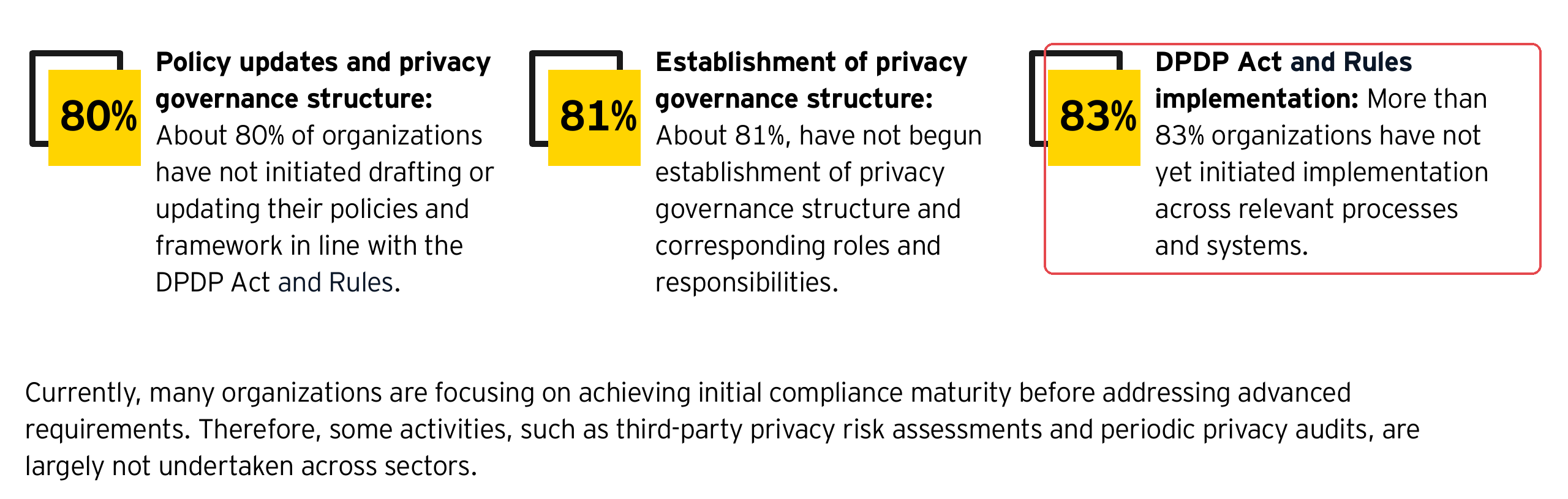
EY surveyed nearly 150 senior leaders, managers and executives across industries for a January 2026 report. More than 83% of their organisations had not begun putting the Act and Rules into practice across processes and systems. About 80% had not started updating their policies.
If you searched for a DPDPA compliance checklist, you probably want something you can hand to a team on Monday: a list of tasks, the Rule behind each one, the evidence a regulator would ask for and a date. That is what this is. Every step below maps to a section of the Act or a Rule, and the whole list comes as a spreadsheet you can assign. By the end you will also know which steps to do first, because the order matters more than most checklists admit.
How to use this DPDPA checklist
Treat it as a project plan. Each of the 30 rows has what to do, the Act section or Rule it comes from, the evidence you should be able to show, a suggested owner, and the deadline.
Download the DPDPA compliance checklist (XLSX)

How to use it well:
- Put a named person in the owner column, never a team. "Engineering" doesn't answer emails.
- Treat the evidence column as the real deliverable. When the Data Protection Board asks, it will ask for a document, a log or a screenshot, and "we do this" won't count.
- Work in phase order inside each phase, but run phases in parallel once Phase 1 is far enough along. The last section explains the order I'd use.

The dates come from Rule 1 of the DPDP Rules, 2025. Rules 1, 2 and 17 to 21 took effect on 13 November 2025. Rule 4, on Consent Managers, takes effect one year later. Rules 3, 5 to 16, 22 and 23, which hold nearly every duty on this list, take effect eighteen months after notification, on 13 May 2027.

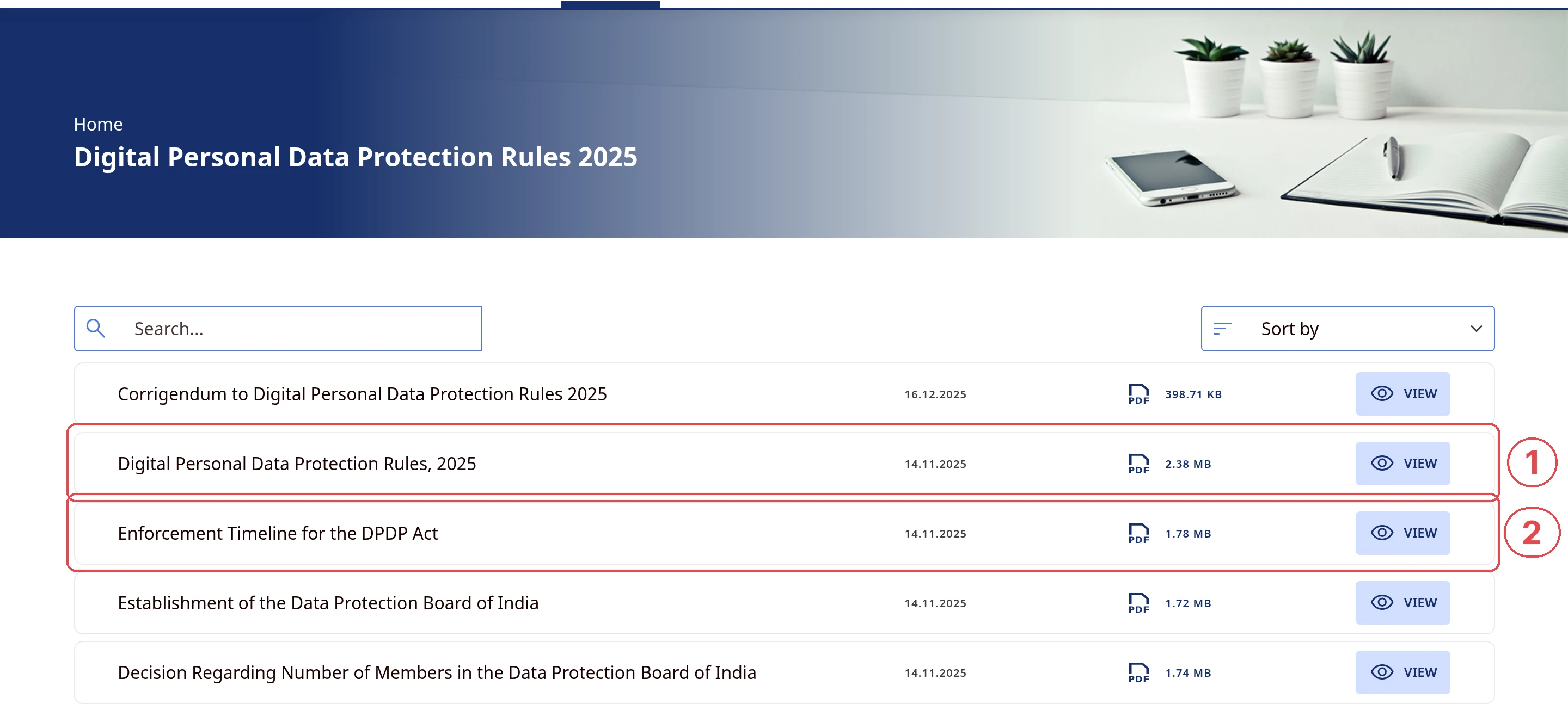
MeitY keeps the Rules, the enforcement timeline and the December 2025 corrigendum on one page. The corrigendum fixed typos and changed no dates. A January 2026 Business Standard report said MeitY was considering a shorter window for some duties, but nothing has been notified, so plan for 13 May 2027 and check that page every quarter.
Phase 1: Know your data
You can't write a notice, set retention or scope a breach for data you haven't found. It's the slowest phase and the one teams most want to skip.
Step 1. Name one owner with a line to the board
Section 8(1) makes the Data Fiduciary responsible for compliance, including for anything its processors do. Someone has to own that. Give it to one senior person and minute the decision. You don't need a formal DPO unless you're notified as a Significant Data Fiduciary, but you do need a name.
Step 2. Build a personal data inventory
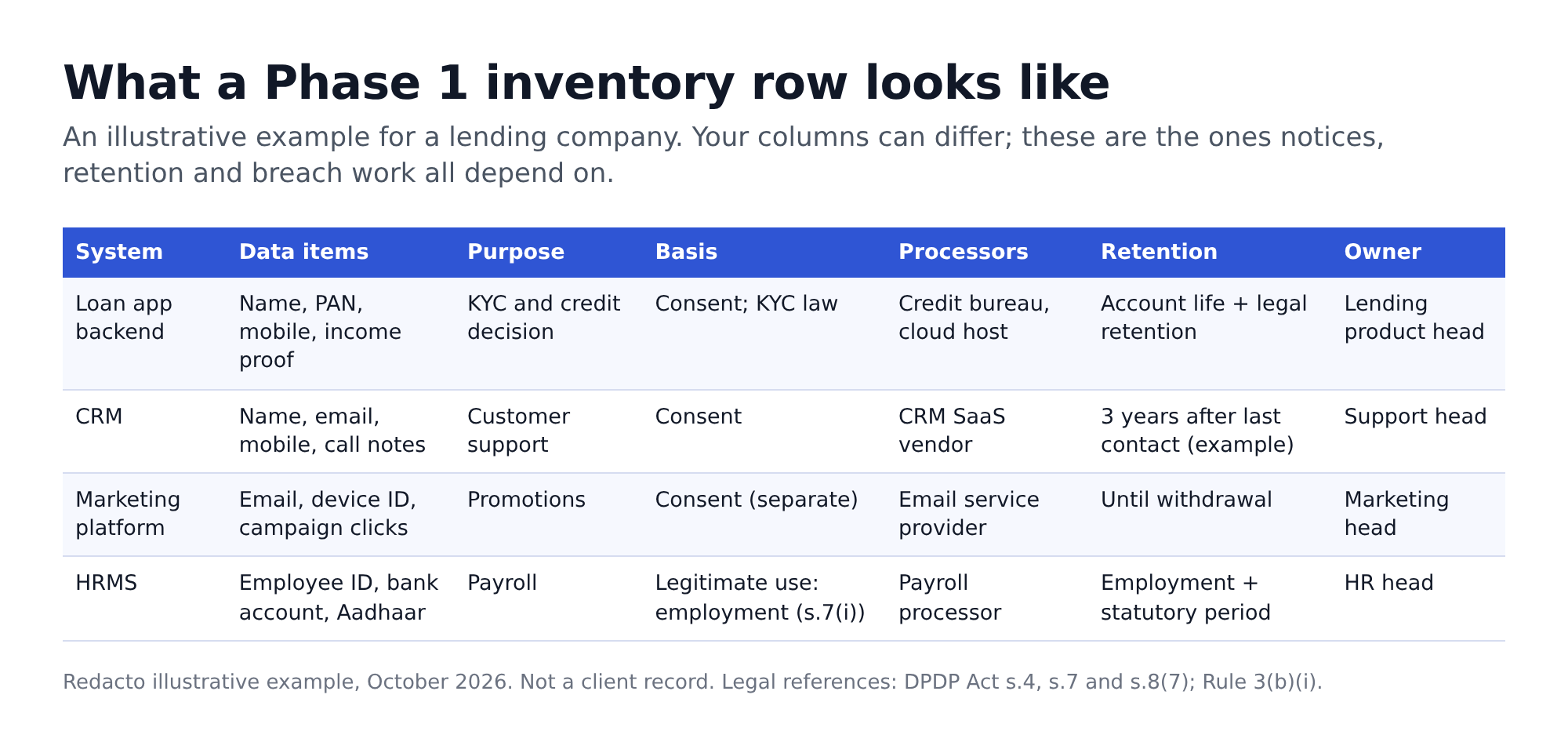
List every system that holds personal data, what data items it holds, whose data it is (customers, employees, applicants, vendors' staff) and who owns the system. Rule 3(b)(i) requires an "itemised description" of personal data in every notice, so you will need this level of detail anyway. Our data inventory guide covers the columns.
Step 3. Map where the data flows
Draw where each data set goes: processors, group companies, analytics tools and anything stored or accessed outside India. Section 16 and Rule 15 let the government restrict transfers to specific countries, and you can't respond to a restriction if you don't know which flows it would hit. See data flow mapping under DPDP.
Step 4. Record a purpose and a basis for each activity
For each processing activity, record the purpose and whether you rely on consent or a section 7 legitimate use, such as employment. The Act doesn't name a ROPA, but a ROPA is the easiest way to prove the purpose behind every row.
Step 5. Flag children's data and guardian data
Tag every place you might hold data of children (anyone under 18) or of persons with disability who have a lawful guardian. Both bring extra consent duties in Phase 8, and the tag is what tells product teams which flows need them.
Phase 2: Notices and consent
Customers see this part, and it's where I see the most rework, because teams write notices before Phase 1 is done.
Step 6. Rewrite every notice to Rule 3
Rule 3 says a notice must stand on its own, in clear and plain language, and include at minimum an itemised list of the data, the specified purpose, the goods or services it makes possible, and a link to withdraw consent, exercise rights and complain to the Board. Section 5(3) lets the Data Principal read it in English or any of the 22 languages in the Eighth Schedule of the Constitution.
Step 7. Re-notice people who consented before the Act
Section 5(2) requires a notice to everyone whose consent you took before the Act began, "as soon as it is reasonably practicable".
Step 8. Make consent specific and withdrawal comparably easy
Consent under section 6(1) has to be free, specific, informed, unconditional and unambiguous, with a clear affirmative action, and limited to the data the purpose needs. Section 6(4) and Rule 3(c)(i) require withdrawal to be comparable in ease to giving consent. One bundled checkbox for "terms, marketing and partners" fails this. One toggle per purpose passes.
Step 9. Keep consent records you can produce
Under section 6(10), if there's a dispute, you have to prove that you gave notice and got consent. That means a timestamped record linked to the notice version the person saw. A screenshot of the form won't hold up.
Step 10. Decide on Consent Managers
From 13 November 2026, Rule 4 lets Consent Managers register with the Board, and a Data Principal can give or withdraw consent through one. If your users may arrive that way, decide now how you will accept and honour those consents.
Phase 3: Reasonable security safeguards
Failing to take reasonable security safeguards carries the largest penalty in the Act: up to ₹250 crore under the Schedule. Rule 6 lists the minimum. If you already run ISO 27001 or RBI controls, most of this is mapping work.
Step 11. Encrypt, mask or tokenise personal data
Rule 6(1)(a) asks for encryption, obfuscation, masking or virtual tokens mapped to the data. Start with stores of identity and financial data.
Step 12. Control access, including processors' access
Rule 6(1)(b) requires access control over the computer resources the Data Fiduciary or its processor uses. Keep quarterly access review sign-offs.
Step 13. Log, monitor and keep logs for a year
Rule 6(1)(c) asks for visibility on access through logs, monitoring and review. Rule 6(1)(e) asks you to keep those logs and the related personal data for one year to help detect and investigate a breach, unless another law needs longer.
Step 14. Back up and test restores
Rule 6(1)(d) requires measures for continued processing if confidentiality, integrity or availability is compromised, including backups. A restore test once a quarter is the evidence.
Step 15. Back the controls with policy, training and testing
Rule 6(1)(g) asks for technical and organisational measures that make those protections work in practice, repeating section 8(4). For me that means written policies, staff training and a yearly penetration test of systems that hold personal data.
Phase 4: Breach readiness
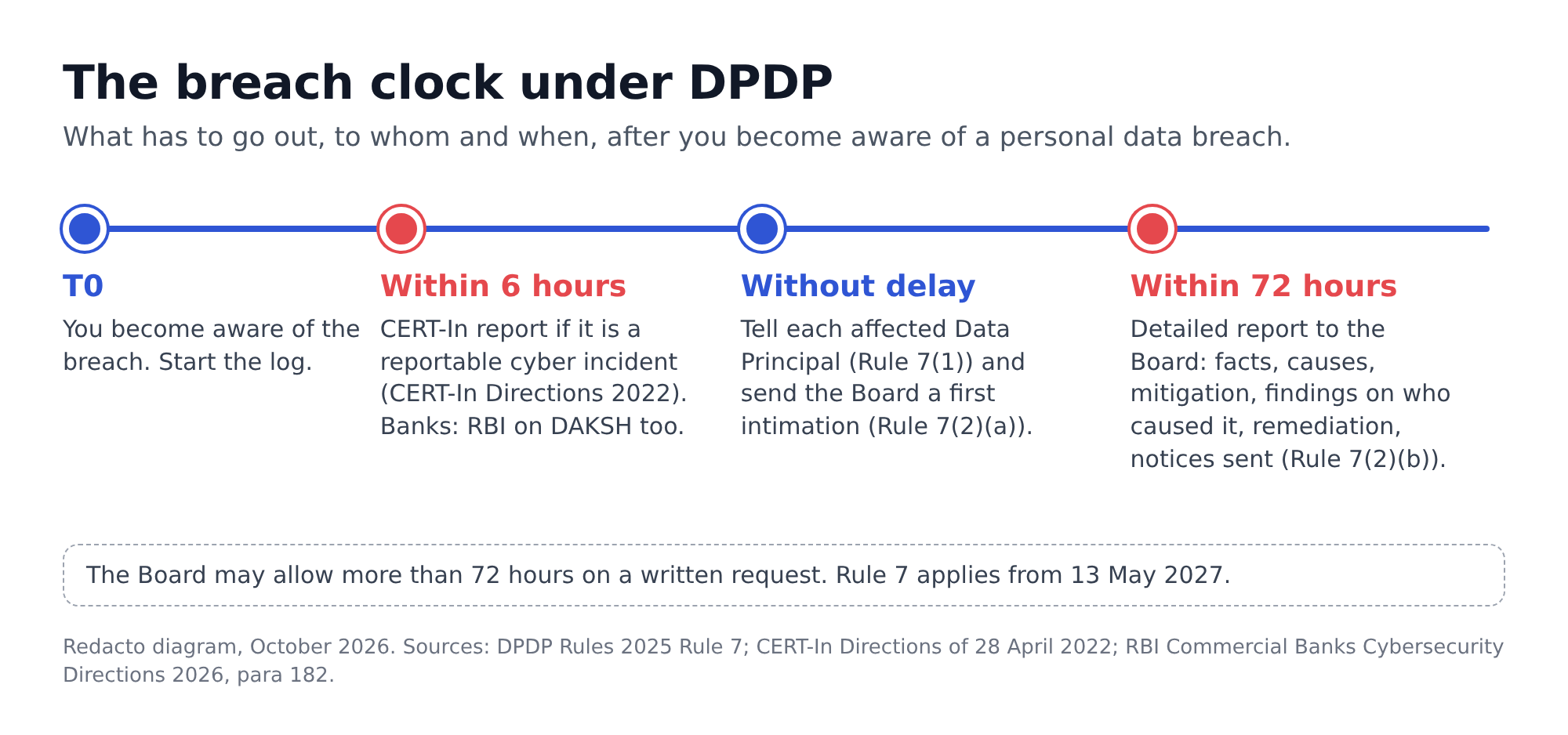
Not notifying a breach properly can cost up to ₹200 crore, separate from the security penalty. Under Rule 7, a personal data breach means two notices, and the clock starts the moment you become aware of the breach.

Step 16. Write a breach plan that names people
Name who declares a breach, who drafts the notices and who signs them off. Most delays I've seen in tabletop exercises come from nobody being sure who can say "this is a breach".
Step 17. Pre-draft the Data Principal notice
Rule 7(1) requires you to tell each affected person, without delay and in plain language, five things: what happened, the likely consequences, what you've done to limit the harm, what they can do to protect themselves, and who to contact.
Step 18. Pre-draft the Board notices
Rule 7(2) requires a first intimation to the Board without delay, then a detailed report within 72 hours covering facts, circumstances and reasons, mitigation, findings about who caused it, remediation and the notices sent. The Board can allow more time if you ask in writing.
Step 19. Rehearse against every clock you're under
CERT-In's Directions of 28 April 2022 require reportable cyber incidents to be reported within six hours of noticing them. Run one tabletop that hits every clock.
Phase 5: Retention and erasure
Section 8(7) says erase personal data once consent is withdrawn or the purpose is no longer served, unless a law requires you to keep it.
Step 20. Set a retention period for every purpose
Write a retention schedule by purpose, with legal holds. The Act's own illustration is a bank that must keep identity records for ten years after an account closes because banking law requires it.
Step 21. Erase on withdrawal or when the purpose ends, at processors too
Section 8(7)(b) requires you to make your processors erase the data as well. Build the deletion job, then build the request to each processor. Our guide on handling DPDPA deletion requests walks through the steps.
Step 22. Keep processing logs for at least one year first
Rule 8(3) requires you to keep personal data, traffic data and logs of processing for at least one year from the processing, even if the person deletes their account. Steps 21 and 22 pull in opposite directions; the schedule has to settle the conflict.
Step 23. Run inactivity erasure if you're in the Third Schedule
E-commerce entities and social media intermediaries with at least 2 crore registered users in India, and online gaming intermediaries with at least 50 lakh, must erase data three years after a user last engaged (Rule 8(1) and the Third Schedule). Rule 8(2) requires a notice at least 48 hours before erasure.
Phase 6: Rights and grievances
The rights in sections 11 to 14 only work if people can find out how to use them.
Step 24. Publish who answers privacy questions
Section 8(9) and Rule 9 require you to publish the business contact details of your DPO, if you have one, or of a person who can answer questions about processing, clearly on your website or app. Rule 9 also requires those details in every response to a rights request.
Step 25. Publish how to exercise each right
Rule 14 requires you to publish the means to request access, correction, completion, updating and erasure, and the identifier you need to verify the person, such as a customer ID. Set up nomination too: section 14 and Rule 14(4) let a Data Principal nominate someone to act on their behalf after death or incapacity.
Step 26. Publish a grievance period of 90 days or less, and meet it
Rule 14(3) requires you to publish the period within which you will respond to grievances, and it can't exceed 90 days. Pick one your support team can meet.
Phase 7: Vendors and processors
You stay liable for what your processors do with your data. EY found that third-party privacy risk assessments are largely not being done across sectors, which makes this the phase I'd worry about most.
Step 27. Sign a valid contract with every processor
Section 8(2) allows you to use a processor only under a valid contract. Rule 6(1)(f) requires that contract to oblige the processor to take reasonable security safeguards. Add breach notification to you, erasure on instruction, sub-processor approval and audit rights. Our post on data processors under the DPDP Act has a fuller clause list.
Step 28. Assess processors before you sign them and every year
Score each processor on the data it holds and how it protects it, and review the high-risk ones every year. The third-party risk management guide covers the method.
Phase 8: Children's data
The children's duties carry a penalty of up to ₹200 crore, and they apply to any service with users under 18, including general apps that children happen to use.
Step 29. Verify parental consent and stop tracking children
Section 9 and Rule 10 require verifiable consent from a parent before you process a child's data. Rule 10 asks you to check that the parent is an identifiable adult, either from details you already hold or through a virtual token from an authorised entity, such as DigiLocker. Section 9(3) bans tracking, behavioural monitoring and targeted advertising directed at children. Rule 12 and the Fourth Schedule exempt some classes, such as healthcare and educational institutions, for specific purposes. Rule 11 sets a similar process for a lawful guardian of a person with disability. The October 2026 Removal of Difficulties Order (S.O. 5458(E)) also corrected the wording of section 9(1) to "child or of a person with disability", so the guardian consent duty clearly covers both groups.
Phase 9: If you're a Significant Data Fiduciary
The government notifies Significant Data Fiduciaries (SDFs) based on volume and sensitivity of data and risk to Data Principals. None has been notified yet. Large banks, insurers and platforms should plan as if they will be.
Step 30. Prepare the SDF duties before you're notified
Section 10 and Rule 13 add a DPO based in India who reports to the board, an independent data auditor, and a Data Protection Impact Assessment (DPIA) and audit every 12 months with the findings reported to the Board. Rule 13(3) adds due diligence on algorithmic software, and Rule 13(4) lets the government require some data to stay in India. Our DPIA guide for the DPDP Act covers the assessment.
In October 2026, MeitY's Removal of Difficulties Order (S.O. 5458(E)) amended section 10(2)(c)(ii) to read "data audit" instead of "audit", so both audit duties in section 10 now clearly mean a data audit.

Fintech and BFSI additions
If you are a bank, NBFC or payments company, DPDP compliance sits on top of what RBI already asks. Most Phase 3 controls already exist in your RBI evidence; the gaps are usually notices, consent and erasure.
Four additions I'd put on a fintech's sheet:
- Join up breach reporting. RBI's Commercial Banks Cybersecurity, Technology: Risk, Resilience and Assurance Framework Directions, 2026 require commercial banks to report cyber incidents within six hours of detection on RBI's DAKSH platform and to notify CERT-In. That runs before the DPDP 72-hour report, so one incident record should feed all three.
- Map outsourcing contracts to Step 27. RBI's November 2025 directions on managing risks in outsourcing, such as the version for commercial banks, already require contracts and oversight. Add the DPDP clauses to the same review cycle.
- Square retention with KYC and anti-money laundering record keeping. Legal holds sit in Step 20, and they can't be erased on request.
- Watch your consent flows. Lending, account aggregator and card flows often collect consent across several screens and partners. Each one needs its own Rule 3 notice and record.

For a sector view, see our DPDPA compliance guide for BFSI.
The order a CISO would do this in
The phase numbers follow the Act. If I had a small team and about six months, this is the order I'd follow, and why.
- Phase 1 first. Nothing else can be scoped without the inventory.
- Phases 3 and 4 next. They carry the two biggest penalties, ₹250 crore and ₹200 crore, and they reuse controls you already have.
- Phase 7 alongside. Contract changes take months because the other side has to sign.
- Phase 2 once Phase 1 is done. Notices written from a finished inventory don't need rewriting.
- Phases 5 and 6 together. Erasure and rights share the same engineering.
- Phases 8 and 9 last, unless you serve children or expect SDF notification, in which case move them up.
Of all the DPDPA compliance work, the one thing I'd never leave late is the breach plan. You can fix a notice next month. You can't redo the first 72 hours after a breach.
Can a DPDPA compliance platform run this for you?
Partly. Software can find personal data, keep consent records, time rights requests, track the breach clock and chase vendor contracts. It can't decide your purposes, set retention periods or sign off a breach notice.
If you're comparing DPDPA-ready enterprise platforms in India, test them against the evidence column of this sheet. Ask each vendor to show where Steps 9, 18, 21 and 26 leave a record. Our list of DPDPA compliance tools compares the options. For banks and fintechs, a fintech DPDPA compliance platform should also track RBI and CERT-In timelines on the same incident record.
Redacto's Breach Management tracks DPDP, CERT-In and sector deadlines on the incident record and drafts the Board and Data Principal notices for your team to approve. Consent Management writes a timestamped receipt linked to the notice version and checks that each withdrawal reached the systems that use the data.
Final thoughts
A DPDPA checklist is only useful if each row has a name and a piece of evidence next to it. Start with the inventory this month, get breach readiness and processor contracts moving next, and leave the polish for 2027. For the full legal background behind each step, read our guides to DPDP Act compliance requirements and the DPDP Rules.
If you want the evidence column filled in as you go, see how Redacto runs privacy governance.