7 Best Digital Anumati Alternatives for an India-Built DPDP Suite (2026)
Seven alternatives to Digital Anumati for an India-built DPDP suite, compared on consent, rights, discovery, deployment, published price and evidence.

When a team tells me they want an India-built privacy programme they can run in their own estate, they often arrive with a homepage, a sales deck, and very little they can test without a call. That is a fair place to start. It is a weak place to stop. Rule 4 of the Digital Personal Data Protection Rules, 2025, is in force from 13 November 2026, so a Board-registered Consent Manager is a live regime from that date. Notices and consent still have to work in the same programme as the later Rule 14 grievance cap, which applies from about 13 May 2027. I wrote this for teams that already have one India suite in the shortlist and want to compare other suites on consent, rights, discovery, deployment, price, and the evidence they can actually export. I will not treat a landing-page count as that evidence.
TL;DR
- Digital Anumati: An India-built suite with a public SaaS tariff you can read today: Free at ₹0 a month, Growth at ₹9,999 a month, and Enterprise on a custom quote. The self-serve request portal starts at Growth. On-prem, private cloud and air-gapped licences are quoted on nodes, not sold as self-serve cards. There is no public review corpus.
- Redacto: One programme record for consent, requests, assessments and incidents, if you can work from a quote and a reference call. I do not claim on-prem or private cloud for this product.
- Privy by IDfy: Another full-stack India DPDP platform, with consent, Data Principal rights and discovery named as three pillars. Quote-based, and no public review corpus.
- Consentin (by Leegality): Signed consent artefacts and notices, including an on-prem track that is still on the public price list. The Starter Pack is 3,000 consent collects a month at ₹0. Discovery sits on the on-prem track.
- OneTrust: A global suite for teams already inside that estate. Quote-based. The dated comments I use sit on the Privacy Automation G2 profile, not on a request-only corpus.
- Consiva: The row I would trial first when rights and grievance are the open job, and you want a public Indian tariff, including a limited-time ₹0 Basic card.
- IQWorks: Another India-built platform, with on-prem and a large connector count named on the homepage. Quote-based. Confirm both claims in a tenant you control.
- Sammati: A smaller India privacy product that names 22 scheduled languages, a hash-chained ledger, and BYOC or managed hosting. Plans are public by data-principal caps; no rupee fee sits on the cards, so you still talk to sales.
Why teams look past Digital Anumati
A missing price list is not the gap. On 13 November 2026, Digital Anumati published three SaaS plans you can read without a call: Free at ₹0 a month, Growth at ₹9,999 a month, and Enterprise on a custom quote. The more useful questions sit under those figures.
The self-serve request portal, and the 72-hour cascading erasure row, start at Growth. Free is a consent-collect plan, with 3,000 collections a month, and it does not include that portal. If you are leaving a specialist rights tool, or you need principals to raise access, correction or erasure themselves, compare the rights rows, not only the monthly fee.
On-prem and private cloud are real packaging, and they are not self-serve. The on-prem track publishes Core, Enterprise and Air-Gapped cards, each as an annual licence quoted on nodes and support. Air-gapped is described as an isolated install with no outbound calls. I would ask for the bill of materials and the support clock in writing, because none of that is a public rupee figure.
I also have no public G2, Capterra or PeerSpot corpus to weigh those claims against. Some of the public copy still points at draft rules, after the Rules have already started to take effect. I have left out client counts that do not appear on the current website. In a trial, I would walk a withdrawal, a request, a discovery hit, and, if on-prem is the reason you shortlisted the product, an install in an estate you control.

Comparison table
| Tool | Best for | Consent and notices | Rights | Discovery | Deployment | Public price |
|---|---|---|---|---|---|---|
| Digital Anumati | An India-built suite with a public SaaS tariff, and quoted on-prem if you need it | Notices and a preference centre; 22 scheduled languages on Growth and Enterprise | Self-serve request portal starts at Growth; 72-hour erasure is a vendor claim, not a Rule 14 fact | Connectors on Enterprise and on the quoted on-prem track | SaaS, plus quoted on-prem, private cloud and air-gapped licences | Free ₹0 / month; Growth ₹9,999 / month; Enterprise custom |
| Redacto | Indian teams that want one programme record and can work from a quote | Consent sits on the same record as assessments and requests | Requests and grievances share that record; a missing connector becomes a tracked task on the same clock | Connected systems and vendors feed the record of processing | I do not claim on-prem or private cloud for this product | Quote-based |
| Privy by IDfy | Enterprises that want another full-stack India DPDP platform | Consent lifecycle is one of three named pillars | Data Principal Rights Management is the second pillar | Personal data discovery is the third pillar | Confirm the estate in a trial | Quote-based |
| Consentin | Teams that want signed artefacts and notices, including on-prem | Signed artefacts and notices; Starter Pack is 3,000 collects a month at ₹0 | Rights sit in the suite; confirm nomination and grievance in a trial | Discovery sits on the on-prem track | SaaS, and on-prem remains on the public price list | Starter ₹0 at that volume; other packs are a quote |
| OneTrust | Global programmes adding DPDP inside an estate they already pay for | A global consent and preference suite | Request tools sit inside the wider platform | Discovery and assessments sit in neighbouring modules | SaaS, for a global estate | Quote-based |
| Consiva | Teams whose first gap is rights and grievance, with a public Indian tariff | Bring a consent tool if notices are still open | Public intake, identity check, two clocks, a closed case file; unmetered volume on every plan | Not the first job | SaaS | Basic ₹0 limited-time; Pro ₹5,999 / month plus taxes |
| IQWorks | Teams comparing another India-built, AI-led platform | Confirm notices and consent in a demo | Walk access, correction, erasure and a grievance in a trial | 650+ data connectors, as a vendor claim | On-prem is a public homepage claim | Quote-based |
| Sammati | Teams evaluating a smaller India privacy product that names consent, notices and a preference centre | 22 Indian languages and a hash-chained ledger, on every paid plan | A rights console is named on the public plans; confirm the path in a trial | A cookie and form scan is named; confirm in-place discovery in a trial | BYOC in your AWS, or managed, with India residency | Named plans by data-principal caps; no rupee fee on the cards; talk to sales |
Facts as of 13 November 2026. Quote-based means talk to sales. Consiva ₹0 Basic is a limited-time offer. No Time Limit is how long you can use that plan. Consentin Starter is a consent-collect pack. The self-serve request portal is absent from Digital Anumati Free. I do not claim on-prem for Redacto.

How we chose these alternatives
I compared each tool as a suite a team might put next to Digital Anumati, not as a cookie banner list. The tests were consent and notices, Data Principal rights, discovery, deployment, a public price or a clear quote, and the evidence you can export from a trial. I re-opened official product and pricing pages on 13 November 2026. I did not treat unpublished client counts as evidence, and I did not invent a review corpus where none is public.
I compare named vendors you could switch to from Digital Anumati, and I leave the category questions to separate guides. If you are still choosing a type of consent product, start with how to choose between types of consent management solutions and the consent management platform guide for India. If you want a wider DPDP tools shortlist, use DPDP Act compliance tools. If the open job is the request itself, use the DSAR management softwares list. I have not treated this post as a replacement for any of those.
I have left OneConsent out of the lead list. DPDP.ai, TrustArc and Securiti sit in reserve if you later want another India rights product or a second global suite. I have not treated DPDP.ai marketing counts as proof.
The 7 best Digital Anumati alternatives for an India-built DPDP suite
1. Redacto
Full disclosure: we build Redacto, so I won't score it beside the others.
Three customers, in their own words:
Surya N, Director, Product Management, TimePay: "As a product team, we had one worry: would privacy compliance hurt the onboarding journey? It didn't. Redacto's consent flows fit into our app with very little engineering effort, and we change notices from the console instead of shipping a new build. Our users get a clear choice at every step, and we get a consent record we can stand behind."
Prem Kumar, Data Protection Officer, Pine Labs Group: "Privacy across a group of businesses is hard because every team has its own systems and its own idea of what personal data it holds. Redacto gave us one view of where personal data is collected, why we collect it and where it goes. When a customer request or an audit question comes in, I answer it with evidence, not a round of emails."
Saif, Head, Infosec Compliance & Privacy, Razorpay: "Our vendor security and privacy reviews used to live in spreadsheets and long email threads. With Redacto, every assessment, every piece of evidence and every follow-up sits in one place. When a customer sends us a security questionnaire, we answer it from that same record. We focus on the vendors that actually carry risk, and the paperwork no longer runs the week."
These are our customers speaking, so weigh them that way and ask for a reference call.
By our own count we've done 40+ successful implementations.
Features
Redacto Privacy Governance is the product I would trial when you want assessments, a living record of processing and a 72-hour breach clock to share one programme record with the notices and requests you already run, and you are prepared to work from a quote. The three modules on this product are Privacy Impact Assessment, ROPA and Breach Management. An assessment can start prefilled from that record. An incident can read the same record. The 72-hour window in the shot below is the notification clock against the obligation, shown as sample data, not a customer file.
I do not claim on-prem, private cloud, or storage in a local country by default for Redacto. Those modes are not something I will write down as a public product fact. If that estate is why you came from Digital Anumati, ask us to show the install path in writing before you treat it as a like-for-like move.
Teams often ask what happens when a system will not take an API call. In Redacto, that work is assigned to the request's owner as a tracked task on the same clock, and the request closes only once that owner's evidence is on file. In a trial, remove a connector and watch whether the request stays open.
I am not writing nomination down as a Redacto product feature here. Sections 11 to 14 of the Act still create the right; in a trial, check whether a nominee can be recorded and then actually served.
Our public list of pre-built SaaS connectors is shorter than the catalogue some global tools put forward. If a long pre-built catalogue is the first thing you are buying, treat that gap as real and ask us for the list we publish today before you decide.

Pricing
Quote-based. The note below is how I have explained our pricing.
The LinkedIn note covers consent volume: how many Data Principals you cover, and how many processors must be told when a person withdraws or grants consent, since each processor adds API calls. I will not treat that as a public tariff for the wider suite, and I will not invent one. The volume rules themselves are in this LinkedIn post from Redacto:
Reviews
There isn't a public review base yet.
Clients
The three quotes above are the public references I will put on this row. Ask for a reference whose stack is close to yours, and bring one request type you actually run plus one system that has to honour a withdrawal.
Summary
Pick Redacto if assessments, the record of processing and a breach clock have to live with the notice and the request, and you can work from a quote and a reference call. The cons are real. There is no public self-serve price. There isn't a public review corpus. I do not claim on-prem or private cloud here. Our public connector list is shorter than the list some global tools put forward.
Against Digital Anumati: you get assessments, ROPA and breach on the same programme record as consent and requests, and a missing connector is raised as a tracked task on the same clock, and closes only once the owner's evidence is on file. What you give up is Digital Anumati's public SaaS tariff, and a public on-prem card I am prepared to write down today.
2. Privy by IDfy
Features
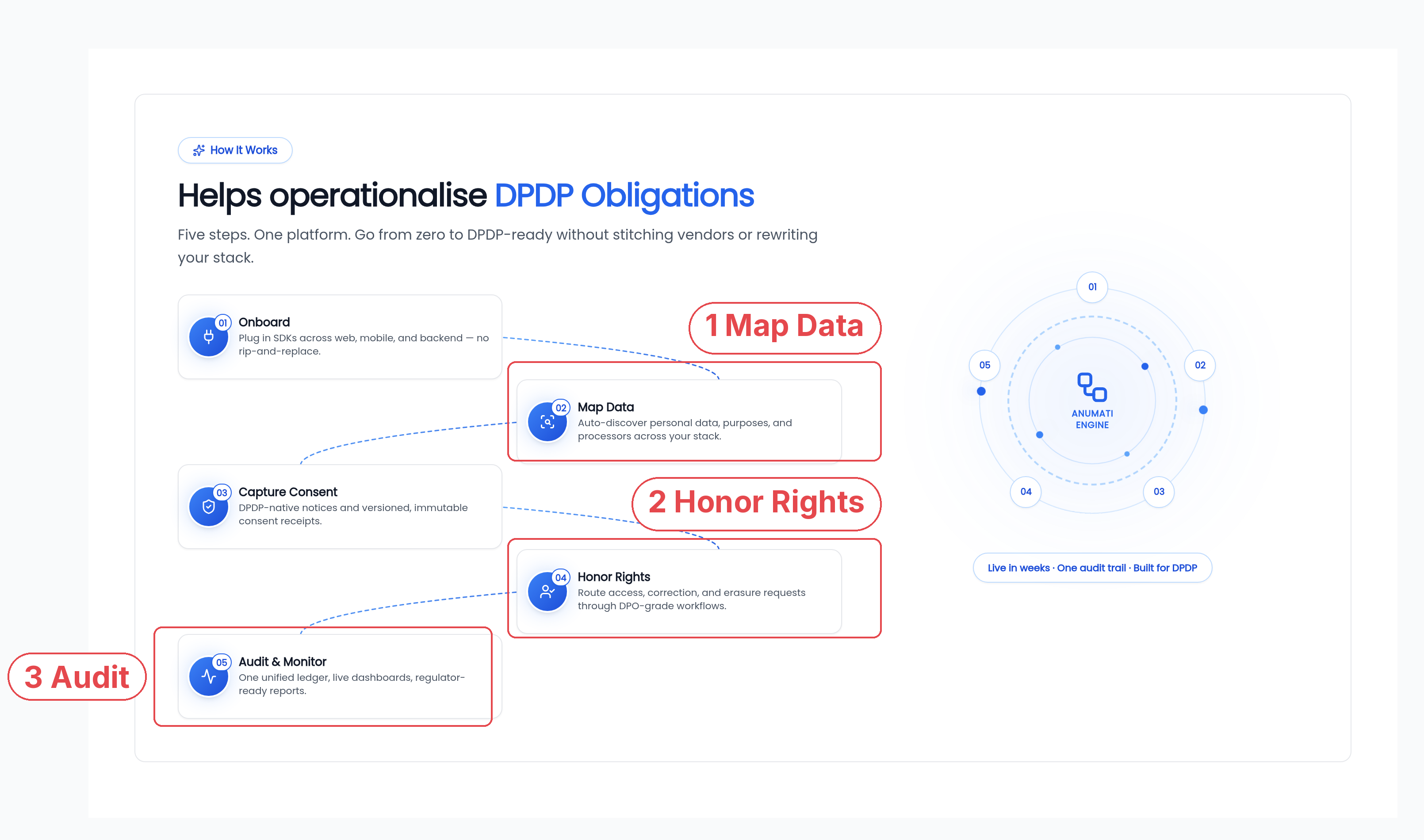
Privy by IDfy is the product I would trial when you want another full-stack India DPDP platform, and you want consent, Data Principal rights and discovery named in the same suite. The homepage sets out three pillars: Consent Lifecycle Management, Continuous Compliance and Risk Management, and Personal Data Discovery and Governance. Under those sit a Consent Governance Platform, Data Principal Rights Management (DPRM), and a cookie manager. Privy is also named as a winner of MeitY's DPDP Innovation Challenge. I have treated the 50+, 10+PB, 500M+ and 2B+ figures in the shot below as marketing counts, not as figures I can verify as customer results.
In a trial, raise a withdrawal, an access request and a discovery hit, and watch whether all three land in the same history. Ask how a system with no API is handled, in writing.

Pricing
Quote-based. I will not invent a suite tariff.
Reviews
Privy by IDfy has no public G2, Capterra or PeerSpot corpus that I can cite. Ask for a reference whose consent volume and request mix look like yours.
Clients
Public materials name enterprises across BFSI, fintech and digital commerce. Ask for a caller in your sector, and bring one withdrawal and one request.
Summary
Pick Privy if you want another India-built suite that already names consent, rights and discovery together, and you can work from a quote. It is a weaker fit if you need a public price, a review corpus, or marketing counts treated as proof.
Against Digital Anumati: you get a second full-stack India platform, with rights and discovery named beside consent. What you give up is a public SaaS fee you can read today, and any independent review base, which neither row has today.
3. Consentin (by Leegality)
Features
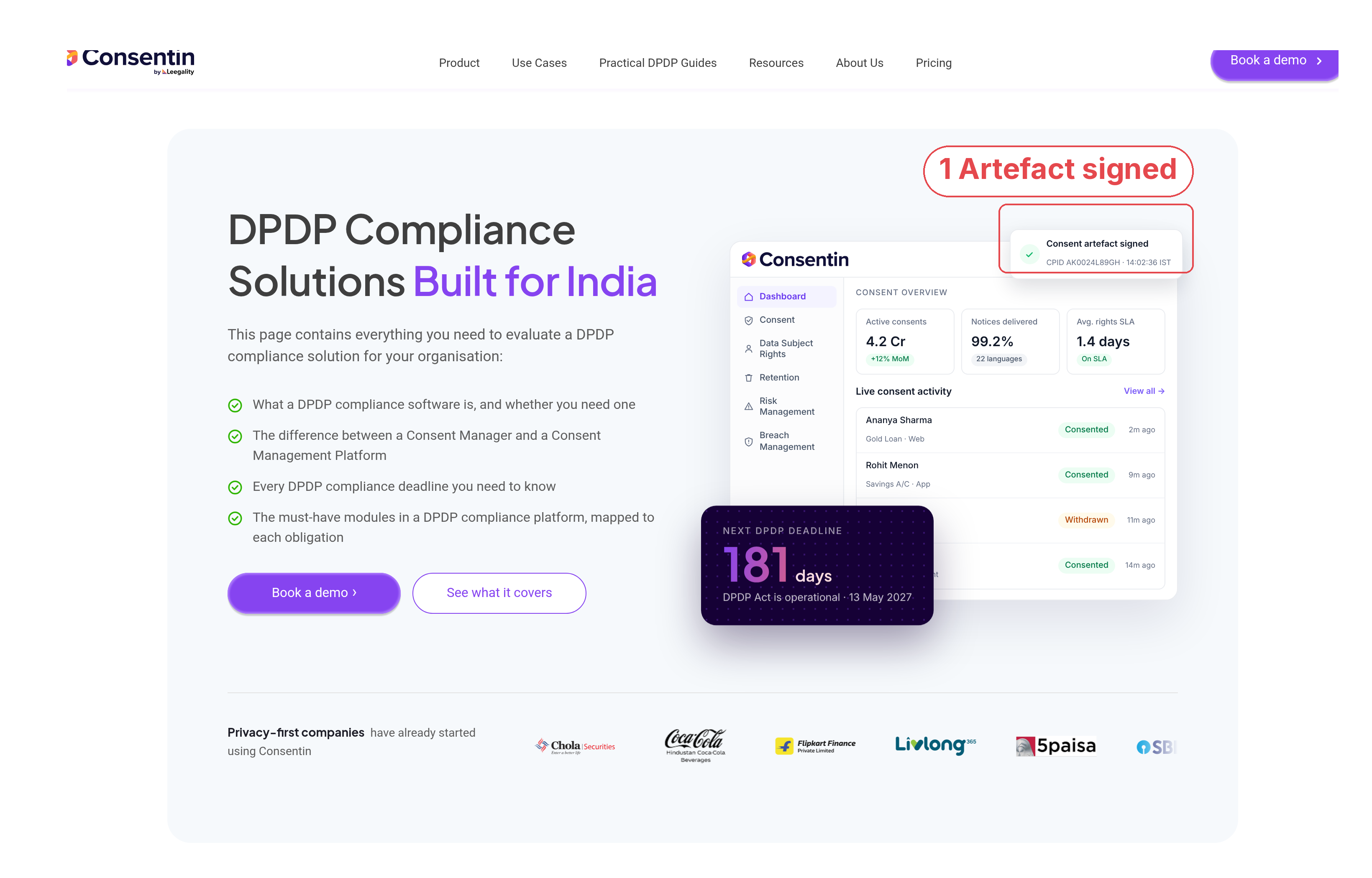
Consentin's DPDP compliance solutions is the product I would trial when you want signed consent artefacts and notices, and you still want an on-prem path on the public price list. The product mock in the shot below shows a signed consent artefact, with a CPID, on the same dashboard as consent activity and a rights item in the product menu. I have treated the dashboard figures, including the 4.2 crore active consents and the 1.4-day rights SLA, as a product mock, not as customer results.
Discovery is described as an on-prem item. If in-place discovery is why you came from Digital Anumati, ask to see that path in an estate you control, and do not assume it ships on the SaaS pack. For a wider read on Leegality's consent product, see Leegality alternatives.
In a trial, collect a consent, export the signed artefact, withdraw it, and watch whether downstream systems actually stop.
Pricing
Consentin's pricing still publishes a Starter Pack of 3,000 DPDP-compliant consent collections a month at ₹0, treated by the vendor as permanent at that volume. That is a consent-collect pack, not a rights tariff, and not a discovery tariff. Other packs are quote-based, as monthly collects and checks, with top-ups if you run out. SaaS and on-prem are both named; discovery is described as sitting on the on-prem track.
Reviews
Consentin has no public G2, Capterra or PeerSpot corpus that I can cite. Ask for a reference whose artefact trail and language set look like yours.
Clients
Public materials name Indian financial and consumer brands. Ask for a caller in your sector, and bring one withdrawal and one artefact export.
Summary
Pick Consentin if signed artefacts and notices are the first job, and you want an on-prem path you can still read on the public price list. It is a weaker fit if you need a public rights tariff, a review corpus, or discovery on a SaaS pack I have not seen priced that way.
Against Digital Anumati: you get signed artefacts, and on-prem remains on the public price list. What you give up, on the Starter Pack, is anything beyond a consent-collect volume, and you still have no independent review corpus on either row.
4. OneTrust
Features
OneTrust is the product I would trial when a global programme is already licensed, and the open job is to add DPDP work inside that estate, not to buy a second India suite from scratch. The homepage presents a wider governance platform, with an AI use-case board in the hero, not a request-only module. I have written this row as the wider suite. If you only need request fulfilment, start with OneTrust alternatives and still test how a DPDP grievance is clocked in the tenant you already have.
The board in the shot below is a product mock. In a trial, raise a DPDP grievance, map the timer to the period you will actually put in public, and walk one withdrawal through to a downstream system.

Pricing
Quote-based. I will not invent a suite tariff, and I will not treat a neighbouring module's G2 listing as the vendor's own price card.
Reviews
OneTrust has no request-only G2 corpus. I have used the Privacy Automation G2 profile, which on 13 November 2026 read 4.3 out of 5 from 155 reviews. Users on G2 like being able to shape the platform and to complete records of processing and impact assessments with less friction, and they complain about awkward bulk uploads, a high price and a steep learning curve (G2, June 2026 and January 2026). Keep those comments inside that module's profile. On 8 June 2026, a mid-market hospital reviewer called the product "Completely customisable to your needs" and also wrote "The bulk uploading of information if your using an existing template can be tricky." On 8 January 2026, Erick Vincent Steve G. complained about "the high price and the steep learning curve." I have also ignored a 29 July 2025 request-handling comment, because it is older than 12 months.
Clients
Customer stories appear on OneTrust's own site. I would ask for a DPDP reference in a group that already runs other OneTrust modules, and I would ask how a grievance is clocked in that tenant.
Summary
Pick OneTrust if the platform is already paid for and the open job is to add DPDP work inside that estate. It is a weaker fit if you are buying OneTrust only for this job, if you need a public price, or if you need a request-specific review corpus.
Against Digital Anumati: you stay inside an estate many large organisations already run, and you get a neighbouring G2 corpus on Privacy Automation. What you give up is Digital Anumati's public Indian SaaS tariff, and an India-built on-prem card you can read before you talk to sales.
5. Consiva
Features
Consiva Data Principal Rights Management is the product I would trial when rights and grievance are the first gap, and you want a public Indian tariff you can read today. The path it publishes is public intake with no login, an identity check, two clocks tracked separately, and a closed case file. The service clock is a period you choose for access, correction, erasure and nomination. The grievance clock is the period you publish for Section 13, which Rule 14(3) caps at ninety days from about 13 May 2027. Volume is unmetered on every plan, including Free. The site blocks automated browser access; the shot below is a fresh crop of a 12 November 2026 capture, not a new headless visit.
In a trial, raise a nominee request and a grievance, and export the case file.

Pricing
Consiva's pricing, on 13 November 2026, still publishes Basic as a limited-time offer at ₹0, down from ₹2,499, with no credit card. "No Time Limit" describes how long you can use the plan, not a promise that the ₹0 price lasts forever. Basic includes manual rights-request handling. Pro is ₹5,999 a month plus taxes, billed monthly, with automated request handling. Lock the ₹0 terms in writing if that card is why you would switch.
Reviews
No public G2, Capterra or PeerSpot corpus is available for Consiva. Ask for a reference whose request mix, including nomination and grievance, looks like yours.
Clients
Ask for an Indian reference whose volume looks like yours. Do not treat the product mock as that reference.
Summary
Pick Consiva if rights and grievance are the job you need to close first, and you want a public Indian tariff, including a limited-time ₹0 Basic card. It is a weaker fit if you need a full consent-to-discovery suite in the same product, or a review corpus.
Against Digital Anumati: you get a rights specialist, unmetered volume on every plan, and a public tariff that still includes a limited-time ₹0 Basic card. What you give up is the rest of a consent, discovery and on-prem suite, which you would still have to buy or build beside it.
6. IQWorks
Features
IQWorks is the product I would trial when you want another India-built platform, and you want on-prem and a large connector count named in public before you book the demo. The homepage states a sub-two-week on-prem deployment and 650+ data connectors. I have treated both as vendor claims. Walk the install, and walk a system that is not in that catalogue, in a tenant you control.
In a trial, raise an access request and a grievance, and ask what happens when a system will not take an API call.

Pricing
Quote-based. A request to a public /pricing path did not return a tariff I can cite, and I will not invent one.
Reviews
No public G2, Capterra or PeerSpot corpus is available for IQWorks. Ask for a reference whose estate, including on-prem if that is your test, looks like yours.
Clients
Public materials name Indian enterprises. Ask for a caller in your sector, and bring one request and one system with no API.
Summary
Pick IQWorks if you want another India-built platform, and you want on-prem and connectors named in public before the demo. It is a weaker fit if you need a public price, a review corpus, or those homepage claims treated as proven.
Against Digital Anumati: you get another India-built platform that already names on-prem in public. What you give up is a SaaS fee you can read today, and any independent review base, which neither row has today.
7. Sammati
Features
Sammati is the product I would trial when you want a smaller India privacy product that already names consent governance, notices in every scheduled language, and a preference centre, and you want a choice between running it in your AWS account or having it hosted for you. The homepage states "Built in India" and "DPDP-native", shows a notice in one of 22 languages, and names a hash-chained ledger, a flat annual licence, and BYOC or managed hosting. India residency is named as a default, with a primary AWS Mumbai region called out on the pricing page. I have not treated the 5 million consent writes, the sub-200ms write, or the 99.9% uptime figures as results I can verify.
In a trial, serve a notice in the language your customers actually use, withdraw consent, and ask to see the ledger entry. If BYOC is the reason you came, ask for the install path in an account you control. On in-place discovery, the public plans name a cookie and form scan; ask what that scan actually covers, and do not assume it is the same job as a connector-led discovery suite.

Pricing
Sammati meters its named plans by the number of data principals you hold. Websites and apps don't change the count. Free covers 1,000 data principals for 90 days. Paid tiers include Starter at 2,500, Essential at 5,000, and larger caps up through Enterprise. Every paid plan is the full platform, with 22 Indian languages and the hash-chained ledger included. There is no rupee fee on the cards. You get the price from sales, with 18% GST added, on annual prepaid terms. Budget for a quote even though the plan names are public.
Reviews
No public G2, Capterra or PeerSpot corpus is available for Sammati. Ask for a reference whose language set and hosting model look like yours.
Clients
Ask for an Indian reference whose principal count looks like yours. Do not treat the homepage counts as that reference.
Summary
Pick Sammati if you want a smaller India product that already names 22 languages, a hash-chained ledger, and BYOC or managed hosting, and you can work from a quote against named principal caps. It is a weaker fit if you need a rupee fee on the card, a review corpus, or in-place discovery treated as a proven suite job.
Against Digital Anumati: you get 22 languages and a BYOC path named in public, with plans you can at least size by principal count. What you give up is a rupee fee you can read on the card today, and any independent review base, which neither row has today.
How to choose, by situation
I need on-prem or private cloud
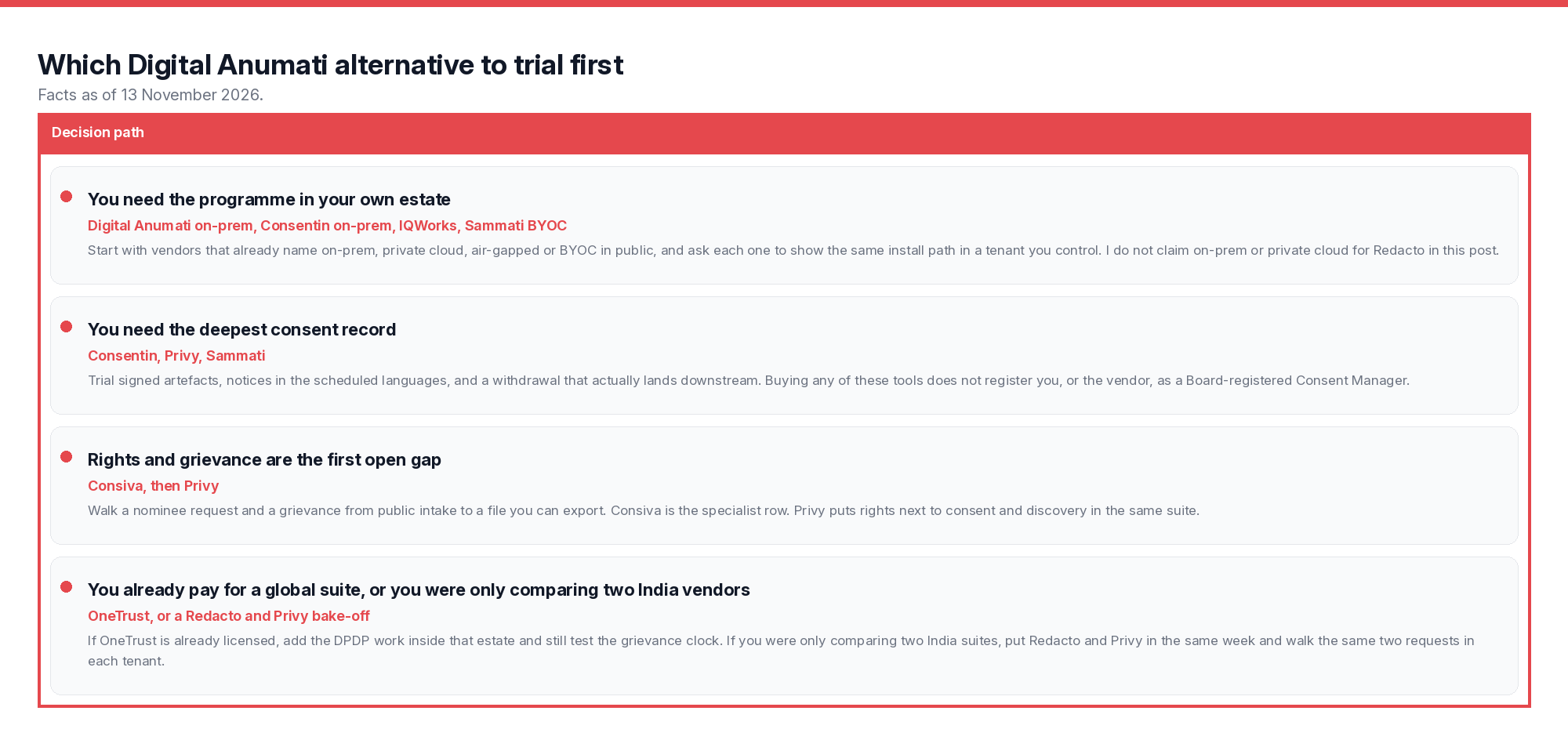
Start with the vendors that already name that estate in public: Digital Anumati's quoted on-prem, private cloud and air-gapped licences, Consentin's on-prem track, IQWorks' homepage on-prem claim, and Sammati's BYOC or managed choice. Ask each one to show the same install path in a tenant you control, and to put the support clock in writing. I do not claim on-prem or private cloud for Redacto, so I would not treat it as a like-for-like on-prem move until you have seen the install path in writing.
I need the deepest consent record
Put Consentin, Privy and Sammati in the same week. Collect a consent, export the artefact or the ledger entry, withdraw it, and watch whether downstream systems actually stop. Notices in the scheduled languages should be part of that week, not a later add-on. Buying any of these tools does not register you, or the vendor, as a Board-registered Consent Manager under Rule 4, which is in force from 13 November 2026.
Rights are the first gap
Start with Consiva, then put Privy beside it. Walk a nominee request and a grievance from public intake to a file you can export. If you also need the rest of a suite, keep Digital Anumati and Privy in that bake-off, and compare the rights rows on each public plan, including the fact that Digital Anumati's self-serve request portal starts at Growth.
I already have a global suite
If OneTrust is already licensed, add the DPDP work inside that estate and still test the grievance clock. If the open question is whether to stay on OneTrust at all, settle that before adding a second suite. I would not buy OneTrust only for this job on the strength of a neighbouring G2 profile.
I was only comparing two India vendors
Put Redacto and Privy in the same week, and walk the same two requests in each tenant. Keep Digital Anumati in that bake-off if a public SaaS fee or a quoted on-prem card is still in play. Add Consentin or Sammati if artefacts, languages or BYOC are the reason you paused. I have left OneConsent out of that week.
Final thoughts
Start with the job. If the programme has to run in your own estate, trial the vendors that already name on-prem, air-gapped or BYOC in public, and watch the install, not the slide. If the consent record is the open job, walk a withdrawal to a downstream stop. If rights and grievance are the gap, start with Consiva and still compare the rights rows on any suite you keep. If you already pay for a global platform, add the DPDP work there and test the clock. I would not treat a landing-page count, a mock dashboard, or a missing review corpus as proof of any of those jobs.