7 Best IQWorks Alternatives for DPDP Privacy Teams (2026)
Seven alternatives to IQWorks for Indian DPDP programmes, compared on discovery, consent, Data Principal rights, evidence and price, with dated reviews.

When a team starts shopping for an India-built privacy programme, the shortlists that come back are often written by the same vendor that is being sold. I hear this from DPOs who have sat through a demo: they can name the modules, and they still cannot tell whether one record will hold a consent, a rights request and a grievance without a second tool. I wrote this for that gap.
Rule 4 of the DPDP Rules, 2025 is in force from 13 November 2026, so Consent Manager registration is open now, while notice and the grievance system apply from about 13 May 2027. If you are comparing platforms for those jobs, you need a shortlist that is not the sales library, with a public price or an honest quote, and with reviews dated inside a year, or a plain statement that none exist. I'll compare seven alternatives on discovery, consent, rights and grievance, India fit and price.
TL;DR
- For an India-built programme record that can hold consent, rights and assessments together, start with Redacto, and keep Privy by IDfy and Consentin (by Leegality) on the same shortlist.
- If you already run a global suite, stay inside OneTrust or Securiti long enough to test DPDP notice, withdrawal reach and a grievance clock, before you add a second platform.
- For request automation tied to a discovery graph, Securiti is the first call; Transcend is the first call when engineering wants consent and requests enforced across systems.
- If discovery is the first job and privacy operations come second, put DiscoverIQ, Securiti's People Data Graph and Consentin Lens on the demo list, and do not treat a scanner alone as a programme record.
- Stay with IQWorks if the modules on the quote already cover consent, requests and discovery, the export path is clear, and you can live without a public price or an independent review corpus. Look elsewhere if you need a published plan, a dated review base, or a specialist rights queue such as Consiva.
Why teams look past IQWorks
IQWorks (iqworks.ai, Mumbai) is the product people type into "iqworks.ai alternatives" and "iqworks alternatives". It sells a modular platform. The three modules a DPDP privacy team usually has on the table are ConsentIQ for consent and preferences, ComplyIQ for requests, assessments and notices, and DiscoverIQ for discovery and classification.

The reasons I hear for a second shortlist are not review-site complaints, because there is almost no independent corpus to quote.
There is no public price. https://iqworks.ai/pricing returned HTTP 404 on 13 November 2026. The FAQ describes per-module pricing and compares that model with other vendors, still without a number you can take to finance. A quote can be fair. A team that has to put a line in a budget this quarter often looks for a published plan as well.
Consent, requests and discovery are sold as separate products. That is visible on the three product URLs above, and IQWorks' own DPDP platforms article tells you to split ComplyIQ, ConsentIQ and DiscoverIQ on a proposal so you do not compare one vendor's suite with another vendor's single module. I would follow that advice in the other direction too: if a rival quote is one record for consent and rights, ask IQWorks to price the same scope, not only the module that won the demo.
There is no independent review base I would use. On G2, IQWorks is listed at 0 out of 5 from 0 reviews, and has not been reviewed yet (13 November 2026). The writing-day Capterra URL returned HTTP 404. There is no Gartner Peer Insights or PeerSpot corpus for this product I would use, and the Reddit threads that mention "IQ Works" or "iQ Works" are about Mitsubishi PLC software, not iqworks.ai. In-house star ratings on product URLs carry no reviewer names or dates; I am not treating those as a review corpus. The compare library is useful for IQWorks' own module names, and it is still a sales asset.
IQWorks also displays enterprise marks on iqworks.ai, including Universal Sompo, Ageas Life, Borosil, Croma, IndusInd, Auxilo and Bandhan Bank. Those marks are a start on references, not a substitute for a dated, independent review.
A smaller diligence point: the same FAQ answers the grievance clock correctly under Rule 14(3), and elsewhere still says DPDP response timelines "will be defined in the rules". MeitY notified those Rules on 13 November 2025. In a demo, ask which clock the request queue actually runs.
Comparison table
| Tool | Best for | Discovery | Consent / notices | Data Principal rights and grievance | DPDP / India fit | Public price |
|---|---|---|---|---|---|---|
| Redacto | Indian teams that want consent, rights and assessments on one programme | Prefill from connected discovery into assessments | Confirm consent on the same record in a trial | The linked module is PIA, ROPA and breach on one governance record; ask to see rights and grievance in the same programme | India-built | Quote-based |
| Privy by IDfy | Indian enterprises that want a named full-stack DPDP platform | Named suite pillar for personal data discovery | Consent Governance Platform | Data Principal Rights Management (DPRM) | India-built; winner of MeitY's DPDP Innovation Challenge | Quote-based |
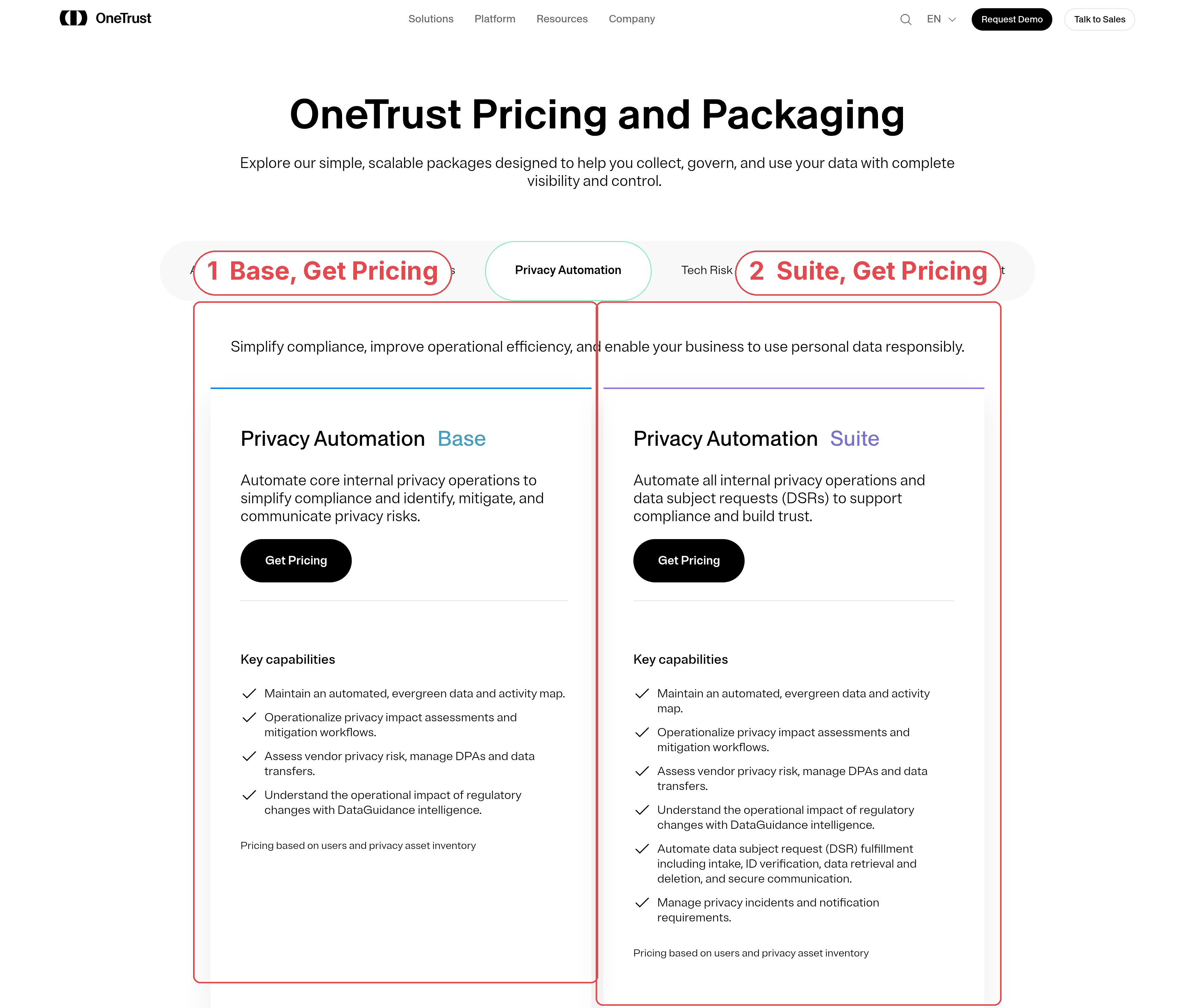
| OneTrust | Organisations that already run, or must run, a global privacy suite | Evergreen data and activity map | Consent packages metered on average daily visitors | DSR fulfilment in Privacy Automation Suite | Global suite; map features into DPDP language | Quote-based |
| Securiti | Teams that want request automation tied to a discovery graph | People Data Graph across structured and unstructured systems | Ask for the consent module in the same buy | DSR automation, identity checks, encrypted response | Global platform, sold by Veeam | Quote-based |
| Consentin (by Leegality) | Indian enterprises that want signed artefacts, notices and rights in one suite | Consentin Lens | Signed artefacts; notices in 22 scheduled languages | Privacy Rights Centre | India-built, by Leegality | Starter Pack of 3,000 consent collects a month at ₹0, forever; paid packs billed as a flat fee |
| Transcend | Engineering-led teams that want purposes and requests enforced across systems | Classification that can feed inventory and requests | Airgap holds trackers until consent | Request infrastructure; confirm DPDP clocks in a demo | US or EU-led; current consent materials do not state a DPDP position | Official pricing URL goes to a contact form; G2 lists a Basic figure of $10,000 per user per year |
| Consiva | Teams that want an India-native rights and grievance specialist, with a published plan | Not the first job on the rights product | Consent banners and records on the public plans | Unmetered rights on every plan, including Free, covering ss.11 to 14 and s.6(4) | India-native | Basic ₹0 (struck-through ₹2,499, limited-time, no time limit on the card); Pro ₹5,999 a month plus taxes |
Feature and price cells are vendor claims or G2 figures dated 13 November 2026. Quote-based means no self-serve price on the vendor's own site.

How we chose these alternatives
Each row had to overlap the jobs IQWorks actually sells: discovery, consent and notices, Data Principal rights, and evidence you can hand over. A scanner with no consent record and no rights clock was not enough. I also required a stated DPDP position or an India-built programme, and either a published tariff or an honest "quote-based". Reviews had to carry a date inside the last year, or I state plainly that none exist.
That is a different test from a generic privacy-suite grid, and from IQWorks' own compare pages. It is closer to the way I would shortlist a data privacy management platform or a set of DPDP compliance tools. For the consent half of the record, I still use the questions in how to choose between types of consent management solutions: can you prove the notice, and does a withdrawal actually travel?
I left BigID out as a lead entry because a DSPM shortlist is a different search. Ethyca (Fides) is in an FAQ for engineering teams that want privacy-as-code, and is not a lead row here. Cookie-only tools are out of scope. OneConsent is not on the main list.
The 7 best IQWorks alternatives for DPDP privacy teams
1. Redacto
Full disclosure: we build Redacto, so I won't score it beside the others.
Three customers, in their own words:
Surya N, Director, Product Management, TimePay: "As a product team, we had one worry: would privacy compliance hurt the onboarding journey? It didn't. Redacto's consent flows fit into our app with very little engineering effort, and we change notices from the console instead of shipping a new build. Our users get a clear choice at every step, and we get a consent record we can stand behind."
Prem Kumar, Data Protection Officer, Pine Labs Group: "Privacy across a group of businesses is hard because every team has its own systems and its own idea of what personal data it holds. Redacto gave us one view of where personal data is collected, why we collect it and where it goes. When a customer request or an audit question comes in, I answer it with evidence, not a round of emails."
Saif, Head, Infosec Compliance & Privacy, Razorpay: "Our vendor security and privacy reviews used to live in spreadsheets and long email threads. With Redacto, every assessment, every piece of evidence and every follow-up sits in one place. When a customer sends us a security questionnaire, we answer it from that same record. We focus on the vendors that actually carry risk, and the paperwork no longer runs the week."
These are our customers speaking, so weigh them that way and ask for a reference call.
By our own count we've done 40+ successful implementations.
Features
Redacto Privacy Governance is the assessments, ROPA and breach module. Privacy Impact Assessment, ROPA and Breach Management share one governance record. An assessment can start prefilled from the record of processing and from connected discovery. A breach record can carry a notification clock against the obligation.

The customer quotes above are about consent flows, a view of where personal data is collected, and assessments on one record. I would still ask, in a trial, to see a consent, a rights request and a grievance sitting with that governance record, because the public Privacy Governance URL does not itself list consent or Data Principal rights as modules. Do not take the shared-record idea on the assessments side as proof that every module is sold separately and still writes to the same person.
I would also ask to see nomination, and the exact grievance period you will publish under Rule 14(3), in a demo before you count on them.
Pricing
Quote-based.
Price follows volume, and each module measures that volume in its own way. The figures I use on a first call are how many Data Principals you serve and how many processors sit on the withdrawal path, because each processor adds API calls when someone withdraws or when a new customer arrives. A simple B2B path that hits two endpoints is a different job from a branch and agent motion. List every channel, call centre and partner app before you ask for a number. I walk through the pricing logic in this LinkedIn post from Redacto:
Reviews
There isn't a public review base yet.
Clients
Those three quotes are the public references for this entry. Ask for a reference call in the motion you are buying, covering consent, rights and assessments if that is the scope, not only a vendor-review motion.
Summary
Pick Redacto if you want an India-built programme where consent, rights and assessments can live together, and you can work with a quote and a reference call. Skip this row if a website banner is all you need, if you require a published tariff and a self-serve start, or if Board registration as a Consent Manager is the work you came to buy. For a banner-only buy, start with the consent management platform shortlist for India instead.
The limits are real. You will not find a public price or a self-serve plan. There is no public review corpus. The Privacy Governance URL I have linked is the assessments, ROPA and breach module; confirm in a trial that the consent and rights work you need sits on the same programme record.
Against IQWorks: you are buying a programme record and a referenceable India-built delivery story, and you are giving up a public compare library and any expectation of a self-serve price, on both sides.
2. Privy by IDfy
Privy by IDfy is an India-built DPDP suite, not the US email-popup product of the same first name. Consent, rights and discovery sit together: DPRM for Data Principal rights, a Consent Governance Platform, a Personal Data Discovery and Governance pillar, and a cookie manager. Privy also names DPIA and third-party risk as part of the broader platform.

Features
The public pitch is a full-stack DPDP programme: multilingual, audit-ready consent, a rights portal, discovery, and assessments. Privy states that it is a winner of MeitY's DPDP Innovation Challenge. I would still take a named module map into a demo and ask to see a withdrawal travel into a core system, and a grievance close against a published period, on a record you can export.
Do not confuse this product with IDfy's KYC tools. They share a parent, and they are not the same corpus or the same buy.
Pricing
Quote-based. There is no public self-serve plan. If you already buy identity services from IDfy, ask whether consent and rights can be priced into that relationship, and how volume is counted across group companies.
Reviews
There isn't a Privy-specific G2 corpus. I am not reusing IDfy KYC reviews for this product.
Clients
Named comments appear under CP Plus, TATA Capital, TATA AIG, Shriram Finance, Axis Bank and TrustPaisa, among other firms. Those are useful as named references, and they are still vendor-hosted quotes, so ask for a call in the motion you are buying.
For a closer product read, use our Privy review and the Redacto vs Privy comparison. If Privy is the incumbent, my Privy by IDfy alternatives shortlist weighs eight replacements.
Summary
Choose Privy when you want an India-built suite with a public MeitY challenge win and named enterprise references, and you can wait for a quote. It is a weaker match if a published price is mandatory, or if you only want a cookie banner.
Against IQWorks: Privy leads with a named DPDP suite and India references you can actually read; IQWorks leads with a wider module catalogue, including discovery depth, and still leaves you without a public price or an independent review base, as Privy does.
3. OneTrust
OneTrust is the global privacy suite a lot of groups already pay for. If that is you, the first alternative to a new IQWorks roll-out is often a module you have not switched on. I weigh OneTrust only where it overlaps with IQWorks, and I treat leaving OneTrust altogether as a separate decision.
Features
On OneTrust pricing, Consent & Preferences packages are metered on average daily visitors across channels and properties, or, for Universal Consent & Preference Management, on total data-subject profiles. Privacy Automation Base covers the data and activity map, privacy impact assessments, vendor privacy risk and regulatory intelligence. Privacy Automation Suite adds data subject request fulfilment (intake, identity verification, data retrieval and deletion, and secure communication) and privacy incidents. Translate those labels into DPDP work before you sign: notice and withdrawal, sections 11 to 14, and a grievance period you can publish under Rule 14(3). A GDPR template is not that test.
Pricing
Quote-based. Each package has a "Get Pricing" button. There is no self-serve number. Privacy Automation is metered on users and privacy asset inventory. Consent packages are metered on visitors or profiles, which can move against you in an app-heavy or festival-season business. Ask what happens in a month when traffic doubles.
Reviews
On the OneTrust Privacy Automation profile the score is 4.3/5, based on 155 reviews, dated 13 November 2026. That is the Privacy Automation module, not a score for the whole OneTrust platform.
Users on G2 like the knowledge base and support, and the ability to manage RoPAs and DPIAs, and complain about bulk uploads from an existing template, a hard first climb, and a high price (G2, June 2026). A verified mid-market user in hospital and health care, 8 June 2026, wrote that the product is "Completely customisable to your needs" and that you can "Easily manage RoPAs, DPIAs", and disliked that "The bulk uploading of information if your using an existing template can be tricky". Erick Vincent Steve G., 8 January 2026, disliked "the high price and the steep learning curve" and the time it took to configure the product.
My take: the score is solid for a suite module, and the complaints are about cost, setup time and messy migration, which is what you should budget for.
Clients
OneTrust states, in its pricing, that 14,000+ customers rely on the company. I am not adding named accounts beyond that figure.
Summary
Pick OneTrust if you already run it, or if a group standard says you must, and you can prove DPDP notice, withdrawal and grievance inside the tenant you will pay for. It is a weaker match if you are India-only, want an India-built process, and have no appetite for a multi-module quote.
Against IQWorks: you keep a global suite with a large, dated G2 corpus, and you still have to translate every feature into DPDP language; IQWorks names the DPDP Act in public materials and still leaves you without that public review base.
4. Securiti
Securiti, now sold by Veeam, is the option I would open when the job is request fulfilment tied to a discovery graph. I judge Securiti only on its overlap with IQWorks; replacing the whole Securiti platform is a bigger call.
Features
The DSR Automation product collects requests, verifies identity, fulfils the request, shares an encrypted response, and keeps records in one place. It uses a People Data Graph to find a person's data across structured and unstructured systems, and a DSR Workbench for status, reports and an audit log. Staff can work on a request without sending personal data over email. Connectors are described as pre-built across hybrid multicloud and SaaS; ask which of your systems are in that set, and what happens when one is not.
Consent is not the centre of this URL. If consent and notices are in scope, ask for that module on the same buy, and do not assume the DSR product is the whole programme.
Pricing
Quote-based. The DSR Automation URL has no public self-serve price, and neither does Securiti pricing. Ask what Veeam ownership means for product plans, support and contract terms.
Reviews
On the Securiti profile, which is platform-wide and lists Veeam as the seller, the score is 4.6/5, based on 116 reviews, dated 13 November 2026.
Users on G2 like automated discovery and classification, and they complain about a heavy first setup and about price for smaller teams (G2, September 2026). Joaquin G., 10 September 2026, wrote that the best thing is "its comprehensive DSPM functionality" and that it "automates data discovery, classification, and risk management", and disliked that "the platform can feel complex to configure and fully optimize at the start". A verified mid-market user, 14 August 2026, liked automated discovery of shadow data and PII, and disliked "the initial setup and rule configuration" and felt "the platform pricing can be high for smaller deployments".
My take: the score is strong, and it is a platform score. Budget time and money for setup, and ask for a rights-and-consent path in the tenant you will actually own, not only a discovery demo.
Clients
Securiti sells to large global enterprises and doesn't name its accounts publicly. Ask for a reference in your industry, using the same module set.
Summary
Pick Securiti if request fulfilment has to follow a discovery graph, and you can absorb an enterprise quote and a serious setup. It is a weaker fit if you want a standalone consent product, a published plan, or a small roll-out.
Against IQWorks: Securiti gives you a large, recent G2 corpus and a People Data Graph that reviewers actually talk about; IQWorks gives you an India-flavoured module map and still no public reviews to put next to it.
5. Consentin (by Leegality)
Consentin is Leegality's DPDP product, not a Board-registered Consent Manager. Against IQWorks, I judge only Leegality's DPDP suite, and I weigh the wider company in Leegality alternatives.
Features
The DPDP solutions URL describes eight modules, including consent with a signed, timestamped artefact, notices in all 22 scheduled languages, a Privacy Centre for withdrawal, a Privacy Rights Centre for access, correction and erasure, assessments, Consentin Lens for discovery, and a breach-notification path. Deployment is described as SaaS and on-premise. I would test the artefact, a Tamil or Hindi notice in the actual flow, and a withdrawal that reaches a downstream system, before I counted the suite as done.
Consentin states it is DPDP compliance software for Data Fiduciaries, and that it is not a registered Consent Manager, with registration open under Rule 4 from 13 November 2026. That distinction is the right one. Keep it in the contract language so nobody confuses a Fiduciary-side platform with a Board-registered intermediary.
Pricing
Under Consentin pricing, a Starter Pack covers 3,000 DPDP-compliant consent collections a month at ₹0, forever, and can also run as a live pilot if your volume is higher. Paid use is charged as one annual or quarterly flat fee covering a pack of consent collects and consent checks, with top-ups after the pack is used, and no separate storage charge. Data discovery is described as an on-premise matter in that pricing, so ask how Consentin Lens is priced if discovery is in scope. The published ₹0 pack is a consent-collect meter, not a rights-request meter. Ask what a rights-only or full-suite contract actually costs.
Reviews
Consentin has no independent review corpus I would use. I am not borrowing Leegality eSign reviews for this product.
Clients
Consentin publishes vendor figures, including 50+ DPDP projects in progress and 100+ banks served by Leegality. Those are scale claims from the vendor, not named case studies. Ask for a reference in your sector.
Summary
Pick Consentin if you want an India-built suite with signed artefacts, 22-language notices and a published way to start at ₹0 on consent volume. It is a weaker match if you need an independent review corpus, or if discovery has to be cloud-side and public pricing still points you on-premise.
Against IQWorks: Consentin gives you a public starter pack and a clearly stated DPDP module map, including language and artefacts; IQWorks gives you a broader cyber-and-discovery catalogue and still no number you can take to finance.
6. Transcend
Transcend is for engineering-led teams that want a consent choice enforced in the stack, not only stored in a banner. Current consent materials do not state a DPDP position, so I am not inventing one.
Features
Airgap is described as a script that holds tracking events locally until consent is given, then blocks or releases them at the network level. If an anonymous choice and a logged-in record disagree, you pick the rule before the conflict: the newest choice wins, the strictest choice wins, or the account record always controls. Sombra is a self-hosted component that holds your API credentials inside your infrastructure. Custom connectors are available. In a demo I would still ask how a DPDP notice, a withdrawal and a grievance period are set up, because those words are missing from the public consent materials.
Pricing
Quote-based on Transcend's own site: https://transcend.io/pricing redirected to a contact form on 13 November 2026. On the G2 profile, Transcend lists Basic at $10,000 per user annually (seen 13 November 2026). Treat that as a vendor-listed starting figure until a quote confirms it, not as a self-serve checkout.
Reviews
On the Transcend profile, which is platform-wide, users rate the product 4.6 out of 5 from 112 reviews (13 November 2026). Its most recent reviews are older than 12 months, so weigh them with that in mind.
Users on G2 have liked the ease of handling preferences and request fulfilment, and have complained about price and about the time it took to connect existing tools (G2, February and April 2025, older than 12 months). A mid-market reviewer, 19 February 2025, wrote that "The price is quite high, which will put this solution out of the range of possibilities for a lot of smaller companies." Another mid-market reviewer, 20 February 2025, disliked that "Integration with some existing tech tools have taken longer/more difficult than anticipated." I am not treating those comments as current, only as the last dated words I could read.
My take: the headline score is high, and the review file is stale. Rely on a current demo and a current quote, not on a 2025 thread, until newer reviews appear.
Clients
Transcend publishes quotes from Gary Cohen, CEO, and Jesse Zhang, Director of Engineering. I am not adding company names those quotes do not include. Ask Transcend for a reference in a similar stack.
Summary
Pick Transcend if engineering wants consent and requests enforced across systems, and you can accept a US or EU-led product whose current consent materials are silent on DPDP. It is a weaker match if you need a stated India position, a published self-serve plan, or reviews written in the last year.
Against IQWorks: Transcend is stronger on enforcement in the stack, with a large (if ageing) G2 file; IQWorks is stronger on naming DPDP in public materials, and weaker on any independent review file at all.
7. Consiva
Consiva is an India-native rights and grievance product with a public plan. If the reason you looked at IQWorks was the request queue, put this row on the shortlist even if you keep a different tool for consent or discovery.
Features
The rights URL lists intake, identity verification, routing, fulfilment and a case file for every right the DPDP Act actually grants: access (s.11), correction and erasure (s.12), grievance (s.13), nomination (s.14), and withdrawal (s.6(4)). Rights volume is unmetered on every plan, including Free. The product tracks a service period you choose for access, correction, erasure and nomination, and a published grievance period for section 13, capped at ninety days by Rule 14(3). That split is the legally accurate one. The Act does not create a data portability right, and Consiva says so plainly.

Consent banners and records are part of the public plans in Consiva pricing. Discovery, ROPA auto-generation and parental consent sit on higher plans. I would not treat Consiva as a like-for-like discovery suite.
Pricing
Consiva pricing was still live on 13 November 2026. Basic is ₹0, with a struck-through ₹2,499, a Limited Time Offer badge, and the line "No Time Limit." The card includes a DPDP banner in English and Hindi, basic cookie scanning, and manual rights-request handling, and it caps cookie consents at 1,000 a month and form consents at 50 a month, on one website. Rights requests remain unlimited, including on this plan. Pro costs ₹5,999 monthly plus taxes, and adds automated DSR handling, 20+ Eighth Schedule languages, and higher consent caps. Enterprise is custom. Re-check the limited-time badge on the day you buy; the ₹0 figure is not something I can promise will still be there next quarter.
Reviews
Consiva has no independent review corpus I would use.
Clients
The rights URL uses a sample scenario and says it is not based on a named customer. I am not inventing accounts. Ask Consiva for a reference if the rights queue is the motion you are buying.
Summary
Pick Consiva if rights and grievance are the gap, you want the legal list stated correctly, and a published plan matters, including a ₹0 start for manual handling. It is a weaker fit if discovery or a full consent suite is the first job, or if you need a dated independent review corpus.
Against IQWorks: Consiva publishes a rights plan and the statutory list, including nomination and the two clocks; IQWorks will still make you wait for a quote, and its public FAQ is not as careful on which DPDP requests have a deadline.
How to choose, by situation

You want one record for consent and rights in India
Start with Redacto, Privy by IDfy or Consentin. Pick this path if you want a DPDP-shaped record and can live with a quote, or with Consentin's published consent packs. In the trial, raise a consent, a withdrawal, an access request and a grievance for the same person, and see whether you get one file or three exports.
Discovery is the gap, privacy ops come second
Put Securiti's People Data Graph, IQWorks DiscoverIQ and Consentin Lens on the same demo script. Pick a discovery-led tool only if the scan can hand a record to notice, rights and grievance work, not if it stops at a findings table. If discovery is all you need this year, say so in the RFP, and do not pay suite prices for a scanner.
You already pay for OneTrust or Securiti
Stay inside that tenant long enough to test DPDP notice, withdrawal reach and a grievance clock. If the module you already own can close those jobs, adding IQWorks, or adding us, is a second programme to run. If it cannot, then a switch or a specialist rights layer has a case. Settle whether to keep the global suite at all before you score any row against IQWorks.
You want a published plan for rights and grievance
Consiva is the row with a live public plan, including unmetered rights on a ₹0 Basic card (still a limited-time offer on 13 November 2026) and a Pro price of ₹5,999 monthly plus taxes. Redacto remains quote-based. Pick Consiva if a published rights price is the constraint; pick Redacto if rights have to sit with consent and assessments on one programme and you can wait for a quote.
A system has no API
Ask every vendor to show a tracked path when a system has no API: who owns the task, what evidence closes it, and whether the clock keeps running. I am not claiming a specific fallback on any product I compare, including ours, until you have seen it in a trial. If the queue stops at the last connector, branch offices, paper files and older cores stay untouched.
Final thoughts
IQWorks is a real option for a team that wants discovery, consent and requests in one vendor conversation, and that can live with a per-module quote and no public review file. It should not be the only shortlist you read, especially when the results for "iqworks.ai alternatives" are often the vendor's own compare library.
If you want an India-built programme record, start with Redacto, and keep Privy and Consentin in the same trial. If OneTrust or Securiti is already on the books, test DPDP inside that tenant first. If rights and grievance are the gap and you want a published plan, open Consiva. If engineering wants enforcement in the stack, open Transcend, and still make them show you a DPDP clock.
Re-open every official URL on the day you sign. Rule 4 is already in force. Notice and the grievance system apply from about 13 May 2027, unless MeitY amends the calendar.