8 AI Tools for Vendor Security Assessments (Judged on What the AI Actually Does)
Eight AI vendor risk assessment tools, compared on what the AI reads, drafts and scores, with prices, user complaints and a checklist to reuse.

Most vendor reviews I've seen stall in the same place. The business team wants the tool live this week, security has a queue of 200-question spreadsheets and half-read SOC 2 reports, and now nearly every new vendor has an AI feature that adds another page of questions about models and training data.
That queue is where the risk sits. Verizon's 2026 Data Breach Investigations Report found that third-party supply chain breaches jumped 60% in a year and now make up 48% of all breaches.

If you're looking for AI that can take on vendor security assessments, you need two answers: which tools actually do the reading and drafting, and how far you can trust what they hand back. Below I'll show you what the AI in eight tools reads, drafts and scores, what each one costs where the price is public, what users complain about, and where a person still has to sign. You'll also get a checklist to run on your next vendor, including a vendor that is itself an AI company.
Full disclosure: we build Redacto, so it's listed first but not scored.
TL;DR
An AI vendor risk assessment tool should read the vendor's evidence, draft or check answers against it, and show you the source. None of them should make the risk decision for you. The eight below split into two camps: tools that help you answer the questionnaires your customers send, and tools that help you review the vendors you buy from. A few do both.
- Redacto: Best for Indian companies that want every drafted answer tied to the vendor's own evidence, with questionnaires mapped to what RBI, SEBI and IRDAI reviews ask about.
- Vanta: Best for SaaS teams that already run compliance in Vanta.
- SecurityPal: Best when you'd rather hand questionnaires to AI plus human analysts than run a tool yourself.
- UpGuard: Best for a published list price and a free way to answer questionnaires.
- OneTrust: Best for enterprises that already run privacy or GRC on OneTrust.
- Panorays: Best for checking a vendor's answers against its external attack surface.
- Black Kite: Best for large portfolios that want outside-in cyber intelligence before any questionnaire goes out.
- ProcessUnity (now including CyberGRX): Best for mature TPRM programmes that want task-specific AI agents and a shared risk exchange.
The 8 AI vendor risk assessment tools compared
AI risk assessment tools for vendor reviews, compared on what the AI actually does:
| Tool | Category | Questionnaire automation: what the AI drafts | What the AI reads or scores | Skip it if | Price (Nov 2026) |
|---|---|---|---|---|---|
| 1. Redacto | TPRM suite + trust center | Drafts each answer from the vendor's evidence, with the source attached | SOC 2 reports, DPAs, contracts; re-rates when they change | You want outside-in cyber ratings | Quote-based |
| 2. Vanta | TPRM inside a compliance platform | Answers customer questionnaires from your knowledge base (add-on) | Vendors' SOC 2 reports, DPAs, trust centers | You don't run compliance in Vanta | Quote-based |
| 3. SecurityPal | Questionnaire automation (managed) | AI drafts, human analysts verify | Vendor documents for its vendor reports | You want to run the tool yourself | Quote-based |
| 4. UpGuard | Outside-in ratings + free questionnaire AI | Free Trust Exchange drafts answers you verify | Vendor documents against controls; external scans | Privacy and contract review is your main need | From $1,750/month |
| 5. OneTrust | TPRM suite | Templates that skip irrelevant questions; Copilot risk agent | Assessments across 50+ built-in control sets | You don't already use OneTrust | Quote-based |
| 6. Panorays | Outside-in ratings | Suggests answers to vendors from previous responses | Vendor answers against external documents and posture | Your risk is mostly in data processing terms | Quote-based; free account |
| 7. Black Kite | Outside-in ratings | Asks vendors only about gaps its parsing finds | SOC 2 reports, policies, outside-in data | You have a small vendor list | Not published |
| 8. ProcessUnity | TPRM suite + risk exchange | Assessment Autofill drafts vendors' answers | SOC 2 reports, contracts, insurance certificates | You need results this quarter | Quote-based, tiered by company size |
Across the table, these vendor risk assessment tools fall into four categories of AI vendor risk automation: questionnaire automation, outside-in ratings, TPRM suites and trust centers. A trust center is what you publish so customers stop sending you questionnaires. Every feature cell is the vendor's own claim, linked in its section below.
How we chose
Each tool had to pass four tests:
- The AI does real assessment work. It reads evidence, drafts or checks answers, scores risk or monitors vendors. A chatbot bolted onto a form doesn't count.
- The AI claims are public. Every feature below is something the vendor puts its name to, linked where it appears.
- It's built for vendor security assessments. GRC suites qualified only if they ship AI for third-party review.
- It's sold today as its own product.
I've judged these tools the way I'd judge them for my own team: demos, product documentation, published pricing and what teams running them report, read against how vendor security reviews actually go wrong. Treat the "what I'd test first" lines as your pilot plan. User opinions come from Gartner Peer Insights, and each line links to the reviews behind it.
The numbers are for navigation, not a ranking, and nothing here is a paid placement. For the wider market beyond AI-first tools, start with our list of third-party risk management software in India.
Why these aren't on the list
CyberGRX now sits inside ProcessUnity, so it's covered there. GRC suites with a vendor module but no AI that reads evidence fail the first test. For tools judged on questionnaires and process rather than AI, see our comparison of vendor assessment software.
Why vendor reviews became the bottleneck
Automated vendor risk assessment exists because the manual version doesn't scale. Every vendor gets a questionnaire, every answer needs a document behind it, and every document needs someone to read it.
AI vendors made the queue longer. A vendor that runs your data through a model raises questions an older questionnaire never asked: does it train on your data, which model provider sees it, and how long are prompts kept?
The usual responses make it worse: teams send the same 300-question spreadsheet to a payroll tool and a coffee supplier, or they wave low-risk vendors through without reading anything. We've written up the common vendor risk management challenges separately; the short version is that tiering and evidence clear the queue, and more questions don't.
Can you take the human out entirely? No. You can automate the reading, the drafting, the chasing and the monitoring, and a person still has to accept the risk. Our guide to automating vendor risk management covers which steps to automate first, before you pick any tool.
What AI can and can't do in an AI vendor risk assessment
AI is good at reading and bad at deciding. Build your process around that split and these tools are worth the money. Ignore it and you'll get faster approvals of the same bad vendors.
I've signed off vendor reviews where nothing touching customer data went live without one. The reviews that worried me most were vendors whose answers were all "yes" and whose evidence said something narrower. For the bigger picture, see how AI is changing vendor security reviews.
Where AI earns its keep
The best AI-powered vendor questionnaire automation platforms take on the reading and the admin, and leave the judgement to you:
- Reading evidence. Pulling the audit period, scope and exceptions out of a long SOC 2 Type II report is what AI does well, and what busy analysts skip.
- Drafting answers from what you already have. Past questionnaires and policies are a ready-made knowledge base, and AI tools for vendor security questionnaires are at their best here, because SIG questionnaires ask many of the same things your last ten customers asked.
- Scoring from artefacts. A tool that generates a risk score from questionnaires and documents is only defensible if the score links back to the answer and the document behind it. Ask to click through from the score to the evidence.
- Watching after the contract starts. Breach news, expired certificates and new sub-processors are signals AI can monitor between annual reviews.
Where a human signs off
- The risk decision. Accepting residual risk is a business call with your name on it. The better vendors design for this: ProcessUnity marks its remediation agent human-gated, and UpGuard asks you to verify all your AI-generated suggestions.
- Contract terms. AI can flag that a DPA lacks a breach-notice timeline. It can't negotiate one.
The AI mistake I'd watch for most is an answer that's true of the policy and not of the system. A tool drafts "Yes, customer data is encrypted at rest" from the vendor's security policy, while the SOC 2 report's scope leaves out the database the product actually runs on. It cites a source, and only someone who reads the scope section catches it. Once one side uses AI to write questionnaire answers and the other uses AI to read them, assume nobody is checking the evidence unless you make it someone's job.
Which AI is most reliable for vendor security assessments?
None has an independent accuracy test; the reliable ones show the evidence behind every drafted answer. Every accuracy figure in this article comes from the vendor that sells the tool.
So look at grounding instead. A tool that drafts only from your policies or the vendor's documents, and shows the passage it used, can be checked. A general chatbot answering from its training data can't. In SecurityPal's own comparison, general models used zero-shot scored 55% to 62% on questionnaire answers. That's the vendor's test, and it still shows the gap grounding closes.
Which AI risk assessment tools actually work for reviewing vendors? The ones that cite their sources and flag low-confidence answers, tested on questionnaires you've already answered by hand. My rule of thumb: let AI do the first 80% of the reading, and spend the time it saves on the 20% of vendors that are actually risky.
Assessing an AI vendor itself
There's a second meaning to an AI vendor risk assessment: reviewing a vendor whose product is AI. A standard questionnaire misses most of what matters, so add four questions.
- Training. Does the vendor, or the model provider behind it, train on your data? Get the opt-out into the contract.
- Retention. How long are prompts, outputs and uploaded files kept, and are they deleted when the contract ends?
- Sub-processors. Every model provider that sees your data is a sub-processor. Section 8(2) of the DPDP Act lets you engage a processor only under a valid contract, so the model provider belongs on the list, with the country where it processes.
- Oversight and the EU AI Act. Ask what the AI decides on its own, what a person approves, and whether you can export that log. If the vendor sells into Europe, ask where its product sits in the EU AI Act's risk tiers and what it gives deployers like you to meet your own duties.
Shadow AI makes this urgent. The same Verizon report found frequent employee use of AI tools rose from 15% to 45%, and ranks shadow AI as the third most common non-malicious data-leakage activity. Some of your AI vendors are tools you already pay for that switched on an AI feature last quarter.
1. Redacto
Full disclosure: we build Redacto, so I won't score it beside the others.
We built Redacto Vendor Risk Management for the review where the DPA and the regulator matter as much as the SOC 2. It reads the reports and contracts a vendor already sent, drafts each answer with its source, chases the gaps and keeps the rating current. Pilot it as hard as you'd pilot the others: give us a vendor you reviewed by hand last quarter and check whether every drafted answer points to the right page.
Features
- Drafts from evidence. Each answer is drafted from the vendor's SOC 2 report, DPA or policy and cites the section it came from. A reviewer accepts, edits or rejects it, so the trail shows why.
- Gaps become requests. When there's no evidence for a question, Redacto asks the vendor instead of guessing, and the request stays on the assessment.
- Context before questions. Intake captures business context, data access and hosting up front.
- A rating that moves. Redacto re-rates the vendor when the contract, the data or the evidence changes, instead of waiting for the annual review.
- Regulator language. Questionnaires map to the areas RBI, SEBI and IRDAI reviews ask about.
- Human approval on risk. Anything that carries risk waits until a named reviewer signs off. When Redacto runs in your own cloud, you can use your own AI provider account.
Pricing
Quote-based.
Reviews
Three customers, in their own words:
Surya N, Director, Product Management, TimePay: "As a product team, we had one worry: would privacy compliance hurt the onboarding journey? It didn't. Redacto's consent flows fit into our app with very little engineering effort, and we change notices from the console instead of shipping a new build. Our users get a clear choice at every step, and we get a consent record we can stand behind."
Prem Kumar, Data Protection Officer, Pine Labs Group: "Privacy across a group of businesses is hard because every team has its own systems and its own idea of what personal data it holds. Redacto gave us one view of where personal data is collected, why we collect it and where it goes. When a customer request or an audit question comes in, I answer it with evidence, not a round of emails."
Saif, Head, Infosec Compliance & Privacy, Razorpay: "Our vendor security and privacy reviews used to live in spreadsheets and long email threads. With Redacto, every assessment, every piece of evidence and every follow-up sits in one place. When a customer sends us a security questionnaire, we answer it from that same record. We focus on the vendors that actually carry risk, and the paperwork no longer runs the week."
Clients
By our own count we've done "40+ successful implementations". For a vendor-risk reference in your sector, ask us in the demo.
Summary
Pick Redacto if you're an Indian company that wants every AI-drafted answer tied to the vendor's evidence and questionnaires in your regulator's language. The limitation I'd flag to any prospect: drafts are only as good as the evidence the vendor sends, so a vendor that sends a two-page policy instead of a SOC 2 report gets a short draft and a long list of requests. We also have fewer years of references than the global suites, and for outside-in cyber ratings UpGuard, Panorays or Black Kite fit better.
2. Vanta
Vanta makes sense if you already run compliance in it. Bought only for vendor reviews, you're paying for a whole compliance platform. Vanta has also acquired Riskey for third-party monitoring, so expect this part of the product to change quickly.
What I'd test first: give the agent three SOC 2 reports with known exceptions and see whether it surfaces the exceptions and the complementary user entity controls, not just the auditor's opinion.
Features
- The agent pulls SLAs, DPAs and custom security terms out of vendors' SOC 2 reports, and fetches documents from vendors' trust centers instead of waiting for email attachments.
- It discovers newly adopted vendors, including shadow IT and AI.
- It applies your own risk tiers and scoring, monitors vendors for breaches and material changes, and drafts remediation plans.
- Vanta claims the agent can cut risk assessment time by 50% and make vendor evidence collection 62% faster. Both are its own figures.
On the answering side, Vanta's questionnaire automation answers an average of 80% or more of questions and puts AI answer acceptance at up to 95%, depending on your knowledge base. Treat both as vendor-reported.
Pricing
Quote-based. Vanta's plans run Essentials, Plus, Professional and Enterprise with no published numbers, and AI-powered security reviews are an add-on. Questionnaire automation comes with 25 questionnaires a year on Plus and 144 on Professional, so count last year's inbound questionnaires before you pick a tier.
Reviews
Users on Gartner Peer Insights like the automated evidence collection and the integrations (Gartner, Sep 2026) and complain about a slow interface and slow test runs (Gartner, Oct 2026). Neither is about the TPRM agent, so ask for a reference who uses it.
Clients
Vanta shows Ramp and Duolingo among its customers.
Summary
Pick Vanta if you already run SOC 2 or ISO 27001 compliance in it and want vendor reviews in the same place. If you don't, the platform cost lands well before the TPRM value does.
3. SecurityPal
SecurityPal is a managed service, not a tool you run. AI drafts and analysts check the work, so you pay for finished questionnaires and vendor reports rather than software seats.
What I'd test first: send a questionnaire you've already answered and compare their version and turnaround against your final one. Ask how they handled questions your policies don't cover.
Features
- AI drafts questionnaire responses and experts verify them before they go back to your customer, with same-day turnaround, or 12 hours on its Concierge Prime tier.
- On the buying side, Vendor Assess promises audit-ready vendor reports within 12 hours.
- A trust center that SecurityPal claims deflects about 60% of inbound questionnaires.
SecurityPal puts its supervised system at 99% accuracy, against 55% to 62% for general models used zero-shot, from its own 2025 evaluation of more than 50,000 questionnaire data points. It's a vendor test, so read it as a claim.
Pricing
Quote-based. SecurityPal compares cost with dollar signs rather than numbers, so you'll only learn the figure on a call.
Reviews
SecurityPal has no reviews on G2 yet; its published case studies are on the answering side, so ask for a reference who uses Vendor Assess and treat that call as the review.
Clients
Its case studies feature Iterable and Tavus.
Summary
Pick SecurityPal if your bottleneck is answering customer questionnaires and you lack the headcount to run a tool. It's the wrong fit if you want to own the process, or if reviewing your own vendors is the main job.
4. UpGuard
UpGuard is the easiest of the eight to budget for and the quickest to try, because the answering side is free and the paid plan has a list price. Where it's thinner is privacy and contract review.
What I'd test first: run the AI control assessment on a vendor whose documents you know well, and count the controls it marks as met that you'd have challenged. Then report on twenty vendors at once.
Features
- UpGuard Vendor Risk uses AI document analysis to find control gaps and produces risk assessments "in under a minute", with "90% less manual work" on questionnaires. Both are its own figures.
- Security ratings update multiple times a day from daily scanning.
- Trust Exchange is free: AI questionnaire automation plus your own trust center, and you verify every AI suggestion before it goes out.
Pricing
UpGuard is the only vendor here with a list price. Vendor Risk Standard is $1,750 a month, billed annually, for 50 vendors, with more at $79 a month each. Professional and above are "Contact us". At 200 vendors, the add-on decides whether you move up a tier.
Reviews
Users on Gartner Peer Insights like how easy it makes vendor assessments and complain about an involved initial setup (Gartner, Mar 2026). An older critical review flags missing bulk vendor reporting (Gartner, Apr 2023), which is why it's in the pilot test above. Budget time to tune vendor lists and alerts before you judge the ratings.
Clients
UpGuard counts itself "trusted by 45,000+ companies". That number may include free Trust Exchange users, so don't read it as paying TPRM customers.
Summary
Pick UpGuard if you want a known price before the first sales call and strong external monitoring. If your vendors handle personal data, pair it with a DPA review step.
5. OneTrust
OneTrust is the right call when your privacy programme already runs on it, and an expensive one when it doesn't.
What I'd test first: ask who keeps the configuration working after each platform update, and how many admin hours a month that takes. Then ask whether the Copilot agent is in your package.
Features
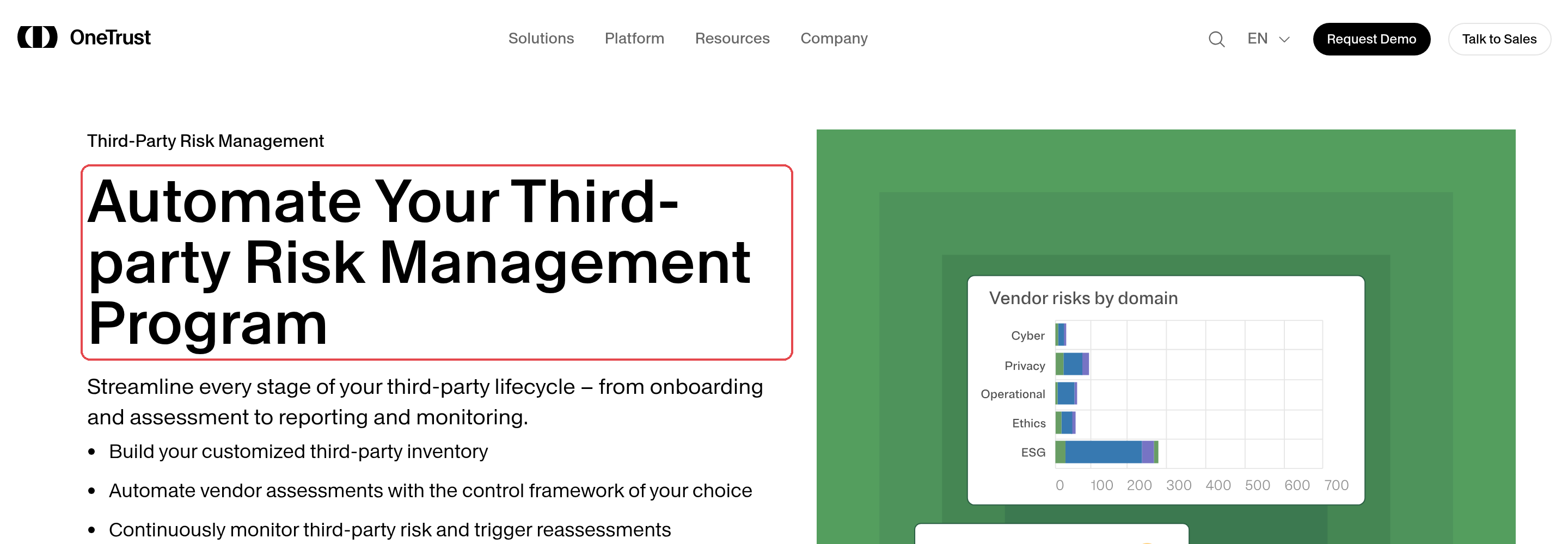
- OneTrust Third-Party Risk Management covers intake, assessment, reporting and monitoring, with templates that only ask relevant questions based on earlier answers.
- More than 50 built-in control sets, or your own.
- Rules start reassessments when a vendor's risk changes.
- A Third-Party Risk Agent in Copilot researches new vendors and launches the first risk assessment. It's generally available, but only with solution packaging, so confirm it's in your contract.
Pricing
Quote-based. Third-party risk is priced on admin users and third-party inventory, so a long tail of low-risk vendors raises the bill even if nobody reviews them. Tier and prune the inventory before you ask for a quote.
Reviews
Users on Gartner Peer Insights like the risk flows vendors fill in and the consistent analysis once they're past the early interface problems (Gartner, Aug 2026), and complain that building a flexible process is hard even with the out-of-the-box templates (Gartner, Jun 2026). Capable, and admin-heavy.
Clients
OneTrust counts 14,000+ customers across all its products, with no TPRM breakdown.
Summary
Pick OneTrust if your privacy team already lives in it and you want vendor reviews tied to your data inventory and DPAs. Configuration is the hidden cost, so confirm what's included before you sign.
6. Panorays
Panorays goes after the oldest problem in vendor reviews: vendors grading their own homework. It checks questionnaire answers against the vendor's external documents and cyber posture, which makes it useful for automated vendor validation and supplier vetting before you sign.
What I'd test first: pick a vendor whose answers you suspect are optimistic and see whether validation flags the mismatch without help.
Features
- Answer validation against external documents and cyber posture, with gaps flagged for a human.
- Built-in SIG and CAIQ questionnaires, custom questions by third-party criticality, and answers suggested to vendors from their previous responses.
- AI that maps third-, fourth- and nth-party relationships, so you can tier vendors and set how often each is assessed.
Pricing
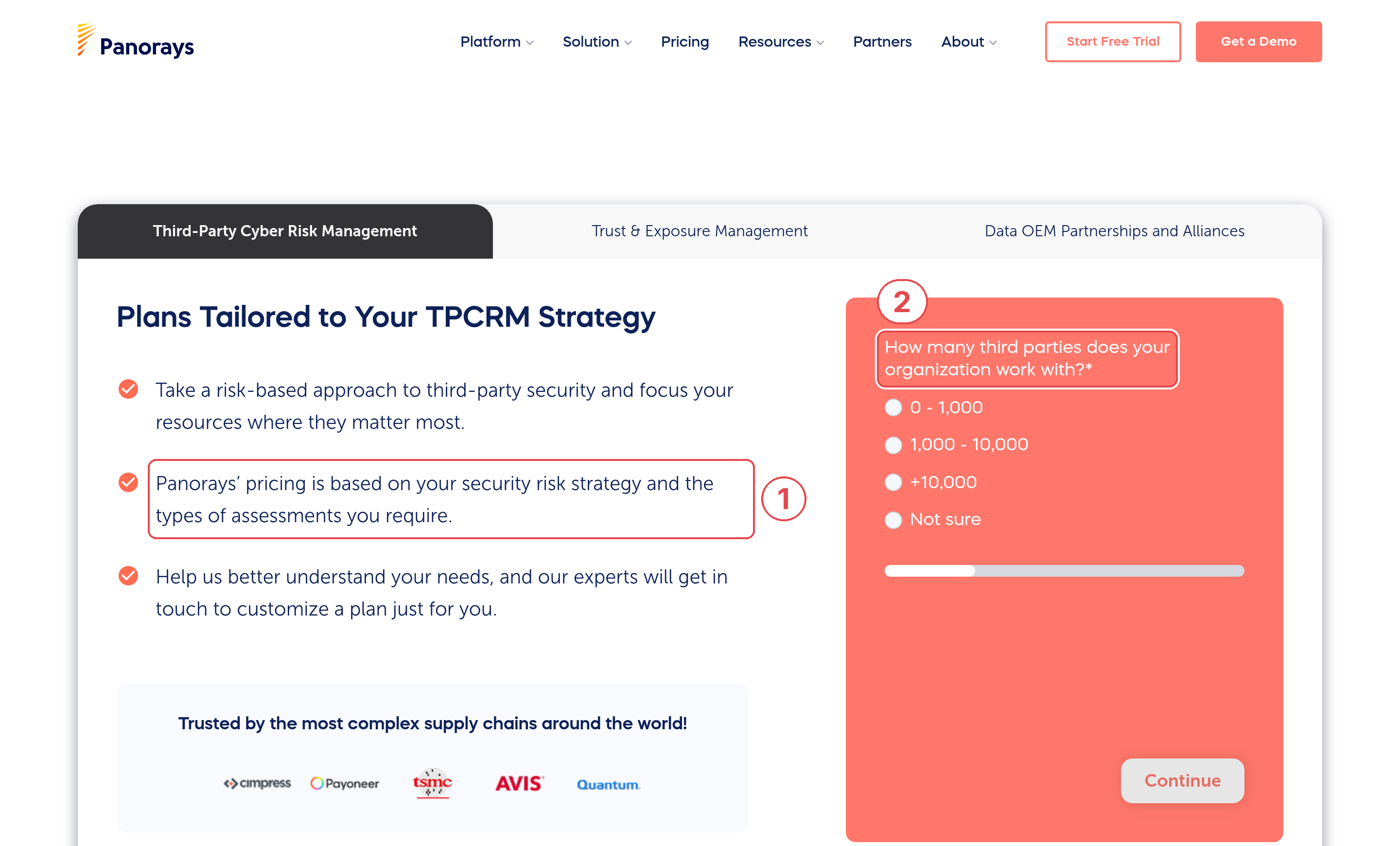
Quote-based: Panorays pricing "is based on your security risk strategy and the types of assessments you require". The plan form opens by asking how many third parties you work with, so expect vendor count to set the quote. A free account lets you send 5 questionnaires and see the cyber posture of 5 third parties.
Reviews
Users on Gartner Peer Insights like how easily it deploys and the real-time view of vendor posture, and complain that it struggles with complex procedures once it's set up (Gartner, Dec 2024). The complaint I'd weigh most is about transparency: it isn't always clear why something was flagged, which is exactly what you need when you challenge a vendor. Both reviews are from late 2024, so ask for a newer reference.
Clients
Panorays lists Cimpress, Payoneer, TSMC, Avis and Quantum among its customers.
Summary
Pick Panorays if you don't trust self-reported answers and want them cross-checked against real exposure. It's weaker if most of your risk sits in privacy terms and data processing rather than external cyber posture.
7. Black Kite

Black Kite is for teams that have given up on sending questionnaires to every vendor, and they're right to. Its AI cyber risk assessments build a picture from outside data and the vendor's own documents first, and ask the vendor only about the gaps.
What I'd test first: take ten low-risk vendors and see whether the outside-in profile plus document parsing would let you skip the questionnaire for each. Include one with stale findings and time the correction.
Features
- AI document parsing reads SOC 2 reports, questionnaires and security policies and flags where vendor input is still needed. Black Kite claims this slashes assessment time "by over 90%".
- Validated controls map against the frameworks and questionnaires you already use.
- AI agents and an MCP server connect your own AI tooling to its vendor intelligence.
- Ransomware susceptibility and financial-impact figures add context a questionnaire never will.
Pricing
Not published. Packages are tiered by the number of vendors assessed, with annual or multi-year terms.
Reviews
Users on Gartner Peer Insights like that it evaluates vendor security across technical, financial and compliance dimensions, and complain about false positives from its non-intrusive sources (Gartner, Aug 2026). That's the usual weakness of outside-in scanning, and it's why the stale-finding test above matters.
Clients
Black Kite shows BNY Mellon, LPL Financial, Markel and Healthfirst among its customers.
Summary
Pick Black Kite if you manage hundreds of vendors and want to stop sending 300-question spreadsheets to low-risk ones.
8. ProcessUnity (now including CyberGRX)
ProcessUnity is the heavyweight here: the most specialised AI agents on this list plus a shared risk exchange, with the rollout effort to match. It absorbed CyberGRX when the two combined in 2023, and CyberGRX's exchange lives on as the Global Risk Exchange.
What I'd test first: find out how many of your current vendors already sit on the exchange, then run the SOC 2 Analyzer on a report with known exceptions.
Features
- TPRM AI agents that each do one analyst job: SOC 2 Analyzer, Contract Scanner, Duplicate Vendor Inspector, Insurance Guardian for certificates of insurance, and a human-gated Issue Remediator that drafts remediation for vendors.
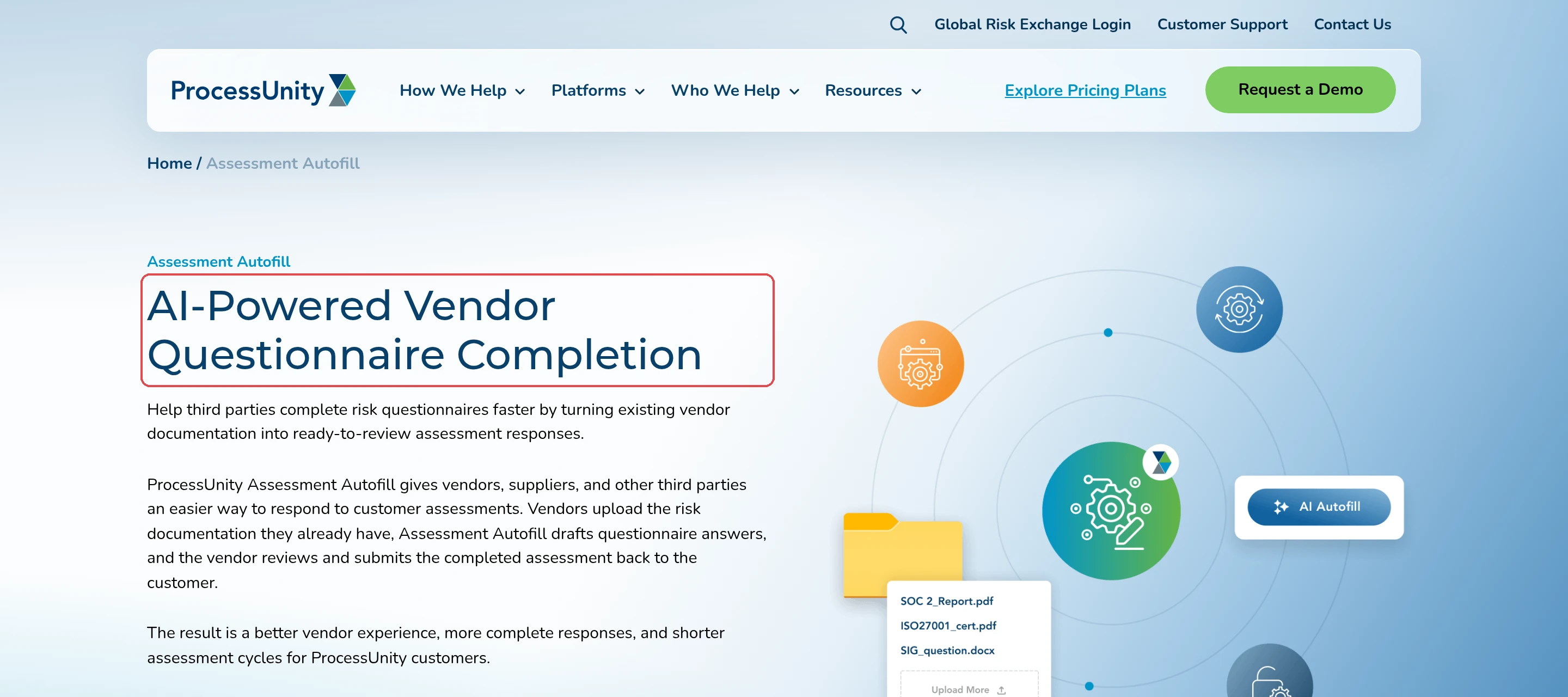
- Assessment Autofill drafts vendors' questionnaire answers from the SOC reports, ISO certificates, completed questionnaires and policies they upload, and the vendor reviews them before submitting.
- ProcessUnity reports that after Autofill reached the exchange, average questionnaire completion dropped from 13 hours to 43 minutes, and 65% of third parties accepted 95% or more of the AI-generated answers. That's the most specific figure any vendor here publishes, and it's still self-reported.
Pricing
Quote-based, with plans tiered by company size: up to $3B in revenue and fewer than 10,000 employees, or larger. Your vendors can use DDQ AutoAssist for free on the exchange, which helps when they push back on yet another portal.
Reviews
Users on Gartner Peer Insights like the flexibility and the support during rollout (Gartner, Oct 2026) and complain that it needs careful rollout planning (Gartner, Mar 2026). Even the happy reviewer needed a "Day 2" project to finish a complex setup, so plan a phased rollout.
Clients
Ask for two references at your scale and in your sector.
Summary
Pick ProcessUnity if you run a large, mature programme and want AI agents for specific analyst tasks plus a shared exchange to cut repeat assessments. It's heavy for a small team that needs results this quarter.
An AI vendor security checklist you can use this week
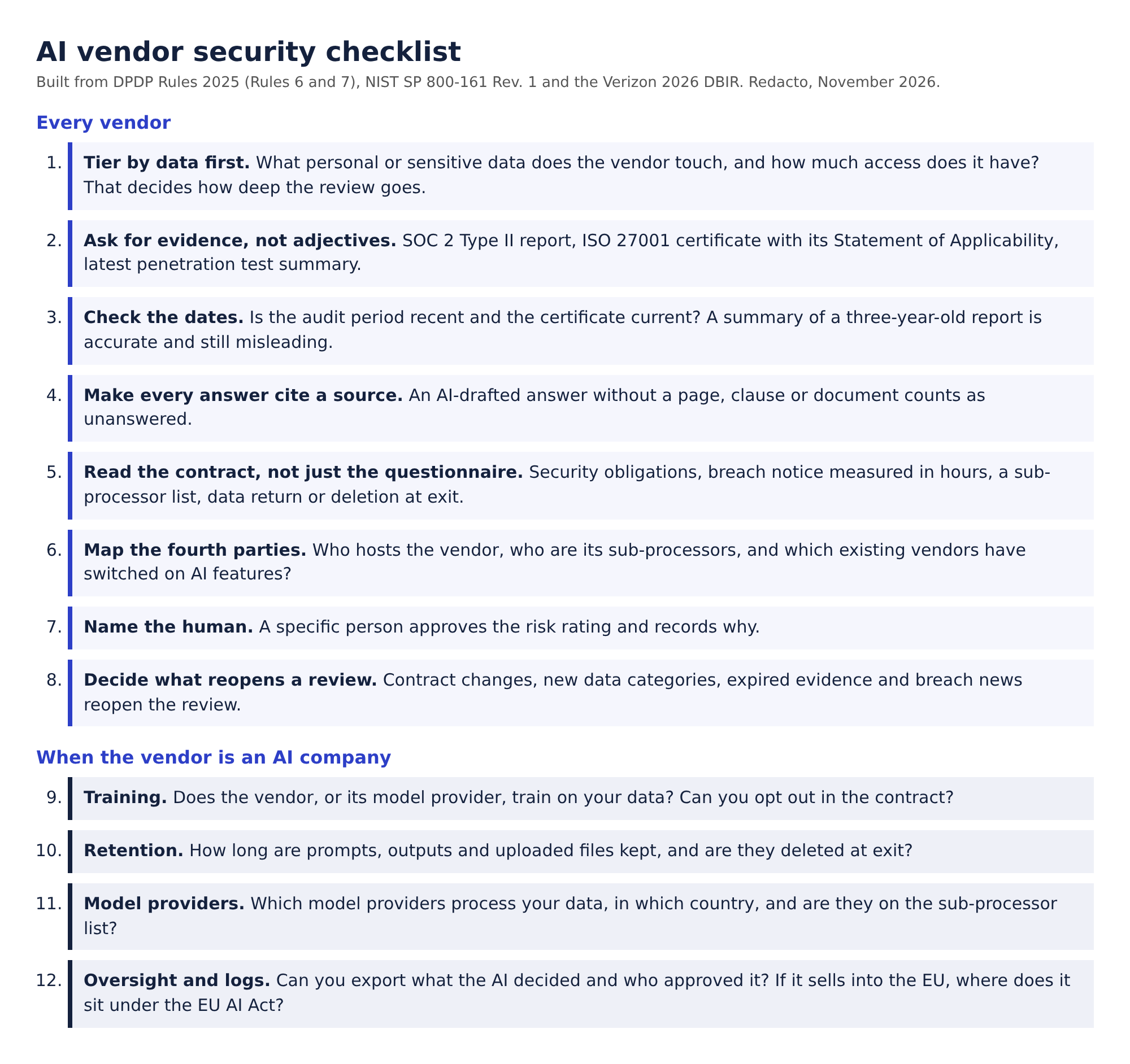
Whichever tool you pick, the review should check the same things. Lines 9 to 12 are for vendors whose product is AI; the reasoning is under "Assessing an AI vendor itself" above.
Every vendor
- Tier by data first. What personal or sensitive data does the vendor touch, and how much access does it have? Tiering on inherent risk decides how deep the review goes.
- Ask for evidence, not adjectives. SOC 2 Type II report, ISO 27001 certificate with its Statement of Applicability, latest penetration test summary.
- Check the dates. Is the audit period recent and the certificate current? A summary of a three-year-old report is accurate and still misleading.
- Make every answer cite a source. An AI-drafted answer without a page, clause or document counts as unanswered.
- Read the contract, not just the questionnaire. Security obligations, breach notice measured in hours, a sub-processor list, data return or deletion at exit. Rule 7 of the DPDP Rules makes you report a breach to the Board within 72 hours, so your vendor's notice window has to be shorter.
- Map the fourth parties. Who hosts the vendor, who are its sub-processors, and which of your existing vendors have switched on AI features?
- Name the human. A specific person approves the risk rating and records why.
- Decide what reopens a review. Contract changes, new data categories, expired evidence and breach news reopen the review.
When the vendor is an AI company
- Training. Does the vendor, or its model provider, train on your data? Can you opt out in the contract?
- Retention. How long are prompts, outputs and uploaded files kept, and are they deleted at exit?
- Model providers. Which model providers process your data, in which country, and are they on the sub-processor list?
- Oversight and logs. Can you export what the AI decided and who approved it? If it sells into the EU, where does it sit under the EU AI Act?
Before you buy any tool, ask its vendor three things: Which model processes our data, and is it trained on it? Can every AI-generated answer be traced to a source document? Who signs off on the final risk rating, and where is that recorded?
How to choose, by situation
First decide whether you're buying for the answering side (customers send you questionnaires) or the reviewing side (you assess your vendors). They look alike in a demo and solve different problems.
You're early-stage without an enterprise budget
The best third-party risk management software for a startup is often the free tier you already qualify for.
- Answering side: UpGuard's Trust Exchange is free and drafts questionnaire answers for you to verify. ProcessUnity's DDQ AutoAssist is free if your customers send assessments through its exchange.
- Reviewing side: Panorays' free account covers 5 questionnaires and 5 third parties, enough to run the checklist above on your riskiest vendors. When you outgrow it, UpGuard's $1,750 a month is the only list price in this group.
At this stage, the checklist and a free AI answering tool will do more for you than an enterprise platform you don't have time to configure.
You review 200+ vendors a year
At this volume, the best third-party risk management software for enterprises is the one that lets you stop sending full questionnaires to everyone. Black Kite and ProcessUnity are built for it: outside-in data and an exchange of completed assessments come first, and questions go out only for the gaps.
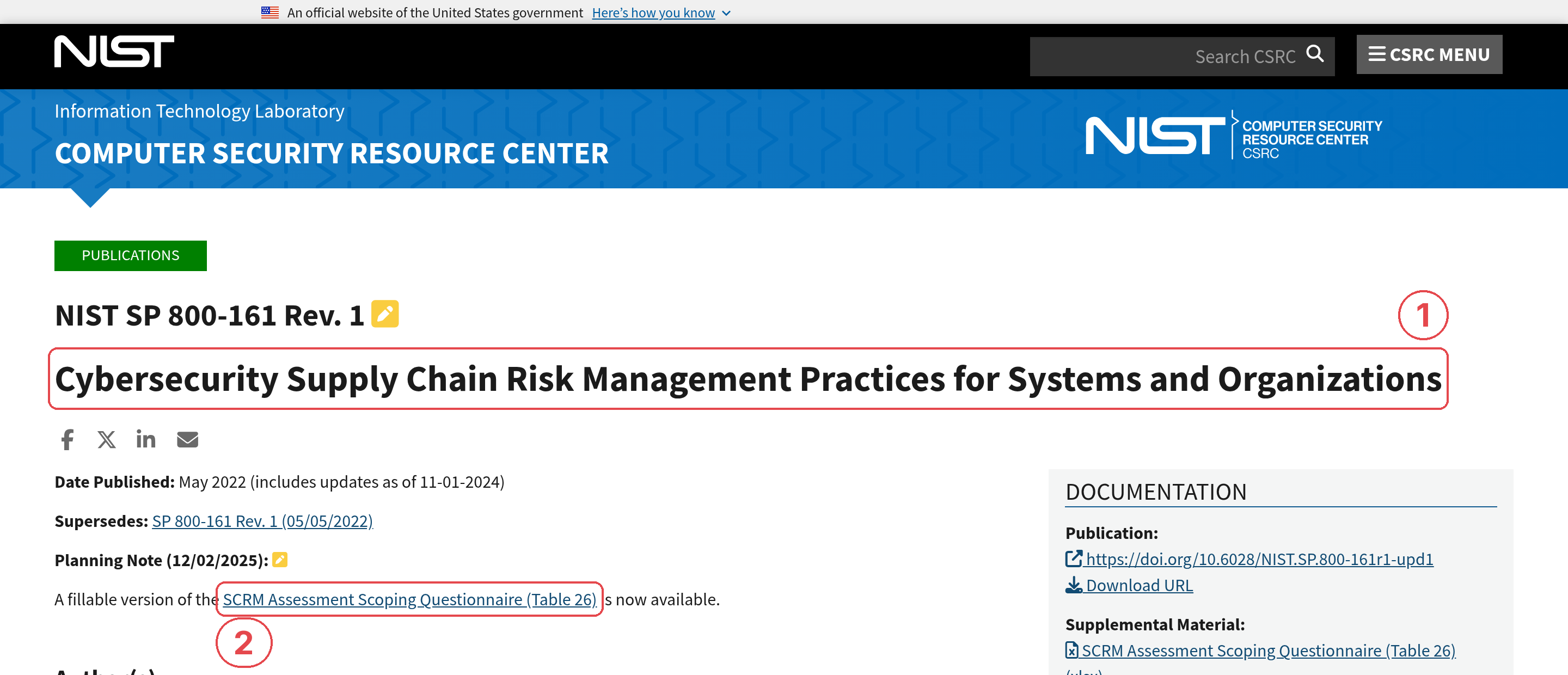
Tier before you automate. NIST SP 800-161 Rev. 1, from the US standards body, publishes a fillable scoping questionnaire you can adapt so low-risk vendors get a short form and critical ones get the full review. If you're still building a TPRM program, set tiers and owners before you buy any of these.
You're in a regulated Indian sector
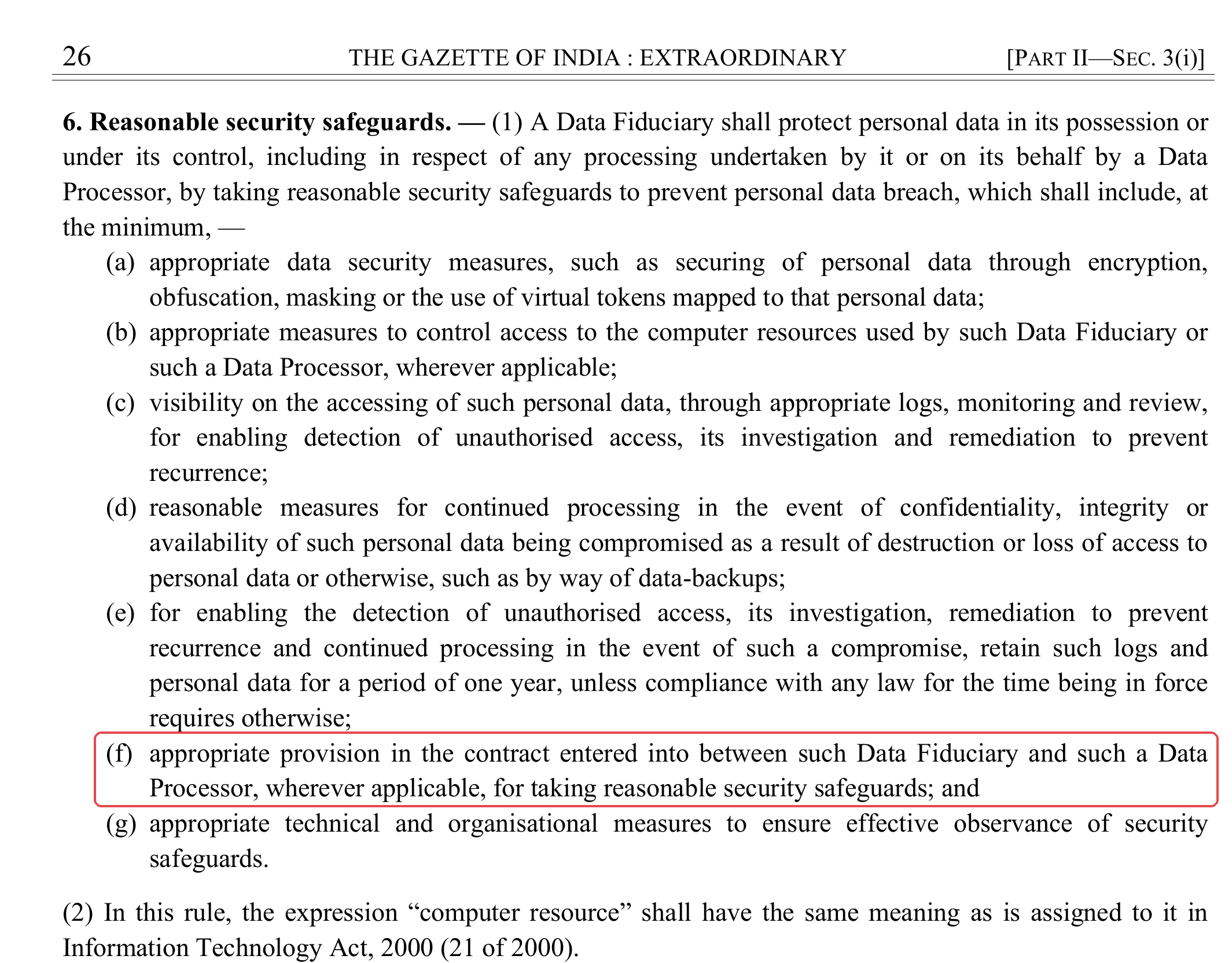
Under Section 8 of the DPDP Act, you stay responsible for personal data your vendors process for you, and you can engage a processor only under a valid contract. Rule 6 of the DPDP Rules 2025 lists the reasonable security safeguards you must take, including in your contracts with processors, and Rule 7 gives you 72 hours to report a breach to the Data Protection Board. Both apply from 13 May 2027.
If you're an RBI-regulated entity, the 2025 Outsourcing Directions expect due diligence before you sign and a review of the service provider at least once a year, and the Board can't hand outsourcing decisions to anyone else. If you also certify to ISO 27001, the ISO 27001 supplier requirements ask for the same evidence trail.
So your tool has to review contracts and DPAs as seriously as SOC 2 reports. That's the gap Redacto was built for. OneTrust is the alternative if you already run privacy on it.
Final thoughts
An AI vendor risk assessment tool earns its price when it moves your analysts' hours from reading to judging.
Before you sign anything, take one vendor you approved last quarter, run it through the tool you're trialling, and compare what the AI flagged with what your analyst did. If you want to see an evidence-first review on vendors you've already assessed, book a Redacto demo.