8 Best Consent Management Platforms for Retail and eCommerce Brands
Eight consent management platforms for retail and eCommerce compared on checkout consent, WhatsApp opt-outs, loyalty, pricing and real user reviews.

I would not judge a retail consent platform by its banner. A shopper can refuse ad tracking on your website, accept offers at the till and then withdraw through WhatsApp. If those choices sit in different systems, the next campaign can still go out.
In a February 2026 LocalCircles study, 96% of the 13,362 WhatsApp users answering the daily-message question said they received promotional or spam messages every day. The study drew over 42,000 responses across 324 districts in India. That is the environment your marketing enters, and it explains why a stale opt-out quickly becomes a customer problem.
If you are comparing consent management for retail, this guide will help you separate cookie consent from what happens at checkout, in a loyalty programme and before a message is sent. I compare eight tools on those jobs, their public prices and what real customers say. Where a vendor proves only website consent, I leave the other channels as demo questions rather than fill the gap with a guess.
TL;DR
Eight options for a retail customer consent management tool, in the order I would shortlist them. Your channels should change that order.
- Redacto: enterprise, omnichannel DPDP consent with privacy governance.
- OneTrust: global retail groups consolidating consent and enterprise privacy.
- Usercentrics: multi-region web and mobile consent measurement.
- Enzuzo: growing multi-store eCommerce teams wanting public self-serve prices.
- CookieYes: small Shopify stores and uncomplicated web consent.
- Privy by IDfy: Indian enterprises with on-prem or VPC requirements and retail operations.
- Consently: India-based D2C stores needing predictable published annual pricing.
- Seqora: Indian D2C and omnichannel brands needing pre-send consent checks.
We build Redacto. It is listed first and not scored. None of these vendors paid for a place. The proof-of-concept below is the part to take into your demos.
The 8 retail CMPs compared
| Tool | Best for | Storefront and channel proof | DPDP evidence | Independent review status | Published price (Nov 2026) |
|---|---|---|---|---|---|
| Redacto | Enterprise omnichannel consent | Web and mobile SDKs and APIs; offline, call-centre and downstream records | English plus 22 scheduled languages; purpose versions and local storage | No independent product reviews | Quote-based |
| OneTrust | Global retail groups | Web, app and CTV CMP; UCPM carries preferences to CRM, CDP and ad systems | Its current template list centres on GDPR, CCPA and other global laws | G2 on Consent & Preferences | Quote-based |
| Usercentrics | Web and app consent analytics | Web CMP, App CMP, GTM and regional consent signals | DPDP is absent from its listed product templates | G2 reviews | Free to €750/month by sessions; Corporate quote |
| Enzuzo | Multi-store eCommerce teams | Native Shopify and Webflow apps; WooCommerce and custom stores via script | Its regional list does not name DPDP | G2 and Shopify reviews | Free; $29 to $79 monthly or annual equivalents of $22 to $59 |
| CookieYes | Small stores needing web consent | Shopify app, cookie blocking, consent logs and ad signals | GDPR and US-state templates; no DPDP template shown | G2 and Shopify reviews | Free to $55 per website per month |
| Privy by IDfy | Enterprise retail with offline operations | POS capture, loyalty remediation, CRM and 3PL data discovery | DPDP purpose capture and multichannel records | No independent product reviews | Quote-based |
| Consently | Indian D2C at a known annual cost | Shopify, WordPress and Wix installs; forms, cookies and requests | DPDPA notices, 22 languages and consent records in Mumbai | No independent product reviews | Free to ₹1,20,000 per website or app a year, plus GST |
| Seqora | Pre-send marketing consent checks | Shopify, WooCommerce, POS and loyalty claims; pre-send checks for SMS, WhatsApp and email | DPDP consent, rights and vendor records | One SoftwareSuggest review | Quote-based |
A web connector proves web consent only. DPDP cells describe the vendor's scope; your legal team still approves the notices, purposes and records. None of these picks is a legal-compliance certificate.
What is consent-driven commerce?
Consent-driven commerce means using a customer's data for an accepted purpose where you can prove that choice. Their record follows them across checkout, stores, apps and marketing tools. Each campaign or data-sharing system checks that record before acting.
A payment provider can help record a choice without becoming your consent system. A withdrawal at payment still has to reach loyalty, CRM, messaging providers and ad audiences. Apply the same test to an ERP: does it consume a live consent signal or rely on yesterday's export?
A preference centre holding only anonymous cookie choices cannot do this job. Identity stitching needs its own notice and consent, purpose records and connections into operational systems. Under the DPDP Rules 2025, Consent Manager registration applies from 13 Nov 2026 and the main notice, consent, children's-data and breach duties from 13 May 2027. Plan these connections before the notice design.
Software for managing retail customer agreements can mean two purchases. A CMP records marketing, profiling and sharing permissions. A contract or e-sign system records acceptance of customer or franchise terms. Neither replaces the other.
How to read CMP reviews for this comparison
I give a broken account or tracking-rule complaint more weight than an attractive banner. Check the reviewer's module, customer type and date. A global rating cannot tell you whether a WhatsApp withdrawal gets enforced.
Some tools have years of reviews; others have none. I don't fill those gaps with vendor endorsements. My method is public-page evidence, not hands-on testing. A retailer using your exact connector is worth more than another rating.
For consent beyond retail, see our India-wide comparison. Here, judge one order, sign-up, withdrawal and its evidence trail.
Where retail consent fails in practice
Effective retail data protection services reach beyond the website. Six pressure points reveal whether a CMP belongs in your retail shortlist or only handles cookies.
Checkout, app sessions and tag control
Start with a guest checkout. Keep the marketing box separate from order terms, optional and clear. Test that optional tags await the shopper's choice and Google Consent Mode receives the update, in logged-in areas and on mobile.
Granular consent tracking for web and mobile apps means more than copying a banner into an app. Does the SDK write to the website's record, and does withdrawal survive a new device? My app consent checklist and guide to unifying web and app consent cover the identity side. Do not leave an app SDK as a web-contract footnote.
Loyalty sign-ups and profiling
One loyalty form can bundle points, partner offers and profiling across online and store activity. Separate those choices, so members can earn points without accepting promotional profiling or partner marketing where lawful.
Give each choice a purpose, channel, timestamp and notice version. Re-consent is pointless if the old export remains live in the campaigns system. Test one historic member opting out and watch the downstream lists.
POS, paper forms and store associates
At a busy till, a forced phone-number field is a weak basis for marketing. Let the customer buy without joining the list. Staff need a simple notice through the POS screen, QR code or recorded phone interaction.
A generic API does not prove your till can do this. Test with a store associate on your actual POS. Keep the source of paper captures and make a store withdrawal change the record used for online fulfilment.
WhatsApp, SMS and email withdrawal sync
WhatsApp requires opt-in as well as the person's number or username, and you must respect on- and off-platform opt-outs. Order updates and offers call for separate categories of permission.
After a STOP reply or preference-centre change, the update must reach your messaging provider and campaign lists. Ask whether the CMP blocks transmission or updates a record afterwards. Email needs an unsubscribe, central suppression and a timestamp for each connected system applying the choice.
Dark patterns and misleading analytics
Unequal buttons, confusing toggles and hidden refusal routes are cookie-banner dark patterns, not wins in opt-in analytics. My guide to cookie banners that do not cost opt-ins covers the design choices.
Measure informed action rather than acceptances alone. Every test variant should offer the same purposes and a comparable withdrawal route. A demo full of conversion rates but no lawful-basis record is incomplete.
Evidence and processor responsibility
When a customer asks why you sent an offer, pull their history: purpose, notice text, capture channel, timestamp, withdrawal and every receiving system. The export should show what processors did, not only what you recorded.
Map messaging agencies, customer-data tools and fulfilment partners to their responsibilities. If an API connects but the campaign tool ignores the signal, responsibility remains yours. Regional templates save setup time; your notices and purposes still need legal review.
Run the same proof-of-concept for every vendor
Give every finalist the same six test identities and ask for a live demonstration. Keep a network log or system export from each receiving tool. That will reveal more than slideware.
- Guest checkout: refuse ad cookies while accepting the order terms. Check the tag manager and consent log before payment completes.
- WhatsApp opt-in and withdrawal: opt into offers, not service updates, then revoke only offers. Verify what the API provider does at send time.
- Loyalty sign-up: accept points but refuse partner profiling. Read the record and ask for the notice version behind each choice.
- Mobile-app withdrawal: sign in on a second device and withdraw there. Check whether the website, CRM and advertising audience inherit the choice.
- Data-principal request: request a copy for a customer who previously checked out as a guest. Inspect identity verification, system coverage and response history.
- Evidence export: export the consent and downstream-delivery record for one person. Ask whether it distinguishes delivery, failed delivery, applied withdrawal and a system still awaiting confirmation.
Then ask who writes each connector and whether it uses an API, event feed or scheduled import. Which usage meter applies in your peak month? How long are records retained? What do separate sites, brands, apps and regions cost?
For global privacy and CIAM platforms, can the consent record leave the identity system in a usable form? An occasional CSV still leaves the shop floor and campaign tools disagreeing.
1. Redacto
Full disclosure: we build Redacto, so I won't score it beside the others. Redacto's consent management platform suits a customer moving between store, app and messaging lists when you must account for withdrawal in each place. Its links to discovery and privacy governance help when nobody owns the full retail record.
Features
We record purpose, notice version, channel and timestamp. Web and mobile capture runs through SDKs and APIs; paper and call-centre choices share the person's history. Notices cover English and the 22 scheduled languages.
Each withdrawal goes to mapped systems and processors. We check which acted, chase the rest and produce a Consent Reconciliation Statement. Ask us to show your own WhatsApp provider and store account, not a generic sample. Choices through registered Consent Managers join the same record; that role under the DPDP Act is explained separately.
Only mapped systems are included, so a franchisee's spreadsheet or unlisted SMS supplier can escape reconciliation. No public retail customer is named yet, making a reference conversation necessary.

Pricing
Quote-based. Pricing follows volume, and each module counts it in its own way. For consent, the thumb rules are your data principal count and processor count, since each processor adds API calls for every withdrawal and new customer. Store staff and franchise counters turn physical interactions into digital records, and sale weeks multiply sign-ups. Bring peak-month volumes. I explain these factors in this short video Redacto posted on LinkedIn:
Reviews
Three customers, in their own words:
Surya N, Director, Product Management, TimePay: "As a product team, we had one worry: would privacy compliance hurt the onboarding journey? It didn't. Redacto's consent flows fit into our app with very little engineering effort, and we change notices from the console instead of shipping a new build. Our users get a clear choice at every step, and we get a consent record we can stand behind."
Prem Kumar, Data Protection Officer, Pine Labs Group: "Privacy across a group of businesses is hard because every team has its own systems and its own idea of what personal data it holds. Redacto gave us one view of where personal data is collected, why we collect it and where it goes. When a customer request or an audit question comes in, I answer it with evidence, not a round of emails."
Saif, Head, Infosec Compliance & Privacy, Razorpay: "Our vendor security and privacy reviews used to live in spreadsheets and long email threads. With Redacto, every assessment, every piece of evidence and every follow-up sits in one place. When a customer sends us a security questionnaire, we answer it from that same record. We focus on the vendors that actually carry risk, and the paperwork no longer runs the week."
These are our customers, not independent product reviews.
Clients
By our own count we've done "40+ successful implementations". No retail customer is publicly named for this case; ask us for a reference and for existing POS and messaging connectors.
Summary
Choose Redacto for multichannel consent linked to governance and an auditable withdrawal trail. It exceeds a single-store banner brief. No public price or independent reviews means the demo and reference call matter.
2. OneTrust
OneTrust suits a retail group already running its privacy programme on the same suite. CMP handles cookie consent; UCPM handles known-customer preferences. Do not assume the website purchase covers the till.
Features
Its CMP covers web, apps and connected TV, with tag blocking, regional banners and receipts. UCPM gathers a customer's preferences across devices and touchpoints, then sends permission into CRM, CDP and advertising systems.
One profile can cover store, app and ad choices once your own integration supplies the POS record. Current web templates centre on GDPR, CCPA/CPRA, LGPD and US state laws. Treat DPDP wording and multilingual notices as legal configuration, not an assumed template.

Pricing
Quote-based. CMP packages count average daily visitors across channels and properties; UCPM counts captured data-subject profiles. A sale raises one meter while loyalty remediation raises another. Ask for both, plus connector, API and support charges.

Reviews
Users on G2 like the simple customer-facing interaction and complain about a clunky interface, a cookie crawl taking one site offline and steep renewal increases (G2, Aug 2025). This covers Consent & Preferences, not Privacy Automation. A September 2026 review is positive but still evaluating deployment, so it cannot settle those concerns. Test scanner load and renewal terms.
Clients
OneTrust counts 14,000+ customers. Ask for a reference running CMP and UCPM in your regions and POS environment. Its 200+ listed connections are a starting map, not proof that your configuration exists.
Summary
Pick OneTrust for enterprise consolidation if you can staff integration and legal configuration. A small single-country store buys too much suite, and two usage meters complicate budgeting. Compare OneTrust alternatives if consolidation is not your priority.
3. Usercentrics
Usercentrics suits retail teams measuring web and app consent across regions without sacrificing ad signals. Current reviews include useful retail evidence. I would buy it for digital consent, not proven store and WhatsApp coverage.
Features
Web CMP supports tag blocking, regional rules, Google and Microsoft signals, multi-language banners and consent downloads. App CMP adds native SDKs, with cross-device sharing on higher plans. Cross-domain sharing on Pro and above reduces repeated banners across related storefronts.
Consent states flow into conversion and audience tools. Web A/B testing is Corporate or a Business add-on; App CMP includes it in Advanced. Plan evidence retention before renewal: web consent histories can be downloaded for 12 months. DPDP is absent from its regional-template list, while web and app are separate purchases. Ask how known-customer preferences leave the system before treating it as a loyalty or POS platform.
Pricing
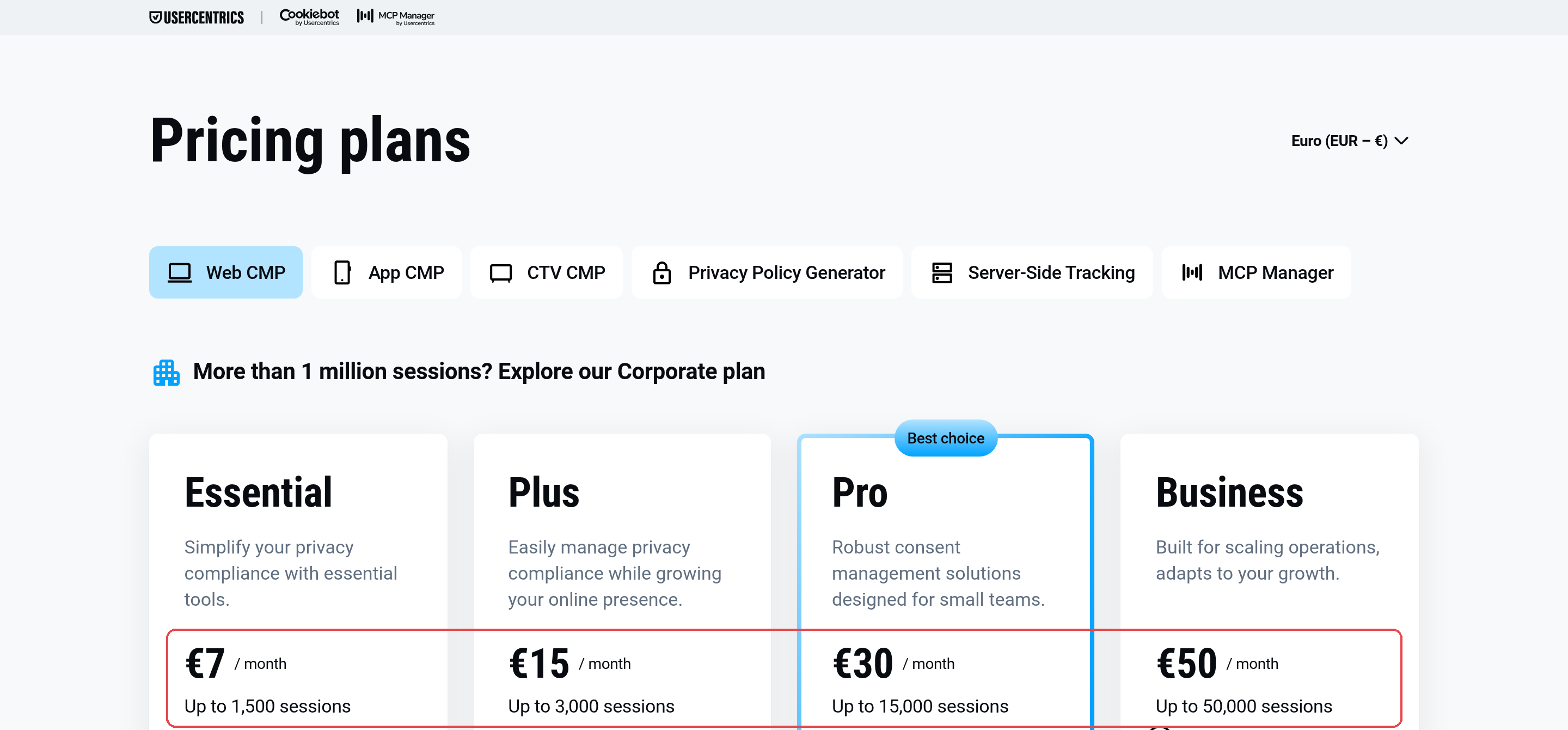
Usercentrics Web CMP is free for 1,000 monthly sessions on one website. Essential costs €7 for 1,500, Plus €15 for 3,000 and Pro €30 for 15,000 on three sites. Business starts at €50 for 50,000 on ten, reaching €750 at one million on 100. Higher tiers add sites rather than multiplying the session price. Exceeding a tier moves you up automatically. Corporate is quoted from a million sessions. App CMP Advanced is €49 monthly billed yearly, or €588 annually, for up to 500,000 daily active users. Model web and app usage separately for sale weeks.
Reviews
Users on G2 like the quick Google Tag Manager setup and improved opt-in rates, and complain about time-consuming setup, limited styling and difficult higher-end rules (G2, Nov 2026). An online tyre retailer wrote the positive November review; a separate 5 Nov review raised the criticisms. Test your own banner and hardest tracking rule rather than assume a fast complex install.
Clients
BAUHAUS and BRAX Store are customer names on its pricing material. The tyre-retail review gives additional storefront evidence. Ask for a separate mobile-app and regional reference if both matter to your business.
Summary
Usercentrics is a strong digital-consent pick for a store buying ads across regions. Watch its session meter during sales. Store choices, known-customer marketing permissions and DPDP wording need separate proof before replacing a broader CMP.
4. Enzuzo
Enzuzo combines clear multi-site pricing with concrete eCommerce installation: native Shopify and Webflow apps, plus WooCommerce, BigCommerce and custom stores via script or tag manager. Try a few storefronts if enterprise quotes killed your shortlist.
Features
The platform covers cookie banners, tag blocking, consent logs, regional rules, legal policies and data-subject requests. It sends consent signals to advertising pixels and regionalises storefront banners. Track acceptance rates without mistaking them for legal compliance.
Plans include several websites, useful for country stores or a second brand. There is no POS, loyalty or WhatsApp synchronisation claim, and its named regions do not include DPDP. Pixel integrations do not answer those gaps; leave them as demo questions.
Pricing
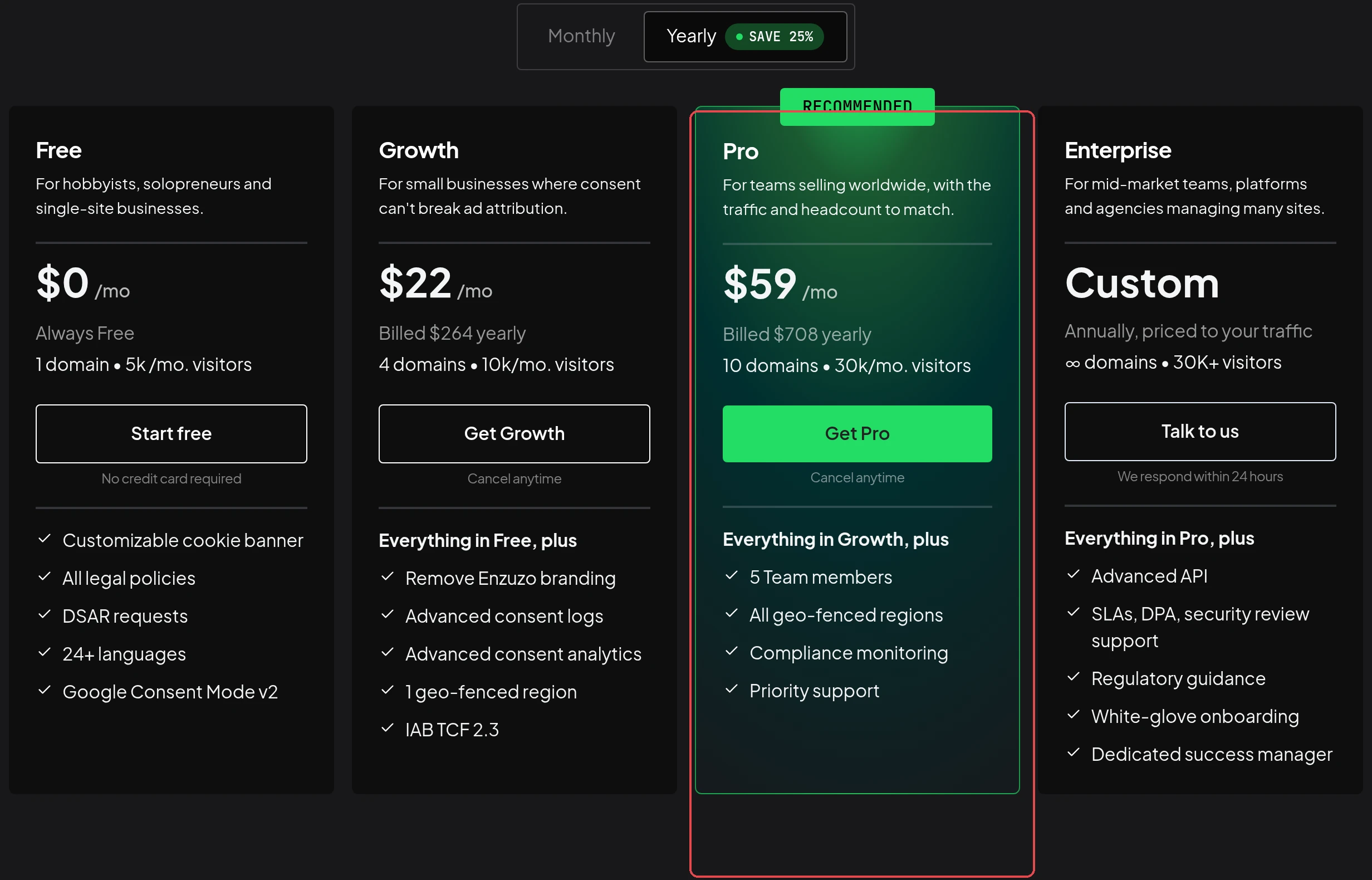
Enzuzo is free for one website and 5,000 monthly visitors. Growth costs $29 month to month, or $22 monthly when billed $264 annually, for four sites and 10,000 visitors. Pro costs $79, or $59 when billed $708 annually, for ten sites and 30,000 visitors. Enterprise is custom. The $22 headline is an annual equivalent, and the visitor cap covers all included storefronts.
Reviews
Users on G2 like the multilingual support and complain about reliability, with one paid account reverting to free (G2, Aug 2023). That critique is the latest on the visible profile, but it is still three years old. Use it as a test question, not a current verdict. Ignore the January 2023 quoted price as obsolete and test account upgrades and consent-record preservation.
Clients
Enzuzo reports over 30,000 business users and feedback from people at Yale, Lucy Group and Jane App. These are not proof of POS or a named retailer rollout. Ask for a multi-Shopify reference and migration example preserving consent history.
Summary
Pick Enzuzo when public pricing and included websites matter more than DPDP-specific coverage. It fits web consent on paper. Loyalty profiles and WhatsApp campaigns built from store records remain unproven.
5. CookieYes
CookieYes is the straightforward web pick for a small Shopify store needing a banner, scanner and consent log without a privacy engineering team. Compare it with banner and tag tools, not a multichannel retail record.
Features
The native Shopify app blocks scripts before a choice and carries consent into Google and Microsoft ad signals. Scanning, logs and a return-to-preferences button are on the free plan; geo-targeting starts at Pro. It covers website tags and records, without a claim to manage WhatsApp, POS or loyalty withdrawals.
That narrowness helps a quick install. Test the tags and categories before sale week. Website logs do not show a known customer opting out of email; notices, marketing purposes and rights need a separate process.
Pricing
CookieYes charges per website. Free covers 5,000 monthly pageviews, Basic costs $10 for 100,000, Pro costs $25 for 300,000 and Ultimate costs $55 for unlimited. Basic and Pro charge $0.30 for each extra 1,000. Annual per-site prices are $100, $250 and $550 plus taxes. Ultimate gives sale-week predictability, but every storefront needs its own plan.

Reviews
Users on G2 like prompt support and simple set-up, and complain about duplicate Shopify/CookieYes accounts and subscriptions spread across email addresses (G2, Jul 2026). The duplicate-account complaint is from a verified retail reviewer. Separately, a Shopify merchant described incorrect payment notices after the app's migration (Shopify, Sep 2026). Test account ownership and recovery for each site.
Clients
The Shopify listing and verified retail review are the relevant customer evidence. Stores under different legal entities should settle account ownership, subscriptions and consent exports before signing.
Summary
Choose CookieYes for a small store needing predictable web prices and advertising-consent control. It should not be your only record across stores, marketing opt-outs and loyalty. Buy it for the narrow job and keep known-customer permissions elsewhere.
6. Privy by IDfy
Privy by IDfy has an explicitly retail DPDP proposition: optional purpose-specific POS consent, loyalty remediation and separate marketing permission for billing data. Those are the right problems for a real store.
Features
Privy's retail consent suite connects consent, cookies, rights requests and discovery across storefront, POS, loyalty, CRM and 3PL systems. Its remediation rebuilds older loyalty records by purpose. Combining store, web and app profiles is a separate processing activity.
The proof is narrower than the suite promise. Demonstrate a real POS transaction, historic loyalty record and withdrawal into your own marketing provider. Separate ready connectors from services work. Data discovery does not itself prove checkout or offline capture.

Pricing
Quote-based. Ask whether discovery, consent, identity checks and downstream connectors are bundled. Price historical loyalty remediation and the yearly run rate, and clarify charges for each counter, store, brand and legal entity.
Reviews
Privy has no reviews on its Capterra India profile yet. IDfy's KYC reviews are for another product. Ask for a retail reference deployment, connector delivery time and what happened during a peak-season withdrawal.
Clients
Privy counts Wakefit, Housing.com and Shoppers Stop among its customers, and Shoppers Stop is the obvious retail reference to request. Ask which modules they run, at what scale and since when, before treating a logo as POS proof.
Summary
Privy merits a serious demo for a large Indian retailer needing offline capture and on-prem or VPC deployment. Its known-customer use cases beat a web-only CMP on relevance. Zero independent reviews and no public price slow validation. My Privy review covers the broader suite.
7. Consently
Consently.in fits a D2C team wanting Indian-language DPDP notices and an annual rupee figure. It covers website forms, cookies, preferences and rights requests. Its annual allowances and setup fees deserve the closest reading.
Features
Every plan covers cookies and DPDPA consent in 22 scheduled languages plus English. Its Shopify material separates account, marketing and checkout choices. SMS OTP quotas are 1,000 on Growth and 5,000 on Business for verifying a phone number. These are one-time passwords, not marketing-message allowances. They do not prove send-time withdrawal enforcement.
Consent records are stored in Mumbai under its commercial terms, and data can be exported. POS capture, a WhatsApp send-time block and a loyalty connector are not shown as standard. Ask for a real CRM demonstration before assuming those links. Free is a small test, not a usable launch tier.
Pricing
Consently.in's annual plans are ₹0, ₹25,000 for Starter, ₹60,000 for Growth and ₹1,20,000 for Business, per website or app, plus 18% GST. Growth covers 40,000 cookie and 20,000 DPDPA consents a year; Business covers 1,00,000 and 50,000. Extra DPDPA consents cost ₹10 each and cookies ₹5 per 100. Setup can add ₹10,000, ₹25,000 or ₹99,999 per property.

Reviews
Consently.in has no independent review page I could verify. The consently.net Shopify app and Dorik-associated G2 product are different products. Their ratings cannot stand in. Test the request centre, consent export and a real marketing connection, then request a merchant reference. First-party customer quotes do not replace that call.
Clients
Consently reports more than 1,000 active websites, without independent retail deployments to examine here. Ask for a merchant with similar traffic and channels, whether quotas lasted through festive campaigns and how much Shopify setup was needed.
Summary
Consently is a budget starting point for Indian storefronts needing DPDP forms and multilingual notices. Multi-store charges, annual limits and paid setup change the maths. Read my Consently review and alternatives for the self-serve comparison.
8. Seqora
Seqora's useful idea checks consent before an SMS, WhatsApp or email promotion leaves. That is closer to enforcement than a banner updating a preference after transmission. Its retail proposition is broad; its public evidence is thin.
Features
Seqora's eCommerce product names Shopify and Shopify Plus, WooCommerce, marketplace data and POS and loyalty capture. Channel consent is versioned, and a recipient can be held before a promotional send. Rights requests require identity verification and review.
Test an opt-in reaching loyalty and a withdrawal preventing transmission. An API, database read or CSV import produces very different freshness; ask which method fits each channel. An industry use-case list does not prove a direct integration. Require a transaction and delivery log in the pilot.

Pricing
Quote-based. Seqora's pricing factors cover data-principal volume, monthly rights requests, connected systems, consent channels and company size. Bring store, channel and guest-checkout volumes. Ask whether scheduled reads and direct API connections carry different services costs.
Reviews
One customer on SoftwareSuggest liked Seqora's mapping of its internal DPDP procedures into modules, but reported role-based access control and live field-level PII masking still being scoped for its deployment (SoftwareSuggest, Oct 2026). That 9 Oct account concerns a steel, metals and e-auction business, not retail consensus or a general defect. Test access roles, masking and download permissions yourself.
Clients
Seqora names no public retail customer whose POS or pre-send integration can be examined. Request a retail reference and evidence of an opt-out stopping a real message before assigning weight to the storefront list.
Summary
Shortlist Seqora when pre-send enforcement matters more than a long review history. Its coverage fits D2C and omnichannel scenarios on paper. A technical pilot should settle API freshness, access restrictions and whether POS and loyalty connectors exist.
Which kind of retailer each fits
A small one-store Shopify brand
Start with CookieYes if cookie consent and modest public prices are your only needs. Enzuzo adds broader privacy-policy and rights-request cover, plus room for another website when you grow. If your store is Indian and you need notices linked to marketing and customer forms, Consently's annual rupee pricing is the more direct comparison. In each case, write down who owns WhatsApp suppression and customer requests. A cookie acceptance on the website does not populate either process by magic.
A multi-region retail group
OneTrust fits when existing legal, privacy and marketing teams already operate its other modules. Usercentrics is the lighter digital-consent contestant if web and app signal control is your priority. Enzuzo is worth adding to the bake-off when you have many smaller storefronts and do not need a large-enterprise privacy suite. I would decide this group on the reference for its actual connectors and regional configuration, not on brand familiarity.
A multi-brand or marketplace seller
Enzuzo's four- and ten-website plans make it easy to cost a growing set of storefronts. Consently makes sense when every property carries similar DPDP purposes, but the annual subscription and setup fee repeat for each one. A marketplace seller should remember that marketplace fulfilment data does not automatically come with marketing permission. Work on consent for your own store, app and repeat-customer programme, and record the source of every imported customer detail.
An omnichannel POS and loyalty operator
Redacto, Privy and Seqora describe the right offline and messaging scenarios. Put all three through the same POS transaction, historic loyalty import and opt-out test. OneTrust belongs here too if UCPM is already in your architecture. None of them should get credit for a generic API until your actual till, CRM and messaging provider stop using the customer's data after the choice changes.
An Indian regulated enterprise
Redacto and Privy are the enterprise DPDP comparison for deployment choice, cross-system evidence and associated governance work. Seqora is a contender if your primary gap is enforcement at marketing send time. Consently fits smaller teams when website forms and predictable annual budgets dominate. The legal team still has to decide which activities have a consent basis and which fall under another permitted use.
Budget and rollout traps
The lowest banner price can become an expensive consent programme once known customer identities enter the picture. I would put these issues in the first procurement sheet, before a winner is chosen.
Four usage meters that move in a sale week
Visitor plans price the crowd, not just the number of stores. Enzuzo counts each monthly visitor once, Usercentrics counts 30-minute sessions, CookieYes counts page loads and OneTrust's CMP counts average daily visitors. They respond differently to the same campaign. A customer opening four pages is four pageviews but not four visitors. Use actual analytics from your busiest month and include brand sites, country stores and microsites in the model.
Consently measures consented interactions separately from cookie consents. OneTrust's known-profile meter is another kind of volume again. Enzuzo bundles websites into a plan; CookieYes and Consently sell subscriptions per property. Decide whether a terminal, temporary sale site and development subdomain count too. Then read what happens when you cross the limit: an automatic tier change, an overage invoice or a conversation with sales.
Connector and API work that sits outside the subscription
An implementation fee is reasonable when a supplier maps purposes and wires your store, but the purchase should describe each output. Consently prices self-install, assisted and managed tiers, with API access available only at certain levels. Enzuzo's better API access is on Enterprise. Other vendors will scope the connection after learning the POS and CRM. Ask for named systems and sync frequency in the statement of work.
Also ask who owns later changes. A checkout redesign, a new WhatsApp sender or an extra loyalty purpose may need professional time rather than a configuration switch. If the API rate, sandbox, analytics export and support package are not priced, the cheapest plan is not fully priced yet. You should own the mapping and receive a machine-readable export if you change supplier.
Privacy and CMP fees can be separate purchases
Cookie consent, preference management, request processing and data discovery are different modules with different records. OneTrust separates CMP and UCPM meters; Usercentrics charges separately for web and app products. Redacto, Privy and Seqora price the work around the business scope, so a quote for only one module will not tell you what a multichannel rollout costs.
Legal review and policy work also have a price. A regional template supplies a start, not the appropriate choice of purpose, notice language and lawful basis for your processing. If a vendor promises a certified or compliant database, ask your counsel which part that statement actually covers. The certification of one ad standard does not satisfy your entire data-protection programme.
A CMP is not a contract or signature tool
Checkout terms, franchise documents and an enterprise services agreement have legal acceptance and version requirements of their own. A CMP tracks permission for processing, messaging and data sharing. Some vendors generate a privacy policy or standard website terms alongside it, but that does not turn a consent log into executed contract management.
Describe the output before purchasing. For countersigned customer agreements with version retention, choose a contract tool. For authority to message a particular person, use a CMP reading that person's live choice.
Leave a test and an exit clause for renewal
Save the exact six test records with your contract and run them before each renewal. Include a historical loyalty import, a failed connector and a message provider that acknowledges delivery late. These expose the fee and operational questions when your business has grown and the salesperson has changed.
Agree on usable exports, record retention after termination and help moving historical consents. A supplier can promise migration from an old CMP without agreeing how notice versions and anonymous identifiers survive. Ask how withdrawal gets checked if the vendor is offline, and whether your messaging provider fails closed or sends without the signal. That is a business-continuity decision, not merely a privacy setting.
My shortlist for the first demo
Start with the job that hurts the most. For an omnichannel operation, put Redacto, Privy and Seqora through the POS-to-WhatsApp test. For a global group, compare OneTrust and Usercentrics on regional web/app handling and known-profile links. For public self-serve pricing across storefronts, Enzuzo is difficult to ignore; CookieYes is the leanest banner option and Consently is the clearest Indian annual price.
I excluded two interesting alternatives rather than leave vague recommendations. Consentin has consent across web, apps, CRM and IVR, but its retail evidence for this list is thinner than Seqora's and Consently's. SecureCMS has a retail-focused proposition, but its published terms and lack of product-specific customer reviews warrant a proof call before treating it as a ranked option. Bring either into the same six-record test if your team wants a broader longlist.
Whichever route you take, do not accept a visual preference centre as evidence of downstream enforcement. Make the vendor show the receipt, the system updates and the failed path. That is where retail opt-outs get lost.