8 Best Usercentrics and Cookiebot Alternatives for DPDP (2026)
Eight alternatives to Usercentrics and Cookiebot for DPDP programmes, compared on records, withdrawal, preferences, price and reviews.

I keep meeting privacy leads whose website banner is already live, yet marketing tags still fire on a first visit, and the DPO cannot produce a notice-shaped record for a later withdrawal. Under the Digital Personal Data Protection Rules, 2025, Rule 3 takes effect from about 13 May 2027, and covers the notice plus a withdrawal as easy as the grant. Section 6(4) of the Act requires that same ease of withdrawal. A cookie log will not, on its own, meet that clock. The teams I picture already run a website CMP in this family, or are about to, and have to decide whether a banner is enough, whether to add a preference layer, or whether the record itself has to move. I compare eight options on the scan, the preference centre, whether a withdrawal leaves the site, and the public price.
TL;DR
- Leave the banner-only plan when you need a DPDP-shaped record, a withdrawal that reaches CRM, or a preference centre that is not another cookie popup.
- Redacto is our product. I put it first for teams that want the cookie choice on the same record as app and form consent. Pricing is quote-based. There isn't a public review base yet.
- Didomi is the pick when marketing wants a branded preference layer as well as a CMP. The pricing URL still returns HTTP 404.
- OneTrust stays on the list for organisations already in that estate. Judge the Cookie Consent CMP for the banner job, and Universal Consent and Preference Management, or UCPM, for the preference portal. Both are quote-based.
- CookieYes is the clean published-price CMP if a single site banner is still the whole job. Basic is $10 a month per site, with a 600-page scan cap.
- Osano is a lighter mid-market consent and preference product. Cookie Consent plans still publish $0 and $199 a month. The Unified Consent & Preference Hub itself goes to a demo.
- Ketch is the pick when you want a published price for a privacy preference centre. That centre sits on every plan. The on-brand marketing preference centre is Pro only.
- iubenda is the pick when you want a CMP plus generated legal policies, starting at €4.99 a site a month on the yearly Essentials plan.
- Consently is the India-focused website CMP with DPDP notices, a Request Centre and a published rupee tariff, from Rs. 25,000 a year on Starter.
Why teams look past Usercentrics and Cookiebot
The usual reason for a switch is not a failed banner. The banner is live. Tags are blocked until a choice is made. The friction starts when legal asks for a DPDP notice, when marketing wants a preference centre that reaches the CRM, or when the invoice packs a second product on top of a cheap CMP plan.
On G2, Usercentrics sits at 4.3 out of 5, from 270 reviews, as of 13 November 2026. Users on G2 like the flexibility of the consent banners and the marketing and analytics connectors, and complain about an overwhelming dashboard, manual CSS work for multi-language banners, and the lack of a real-time alert for new third-party scripts (G2, November 2026). Amisha B., on 9 November 2026, liked having "all consent management into one place" and "the flexibility it offers in customizing consent banners" with marketing and analytics connectors, and wrote: "the dashboard can sometimes feel a bit overwhelming, especially when navigating different settings or making quick changes." A verified reviewer in banking, last updated 4 November 2026 and first filed on 1 November 2026, said the product helped them "stay aligned with data protection requirements like the DPDP Act as well as international regulations such as GDPR," then added: "Making multi-language consent banners work across different regions can be a bit tricky. At times, I have to manually adjust the CSS because the visual editor isn't very flexible when it comes to more unique layout templates." The same review asked for a way to "alert us in real time whenever it detects new third-party scripts." Those November comments are about the website CMP and the banner, not about Preference Manager.
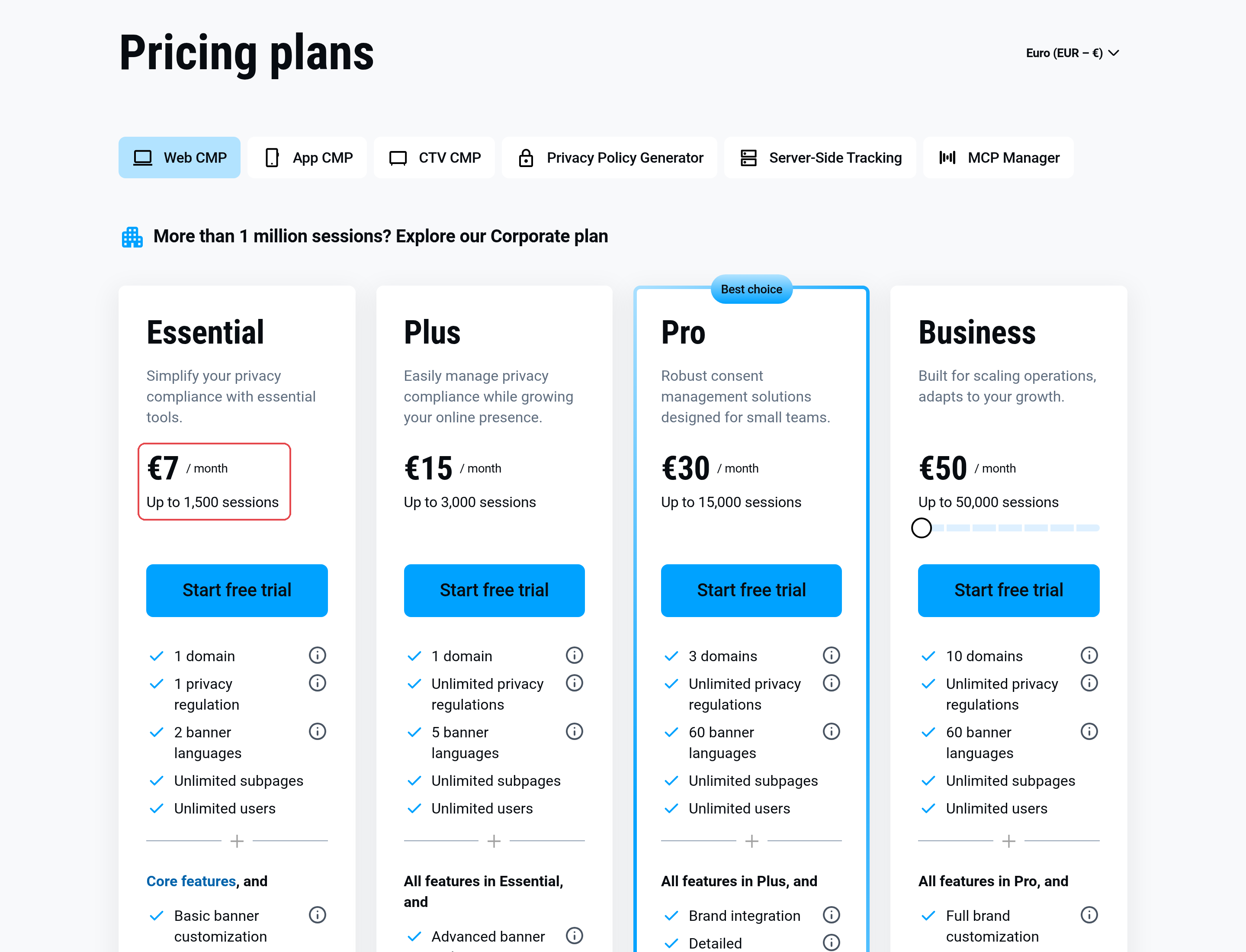
Price packing is the other reason people start a shortlist. Usercentrics Web CMP still publishes Essential at €7 a month for up to 1,500 sessions, on one site, with two banner languages. G2 lists the same Essential figure. That tariff is the CMP. Preference Manager is a separate product, with no self-serve price on the Web CMP cards. Cookiebot Core also starts Premium Lite at €7 a month, billed on subpages, up to 50, on one site.
The structural gap matters more than the invoice. A CMP log proves a cookie choice. Rule 3, from about 13 May 2027, still asks for a notice and for a withdrawal as easy as the grant. If the DPO cannot show that notice, and if a withdrawal dies in the banner, the tool has done the website job and stopped short.
Cookiebot, Usercentrics, and the Preference Manager
Cookiebot is a trademark of Usercentrics A/S, registered in Denmark. You are dealing with one vendor family and two commercial tracks.
Cookiebot Core is the website CMP billed on the number of subpages and the number of sites. The free plan covers up to 50 subpages on one site. Premium starts at Lite, €7 a month, and then rises with subpage count, up to XLarge at €90 a month per site, exclusive of VAT. Usercentrics Advanced, on the same Cookiebot pricing URL, is a session-based enterprise track sold through sales. Cookiebot's own FAQ is blunt: Core and Advanced "are based on different technologies and functionalities," so you cannot upgrade from one to the other inside the product.
Usercentrics Web CMP is the session-based track on usercentrics.com/pricing. Free covers fewer than 1,000 sessions a month on one site. Essential, Plus, Pro and Business then step up by session volume, and Corporate starts from 1 million sessions, through sales. Prices are in euro, exclusive of VAT. Essential allows one privacy regulation and two banner languages. IAB TCF support starts at Pro.
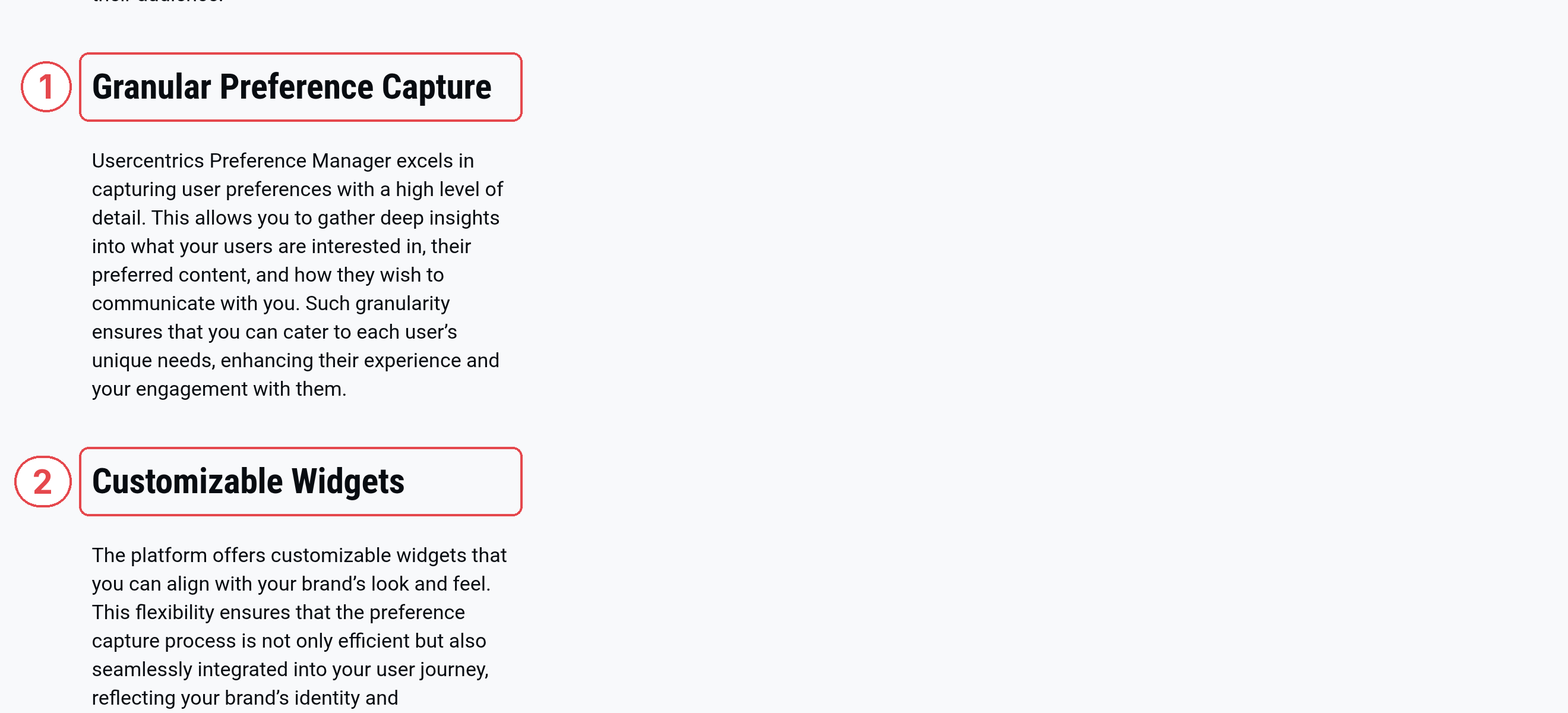
Preference Manager is the third piece of the family, and it is easy to miss on a CMP invoice. I would judge it on granular preference capture, widgets you can adjust, and connectors such as Mailchimp and Zapier, all covered in this help article. It sits outside the Essential plan, and I would budget it separately from the Web CMP cards.
If you already pay for Cookiebot or Usercentrics and you only needed a website banner, you may be fine. Read on if the next purchase is a preference layer, a DPDP record, or a cheaper published CMP.
Comparison table
Prices, plan limits and G2 scores in this table are dated 13 November 2026.
| Tool | Best for | Banner and scan | Preference centre | DPDP record / withdrawal reach | Public price |
|---|---|---|---|---|---|
| Redacto | Teams that outgrew a banner and need a DPDP record, with cookie consent as a module | Site scan and a banner in English or the 22 scheduled languages | Not sold as a stand-alone marketing preference centre | The cookie choice writes to the programme record; a later withdrawal is meant to follow that record | Quote-based |
| Didomi | Marketing-led teams that want a branded preference layer as well as a CMP | CMP with a cookie scan and ad-tech standards | Preference Management Platform: full-page centres, forms and widgets | Confirm a DPDP-shaped record, and whether a withdrawal leaves the site, in a trial | Quote-based; /pricing returns 404 |
| OneTrust | Organisations already in the OneTrust estate | Cookie Consent CMP with auto-blocking | UCPM, a separate preference portal | Confirm a DPDP notice and downstream reach in a trial | Quote-based |
| CookieYes | Teams that still only need a website CMP at a published price | Published scan depth and pageview caps | Banner controls, not a marketing preference centre | A website CMP log | Basic $10 a month per site |
| Osano | Mid-market teams that want a lighter consent and preference product | Cookie Consent plans with tracker discovery | Unified Consent & Preference Hub | Confirm a DPDP-shaped record in a trial | Cookie Consent from $0; $199 a month at 30,000 visitors |
| Ketch | Teams that want a published price for a privacy preference centre | Tracker scanning on every plan | Privacy preference centre on all plans; marketing preference on Pro | Confirm a DPDP-shaped record in a trial | Free $0 (5,000 unique users); Starter $150 a month |
| iubenda | Teams that want a CMP plus legal-policy generation | Site scans plus generated privacy and cookie policies | Privacy controls on the CMP | Confirm a DPDP-shaped record in a trial | Essentials €4.99 a site a month, billed yearly |
| Consently | India-focused website CMP with DPDP positioning | Automated cookie scanner on paid plans | Privacy Preference Centre; full centre from Growth | DPDP notices, easy withdrawal and a Request Centre | Starter Rs. 25,000 a year |

How we chose these alternatives
I started from the job the search implies: you already run Usercentrics, Cookiebot, or both, and you want to know what else exists. I kept the field to eight, and scored each row on the banner and the scan, on whether a preference centre exists and which plan it sits on, on whether I can see a path to a DPDP-shaped record and a withdrawal that leaves the site, on a public price, and on a dated review corpus.
If you are still choosing a category rather than leaving a vendor, start with consent management platforms in India, and read cookie consent manager versus a DPDP Consent Manager when you need the legal distinction. For the three types of consent tool, use how to choose between types of consent management solutions.
Didomi, OneTrust UCPM, Osano and Ketch are here because a Preference Manager conversation is often why a Usercentrics customer opens a shortlist. CookieYes, iubenda and Consently are here because many teams in this query still only needed a published banner plan. Termly and Complianz stay in the situation notes, not as leads, unless you are on WordPress and want a plugin-first install.
Against Usercentrics or Cookiebot, for every row below, means this: does the alternative close the gap that made you look, a DPDP record, a preference centre, or a clearer public price, without a second unnamed product on top of the CMP.
The 8 best Usercentrics and Cookiebot alternatives
1. Redacto
Full disclosure: we build Redacto, so I won't score it beside the others.
Three customers, in their own words:
Surya N, Director, Product Management, TimePay: "As a product team, we had one worry: would privacy compliance hurt the onboarding journey? It didn't. Redacto's consent flows fit into our app with very little engineering effort, and we change notices from the console instead of shipping a new build. Our users get a clear choice at every step, and we get a consent record we can stand behind."
Prem Kumar, Data Protection Officer, Pine Labs Group: "Privacy across a group of businesses is hard because every team has its own systems and its own idea of what personal data it holds. Redacto gave us one view of where personal data is collected, why we collect it and where it goes. When a customer request or an audit question comes in, I answer it with evidence, not a round of emails."
Saif, Head, Infosec Compliance & Privacy, Razorpay: "Our vendor security and privacy reviews used to live in spreadsheets and long email threads. With Redacto, every assessment, every piece of evidence and every follow-up sits in one place. When a customer sends us a security questionnaire, we answer it from that same record. We focus on the vendors that actually carry risk, and the paperwork no longer runs the week."
These are our customers speaking, so weigh them that way and ask for a reference call.
By our own count we've done 40+ successful implementations.
Features
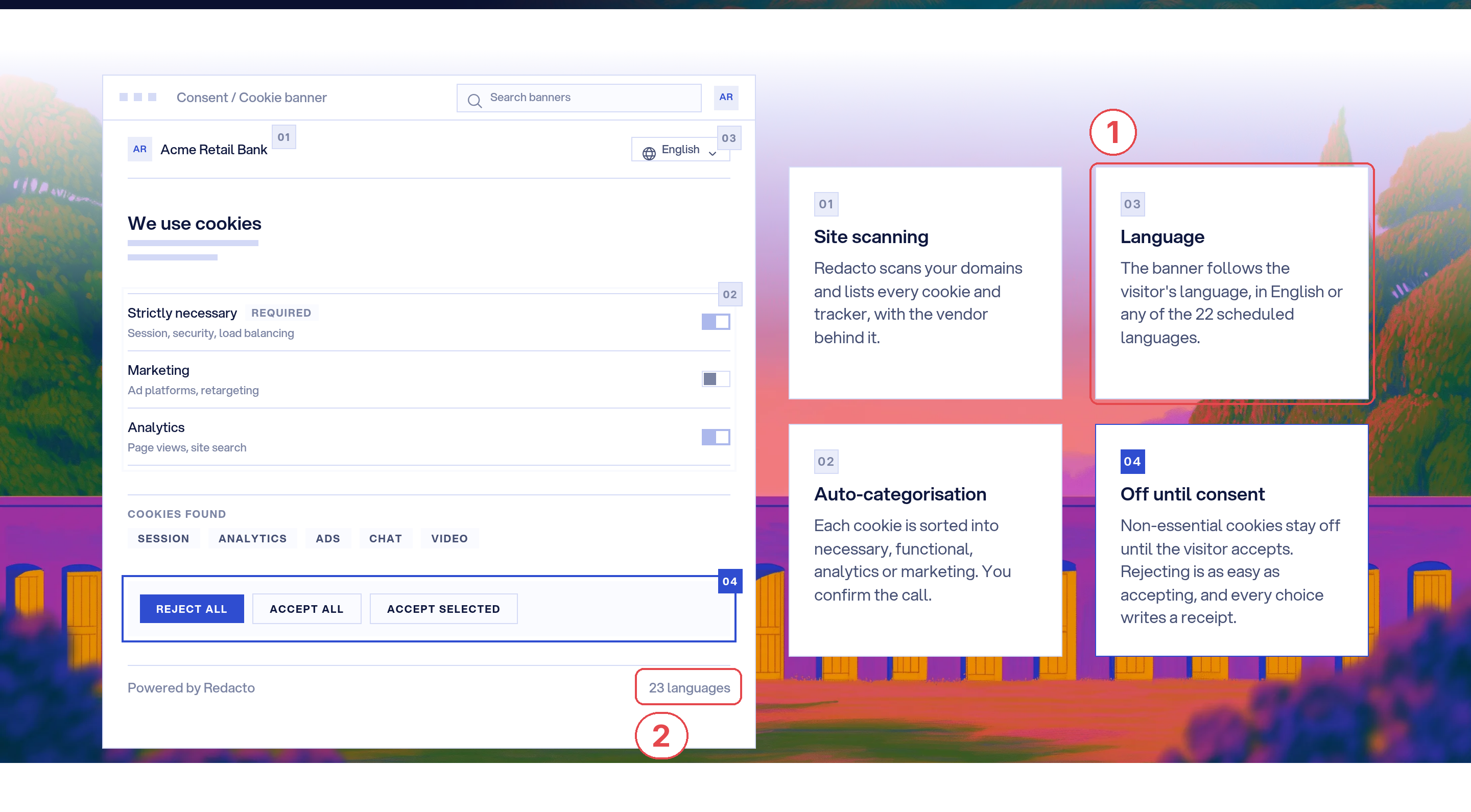
Redacto Cookie Consent scans your sites, names the vendor behind each cookie and tracker, and asks a person on your team to confirm the category. I like that human sign-off. First-party analytics cookies are miscategorised often enough that a minute of review is worth it.
Visitors can be shown the banner in English or in any of the 22 languages of the Eighth Schedule. Optional cookies remain blocked until the visitor accepts. Reject is on the same layer as Accept. Each choice writes a receipt that points back to the banner version in force at the time, so an older grant still shows the older wording. Scheduled scans keep the cookie list current when marketing adds a tag.
Why I rank it: the cookie choice is meant to sit on the same consent record as notices in your app, web and branches. A withdrawal made in the app should be honoured on the website too. In a trial, I would watch one withdrawal land in every system we have mapped.
Pricing
Quote-based.
A quote follows volume, and consent is metered on how many Data Principals you serve and on how many processors must receive each withdrawal or each new user, because each processor adds API calls. List every channel before you ask for a number. The same volume rules are in this LinkedIn post from Redacto:
Reviews
There isn't a public review base yet.
Clients
I am treating the three quotes above as the public references for this row. Ask for a reference in a stack close to yours, and come to the first call with one of your live sites.
Summary
Pick Redacto if the cookie module is part of a wider DPDP record and you are willing to work from a quote plus a reference call. The cons are real. There is no public self-serve CMP price, so a team that only wants a dollar or pound banner plan will usually be better served by CookieYes or a similar published tariff. There isn't a public review corpus. Cookie consent is one module of a wider record, which is unnecessary if the only job is a banner on a single site.
Against Usercentrics or Cookiebot: the cookie choice is meant to sit with the rest of the programme record, in Indian languages, without a second product invoice for a preference layer you may not need. What you give up is a published €7 starting plan and a large G2 corpus.
2. Didomi
Features
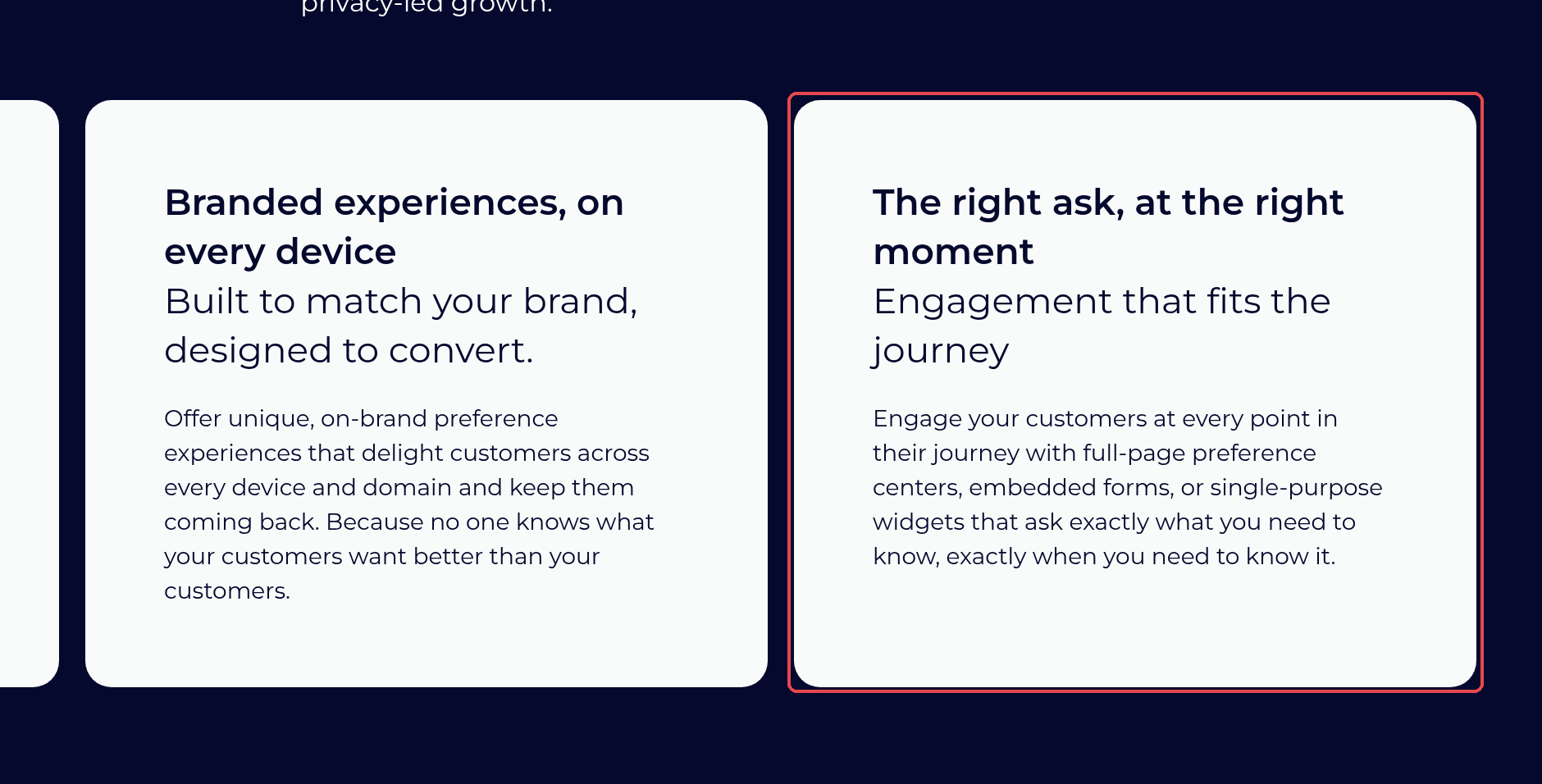
Didomi's consent management platform is the website and app CMP, with a cookie and tracker scan and support for IAB TCF, GPP, Google Consent Mode, Microsoft UET Consent Mode and AWS Consent Mode. If you are leaving Usercentrics because Preference Manager never quite landed, the product I would actually trial is the Preference Management Platform: full-page centres, embedded forms, or single-purpose widgets that ask at the moment the choice matters.
I would still ask, in a trial, whether a withdrawal or a preference change leaves the centre and reaches the marketing tools you already run, and whether a DPDP notice can sit on the same record as the CMP log.
Pricing
Quote-based. didomi.io/pricing was still a 404 on the writing day, 13 November 2026, same as the day before. Get the CMP and the preference platform priced as separate lines if you might buy only one.
Reviews
On G2, Didomi sits at 4.5 out of 5, from 182 reviews, as of 13 November 2026. Users on G2 like fast support and clear reporting, and complain about the custom CSS needed for deeper styling, a clunky UI, and a mid-market price that some find high (G2, October 2026). Hywel T., on 14 October 2026, praised "Lightning-Fast Human Support" and "an Intuitive UI with Clear Reporting," and wrote that "the custom CSS needed for advanced styling" can slow a project because it needs developer time. A mid-market reviewer, last updated 14 October 2026 and first filed on 15 July 2026, liked easy setup, A/B testing and support, and wrote: "Price is a bit high compared to the market." Sushmeet S., on 26 October 2026, wrote: "The UI feels very clunky, and it isn't especially intuitive to use." Those comments are recent, and they are mostly about the CMP and support, so ask for a preference-centre walkthrough as well.
Clients
Ask Didomi for a reference in your sector, on the preference platform if that is the module you are buying.
Summary
Pick Didomi if marketing wants a branded preference layer and you can live with a quote. Skip it if a published starting price is required, or if a DPDP-shaped record is the job and the trial cannot show one.
Against Usercentrics or Cookiebot: you get a preference platform that is sold and documented as its own product, with a current G2 corpus, at the cost of no public tariff and a UI some reviewers still call clunky.
3. OneTrust (CMP / UCPM)
I am judging two modules here, and I will keep them apart. Cookie Consent is the website CMP, with cookie auto-blocking named on the product URL. Universal Consent and Preference Management, or UCPM, is the preference portal. If you already pay for OneTrust, the honest question is which module you are being asked to add, not whether the brand name is familiar.
Features
The CMP is the like-for-like row against Usercentrics Web CMP or Cookiebot Core: a banner, a scan, auto-blocking, and a consent signal into the tag stack. UCPM is the like-for-like row against Preference Manager: a single portal where people set consent and communication choices, with the vendor claiming a sync into marketing tools. I would ask to see a DPDP notice and a withdrawal that reaches those tools, in a trial, on the module you are actually buying.
If the wider suite is itself in question, use OneTrust alternatives. This entry assumes you may stay inside the estate.
Pricing
Quote-based. I did not treat any third-party listing as OneTrust's own tariff.
Reviews
On G2, Consent and Preferences is 3.6/5, from 17 reviews, dated 13 November 2026. The corpus is small, and some comments describe cookie banners, so only count a review as UCPM if the title is about the preference portal. The newest in-window comment is from Priyanka S., on 29 September 2026, who wrote that her company "evaluated many other products in the market for UCPM" and chose OneTrust, and was still evaluating the rollout. A mid-market reviewer, on 20 August 2025, liked a simple customer-facing interface, and complained about a clunky admin, a cookie crawl that "knocked us offline," and "Very short notice for massive 275% followed by 468% price increases." That review is older than 12 months. Treat it as one customer's report, and still ask about crawl rate limits and renewal caps.
Clients
Ask for a reference on the module you are buying, CMP or UCPM, in a stack close to yours.
Summary
Pick OneTrust if you already live in the estate and a trial of the right module shows the DPDP notice or the preference portal you are missing. It is a weaker fit if you wanted a published CMP price, or if you are trying to leave the suite.
Against Usercentrics or Cookiebot: you can add a preference portal inside a platform you may already have, at the cost of a quote, a small and mixed G2 corpus, and the need to pin down which module is in the order form.
4. CookieYes
Features
CookieYes is a website CMP with auto-blocking, Google Consent Mode v2, and a published scan and pageview cap on each plan. The free plan covers 100 pages in each scan and 5,000 pageviews a month. Basic, at $10 a month per site, raises the scan to 600 pages and the traffic cap to 100,000 pageviews, with overage at $0.30 per 1,000 extra pageviews. Pro is $25 and Ultimate $55, or $100, $250 and $550 when billed yearly (two months free). IAB TCF and geo-targeting start at Pro. This is a banner product, not a marketing preference centre and not a DPDP programme record.
Pricing
Those figures are from cookieyes.com/pricing on 13 November 2026, in US dollars, exclusive of local taxes, per site. Annual billing is ten months paid, two months free.
Reviews
On G2, CookieYes sits at 4.8 out of 5, from 327 reviews, as of 13 November 2026. Users on G2 like how easy the product is to use and the customer service, and complain about a WordPress plugin that can be glitchy at install and about a double-billing incident that was later refunded (G2, October 2026). Jean-Philippe A., on 30 October 2026, wrote "Great customer service, easy to use and install product," and also: "Wordpress plugin can be a bit glitchy at install time and I was double billed, but then refunded upon request." Most of the recent corpus is about install, support and the banner, which is the right corpus for this row.
Clients
Ask CookieYes for a reference if you are buying for more than one property.
Summary
Pick CookieYes if a published banner plan is the whole job and you can live with the scan and pageview caps. Skip it if you need a DPDP notice, a preference centre that reaches CRM, or Indian-language notices as a first-class product claim.
Against Usercentrics or Cookiebot: you get a clear dollar tariff and a large, current G2 corpus, at the cost of staying in website-CMP scope.
5. Osano
Features
Osano's Unified Consent & Preference Hub is the preference product: a centre people can use with simple toggles, on a site or in an app, with connectors named for tools such as HubSpot, Mailchimp and SendGrid. Cookie Consent is the banner product, with tracker discovery, auto-blocking and regional banner rules. Recent G2 comments, including Bill R. on 21 September 2026, are mostly about the cookie product, so keep the two modules apart in the demo.
Pricing
The main plans URL, on 13 November 2026, no longer lists dollar figures; it sends you to a demo. The Cookie Consent plans URL still does: a $0 monthly plan for 5,000 monthly visitors on one site, and $199 a month for 30,000 monthly visitors, with a custom tier above that. G2 lists a Basic figure of $119.99 "Per Feature Per Month." That is G2's listing, not a figure I am treating as Osano's own published tariff. Get the Unified Consent & Preference Hub priced as its own line.
Reviews
On G2, Osano sits at 4.5 out of 5, from 173 reviews, as of 13 November 2026. Users on G2 like a simpler setup than OneTrust and AI-assisted script categorisation, and complain about the lack of a bulk way to blocklist scripts (G2, September 2026). Those recent comments are about Cookie Consent, not the Unified Consent & Preference Hub. Bill R., on 21 September 2026, wrote that setup was "a big improvement" on OneTrust, and that AI "categorize[s] many of the scripts," and asked for "a better way to bulk categorize as 'Blocklisted' those scripts we'd like to block." Like most recent Osano comments, that review is about cookie consent, not the Unified Consent & Preference Hub.
Clients
Ask for a Unified Consent & Preference Hub reference if that is the module you need, not only a banner reference.
Summary
Pick Osano if you want a mid-market consent and preference vendor with a published Cookie Consent starting price. It is a weaker fit if the Unified Consent & Preference Hub is the job and you cannot get a written price and a worked withdrawal before you sign.
Against Usercentrics or Cookiebot: you get a lighter preference product in the same vendor as the banner, and a published $0 / $199 Cookie Consent tariff, at the cost of a Unified Consent & Preference Hub price that still goes through sales.
6. Ketch
Features
Ketch consent management is the CMP, with tracker scanning and a consent experience designer on every plan. The important split, if you are leaving Usercentrics for a preference centre, is on the pricing table. A privacy preference centre is included on Free, Starter, Plus and Pro. An on-brand marketing preference centre, with granular controls for type, frequency and channel, is included on Pro only.
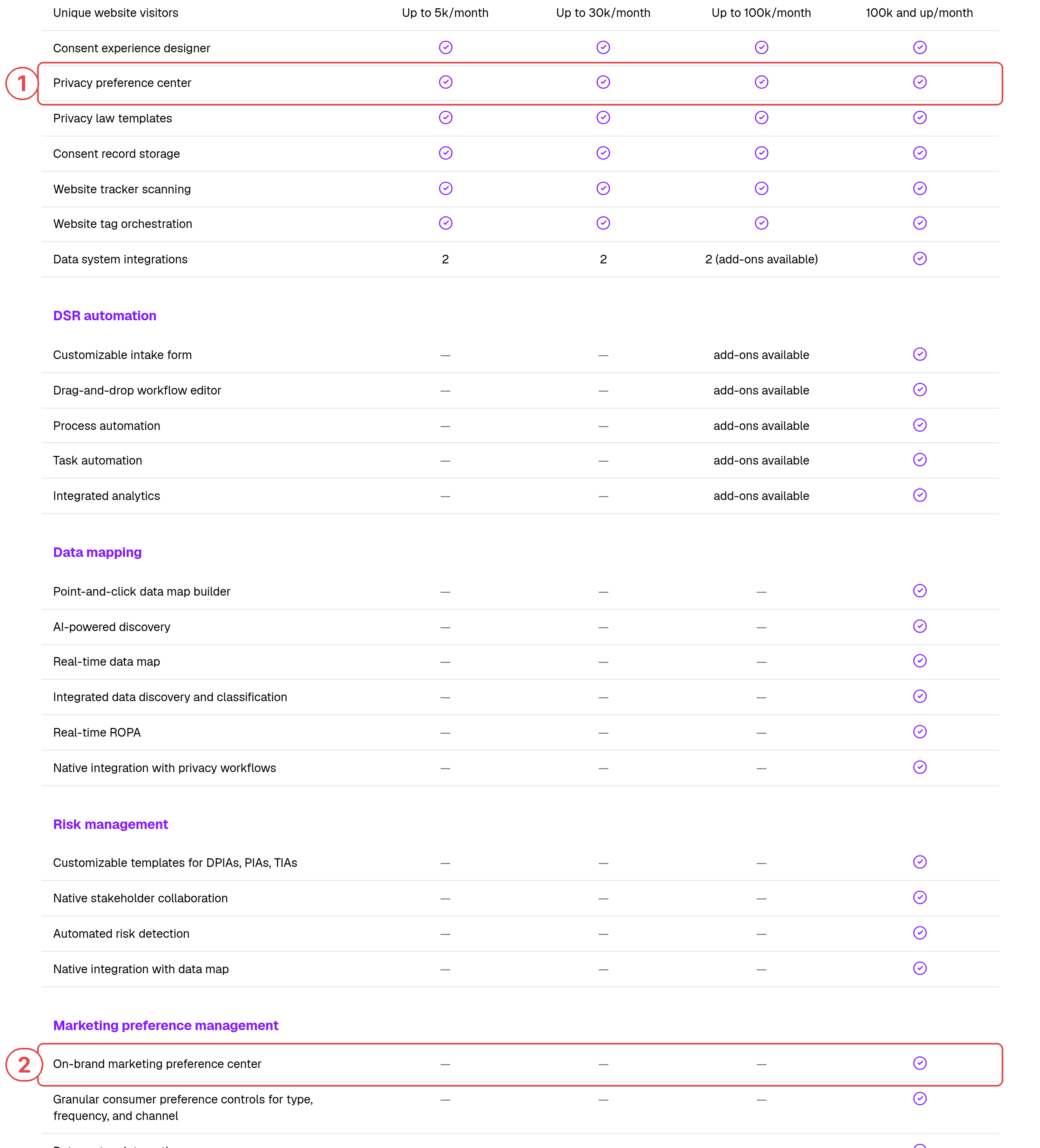
I would ask, in a trial, whether the centre you are buying is the privacy centre or the marketing centre, and whether a DPDP notice can live on that record.
Pricing
Rechecked on 13 November 2026. The free plan is $0, capped at 5,000 unique users a month. Starter is $150 a month, billed monthly, for up to 30,000. Plus starts from $499 a month, billed annually, for up to 100,000. Pro is custom, and it is the plan that includes marketing preference management. Unique users are counted across web and app, whether or not the visitor interacts with the banner.
Reviews
On G2, Ketch is 4.6/5, from 225 reviews, dated 13 November 2026. Users on G2 like the banner design tools and the support, and complain about costly add-ons and a price that feels high once rights and downstream consent are added (G2, November 2026). A 2 November 2026 reviewer titled the piece "Easy-to-Use Consent Management with Great Support, but Costly Add-Ons," liked the banner design tools and support, and wrote that rights management and sending consent choices downstream "should be more baked into the consent plans," and that "The current price is a bit high for us given what we already spend for Ketch." Most November 2026 comments are about website banners and cookie consent. If marketing preference is the reason you are buying Pro, have sales write down which centre sits on which tier.
Clients
Ask Ketch for a reference on the centre you are buying.
Summary
Pick Ketch if you want a published price and a privacy preference centre that starts on the free plan, and you can accept that the marketing centre sits on Pro. Skip it if the only job is a cheap banner and you do not want another CMP to configure.
Against Usercentrics or Cookiebot: the privacy preference centre is on the public tariff, including Free, so you are not guessing whether a €7 CMP plan includes it. The trade-off is a Pro-only marketing centre and a review corpus that still talks mostly about banners.
7. iubenda
Features
iubenda combines a cookie consent banner with generated privacy and cookie policies, and, on higher plans, terms and conditions. The entry plan, Essentials, includes the banner, a standard privacy and cookie policy with up to 20 service clauses, one language, monthly site scans, and up to 25,000 pageviews a month. Higher plans raise the pageview cap and add geo-targeting; Ultimate also adds hourly scans, all languages, a mobile SDK and consent analytics. Extra pageviews are billed at €0.05 per 1,000. This is a CMP plus a policy generator. A DPDP-shaped record still has to be confirmed in a trial.
Pricing
On 13 November 2026, Essentials is €4.99 a site a month when billed yearly, or €5.99 on monthly billing, in euro exclusive of VAT. Advanced is €19.99 yearly / €21.99 monthly. Ultimate is €79.99 yearly / €89.99 monthly. iubenda also quotes dollar equivalents.
Reviews
On G2, iubenda sits at 4.5 out of 5, from 71 reviews, as of 13 November 2026. Users on G2 like a straightforward setup, Google Tag Manager templates and the automatic website scan, and complain about early trouble with how preferences were stored, and about extras that are hard to place (G2, November 2026). Kateryna S., on 6 November 2026, liked a "straightforward" setup, Google Tag Manager templates, and "the automatic website scan," and wrote that the team "initially experienced some technical issues related to how user preferences were stored," which support then resolved. A 30 October 2026 reviewer liked the free option and the guided banner setup, and found the extras, such as a consent database and a whistleblowing form, "a bit difficult to know what you should use."
Clients
Ask iubenda for a reference if you are buying for more than a single brochure site.
Summary
Pick iubenda if you want the banner and the legal documents from one vendor, at a published euro price. Skip it if you need a DPDP programme record or a marketing preference centre as the first job.
Against Usercentrics or Cookiebot: you get a cheaper published entry plan plus policy generation in the same buy, at the cost of staying in website-CMP and document-generation scope.
8. Consently
This is consently.in, not consently.net.
Features
Consently sells a website CMP with an automated cookie scanner, Google Consent Mode v2, and multi-language banners, plus DPDPA consent notices, a Privacy Preference Centre, a Request Centre for rights requests, and easy withdrawal. Every paid plan includes all 22 scheduled languages. The Preference Centre is basic on Free and Starter, and full from Growth. The scanner is monthly on Starter, weekly on Growth and daily on Business. If you want a deeper read, use our Consently review and the Consently alternatives shortlist. I am not using our own review as a stand-in for an independent corpus.

Pricing
All paid plans are billed annually, exclusive of 18% GST, and priced per website or mobile application. Free is Rs. 0, with 100 cookie consents and 100 DPDPA consents a year. Starter is Rs. 25,000 a year. Growth is Rs. 60,000. Business is Rs. 1,20,000. Enterprise is custom. Those figures were unchanged on 13 November 2026. Overage and optional setup fees sit on the same pricing URL; they are not the subscription price.
Reviews
There is no G2, Capterra or PeerSpot corpus for Consently. Use the review linked above as our own take, and ask for a customer reference in your sector.
Clients
Ask for a reference whose site size and form load look like yours.
Summary
Pick Consently if you want a published rupee CMP with DPDP notices, Indian languages and a Request Centre. Skip it if you need a global ad-tech CMP, a large independent review corpus, or a preference platform at Didomi's or OneTrust's depth.
Against Usercentrics or Cookiebot: the DPDP notice, the languages and a public rupee tariff sit in the same plan as the banner, at the cost of a smaller vendor and no independent review corpus I can cite.
How to choose, by situation
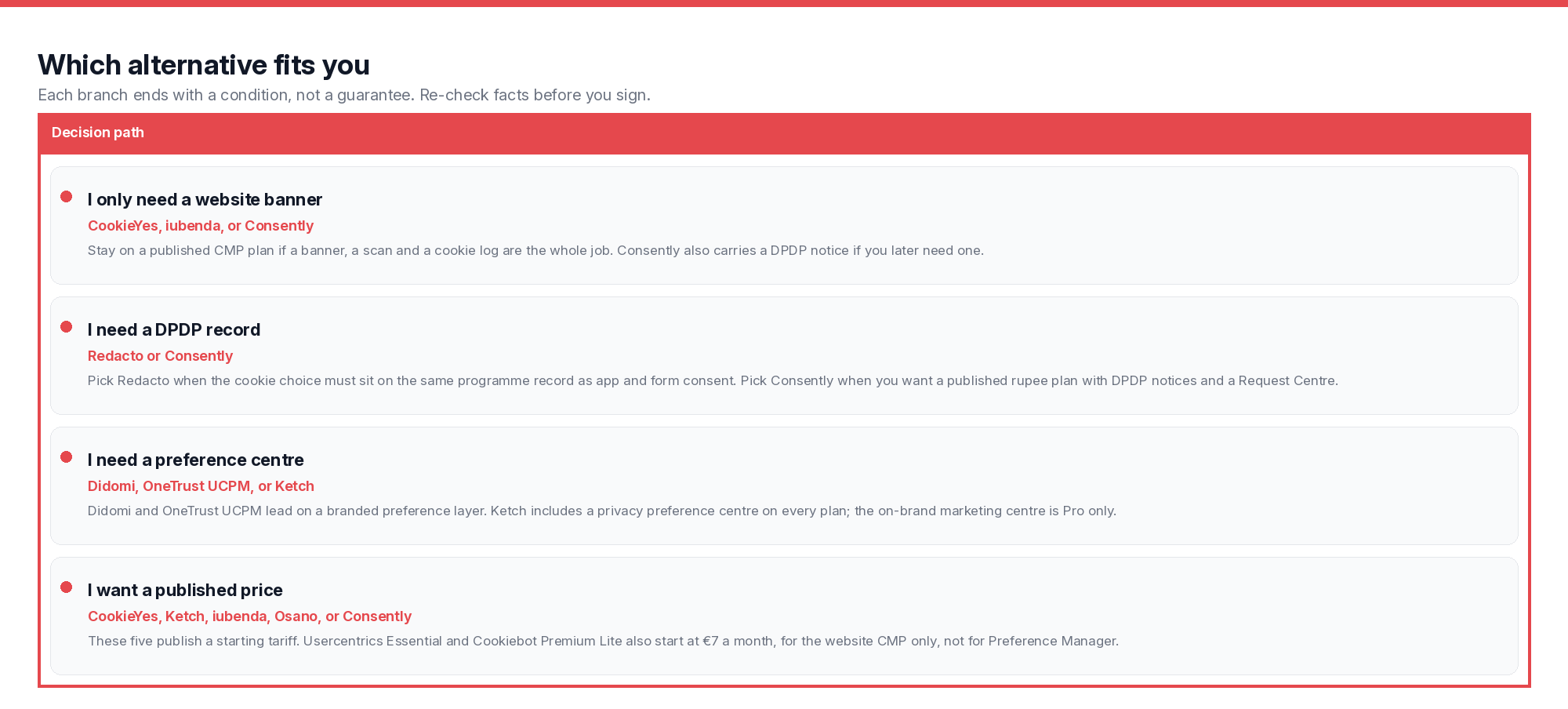
I only needed a website banner
Stay on Usercentrics Essential or Cookiebot Premium Lite if the current install is stable, the session or subpage cap still fits, and nobody is asking for a DPDP notice. If the invoice is the problem, CookieYes and iubenda publish a starting tariff that is easy to compare with €7 a month. Consently is the India-shaped version of the same job, with a DPDP notice sitting on the plan if you later need one. If you are on WordPress and want a plugin-first install, look at Complianz and Termly; I have not made them leads, because this query is not, by default, a WordPress-only search.
I need a DPDP record as well
A banner log will not get you there on its own. Shortlist Redacto if the cookie choice must sit on the same record as app and form consent, and you can work from a quote. Shortlist Consently if you want that notice and a Request Centre on a published rupee plan. In either case, watch one withdrawal leave the website and reach the systems that still hold the data, in a trial, before you move the script.
I need a preference centre, not another banner
Didomi's Preference Management Platform and OneTrust UCPM are the two products built for a branded preference layer. Ketch gives you a privacy preference centre on every public plan, and a marketing preference centre on Pro only. Osano's Unified Consent & Preference Hub is the mid-market version of the same idea, sold through a demo. Usercentrics Preference Manager can stay in the conversation if you already pay for the CMP, but do not treat the Essential plan as that product. Confirm, in a trial, that a change in the centre reaches CRM, email and ads.
I want a published CMP price
CookieYes, iubenda, Ketch, Osano Cookie Consent and Consently all had a published starting price on 13 November 2026. Usercentrics Essential and Cookiebot Premium Lite also start at €7 a month, for the website CMP only. Redacto, Didomi and OneTrust do not publish a self-serve CMP price. If finance needs a number this week, start with the five published rows.
I already pay for OneTrust
Do not start a net-new CMP search until you know which module is missing. If the gap is a website banner, the Cookie Consent CMP may already be in the estate. If the gap is a preference portal, trial UCPM. If the gap is a DPDP notice and you cannot get one in that trial, add Redacto or Consently, and weigh a full exit from OneTrust only after that.
Final thoughts
Most teams that type this query do not hate their banner. They have outgrown what a banner can prove. If the next six months are about Rule 3, a withdrawal that has to leave the site, or a preference centre marketing can actually use, pick the row that closes that gap and make the trial show it on your stack. If the job is still a single site and a published CMP price, a cheaper banner plan is a valid answer, including staying on the plan you already have.