7 Best Transcend Alternatives for Privacy Infrastructure (2026)
Seven alternatives to Transcend for privacy infrastructure, compared on consent, request automation, enforcement, DPDP fit, price and dated reviews.

I keep meeting privacy leads whose engineering team owns a deep enforcement stack, yet the DPO still cannot show a notice a Data Principal would recognise, a withdrawal receipt that reached the systems that hold the data, or a grievance clock that satisfies Indian law. Under the Digital Personal Data Protection Rules, 2025, Rule 14, which applies from about 13 May 2027, sets a ceiling of ninety days for a grievance. Sections 11 to 14 of the Act cover the rights that sit beside that clock. The Rules do not set a statutory deadline for access, correction or erasure. I picked these rows for teams that run, or will soon buy, an engineering-led consent and rights platform, and now have to decide whether that stack also carries a DPDP-shaped record. I compare seven options on consent and preference, request fulfilment, what happens when a system will not take an API call, Indian-law fit, and the public price.
TL;DR
Transcend (transcend.io) is a strong buy when engineering will own real-time consent and preference enforcement, and when a request has to be honoured across connected systems. Teams look past it when they need a published price, when the public review comments available to quote are older than 12 months, when a DPDP notice or grievance clock has to be proven in India, or when the DPO wants an India-built programme record.
- Redacto. Best when requests and grievance have to sit on the same record as consent. Quote-based. The product URL still uses DSAR naming. No public review corpus.
- Ketch. Best when you want consent routing on a published plan, and can treat DSR automation as a Plus add-on or a Pro inclusion. Free is $0 for 5,000 unique users a month. DSR automation is not on Free or Starter.
- DataGrail. Best when a privacy-ops team wants SaaS request automation, with Smart Verification and in-platform collaboration. Quote-based.
- OneTrust DSR Automation. Best when OneTrust is already in the estate. Quote-based. Comments sit on the Privacy Automation G2 profile, not on a DSR-only corpus.
- Securiti DSR Automation. Best when fulfilment is expected to follow a discovery graph. Quote-based. Securiti is now part of Veeam.
- Didomi. Best when the first job is a designed preference centre, and request proof still has to be confirmed in a trial. Quote-based. didomi.io/pricing still returns HTTP 404.
- Privy by IDfy. Best when rights and consent have to live inside an India-built suite. Quote-based. No public review corpus.
Why teams look past Transcend (transcend.io)
I mean Transcend the privacy product, at transcend.io. Other firms share the name, and I leave them out.
Someone looking for a self-serve price will not find one on the current site. Opening transcend.io/pricing on 13 November 2026 still lands on a contact form. On the same day, the Transcend profile on G2 shows a Basic figure of $10,000 per user per year. Until that number appears on Transcend's own pricing page, I would read it as a directory listing, not as a confirmed tariff.
The Transcend G2 profile, dated 13 November 2026, scores 4.6 out of 5 from 112 reviews. Users on G2 have liked how simple the system is for user preferences, and have complained that the price puts it outside the range of many smaller companies (G2, February 2025, older than 12 months). That score is current. The comments you can actually read on the most-recent pages are not. A mid-market reviewer on 20 February 2025 wrote "We've enjoyed the simplicity of using the system for user preferences." A mid-market reviewer on 19 February 2025 wrote "The price is quite high, which will put this solution out of the range of possibilities for a lot of smaller companies." Both lines are older than 12 months, so I would read them as dated reports, not as a 2026 verdict. I have left PeerSpot and Capterra figures out.
On the product side, Transcend leads with request automation and with consent that is meant to take effect in the systems that still hold the data, not only in a banner. The lead artefacts on the DSR Automation hero are a request-status total, an erasure count, and requester actions to download data, opt out, or delete. The same hero also claims fulfilment can reach vendors with no API at all. Treat that as a claim to walk through in a trial. That packaging is written for a global, engineering-led buyer. A DPDP notice, a withdrawal receipt, and a grievance path that would satisfy Rule 14 still have to be walked through in a trial.
The same DSR page still names Sombra as Transcend's self-hosted, zero-trust component that can run inside your infrastructure. That is useful if security wants the control plane close to your systems. It is also more infrastructure than some DPOs want to own. Whether a Transcend-hosted option is available on your contract is a question for the trial.
Engineering time is the other reason teams look around. A stack that can honour a request across connected systems is only useful if your team can own the connectors, the self-hosted component if you choose it, and the exceptions that still need a person. If that ownership is not in the plan, a request-first queue or an India-built programme record will usually be a better first trial than another enforcement platform.

Comparison table
| Tool | Best for | Consent / preference | Request fulfilment | No-API path | DPDP / Indian-law fit | Public price |
|---|---|---|---|---|---|---|
| Redacto | Indian teams that want requests and grievance on the same record as consent | Consent and requests on the same programme record | Request and grievance queue with a visible SLA clock | A missing connector becomes a tracked task on the same clock; confirm in a trial | India-built record; Rule 14 is the official ninety-day grievance ceiling | Quote-based |
| Ketch | Teams that want consent routing and a published plan, with DSR as an add-on or a Pro inclusion | Privacy preference centre on every plan | DSR automation on Pro; Rights Workflows add-on on Plus | Ask in a trial | Confirm a DPDP-shaped record in a trial | Free $0 (5k unique users/month); Starter $150/month billed monthly; Plus from $499/month billed annually |
| DataGrail | Privacy-ops teams centred on SaaS request automation | Consent sold as a separate module | Request Manager: Smart Verification and in-platform collaboration | Ask in a trial | Confirm a DPDP notice and grievance path in a trial | Quote-based |
| OneTrust DSR Automation | Organisations already on OneTrust | Consent in the wider OneTrust estate | DSR Automation module | Ask in a trial | Confirm a DPDP notice in a trial | Quote-based |
| Securiti DSR Automation | Discovery-graph fulfilment | Consent in the wider Securiti estate | DSR Automation on a discovery graph | Ask in a trial | Confirm a DPDP notice in a trial | Quote-based |
| Didomi | Preference and consent-led teams that still need proof and connectors | Preference Management Platform, with centres, forms and widgets | Confirm request fulfilment in a trial | Ask in a trial | Confirm a DPDP notice in a trial | Quote-based; no public tariff; see didomi.io/offers |
| Privy by IDfy | Indian enterprises that want rights and consent in an India-built suite | Consent in an India-built suite | DPRM portal and grievance routing | Ask in a trial | India-built; 22 scheduled languages | Quote-based |

How we chose these alternatives
The shortlist is limited to tools that can run a request or a withdrawal across systems, not only a website banner. Cookie-banner specialists are not in this table. Each row had to show a sourced fact on consent or preference, on request fulfilment, on a DPDP or Indian-language position stated on a current official page, and on a public price or a clear quote path. For every row I also needed a clear answer, or an honest gap, on what happens when a system will not take an API call. Where that path is not a confirmed fact on a current official page, the cell says to ask in a trial. These are vendor claims and public pages, not lab results. A "best for" line is a place to start, not a promise.
I include DataGrail as a SaaS privacy-ops option and Didomi as a preference-led option. If Didomi is the tool you are leaving, start with Didomi alternatives.
I kept Osano, Consiva and TrustArc in reserve, because I built the rows around request infrastructure and an India-shaped record, and a consent-banner comparison would be a different exercise. Ethyca is not a tool in this table; it belongs in a privacy-as-code conversation, which is not the job here.
The 7 best Transcend alternatives for privacy infrastructure
1. Redacto
Full disclosure: we build Redacto, so I won't score it beside the others.
Three customers, in their own words:
Surya N, Director, Product Management, TimePay: "As a product team, we had one worry: would privacy compliance hurt the onboarding journey? It didn't. Redacto's consent flows fit into our app with very little engineering effort, and we change notices from the console instead of shipping a new build. Our users get a clear choice at every step, and we get a consent record we can stand behind."
Prem Kumar, Data Protection Officer, Pine Labs Group: "Privacy across a group of businesses is hard because every team has its own systems and its own idea of what personal data it holds. Redacto gave us one view of where personal data is collected, why we collect it and where it goes. When a customer request or an audit question comes in, I answer it with evidence, not a round of emails."
Saif, Head, Infosec Compliance & Privacy, Razorpay: "Our vendor security and privacy reviews used to live in spreadsheets and long email threads. With Redacto, every assessment, every piece of evidence and every follow-up sits in one place. When a customer sends us a security questionnaire, we answer it from that same record. We focus on the vendors that actually carry risk, and the paperwork no longer runs the week."
These are our customers speaking, so weigh them that way and ask for a reference call.
By our own count we've done 40+ successful implementations.
Features
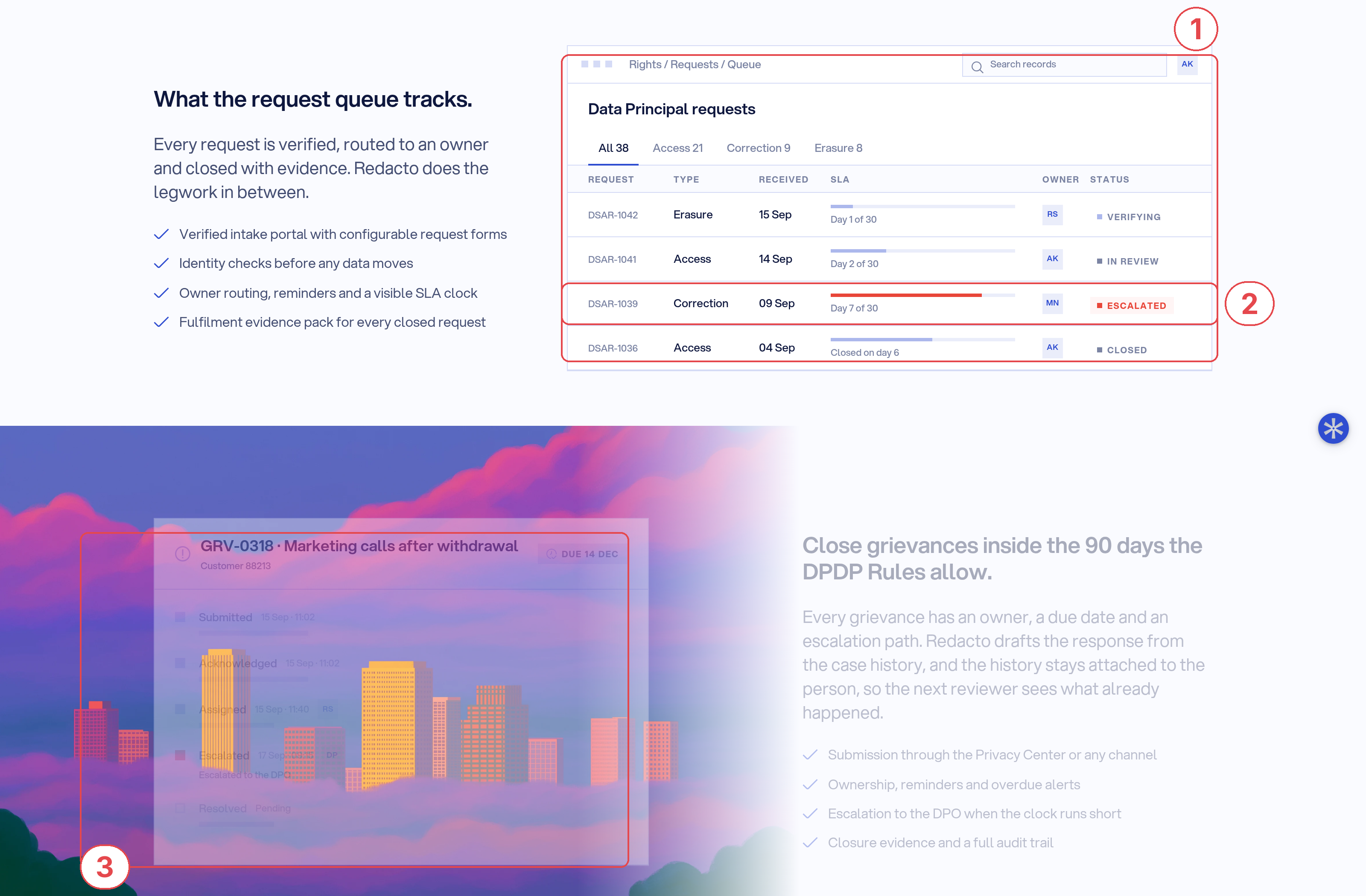
Redacto DSAR and Grievance Management is the product I would trial when access, correction, erasure and grievance have to sit on the same record as consent. The product URL still uses DSAR in the slug and the heading. The work itself is a Data Principal request queue: each item is routed to an owner, and a visible SLA clock sits on the row. A grievance case can carry a due date and an escalation to the DPO. The sample screen below is not a customer record.
The legal ceiling for a grievance is in Rule 14 of the Digital Personal Data Protection Rules, 2025, which applies from about 13 May 2027, and is not more than ninety days. Map the clock you see in a trial to the deadline you will actually publish. Rule 14 is the legal ceiling, not a product setting.
Requests are verified before data moves. Ask in a trial how that check is done, then follow one access request and one grievance from intake to an approved response, and read the notice that sits on the same programme record.
We have fewer pre-built connectors than some global request tools. Treat that as a real gap if pre-built SaaS connectors are the first job, and ask us for the current list before you decide.
Pricing
Quote-based; the way we price is explained in this Redacto post.
A quote for the wider programme follows how many Data Principals you cover and how many processors must be told about each withdrawal or each new grant, since every processor adds API calls. That metering is for consent volume. There is no separate public tariff for the rights module. The volume rules for consent are in this LinkedIn post from Redacto:
Reviews
There isn't a public review base yet.
Clients
Those three quotes are the public references for this row. Ask for a reference whose stack looks like yours, and bring one live request type plus one system that must honour a withdrawal.
Summary
Pick Redacto if requests and grievance have to share a DPDP-shaped record with consent, and you can work from a quote and a reference call. The cons are real. There is no public self-serve price. There isn't a public review corpus. The product URL still uses DSAR naming. Fewer pre-built connectors are published on our page than on some global request tools.
Against Transcend: the request and the grievance sit with the notice, in a queue a DPO can actually run. What you give up is Transcend's real-time enforcement story, a large G2 corpus, and a published catalogue of engineering connectors.
2. Ketch
Features
Ketch is the row I would open when a published consent plan matters on day one, and request automation can wait for the right card. As of 13 November 2026, Ketch pricing puts a privacy preference centre on Free, Starter, Plus and Pro. Data subject rights automation is included on Pro. Plus offers a Rights Workflows add-on. Free and Starter do not include DSR automation. That work runs in Ketch DSR Automation.
In a trial I would buy the centre and the fulfilment path as separate questions. Confirm which card actually includes the Rights Workflows or the Pro DSR automation, and watch a request reach the systems that still hold the data.
For a broader Ketch shortlist, see Ketch alternatives.

Pricing
On ketch.com/pricing, dated 13 November 2026, Free is $0 for 5,000 unique users/month. Starter costs $150 a month, billed monthly, for up to 30,000 unique users. Plus begins at $499 monthly when you pay annually, for up to 100,000 unique users. Pro is a quote. DSR automation, data mapping, marketing preference management and risk assessments are sold separately from consent management, and DSR automation is included on Pro.
Reviews
On the platform-wide Ketch G2 profile, dated 13 November 2026, the score is 4.6 out of 5 from 225 reviews. Users on G2 like consent management that is easy to run and support that is strong, and complain about costly add-ons and about rights work that is not baked into the consent plans (G2, November 2026). A 2 November 2026 reviewer titled the piece "Easy-to-Use Consent Management with Great Support, but Costly Add-Ons," and wrote that rights management and sending consent choices downstream "should be more baked into the consent plans." I would ask sales to write down which fulfilment work sits on which tariff before you start on Free.
Clients
Customer stories appear on Ketch's own site. I would ask for a reference that already runs DSR automation, not only the consent plan, and I would ask how long a request takes to reach a connected system.
Summary
Pick Ketch if a published consent plan is the first job, and you can accept that DSR automation sits on Plus as an add-on or on Pro as an included module. Prove a DPDP-shaped record in a trial. Do not start on Free or Starter expecting request automation to come with that card.
Against Transcend: you get a public tariff and a consent plan you can start on. What you give up is Transcend's enforcement-first packaging, and fulfilment is a later, or dearer, card.
3. DataGrail
Features
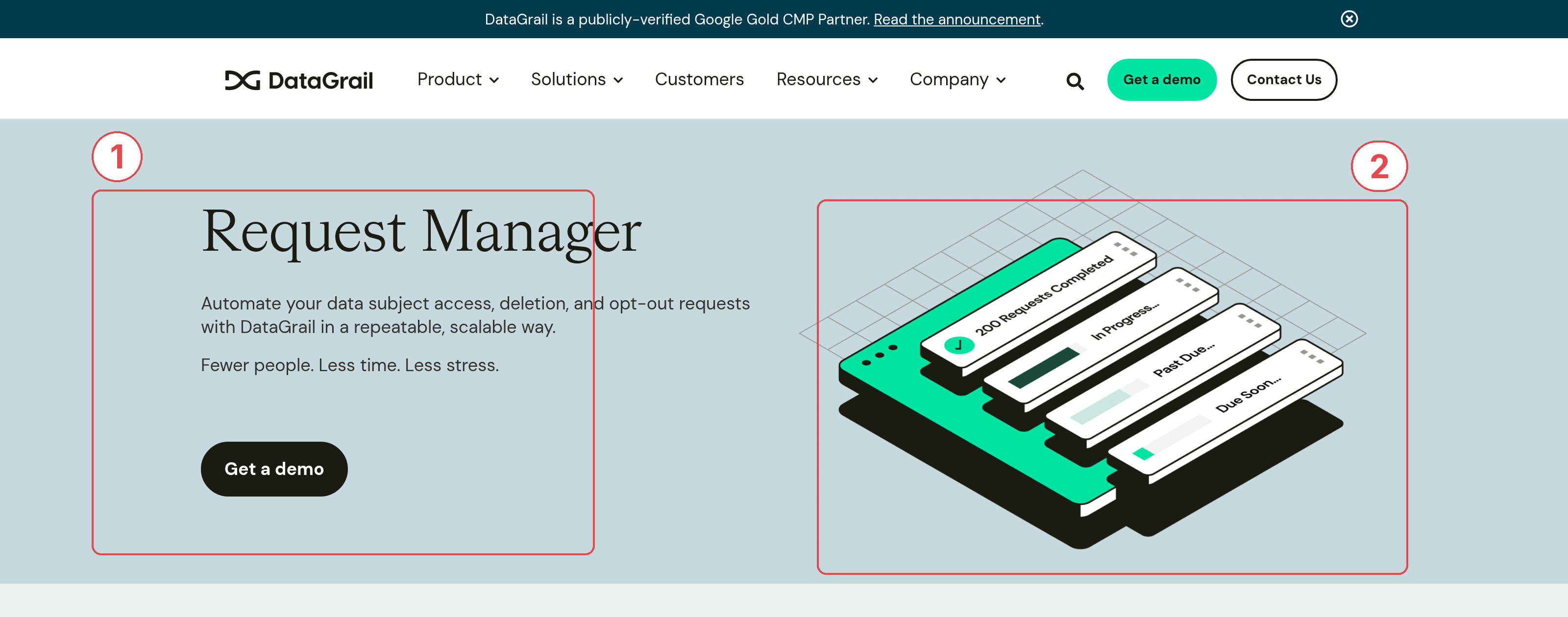
DataGrail Request Manager is the product I would trial when a privacy-ops team wants access, deletion and opt-out automation across a SaaS-heavy stack. Identity is checked with Smart Verification, which uses data already on file, before fulfilment starts. Legal, IT and vendor owners can collaborate inside the product, instead of moving the work back to a shared inbox.
In a trial, run the connectors you actually use, including the awkward payment and franchise tools, and ask to see a DPDP notice, a grievance path, and what happens when a request hits an error. A large connector catalogue is not proof that every system you run is covered.
A later DataGrail switcher, when live, should carry the deeper privacy-ops comparison. This row is only the Transcend-infrastructure question.
Pricing
Quote-based. datagrail.com/pricing returned HTTP 404 on 13 November 2026. No self-serve tariff appears on that URL.
Reviews
The platform-wide DataGrail G2 profile, dated 13 November 2026, carries 4.7 out of 5 across 208 reviews. Users on G2 like the product's ease of use and the quality of support, and complain about API errors during setup that delayed the first weeks of work (G2, October 2026 and April 2026). On 20 October 2026, a mid-market reviewer in sports titled a review "Intuitive to Use with Outstanding Support" and wrote "Intuitive to use. Support is outstanding." The same reviewer said DataGrail had cut the time spent on DSRs, risk assessments, data mapping and RoPAs for a privacy office of one. On 1 April 2026, a mid-market reviewer wrote that API errors during setup "delayed the onboarding process by a few weeks." Both comments are within the last 12 months.
Clients
DataGrail publishes customer stories on its own site. I would ask for a Request Manager reference in a SaaS stack close to yours, and I would ask how a failed fulfilment is surfaced to the operator.
Summary
Pick DataGrail if most of the personal data lives in SaaS, you want request automation with in-platform collaboration, and you can prove the connectors in a trial. It is a weaker fit if you need a public price, or a DPDP grievance path you have already seen in your own tenant.
Against Transcend: you get an ops-led request queue built for SaaS catalogues, and a current G2 corpus. What you give up is Transcend's enforcement-first architecture, a public price, and any assumption that an India-shaped notice is already in the box.
4. OneTrust DSR Automation
Features
OneTrust DSR Automation is the module I would trial if OneTrust is already in the estate. The job is request intake, identity, fulfilment and a file you can keep. In a trial, watch a worked request leave the module and arrive in the systems you actually run, and ask for a DPDP-shaped notice and a grievance path. A European template with a new title is not enough.

Other OneTrust modules are covered in OneTrust alternatives.
Pricing
Quote-based. OneTrust quotes DSR Automation through its sales team, with no self-serve price.
Reviews
There is no DSR-only G2 profile. Comments sit on the OneTrust Privacy Automation profile, which, dated 13 November 2026, carries 4.3 out of 5 across 155 reviews. Users on G2 like that teams can shape the product to their needs and can manage RoPAs and DPIAs without much trouble, and complain about tricky bulk uploads, a high price and a steep learning curve (G2, June 2026 and January 2026). These comments sit on the Privacy Automation profile, not on a DSR-only corpus. On 8 June 2026, a verified mid-market reviewer in hospital and health care wrote that the product is "Completely customisable to your needs" and that you can "Easily manage RoPAs, DPIAs", and disliked that "The bulk uploading of information if your using an existing template can be tricky". Erick Vincent Steve G., 8 January 2026, wrote about "the high price and the steep learning curve." A 29 July 2025 review that also talks about request handling is older than 12 months.
Clients
Customer stories appear on OneTrust's own site. I would ask for a reference that runs DSR Automation, not only Cookie Compliance, and I would ask how long a request takes to reach a connected system.
Summary
Pick OneTrust DSR Automation if OneTrust is already paid for and the job is request fulfilment inside that estate. Prove a DPDP notice in a trial. If OneTrust is not already paid for, weigh the cost of the wider suite before treating this module as a new purchase.
Against Transcend: you stay inside an estate you already pay for, and you get a request module with a large neighbouring review base. What you give up is Transcend's enforcement-first product, a DSR-only G2 corpus, and a public self-serve price.
5. Securiti DSR Automation
Features
Securiti DSR Automation is the row I would open when fulfilment is expected to follow a discovery graph: find the data, then honour the request in the systems that graph has mapped. Securiti is part of Veeam. In a trial, watch one request travel from intake to a system the graph actually knows, and ask for a DPDP-shaped notice and a grievance path.

A wider Securiti comparison is in Securiti.ai alternatives.
Pricing
Quote-based. No self-serve DSR Automation tariff appears on the public product path.
Reviews
The platform-wide Securiti G2 profile, dated 13 November 2026, carries 4.6 out of 5 across 116 reviews, and lists Veeam as the seller. On 21 August 2026, a mid-market reviewer wrote that Securiti "has a steep learning curve and a complex initial setup process" and that "The pricing structure can also be restrictive for smaller teams that need advanced features." I would take that as a report on the wider platform, and I would ask for a walkthrough of DSR Automation itself.
Clients
Securiti publishes customer stories on its own site. I would ask for a reference that already runs DSR Automation on the discovery graph, and I would ask how a request is honoured when the graph has not yet mapped a system.
Summary
Pick Securiti DSR Automation if the estate is already paid for, or if discovery-graph fulfilment is the reason you are buying, and you can work from a quote. Prove a DPDP notice in a trial. A smaller team that only wants a request queue may find the wider platform heavier than the job.
Against Transcend: fulfilment can follow a discovery graph, which is a different architecture from Transcend's request-and-enforcement stack. What you give up is a public price, and you still have to prove an Indian notice in a trial.
6. Didomi
Features
Didomi's Preference Management Platform is the product I would trial when marketing wants a designed centre, form or widget, plus a named cloud connector, and the team leaving Transcend still needs proof that a purpose change actually leaves that centre. Didomi also sells a CMP. In a trial, watch a preference change reach campaign tools, and ask how a Data Principal request is recorded and fulfilled. Request automation is not the lead artefact on the PMP page, so treat fulfilment as a question, not as a given.

Pricing
Quote-based. didomi.io/pricing still returns HTTP 404, as of 13 November 2026. The live packaging page is didomi.io/offers, which names several tiers with no public dollar figures. Preference Management is priced by user-database size and API calls, and Privacy Requests (DSAR) appears under the PMP package. I would still confirm request fulfilment in a trial, and I would not treat the server-side tagging figures on that page as a PMP tariff.
Reviews
The platform-wide Didomi G2 profile, dated 13 November 2026, carries 4.5 out of 5 across 182 reviews. Users on G2 like lightning-fast human support, and complain about the custom CSS needed for deeper styling and a price some buyers find high compared with the market (G2, October 2026). On 14 October 2026, Hywel T. titled a review "Lightning-Fast Human Support" and noted "the custom CSS needed for advanced styling". A mid-market review, last updated 14 October 2026, said "Price is a bit high compared to the market". Those comments are recent, and they are mostly about the wider product and support, so ask for a preference-centre and a request walkthrough as well.
Clients
Didomi publishes customer stories on its own site. I would ask for a reference that already uses the Preference Management Platform, and I would ask how a request, not only a preference change, is honoured.
Summary
Pick Didomi if a designed preference centre is the first job and you can work from a quote. Confirm request fulfilment and a DPDP notice in a trial. A team that needs engineering-led enforcement across the backend will usually stay closer to Transcend, or look at Ketch or Redacto.
Against Transcend: you get a designed preference product and a current G2 corpus. What you give up is Transcend's enforcement layer as the lead artefact, a public price, and any assumption that request fulfilment is already in the PMP card.
7. Privy by IDfy
Features
Privy Data Principal Rights Management is the India-built product I would trial when a Data Principal portal and grievance routing have to sit beside consent in the same IDfy suite. The product page, and the capture below, show a Support and Grievance path, with requests in process, and a History and Activity Trail. The same product is sold with a multilingual portal, including 22 scheduled Indian languages. In a trial, complete one portal request in a language you actually use, and follow a grievance through the routing you were sold.
For a fuller product read, see Privy review.

Pricing
Quote-based. Privy has no self-serve price for its rights module.
Reviews
Privy by IDfy has no public G2 corpus. Ask for a reference call, and bring the portal flow you want a Data Principal to complete.
Clients
Customer stories appear on IDfy's own sites. I would ask for an Indian enterprise reference that already uses the DPRM portal, and I would ask how a grievance is recorded against the notice.
Summary
Pick Privy if rights and consent have to live inside an India-built suite, and you can work from a quote and a reference call. Prove the portal and the grievance path in a trial. A team that wants engineering-led enforcement across a global stack will usually stay closer to Transcend or Ketch.
Against Transcend: the portal and the grievance path sit inside an India-built suite. What you give up is Transcend's enforcement-first architecture, a public price, and a review corpus.
How to choose, by situation

Engineering wants to own the enforcement layer
Keep Transcend (transcend.io) in the running if engineering will own real-time consent and preference enforcement across the stack, and if a self-hosted component such as Sombra is a requirement you actually want. Open Ketch if you also want a published consent plan on day one, and be clear whether DSR automation is in the card you are buying. In both trials, watch a withdrawal leave the centre and arrive in a system that still holds the data, and ask who owns the exception when that hop fails.
The DPO wants an India-built programme record
Start with Redacto when requests and grievance have to sit on the same record as consent. Start with Privy when the Data Principal portal has to live inside an India-built suite. In both cases, follow one withdrawal and one grievance into the systems that still hold the data, and read the notice a Data Principal would actually see. A global enforcement stack can still be the right second tool, but it is a weak first answer if the DPO cannot show that record today.
Requests and grievance are the first job
Start with Redacto for a DPDP-shaped queue. Start with DataGrail when the stack is mostly SaaS. Start with OneTrust DSR Automation, or Securiti, if that estate is already paid for. Ketch puts DSR automation on Pro, with an add-on on Plus. A category read of request tools is in DSAR management software. For a deletion request under DPDP, see how to handle a DPDP data deletion request.
We already pay for OneTrust or Securiti
Trial the request module you already hold before you open a net-new shortlist. Leave only if a trial cannot show a DPDP notice, a grievance path, or fulfilment in the systems you actually run.
Many systems have no API
In a trial, break a connector and watch whether the request stays open as a tracked task. A catalogue of APIs is not the same job. At Redacto, a missing connector becomes a tracked task on the same clock, and the request only closes once evidence is on file. Confirm it in a trial. For every other row, including Transcend's own "no API at all" claim, get the vendor to show that path in writing before you sign.
Final thoughts
An engineering-led privacy stack is only as good as the record it writes and the systems that honour it. Transcend (transcend.io) remains a serious option when enforcement is the job, and when engineering will own that layer. Look past it when you need a published price, a DPDP-shaped notice and grievance clock in India, or a programme record a DPO can run without another infrastructure project. Trial the two closest rows on this list with one live request and one withdrawal, and keep the vendor that can show both. If a system in your stack will not take an API call, make that the third test, and do not sign until the path is in writing. A catalogue of connectors is a starting point, not that proof. Ask to see the failed request still sitting in the queue.
For the wider question of how consent, preference and rights tools sit together, see how to choose between types of consent management solutions.