How AI Is Changing Privacy Compliance (and Where It Still Fails)
Where AI helps privacy compliance (discovery, DSARs, vendor reviews, breach alerts), where it adds risk, and what the EU AI Act and DPDP expect.

I've watched AI land on privacy desks twice: once as a new risk to govern, and once as a pitch to do the job faster. If you lead privacy, you're probably juggling both while your team still handles rights requests, vendor reviews and breach drills.
In a January 2026 survey of 5,200 IT and security professionals with privacy duties across 12 markets, including India, 90% said AI had widened the scope of their privacy programme, and only 12% called their AI governance structures mature (Cisco 2026 Data and Privacy Benchmark Study).
You searched for how AI is changing privacy compliance, so I'll answer the two questions I'd ask in your seat: which parts of the job AI can take off your plate, and which new rules apply now that your company uses AI. I'll walk you through each task and each law with the dates that matter and the official sources, then tell you where I'd automate first, where I'd keep a person in charge, and what I'd ask before I sign with a vendor.
TL;DR
AI is changing privacy compliance in two directions at once. It now does much of the reading and sorting that privacy teams used to do by hand, and it creates a new kind of processing that regulators treat as a risk of its own.
- AI is good at finding personal data, routing rights requests, reading vendor evidence and spotting odd data movement. It is poor at the judgement calls the law leaves to you.
- The new risks are training data you had no lawful basis for, models that leak what they learned, and staff pasting customer data into chatbots nobody approved.
- Most EU AI Act rules have applied since 2 August 2026. After the AI Omnibus, high-risk duties start on 2 December 2027 (Annex III) and 2 August 2028 (Annex I).
- India has no AI-specific statute. Personal data used in AI falls under the DPDP Act, with most duties starting on 13 May 2027. Banks and NBFCs also have the RBI's FREE-AI report and a draft model risk paper to read.
- Buy AI compliance tools on evidence: confidence scores, a human review step, logs you can export, and a clear answer on where your data goes.
What AI changes in privacy compliance (and what it doesn't)
My view, up front: AI makes the evidence-gathering half of privacy work cheaper. It doesn't make the decisions for you, and no regulator I know of accepts "the model decided" as an answer. Treat it as a fast junior analyst whose work you still sign.
What doesn't change is who answers for the outcome. The GDPR makes the controller responsible for compliance and for proving it (Articles 5(2) and 24 of the GDPR). In India, s.8(1) of the DPDP Act, 2023 makes the Data Fiduciary responsible for any processing done by it or on its behalf by a Data Processor, whatever the contract says. A model can do the work; it can't take the liability.
Where AI helps today
If you're asking which workflow automation improves privacy team productivity, my answer is the four tasks below, in this order. Each one is high-volume, rule-bound and checkable, which is where a model earns its keep.

Data discovery and classification
This is where I'd start. A model can scan databases, buckets and SaaS exports, tag fields that look like Aadhaar numbers, card data or health records, and give each tag a confidence score. A manual data map goes stale the day you finish it; a scan can run on a schedule. Our guide to data discovery tools compares the options.
The catch is the long tail. Free-text fields, scanned PDFs and regional-language notes are where tags go wrong, and they are also where the surprises live. I'd send everything below a set confidence score to a reviewer and track how often the reviewer overrules the model. If you're after DPDP compliance automation, this inventory comes first: every notice, retention period and breach report depends on knowing what you hold.
DSAR and deletion handling
Rights requests are a matching problem, and models match well. AI can check identity steps, find one person's records across systems and draft the reply. The GDPR gives you one month to respond under Article 12(3). Under the DPDP Rules, from 13 May 2027 you must publish how people can use their rights and answer grievances within a period of no more than 90 days.
Keep a person on exemptions, legal holds and anything that includes other people's data. Erasure is the riskier half: a model that deletes the wrong customer's records creates a breach of its own. Our DSAR management software roundup and the guide to handling DPDPA data deletion requests go further.
Vendor and questionnaire review
Vendor reviews are mostly reading: SOC 2 reports, policies, sub-processor lists, past answers. AI drafts the first pass in minutes and lists the gaps. We wrote about what changes when AI takes over the questionnaire, and compared AI tools for vendor security assessments on what the AI does.
AI is also good at a first-pass DPA compliance check: reading a data processing agreement against the clauses you require, such as purpose limits, sub-processor approval, breach notice timing, deletion at the end of the contract and no training on your data. GDPR Article 28(3) lists the terms a processor contract must contain, and DPDP s.8(2) lets you use a Data Processor only under a valid contract. A lawyer still decides which gaps you can accept.
If you've been asked to evaluate a cloud-based content management company on security and compliance, the model can tell you what the documents say. It can't tell you what the documents leave out. I'd still ask three things by hand: where customer content is stored, whether it trains any model, and who their sub-processors are. The same goes for document-processing AI that reads contracts, ID cards or scanned forms: ask whether files are kept after processing, whether they train any model, and whether you can mask personal data before upload.
Monitoring and breach detection
Models are good at spotting unusual access and data leaving where it shouldn't. Some tools go further, with autonomous AI rollback: pausing a job, revoking a token or reverting a change without waiting for a person.
That's useful for containment, and it doesn't change your legal clock. Under DPDP Rule 7 you tell affected people and the Data Protection Board without delay, and send the Board a detailed report within 72 hours of becoming aware. GDPR Article 33 gives you 72 hours to tell the supervisory authority. A rollback that hides the evidence can make that report harder to write, so log what the system did before it undoes anything.
Where AI creates new compliance risk
AI doesn't only automate privacy work. It is personal data processing in its own right, and it fails in ways your old controls weren't built to catch.
Training data and lawful basis
The European Data Protection Board's opinion of 18 December 2024 is the clearest regulator view I've seen. A model counts as anonymous only if it is very unlikely that anyone can identify the people in its training data or pull their data out through queries. Legitimate interest can work as a legal basis for training, but only if the processing is strictly necessary and passes the three-step test the opinion sets out. And a model built on unlawfully processed data can taint its own deployment unless it has been anonymised.

India is looser on paper. Section 3(c)(ii) of the DPDP Act says the Act doesn't apply to personal data that the person made public, or that someone had a legal duty to publish. That is not a licence to scrape. I'd read it narrowly, keep proof of where each training set came from, and assume a lawyer will ask.
Inference and model leakage
A model can reveal what it learned. Two attacks worry me most, and the RBI's FREE-AI report names both: model inversion that rebuilds a person's financial profile, and membership inference that shows whether someone's record was in the training set. If a model was trained on customer data, treat the model as holding customer data. Access control, logging and deletion rules apply to it too.
Shadow AI
The risk I'd worry about most is the simplest, and it's where enterprise AI security usually breaks. Staff paste customer records into public chatbots because it's quicker. You can't govern a use you don't know about, so start with a short approved-tools list, a block on the rest at the proxy, and a plain rule on what data may go into a prompt.
How to govern data for LLMs
Here's the order I'd use. The same list answers most AI workflow privacy compliance questions, because every AI step inside a business process is processing in its own right.
- Keep an inventory of every model and AI feature that touches personal data, including the ones inside your SaaS vendors.
- Record the purpose and legal basis for each training and fine-tuning set, and its source.
- Strip or mask personal data before it reaches a prompt or a retrieval index, wherever the task allows. Our piece on privacy-enhancing technologies covers the options.
- Log prompts and outputs that include personal data, with a retention period.
- Run a privacy impact assessment before launch. Here's how to do privacy risk assessments.
- Update your privacy notice. This is how I'd adapt a privacy policy for AI: say which features use AI on personal data, for what purpose, and whether that data trains a model. The GDPR already requires you to tell people about solely automated decisions that produce legal effects concerning them or similarly significantly affect them (Articles 13(2)(f) and 22). Article 50 of the AI Act requires people to be told when they're dealing with an AI system such as a chatbot. And from 13 May 2027, DPDP Rule 3 requires the consent notice to give an itemised description of the data and the specified purpose.
The rules that now apply to AI and personal data
Here's where the rules stand on 3 November 2026. When people ask how global companies are updating compliance programmes for AI and privacy laws, the answer I'd give is that most are adding AI to the privacy programme they already run, because the data rules haven't moved and the AI rules sit on top of them. We make the same case in why AI governance starts with data privacy.
The EU AI Act after the AI Omnibus
The AI Act entered into force on 1 August 2024 and applies in stages. Bans on prohibited practices and the AI literacy duty (softened by the Omnibus) have applied since 2 February 2025, and duties for general-purpose AI model providers since 2 August 2025. Most of the remaining rules, including the Article 50 transparency duties, applied from 2 August 2026, when enforcement also started.
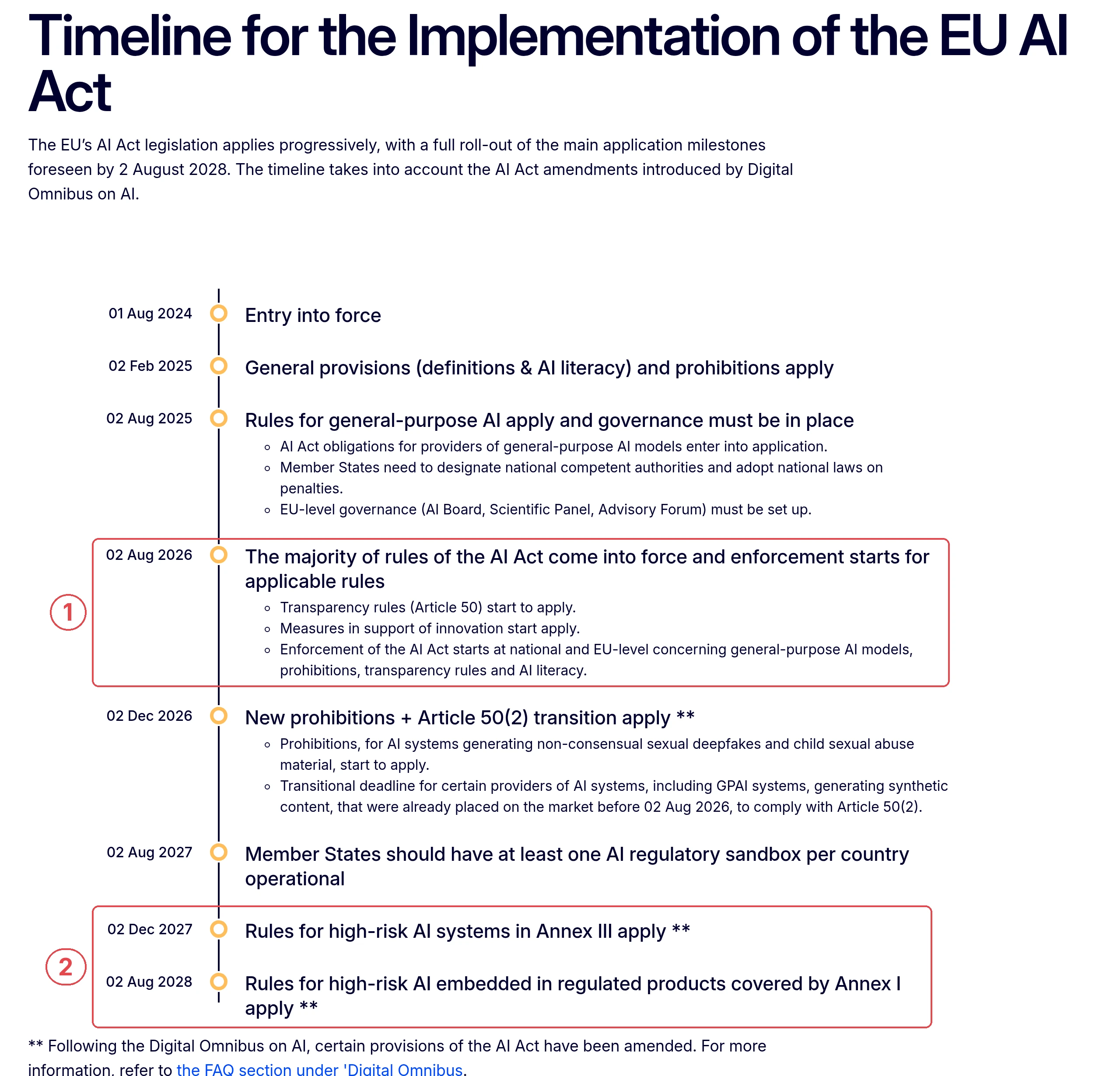
The AI Omnibus entered into force on 27 July 2026 and moved the high-risk dates. Rules for high-risk systems in Annex III, which covers uses such as credit scoring and hiring, now apply from 2 December 2027. Rules for high-risk AI built into products under Annex I apply from 2 August 2028. Two smaller points matter for privacy teams. New bans on AI that generates non-consensual sexual content or child sexual abuse material apply from 2 December 2026, the same date by which providers of synthetic-content systems already on the market before 2 August 2026 must mark that content under Article 50(2). And the Omnibus allows processing of special categories of personal data to detect and correct bias.

I wouldn't read the delay as breathing room. If you sell into the EU and run anything close to Annex III, two years is about how long it takes to build the documentation and human oversight the Act asks for.

India: the DPDP Act and Rules, 2025
India regulates AI through its data law. There is no separate AI statute, so personal data used to train, tune or run a model is covered by the DPDP Act like any other processing. The Rules were notified on 13 November 2025. Consent Manager registration opens on 13 November 2026. Notice, consent, security, breach intimation, retention, children's data and rights all apply from 13 May 2027. Our DPDP Act compliance requirements guide goes duty by duty, and the DPDP Rules explained covers the Rules.
India's AI Governance Guidelines
MeitY released the India AI Governance Guidelines on 5 November 2025. They set out seven principles, recommendations across six pillars and an action plan, and they don't create new legal duties. MeitY Secretary S. Krishnan said at the launch: "Our focus remains on using existing legislation wherever possible." For a compliance team, that means the DPDP Act, the IT Act and your sector regulator remain the rules you're audited against.

Elsewhere in Asia, South Korea's AI Basic Act took effect on 22 January 2026, with a grace period of at least a year before penalties (MSIT, January 2026). We cover it in South Korea's AI Act: what organisations need to know.
Financial services: what's different
Banks, NBFCs and fintechs carry a second rulebook. On 13 August 2025 the RBI published the report of its FREE-AI committee. It sets out seven Sutras and 26 recommendations, including a board-approved AI policy for each regulated entity and AI risks added to product approval, audit and incident reporting. It is a committee report, not a direction, but I'd treat it as a preview of what supervisors will ask.

The report's own survey shows the gap. Of 612 regulated entities surveyed between February and May 2025, 20.8% were using or building AI. Of the 127 that were, only 18% kept audit logs and 21% monitored for data or model drift (FREE-AI report, para 3.3.13). On 24 June 2026 the RBI followed with a draft paper on model risk management that covers third-party models and AI/ML models, with comments due by 24 July 2026 (RBI press release). Check rbi.org.in for the final text before you build to it.
Two more things from that report I'd act on now. If a vendor uses AI to deliver a service you've outsourced, the RBI treats that as outsourcing, and your outsourcing contract probably says nothing about AI. And for AI-driven credit risk assessment, the RBI's digital lending rules already require creditworthiness checks to be auditable, so a model you can't explain is a problem before any AI rule arrives.
People search for the best AI data privacy compliance software for financial services. I don't think there is one best tool for BFSI. I'd judge any candidate on four tests taken from the RBI report: can it show audit logs, can it show drift monitoring, can a person override it, and can it keep data where your regulator expects it to stay.
A CISO's rules for buying AI compliance tools
Whether you're comparing AI governance solutions, AI security platforms with compliance features, AI optimization platforms for data compliance or a privacy tech vendor's consent management module, the same rules apply. Ask for evidence you can check yourself.
- Ask for confidence scores. A tool that can't tell you how sure it is will be confidently wrong on exactly the records that matter.
- Insist on a human review step. Someone at your company signs the outcome. The product should make that sign-off easy and logged.
- Get logs you can export. When the Board or a supervisor asks what the system did, "the vendor has it" is a weak answer.
- Ask where your data goes. Which region, which sub-processors, and whether your data trains their model. Get the answers in the contract.
- Test on your own data. Run a pilot on a messy sample and count the errors yourself.
- For consent management, check the record. Withdrawing consent must be comparable in ease to giving it (DPDP Act s.6(4)), so ask to see a withdrawal flow end to end, and whether consent is enforced at runtime, with trackers and data flows blocked until consent, or only recorded.
The claim I trust least is "fully automated compliance". When a vendor says their tool makes you compliant, I ask who signs the DPIA, who answers the Board and who decides that a breach is notifiable. The answer is always someone at your company. AI can draft, sort and flag; it can't carry the accountability the DPDP Act puts on the Data Fiduciary, so I treat any pitch that says otherwise as a reason to look harder at the rest of the product.
Where to start this quarter
If you do one thing, build the inventory: what personal data you hold, which AI systems touch it, and which vendors' AI features are switched on. Every rule above, from Article 50 to DPDP Rule 7, assumes you know that.
Then pick one high-volume task, usually discovery or rights requests, and put AI on it with a person reviewing the output. Measure the override rate for a month before you widen it.
If you'd like help with the first step, Redacto's data discovery and classification finds and tags personal data across your systems, with a review queue for the calls a person should make.