Privacy-Enhancing Technologies (PETs): Types, Examples and When to Use Each
What privacy-enhancing technologies (PETs) are, the main types with real examples, their trade-offs, and how they help with DPDP and GDPR.

TL;DR
Privacy-enhancing technologies (PETs) let you use data for analytics, AI and sharing while exposing less personal information. The eight that matter are pseudonymisation and tokenisation, anonymisation, differential privacy, homomorphic encryption, secure multi-party computation, federated learning, trusted execution environments and synthetic data. Start with tokenisation and masking, which are cheap and mature. Save the complex ones for specific jobs. None of them replaces consent, notices or the rest of the DPDP Act.
Disclosure: this is Redacto's blog. The views on which PETs are worth the effort are mine, formed as CISO and DPO at a major Indian payments company, and don't depend on any product.
Most breached companies hadn't encrypted their sensitive data
Every analytics project, AI pilot and data-sharing deal asks for more personal data than the last one. Every copy adds risk, and most of those copies aren't protected well. In IBM's Cost of a Data Breach Report 2026, 53% of breached organisations hadn't encrypted their sensitive data at rest and in motion when the breach happened, and another 10% weren't sure.
If you searched for privacy-enhancing technologies, you probably want a plain list of the types, real examples of each in use, and a sense of which ones are worth your budget. That's what this guide covers, along with how PETs fit GDPR and India's DPDP Act, and a short decision guide for picking one.
What are privacy-enhancing technologies?
Privacy-enhancing technologies are techniques that let you collect, process, analyse and share data while protecting the privacy of the people in it. PET is short for privacy-enhancing technology. The OECD's 2023 paper Emerging privacy-enhancing technologies describes them as digital solutions that protect data confidentiality and privacy across that whole lifecycle.
The UK ICO's PETs advice is the most usable regulator text I know. It covers differential privacy, synthetic data, homomorphic encryption, zero-knowledge proofs, trusted execution environments, secure multi-party computation, private set intersection and federated learning, with case studies. It's now under review after the UK's Data (Use and Access) Act, so check for updates.

One question that comes up: are there technologies that protect privacy better than VPNs? A VPN protects data in transit between you and a server. PETs protect data while it's stored, analysed and shared, which is where most exposure happens. They solve a different, larger problem.
Types of privacy-enhancing technologies, with examples
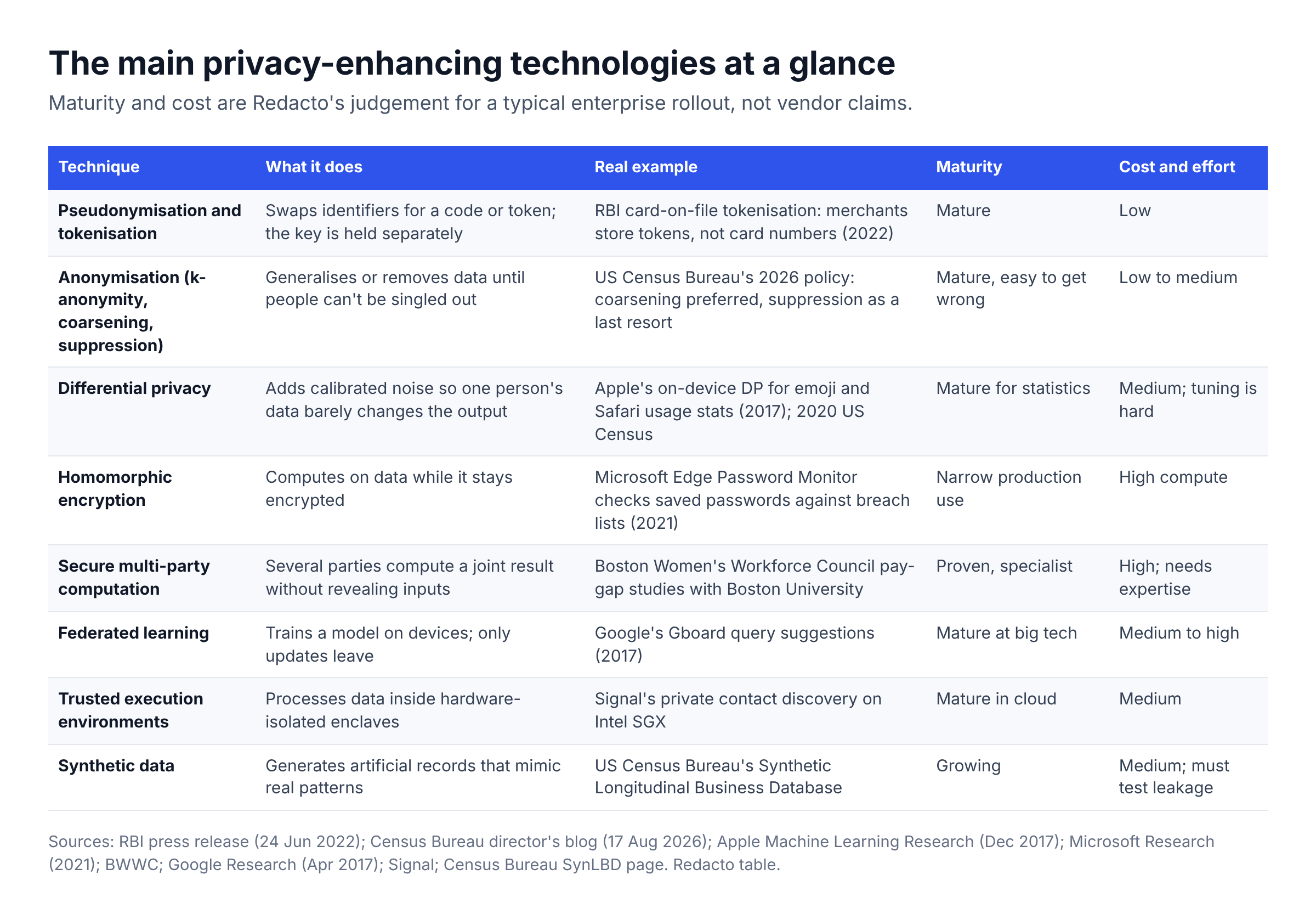
| Technique | What it does | Real example | Maturity | Cost and effort |
|---|---|---|---|---|
| Pseudonymisation and tokenisation | Swaps identifiers for a code or token; the re-identification data is held separately | RBI card-on-file tokenisation (2022) | Mature | Low |
| Anonymisation (k-anonymity, coarsening, suppression) | Generalises or removes data until people can't be singled out | US Census Bureau's 2026 disclosure policy | Mature, easy to get wrong | Low to medium |
| Differential privacy | Adds a set amount of random noise so one person's data barely changes the output | Apple usage statistics (2017); 2020 US Census | Mature for statistics | Medium; tuning is hard |
| Homomorphic encryption | Computes on data while it stays encrypted | Microsoft Edge Password Monitor (2021) | Narrow production use | High compute |
| Secure multi-party computation | Several parties compute a joint result without revealing inputs | Boston Women's Workforce Council pay-gap studies | Proven, specialist | High; needs expertise |
| Federated learning | Trains a model on devices; only updates leave | Google Gboard (2017) | Mature at big tech | Medium to high |
| Trusted execution environments | Processes data inside hardware-isolated enclaves | Signal private contact discovery | Mature in cloud | Medium |
| Synthetic data | Generates artificial records that mimic real patterns | US Census Bureau SynLBD | Growing | Medium; must test leakage |
Maturity and cost are my judgement for a typical enterprise rollout. ENISA's 2022 report Data Protection Engineering is a good neutral reference on how these techniques map to GDPR principles.

Pseudonymisation and tokenisation
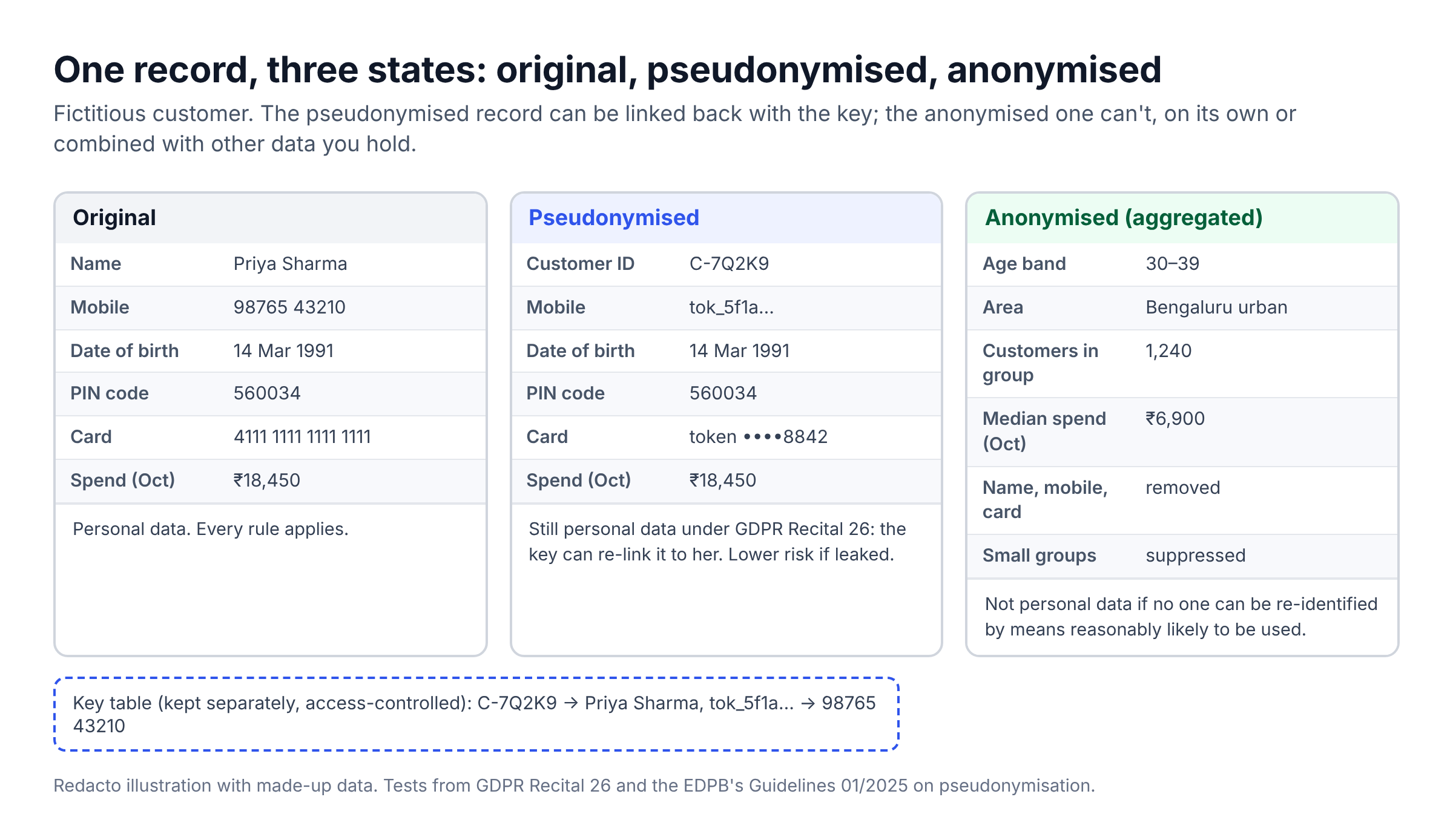
Pseudonymisation replaces direct identifiers, such as a name or phone number, with a code. Tokenisation is the common form: a token takes the place of the value, and the mapping lives in a separate vault. Whoever holds the vault can link the data back, so it's still personal data for them. Its value is that a leaked analytics table or vendor feed exposes tokens, not people.
India has run one of the world's largest tokenisation programmes. Under RBI's card-on-file tokenisation rules, merchants can't store card numbers. Cardholders create tokens instead, and, as RBI's June 2022 press release put it, "these tokens can then be stored by the merchants" for future payments. For a deeper explainer see what is tokenisation, and for products see our pseudonymisation tools roundup.

Anonymisation and k-anonymity
Anonymisation changes data so no one can be identified from it. The basic tools are coarsening (age bands instead of birth dates, district instead of PIN code), suppression (dropping rare values or small groups) and k-anonymity, which makes sure every record looks like at least k others on the attributes an attacker might know.
It's easy to do badly. A dataset with age, PIN code and gender can single people out even with names removed. Test re-identification before you call anything anonymous. Our data anonymisation software guide covers tools that help.
Differential privacy
Differential privacy adds carefully measured noise to results, so the output barely changes whether or not any one person's data is included. Apple's research team described in December 2017 how it uses local differential privacy on devices to learn things like popular emojis and Safari media preferences without collecting individual records. NIST published SP 800-226 in March 2025 to help teams evaluate differential privacy claims.

The US Census Bureau is the best-known case, and the most instructive one. It used differentially private noise for 2020 Census data. In June 2026 the Department of Commerce issued an order banning noise infusion, including differential privacy, record swapping and synthetic data, for new Census products. The Bureau's director explained in August 2026 that it will rely on coarsening and suppression instead, citing concerns that noise made statistics less accurate. Published 2020 Census data isn't affected.
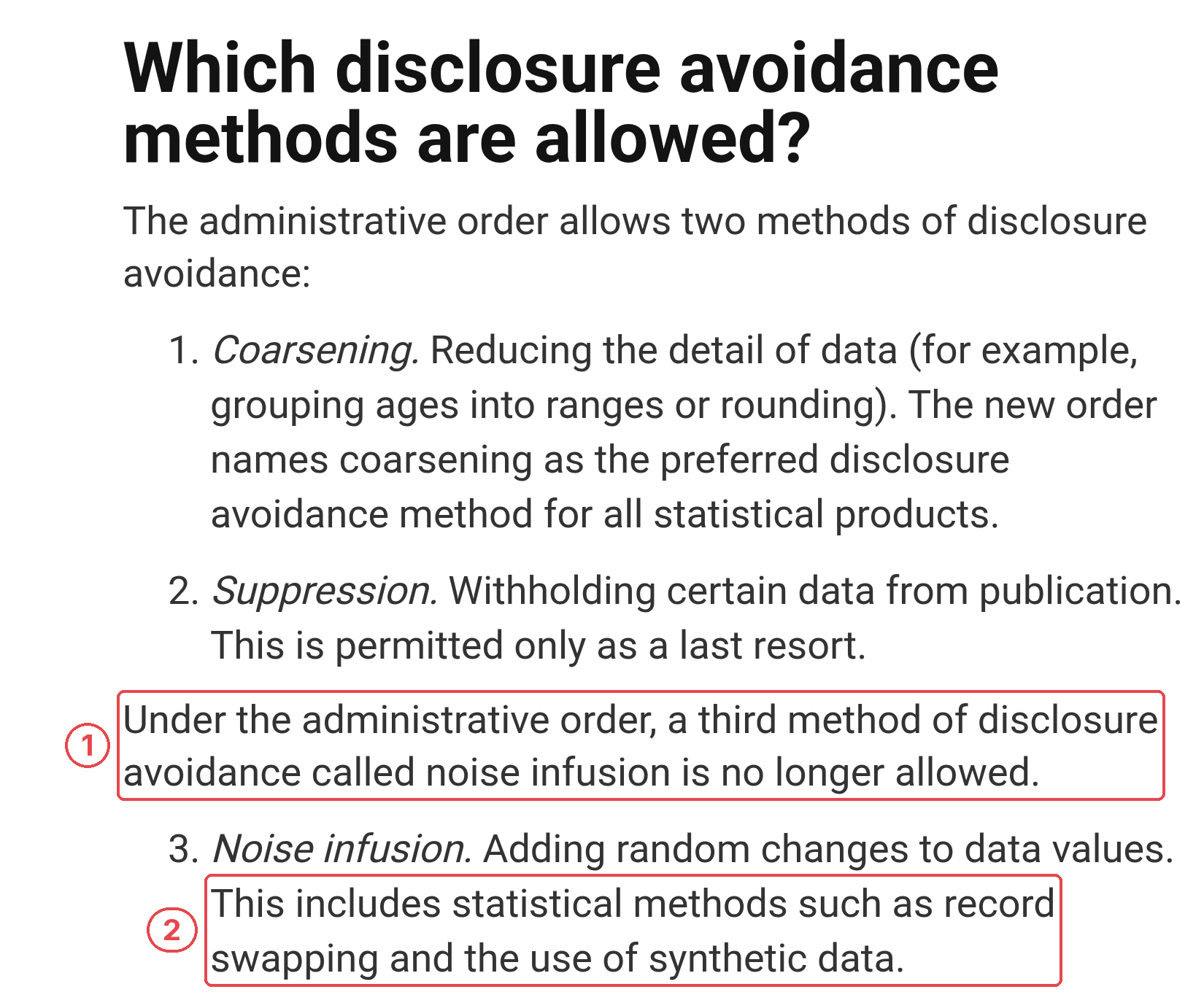
If you deploy differential privacy, get your data users to accept the accuracy trade-off first. At the Census Bureau, concerns that noise made statistics less accurate and harder to trust led to a Commerce Department order ending its use in new products.
Homomorphic encryption
Homomorphic encryption lets a server compute on data without decrypting it. It's slow and expensive, so production use is narrow. Microsoft's Edge Password Monitor is a good example: it checks your saved passwords against breach lists without Microsoft seeing them. For the basics of encryption itself, see our data encryption guide.
Secure multi-party computation
Secure multi-party computation (SMPC) lets several organisations calculate a joint result while each keeps its inputs private. The Boston Women's Workforce Council has used it with Boston University to measure pay gaps across employers' payroll data without any employer revealing its figures. Data clean rooms for advertising use related ideas. Expect to need specialist help.
Federated learning
Federated learning trains a model across many devices or sites. Data stays where it is, and only model updates travel. Google described it in April 2017 for Gboard query suggestions on Android phones. Updates can still leak information, so it's usually paired with differential privacy. It matters more and more for AI governance; see why AI governance starts with data privacy.
Trusted execution environments
A trusted execution environment (TEE) is a hardware-isolated enclave where code runs on data that even the server's operator can't see. Signal used Intel SGX enclaves for private contact discovery, so its servers could match your contacts without learning your address book. Major clouds now offer confidential computing built on TEEs. The trust moves to the hardware maker, so ask how the chip proves what code it is running and how patching works.
Synthetic data
Synthetic data is generated to mimic the patterns of a real dataset without copying its records. The US Census Bureau's Synthetic Longitudinal Business Database gives researchers a public synthetic version of confidential business data and asks them to check results against the real data. Note that the June 2026 Commerce Department order that ended noise infusion for new Census products covers synthetic data too, so SynLBD shows the technique rather than where the Bureau is heading. It's popular for software testing and AI training, but a generator trained too closely on real data can reproduce real people. Test for that.
PETs and the law
GDPR: Recital 26
Recital 26 draws the line that matters. Pseudonymised data that could be attributed to a person using additional information is still personal data. Anonymous information, where the person is not or no longer identifiable, is outside the GDPR. Whether someone is identifiable depends on "all the means reasonably likely to be used", including cost, time and available technology.

Two recent developments sharpen this. The EDPB adopted Guidelines 01/2025 on pseudonymisation for public consultation in January 2025. And on 4 Sep 2025 the EU Court of Justice ruled in EDPS v SRB (C-413/23 P) that pseudonymised data isn't necessarily personal data for every recipient: it depends on whether that recipient can reasonably re-identify people. The controller who can reverse it still treats it as personal data.
India: the DPDP Act and Rules
The DPDP Act has no anonymisation clause. It applies to personal data, meaning any data about an individual who is identifiable by or in relation to that data. Pseudonymised data is therefore personal data under the Act, and fully anonymised data probably isn't, though no Indian regulator has set a test yet.
The Rules do name PETs. Rule 6(1)(a) lists "encryption, obfuscation, masking or the use of virtual tokens mapped to that personal data" among the reasonable security safeguards a Data Fiduciary must take. Rule 10 allows a parent's identity and age to be verified through a virtual token issued by an authorised entity. These duties apply from 13 May 2027; our DPDP Rules explainer has the full timeline.

My view on PETs and DPDP compliance in India: tokenisation and masking are now the expected baseline, because the Rules name them. They lower the chance that a breach exposes real identities and make it easier to argue you took reasonable security safeguards. They don't remove your duties on notice, consent, rights or retention.
How to choose a PET
Start from the job, not the technology. The decision guide below is the order I'd work through.
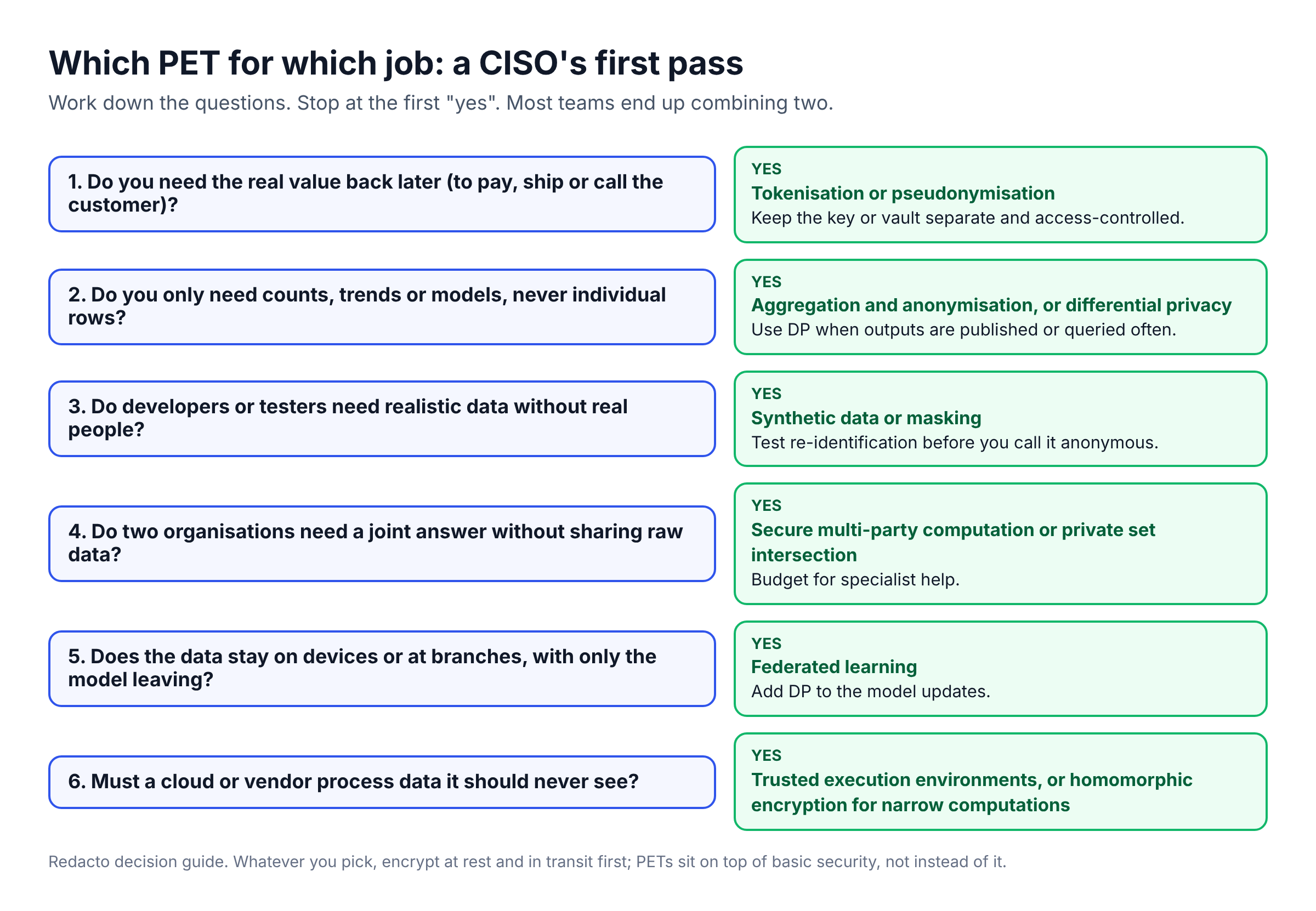
What PETs are enterprises adopting to get analytical value while reducing personal data exposure? In the Indian enterprises I've seen, the pattern is consistent. Tokenisation of identifiers in analytics and data warehouses comes first, then masking in test environments, then aggregation for reporting. Differential privacy, clean rooms and federated learning appear only where a specific use case justifies the cost, usually in large banks, telecoms and platforms.
Before any of that comes knowing where personal data sits. You can't tokenise a column you don't know exists, which is why data discovery tools and data catalogs that tag sensitive fields and apply masking are often the first PET-related purchase. Redacto's Data Security Posture goes one step further and proposes masking for exposed fields, which an owner approves before anything changes. Pair that with data minimisation, which is the cheapest privacy technology of all.
If you're choosing a PET vendor for a compliance-driven purchase, three questions separate the useful from the merely flashy:
- Which regulatory requirement does it help you meet, in writing? For DPDP, map it to Rule 6.
- Who holds the decryption secrets or token vault, and where? If the vendor holds them, it's your processor.
- Can you prove re-identification risk was tested? Ask for the method and results.
The best privacy solution that still meets institutional compliance requirements is usually the simplest one that does the job: tokenise, mask, aggregate, and keep decryption and re-identification secrets tightly controlled. Compare options in our roundups of pseudonymisation tools and anonymisation software.
Related reading
- What is tokenisation?
- All you need to know about data encryption
- GDPR vs DPDPA
- DPDP Rules 2025 explained
If you'd like to find where PAN, Aadhaar and card numbers sit before you decide what to tokenise, see Redacto Data Discovery & Classification.