5 Best Consent Management Tools for Finance: NBFCs, Fintechs and Insurers
Five consent tools for NBFCs, fintech lenders, insurers and brokers, compared on RBI lending rules, KYC holds, IRDAI sharing limits and price.

The consent question I find hardest in finance is never whether a lender has consent. It's which consent covers which use. A customer ticks one box at sign-up, and then a credit bureau, a KYC vendor, a collection agency and a cross-sell insurer all act on it. When that customer withdraws, nobody can say which of those uses the tick ever covered, or which records the law makes you keep anyway.
Customers feel the other end of this. In a LocalCircles survey released on 19 Feb 2024, 54% of people who answered the question (almost 12,000 responses) said companies selling financial services were behind most of the unwanted calls they got, well ahead of real estate at 22% (LocalCircles).

If you run compliance or product at an NBFC, a fintech lender, an insurer or a broker, you're probably here for a shortlist of consent tools that understand RBI, IRDAI and SEBI rules, not just the DPDP Act. I'll give you five, put through the four tests I'd use in your seat, with what each one costs. I'll also answer the question fintech teams ask me most: how to add consent to a product that already does KYC without rebuilding sign-up.
TL;DR
In lending and insurance, the hard part of consent isn't collecting it. It's proving which purposes a customer agreed to, stopping the ones they withdraw, and documenting why the KYC, AML and claims records stay. Pick the tool that can show both on one record.
- Redacto - Best for lenders and fintechs that need proof a withdrawal reached every partner: lending service providers, bureaus, collection agencies and insurers.
- Privy by IDfy - Best for lenders and insurers already using IDfy for KYC that want consent from the same vendor.
- ConsentOS - Best for NBFCs, insurers and brokers that want a documented legal hold at a published rupee price.
- Surepass DPDP Consent - Best for fintechs already calling Surepass KYC APIs.
- Consently - Best for an early-stage fintech with one app or site that wants a fixed annual price.
Full disclosure: we build Redacto, so it's listed first. The rest are in the order I'd shortlist them for a lender. Nobody paid to be here.
The 5 tools compared
If you're choosing the best consent management platform for fintechs in India, start with what you already run for KYC and how many partners act on your customers' data. The table shows where each of the five fits.
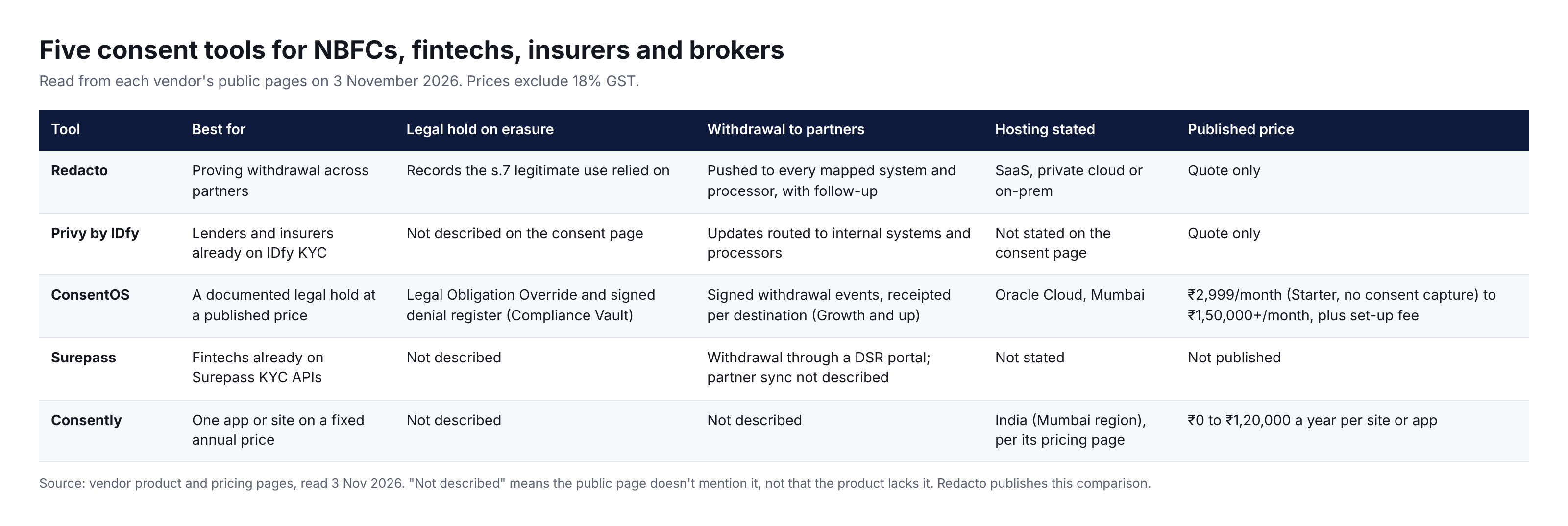
A consent management platform for financial services in India has to do two things a website cookie tool never does: hold one consent per purpose across app, branch and call centre, and keep the records a regulator requires after the customer says stop. Here's how the five compare on both.
| Tool | Best for | Lending and insurance features | Regulators it speaks to | Deployment and hosting | Pricing (3 Nov 2026) | Skip it if |
|---|---|---|---|---|---|---|
| Redacto | Proving withdrawal across partners | Receipt per purpose tied to the notice version; withdrawal sent to every mapped system and processor, with a Consent Reconciliation Statement; records the legitimate use relied on | DPDP-first; the AuthBridge edition covers RBI, SEBI and IRDAI rules | SaaS, private cloud or on-prem | Quote-based | You need a published price before the first call |
| Privy by IDfy | Lenders and insurers on IDfy KYC | Live check of whether a consent is active, revoked or expired; updates routed to systems and processors; renewal and parental consent | DPDP; NBFC customers named in IDfy's July 2026 release | Ask | Quote-based | You want a light, self-serve setup |
| ConsentOS | A documented legal hold at a published price | Legal Obligation Override and signed denial register (Compliance Vault plan); signed withdrawal events receipted per destination | RBI and PMLA retention (Compliance Vault plan) | Oracle Cloud, Mumbai | ₹2,999 to ₹1,50,000+ a month, plus ₹25,000 to ₹5,00,000 setup | You need a vendor with years of finance references |
| Surepass | Fintechs on Surepass KYC APIs | Purpose definitions, immutable ledger, withdrawal through a rights portal, 7-year consent evidence | Use cases name banks, NBFCs, fintechs, payment platforms and insurers | Ask | Quote only | You need proof of live consent deployments |
| Consently | One app or site on a fixed budget | Purpose-linked consent, preference centre, request centre, audit log, REST API for mobile apps | DPDP only | India (Mumbai region) | ₹0 to ₹1,20,000 a year per site or app | You run several apps or need partner sync |
Prices exclude 18% GST. Where a cell says "Ask", the vendor doesn't make it clear, and that's worth a direct question before the demo, not proof the product lacks it.
How we chose
I put every tool through four questions. They come from the rules a lender or insurer answers to, not from a generic DPDP checklist.
- Per-purpose consent with an audit trail. RBI wants digital lending data collected "with prior and explicit consent of the borrower having audit trail". The DPDP Act wants consent that is specific to each purpose. So the tool has to hold one record per customer, per purpose, with the notice version and channel.
- A legal hold that survives withdrawal. When a borrower withdraws, Section 8(7) of the DPDP Act lets you keep data where "retention is necessary for compliance with any law". The tool has to keep the KYC file, stop the marketing and write down which law it relied on. Our guide to handling DPDP deletion requests covers the request side.
- Withdrawal that reaches partners. Section 6(6) makes you and your processors stop. Partners that decide their own uses, such as a cross-sell insurer, aren't your processors, so tell them under your contract and record that you did. In finance the processors are lending service providers (LSPs), collection agencies, KYC vendors, third-party administrators (TPAs) and agents. The tool has to push the withdrawal to each one and prove it landed.
- An API that fits existing KYC and sign-up. Few lenders will rebuild their KYC flow for a consent tool, and they shouldn't have to. The consent layer needs APIs and SDKs that sit beside KYC.
I've judged these tools the way I'd judge them for my own team: demos, product documentation, published pricing and what teams running them report, read against the RBI, IRDAI, SEBI and TRAI texts cited below and the DPDP Rules 2025, because that's what your auditor will read them against. User opinions come from G2, Capterra, PeerSpot and Reddit; where nobody has written about a tool yet, I say what that means for you. For the wider market, see our comparison of consent management platforms in India.
Considered and left out
- AuthBridge sells a consent product "powered by Redacto", so listing it would count us twice.
- Perfios fits lenders already on its stack; I cover it in our post on consent tools for banks.
- Digio and Signzy were left out to keep the list to five; both are better known for e-sign and KYC.
- ComplyDP was left out because it advertises a Consent Manager registration timeline that doesn't match the notified DPDP Rules. If a vendor gets the dates wrong, I won't trust its product on the rest.
What is the best architecture for DPDP consent in a fintech that already has KYC?
Here's the question as one fintech team put it: "we already have kyc and customer onboarding in place, but we need a way to capture explicit user consent, maintain audit trails, support consent withdrawal, and prepare for future rbi requirements without rebuilding our entire onboarding process. what is the best architecture and which platforms should we evaluate?"
My answer: don't rebuild KYC. Add a consent layer beside it, and make that layer the only place anyone asks "may we use this data for this purpose?"
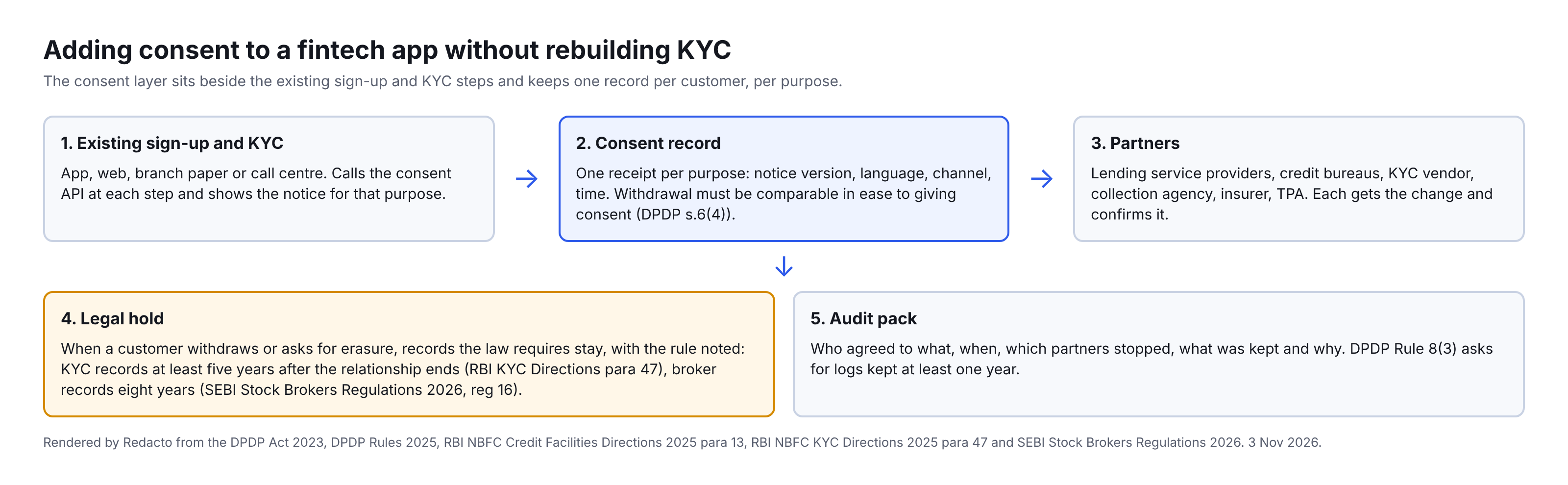
It has five parts.
- Your existing sign-up and KYC. At each step that needs consent, the app or the branch form calls the consent API, shows the notice for that purpose, and gets back a receipt ID. KYC logic stays where it is.
- One consent record. Each receipt holds the purpose, notice version, language, channel and time. Section 6(4) says withdrawing must be comparable in ease to giving consent, so the same record takes the withdrawal from any channel.
- Partner sync. When a purpose changes, the layer tells every partner that uses it: the LSP, the bureau, the collection agency, the insurer. Each confirms. RBI's para 13(4) asks for explicit consent before sharing with any third party, except where a statute or regulator requires the sharing, so the record should also show which shares rest on a legal duty.
- Legal hold. A withdrawal or erasure request doesn't delete records the law makes you keep. The layer flags them, notes the rule, and sets the date they can go.
- Audit pack. One export per customer: what they agreed to, what they withdrew, who stopped, what was kept and why. Rule 8(3) of the DPDP Rules asks for logs kept for at least a year.
The platforms I'd evaluate for this are the five below. Test each on one thing: withdraw marketing consent for a test customer and ask for proof that every partner stopped while the KYC file stayed. For the build itself, see our guide on how to automate consent collection in a fintech app.
On timing: the DPDP Rules were notified on 13 Nov 2025. Rule 4 on Consent Managers applies from 13 Nov 2026, and the notice, consent, security and retention rules apply from 13 May 2027.
What finance regulators add on top of DPDP
The DPDP Act sets the floor. Your sector regulator adds rules on what you collect, who you share it with and how long you keep it. These are the ones a consent tool has to model.
RBI: digital lending consent requirements
RBI's digital lending rules now sit in the Reserve Bank of India (Non-Banking Financial Companies – Credit Facilities) Directions, 2025, last updated on 15 Jul 2026. Para 13 is the consent section, and it's stricter than DPDP in places.

- 13(1) Data collection by the NBFC's digital lending app and its LSP's app must be need-based, "with prior and explicit consent of the borrower having audit trail". The apps must not access files, media, contact lists, call logs or telephony functions. A one-time access to the camera, microphone or location is allowed only "for the purpose of on-boarding / KYC requirements", with explicit consent.
- 13(2) The borrower can give or deny consent for specific data, restrict disclosure to third parties, limit retention, revoke consent and ask for deletion.
- 13(3) The purpose has to be disclosed at each stage of the interaction.
- 13(4) Explicit consent before sharing personal information with any third party, except where a statute or regulator requires it.
- Para 14 LSPs store only minimal data, and storage must be on servers in India.
So, can a loan app access your contacts? Not if the lender is an RBI-regulated NBFC: para 13(1) rules it out for the NBFC's app and its partners' apps. Our guide to consent for mobile app permissions covers how to ask for the one-time permissions that are allowed.
Consent for credit bureau data sharing. Para 17 requires NBFCs to report lending done through their apps and their LSPs' apps to credit information companies under the CIC (Regulation) Act, 2005. That's a legal duty, which is why 13(4) carves it out. A withdrawal shouldn't stop it, and your record should say why. Pulling a prospect's bureau report before a loan is a different use; I'd record it as its own purpose.
KYC records. RBI's NBFC KYC Directions, 2025 (para 47) require transaction records for at least five years from the transaction, and identity and address records for at least five years after the relationship ends. Whether you collect KYC data on consent or on a legitimate use under Section 7 is a call for your counsel, since Section 7 has no ground written for KYC. Retention is clearer: Section 8(7) lets you keep what para 47 requires.
Account Aggregators and DPDP consent
Account aggregator consent vs DPDP consent is the comparison lenders mix up most. An Account Aggregator fetches your financial information from one regulated entity (a bank, AMC, insurer or depository) and passes it to another, on a standard consent artefact. RBI's NBFC Account Aggregator Directions, 2025 (paras 15 to 21) set what the artefact holds, let you revoke it in full or in part, and require it to be logged and auditable.
DPDP consent is wider. It covers every purpose a fiduciary processes your personal data for: marketing, cross-sell, analytics, partner sharing. An AA consent artefact covers only the financial information it names, for the purpose, recipients and dates it states. Sahamati, the AA industry body, argued in March 2025 for "ensuring that the DPB deems and/or registers all operating AAs as Consent Managers", which tells you it isn't automatic (Sahamati). For how Consent Managers work under the Act, see the role of a Consent Manager.
In practice a lender needs both: the AA artefact for the bank statement fetch, and its own DPDP consent record for everything it does with that data afterwards.
IRDAI: who an insurer can share proposal data with
IRDAI's (Protection of Policyholders' Interests, Operations and Allied Matters of Insurers) Regulations, 2024 were published in the Gazette on 22 Mar 2024. Regulation 15(2) is the line that matters for consent.

Can an insurer share your proposal data without consent? Only in three cases. Regulation 15(2) says information from the proposal form "shall not be parted or shared with any third party without the explicit consent of the policyholder", except with statutory authorities under existing law, for underwriting the policy or settling a claim, or with an institution IRDAI authorises. Regulation 15(3) bars a proposal form from carrying a clause that shares data by default.
For a consent tool, that means a cross-sell partner or a marketing agency needs its own explicit consent. A TPA settling a claim can rest on the claims exception, and the record should say so rather than show a consent that was never asked for.
SEBI: how long brokers keep client records
How long must a stockbroker keep client records under DPDP? The DPDP Act doesn't set a period; SEBI does. Regulation 16 of the SEBI (Stock Brokers) Regulations, 2026, notified on 7 Jan 2026, says brokers "shall maintain the books of account and other records under regulation 15 for a minimum period of eight years" (SEBI). Regulation 15 includes client account opening forms and clients' written consent for principal contracts. Section 8(7) of the DPDP Act lets the broker keep them for that period after a client withdraws.
For AMCs and other intermediaries, check your own SEBI regulations for the period. SEBI's cybersecurity circular (CSCRF) of August 2024 sits alongside, on the security side.
Telemarketing: the 1600 number series
Consent doesn't stop at data. TRAI's Direction under press release 135/2025 (19 Nov 2025) moved service and transactional calls from regulated entities to the 1600 number series.

The deadlines were 15 Feb 2026 for mutual funds and AMCs, 15 Mar 2026 for qualified stockbrokers, 1 Feb 2026 for NBFCs with assets above ₹5,000 crore and 1 Mar 2026 for the rest. Press release 151/2025 (17 Dec 2025) set 15 Feb 2026 for IRDAI-regulated entities. The 1600 series is for service and transactional calls. Promotional calls and messages run on the customer's preferences under TRAI's commercial communication rules, so if your consent tool records a marketing opt-out, the dialler and the SMS vendor need it too.
1. Redacto

Full disclosure: we build Redacto. I've put it through the same four tests as the others and listed where it falls short.
Features
Redacto is built for the moment a customer withdraws and someone asks: did every system and partner stop? One customer's record holds consents from a mobile app, the web, a call centre and branch paper, so "Account opening" can stay granted while marketing shows as withdrawn, on the same screen.
- Purposes are set one by one, so loan servicing, bureau pulls, cross-sell and marketing are separate choices.
- Every click writes a receipt with a timestamp and the notice version the customer saw.
- Notices run in English and the 22 scheduled languages.
- A withdrawal goes to every system and processor mapped to that purpose. Redacto follows up on the ones that haven't confirmed, then issues a Consent Reconciliation Statement.
- Consent taken offline, at a call centre or on paper can be recorded, and historical consents can be imported.
- It records which Section 7 legitimate use applies where you're not relying on consent, handles children's consent under Rule 10, and accepts consents through registered Consent Managers.
- It deploys as SaaS, in a private cloud or on-premises. Records stay in the local country by default, and retention is set per purpose.
On the four tests, per-purpose records and partner sync are where Redacto is strongest. The legal hold works through per-purpose retention and recorded legitimate uses, so in the demo, ask how a KYC record is held after a withdrawal and where the rule is noted. Most teams go live on their first channel in a week.
Pricing
Quote-based. Pricing follows volume, and each module counts it in its own way. For consent, the thumb rules are your data principal count and how many data processors you have, since every processor adds API calls for each withdrawal and each new customer. Industry matters too: a plain B2B flow hitting two API endpoints is far simpler than physical-to-digital flows where company agents access data. My own read for finance: a lender whose withdrawals have to reach LSPs, bureaus, collection agencies and field agents sits at the complex end. In the demo, ask how group entities and channels are counted. I walk through it in this short video Redacto posted on LinkedIn:
Reviews
Three customers, in their own words:
Prem Kumar, Data Protection Officer, Pine Labs Group: "Privacy across a group of businesses is hard because every team has its own systems and its own idea of what personal data it holds. Redacto gave us one view of where personal data is collected, why we collect it and where it goes. When a customer request or an audit question comes in, I answer it with evidence, not a round of emails."
Surya N, Director, Product Management, TimePay: "As a product team, we had one worry: would privacy compliance hurt the onboarding journey? It didn't. Redacto's consent flows fit into our app with very little engineering effort, and we change notices from the console instead of shipping a new build. Our users get a clear choice at every step, and we get a consent record we can stand behind."
Saif, Head, Infosec Compliance & Privacy, Razorpay: "Our vendor security and privacy reviews used to live in spreadsheets and long email threads. With Redacto, every assessment, every piece of evidence and every follow-up sits in one place. When a customer sends us a security questionnaire, we answer it from that same record. We focus on the vendors that actually carry risk, and the paperwork no longer runs the week."
Clients
By our own count we've done "40+ successful implementations". Pine Labs Group, TimePay and Razorpay are quoted above. AuthBridge also sells a consent product "powered by Redacto", and its policy engine covers RBI, SEBI and IRDAI rules.
Summary
Choose Redacto if consent comes through apps, branches, agents and call centres and you need proof that withdrawals reached every LSP, bureau and agency. The limit I'd flag: reconciliation covers only the systems you map, so a lender with an untracked collection agency or an old SMS vendor needs to fix that inventory first. It's also more than a single-app startup needs.
2. Privy by IDfy

Privy is the privacy product of IDfy, a KYC and identity vendor that many Indian lenders and insurers already use.
Features
- Multilingual, purpose-specific notices, with a consent artefact per purpose.
- A live check of whether a consent is active, revoked or expired, which a lending system can call before it uses data.
- Updates routed automatically to internal systems and processors, with self-serve withdrawal for customers.
- Immutable audit trails, parental consent and consent renewal.
- Collection through forms, APIs, mobile apps, third-party integrations and offline channels.
Against the tests above, Privy covers per-purpose records, partner routing and API fit. The gap I'd press on is legal retention: ask IDfy to show how a KYC record is kept after a withdrawal.
Pricing
Quote only. If you already buy KYC from IDfy, ask for consent priced into that contract rather than as a separate deal.
Reviews
Privy has no user reviews on PeerSpot or Capterra yet. The one honest opinion I've seen is a founder on r/IndiaBusiness who, in a 2026 post, called it "Strong on consent and India-specific, yet it still feels heavy with too much setup". That matches what I'd expect from an enterprise suite: plan for a real rollout, not a weekend.
Clients
IDfy won MeitY Startup Hub and NeGD's Code for Consent challenge (8 Jul 2026), and counts Shriram Finance and Aditya Birla Capital among its finance customers, with "50-plus live implementations". Redacto was one of the shortlisted entrants in that challenge, so read my take with that in mind; we cover the challenge in NeGD's Consent Manager programme.
Summary
If you already run IDfy for KYC, Privy is the obvious first call: one vendor, one contract, one integration team. Expect an enterprise rollout rather than a self-serve one. Our Privy review goes deeper.
3. ConsentOS
ConsentOS is the newest vendor here and the only one that publishes a legal-hold feature and its price.
Features
ConsentOS is run by CivicLayer Technologies, a Gurgaon company incorporated in 2026, with 15 organisations in early access. You'd be one of its first customers, and that cuts both ways.

- Growth plan and up: a rights portal, a breach register, consent artefacts signed with HMAC-SHA256 and signed withdrawal events. Withdrawals are "signed, then receipted per destination", which is exactly what my partner test asks for.
- Scale plan: a conflict-of-law register.
- Compliance Vault plan: a Legal Obligation Override, an HMAC-signed denial register and automatic flags when an erasure request conflicts with a retention duty. "The flag never blocks the request; an admin still decides it", and that's the right design: a person makes the call and the record shows why.
- Data is hosted on Oracle Cloud in Mumbai.
Several features are planned rather than live: a retention schedule dashboard and a vendor compliance tracker (both H1 2027), a 72-hour breach pipeline (H2 2026) and a Consent Manager API (late 2026). I also wouldn't rely on ConsentOS's claims about the Data Protection Board and registration deadlines; check dates against the notified Rules.
Pricing

Early access pricing, plus 18% GST:
- Starter: ₹25,000 setup plus ₹2,999 a month, up to 50,000 data principals. Readiness tools only; consent capture starts at Growth.
- Growth: ₹1,25,000 plus ₹14,999 a month, up to 5 lakh data principals.
- Scale: ₹2,50,000 plus ₹34,999 a month, up to 20 lakh.
- Compliance Vault: ₹5,00,000 plus ₹1,50,000+ a month.
- SDF / Enterprise: ₹7,50,000+ plus ₹1,50,000+ a month.
- A readiness assessment costs ₹3,00,000 one-time, with a ₹25,000 credit.
Annual billing gives two months free, and there's no lock-in. For a lender, the realistic entry point is Growth, and the legal hold sits on Compliance Vault.
Reviews
ConsentOS has no reviews on G2, Capterra, PeerSpot or Reddit yet, which is normal for a 2026 company. Treat your reference call as the review.
Clients
None named. The 15 early-access organisations are ConsentOS's own count, so ask to speak to one.
Summary
If the legal hold is your main worry and you want a price before the first call, ConsentOS has the clearest answer on paper. The risk is age: a 2026 company with planned features still to ship. Ask for a reference in your sector and a live demo of the override on a KYC record.
4. Surepass DPDP Consent

Surepass is best known for KYC and verification APIs. Its DPDP consent product is newer.
Features
- A step-by-step setup: define purposes, publish notices, collect consent, record it in an immutable ledger, and take withdrawals through a rights (DSR) portal.
- Rights requests, grievances, audit reports, and data discovery and lineage.
- Consent records kept in machine-readable form for seven years. That's longer than the one-year minimum log period in Rule 8(3), which suits lenders.
- Consent notices in 22 languages, cookie scanning, breach management, role-based access and a record of processing.
- API-first, which suits a fintech already calling Surepass for KYC.
Surepass pitches it at banks, NBFCs, fintechs and payment platforms "for purpose-based consent—covering onboarding, loans, marketing, data sharing & withdrawal", and at insurers. Partner sync and a legal hold are the two gaps I'd press on before signing.
Pricing
Quote only for the consent product.
Reviews
Surepass's consent product has no reviews on G2 yet. The closest signal is its Aadhaar Verification API, at 3.3 out of 5 from 4 reviews. In the 2023 reviews, users on G2 like the easy integration and complain about latency at peak times and complex error codes; the latest review, from 19 Aug 2026, complains about support and the wallet policy (G2, Aug 2026). That's the KYC API, not consent, but it's the same company you'd call for support. I'd also ignore the "4.6 on G2" in its footer until you can see where it comes from.
Clients
No named customer for the consent product yet, so ask for one live lender before you sign.
Summary
Worth a look if you already run Surepass KYC and want consent from the same API vendor. I'd ask for one live consent customer in lending before signing, and test how a withdrawal reaches your partners.
5. Consently
Consently is a DPDP-first tool with the plainest rupee pricing of the five.
Features
- Every plan includes cookie consent, DPDP consent with a request centre, and breach management.
- Purpose-linked consent on forms, per-purpose choices, a privacy preference centre, easy withdrawal and an immutable audit log.
- All 22 scheduled languages.
- Consent records are stored in India (Mumbai region).
- A REST API for mobile apps, but check which plan carries it before you budget.
- SMS OTP quotas of 1,000 on Growth and 5,000 on Business, useful for verifying a phone number.
Consently handles per-purpose consent and API fit for one app. I wouldn't count on it for legal holds or for pushing withdrawals to partners, which is fine for a startup and a problem for a lender. If you need either, ask Consently before you sign.
Pricing
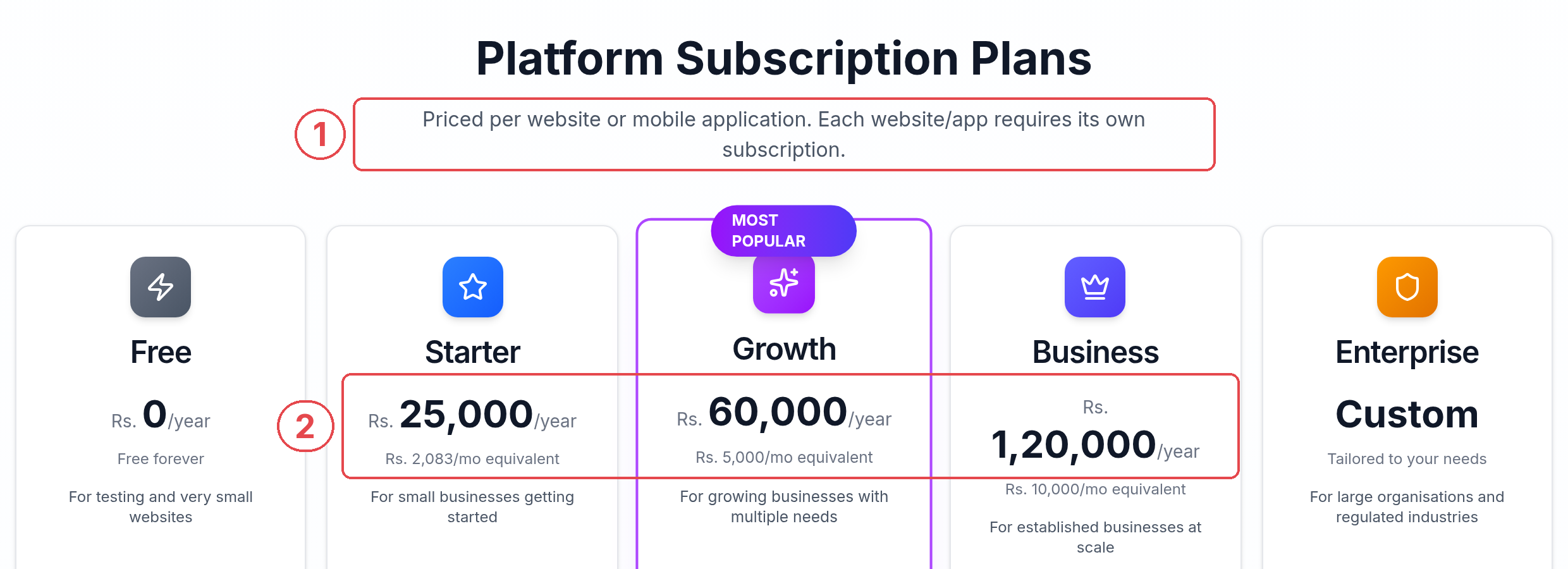
Pricing is the plainest here: Free (100 DPDP consents a year), Starter at ₹25,000 a year (5,000 consents), Growth at ₹60,000 (20,000) and Business at ₹1,20,000 (50,000). All are per website or app, billed annually, plus 18% GST. Enterprise is custom. Extra DPDP consents cost ₹10 each. Setup is free if you do it yourself, or ₹10,000, ₹25,000 or ₹99,999 for assisted, managed or enterprise setup. An optional legal support plan from a law firm costs ₹24,999 or ₹74,999 a year.
Reviews
I haven't seen a user review I can tie to Consently.in yet. A similarly named international tool has reviews, so don't mix them up when you go looking.
Clients
Consently counts 1,000+ Indian businesses as users, but names no lenders or insurers among them.
Summary
A fair choice for an early-stage fintech with one app that wants DPDP consent at a known price. A lender with several apps, LSPs and agencies will outgrow it, both on per-app pricing and on partner sync. Compare it with Consently alternatives.
How to choose, by situation
Consent management for NBFCs
An NBFC's hardest case is the withdrawal that has to reach LSPs and collection agencies while the KYC file stays for five years. Start with Redacto or ConsentOS's Compliance Vault for that. If you already verify customers through IDfy, add Privy to the shortlist. Run the test from the architecture section on each: one withdrawal, proof from every partner, KYC kept with the rule recorded.
Consent management for fintechs in India
For a fintech app with a KYC partner already in place, API fit matters most. If you're on Surepass or IDfy for KYC, try their consent products first. If you're a single-app startup on a budget, Consently gets you DPDP notices in all 22 languages at a known price. Once you add lending partners, you'll need partner sync, which points to Redacto or Privy.
Consent management for insurance companies in India
Insurers need separate records for underwriting, claims, cross-sell and marketing, because regulation 15(2) treats them differently. Ask each vendor to show a TPA share recorded under the claims exception and a cross-sell share blocked for lack of consent. Agents and brokers add channels, so offline capture counts.
Brokers and AMCs
Retention runs long: eight years for broker records under SEBI's 2026 regulations. A legal hold that records the rule and the end date is the feature to test. ConsentOS has one on its Compliance Vault plan; ask Privy and us how a broker record is held after a client withdraws.
Related reading
- The best consent management tools for banks
- How to automate consent collection in a fintech app
- DPDP compliance software for BFSI
- Consent management platforms in India compared
- The role of a Consent Manager under the DPDP Act
- DPDP Rules 2025 explained
If you want to see a withdrawal travel from your app to every lending partner, with the KYC record held and the rule written down, book a consent demo with Redacto.