6 Best Consent Management Tools for Hospitals in India, Judged on Patient Consent
Six consent tools for Indian hospitals, compared on ABDM consent, guardian consent for minors, emergency access, insurer sharing and pricing.

The consent form I've learned to distrust most is the one-page bundle. Hospitals have their own version. One signature at the admission desk covers the surgery, the insurer's claim file, ABHA linking, relatives calling the ward, a research registry and the health-check offers that follow the patient home. Six uses ride on one pen stroke, and months later nobody can show which of them the patient actually agreed to.
In a LocalCircles survey released on 28 May 2025, 18% of 9,381 responses said they now get promotional calls or messages from the labs, hospitals or third parties where they took a COVID test (LocalCircles release).

You're looking for patient consent management software that works inside an Indian hospital, with its admission desk, its ER and its ABDM link, and a cookie banner won't do that job. I'll judge six tools on four hospital tests, show you where clinical consent ends and DPDP data consent begins, and tell you which tool I'd pick for a hospital group, a lab chain, a single hospital and a hospital with international patients. By the end you'll know what to ask in the demo and which answers should end the call.
TL;DR
Consent management for hospitals means keeping three kinds of "consent" apart, and most tools handle one of them. There's the procedure consent a surgeon needs, the data consent the DPDP Act needs for insurer sharing, research and marketing, and the records you must keep whatever the patient says. Pick a tool that keeps the last two apart on one patient record and can log an emergency override.
- Redacto: best for hospital groups that need withdrawal proof across HIS, CRM, call centre and outside vendors.
- Digital Anumati: best for ABDM-linked providers and labs that want emergency-access logging and a free tier.
- Sammati: best for hospitals that want to self-host and keep withdrawal separate from records retained by law.
- Certinal: best for hospitals whose first problem is getting paper procedure and privacy consents signed digitally.
- OneTrust: best for hospital chains with international patients that already run OneTrust.
- Aarogya Consent Management: best for hospitals already on Aarogya HMIS that need digital procedure consent. It's not a DPDP tool, and I include it to show the difference.
The 6 tools compared

| Tool | Best for | Patient consent types | ABDM/ABHA support | Deployment | Pricing (Nov 2026) | Skip it if |
|---|---|---|---|---|---|---|
| Redacto | Hospital groups proving withdrawals across many systems | Purpose-wise data consent; parent or guardian consent for under-18s; Section 7 legitimate uses recorded with the ground. No procedure consent | Ask in the demo | SaaS, private cloud or on-prem; India storage by default | Quote only | You need bedside procedure consent on day one |
| Digital Anumati | ABDM-linked providers and labs | Data purposes; guardian and nominee consent; emergency override log; teleconsultation notices | ABHA ID and HIE-CM sync (vendor claim) | SaaS or on-prem | Free ₹0 a month (3,000 consent collections); Growth ₹9,999 a month; Enterprise custom | You want independent user reviews before you buy |
| Sammati | Hospitals that want to self-host | Data purposes; parental consent under s.9; correction recorded as an amendment | Ask | SaaS or in your own cloud | Free for 1,000 data principals for 90 days; paid plans quote-based, metered on data principals | You need ABHA-linked consent artefacts |
| Certinal | Digitising paper procedure and privacy consents | Surgical, procedural, privacy and parental consents; IPD, OPD, day care and ER flows | "ABHA-ready" remote signing; ABHA listed as an ID check | SaaS | Quote only | You need proof a withdrawal reached downstream systems |
| OneTrust | Chains with international patients already on OneTrust | Web, app and preference-centre consent; no hospital flows | Not its strength | SaaS | Quote only, metered on daily visitors (CMP) or profiles (UCPM) | You're a single hospital with a small privacy team |
| Aarogya Consent Management | Hospitals on Aarogya HMIS | Procedure and department consent; person giving consent and relationship; Aadhaar OTP or fingerprint signing | Not mentioned | Inside Aarogya HMIS | Not published | You need DPDP purpose-wise consent or withdrawal |
Prices exclude GST. "Quote only" means you won't see a number until you talk to sales.
How we chose
I used four pass/fail tests, each taken from a situation every hospital privacy team meets in its first month.
- Data consent sits apart from procedure consent. The tool records insurer sharing, research, marketing and ABHA linking as separate purposes, and doesn't fold them into the surgical form.
- Guardians are first-class. For a child or an incapacitated adult, the tool records who consented and their relationship to the patient. A ticked box saying "guardian" fails.
- Emergency access is logged with a reason. When the ER opens a record without consent, the tool writes who opened it, when and on what ground.
- Withdrawal stops the right things. A withdrawal switches off the uses that rested on consent, erases the data held only for them, and leaves the medical record the law makes you keep, with the legal basis written down.
Here's how each one does. "Not documented" means I haven't seen the vendor show it, which in a hospital demo is a no until they prove otherwise.
| Tool | 1. Data vs procedure consent | 2. Guardian recorded | 3. Emergency logged | 4. Withdrawal vs retention |
|---|---|---|---|---|
| Redacto | Pass | Pass (under-18 flow, Rule 10) | Partial: legitimate uses recorded with the ground; ask to see the ER case | Partial: withdrawal pushed to every mapped system, with a Consent Reconciliation Statement; ask to see a record kept by law |
| Digital Anumati | Pass | Pass | Pass | Pass ("Withdraw & Notify") |
| Sammati | Pass | Pass | Not documented | Pass |
| Certinal | Partial: purpose-tagged, but built on e-signature | Pass | Not documented | Not documented (preference centre has "Withdraw") |
| OneTrust | Partial (web and app purposes) | Not documented | Not documented | Not documented |
| Aarogya | Fail (procedure consent only) | Pass (relationship recorded) | Fail | Fail |
I've judged these tools the way I'd judge them for my own team: demos, product documentation, published pricing and what teams running them report, read against how consent breaks in a hospital. User opinions come from Gartner Peer Insights and Capterra, the two sites where any of these tools has reviews. If you're shopping for healthcare consent management software, treat the "vendor claim" labels below as questions for the demo.
Full disclosure: we build Redacto, and it's #1 here. The order isn't a score; the test results are in the table above. Nothing here is a paid placement, and no vendor saw the draft.
I left out four tools on purpose. Securiti, BigID, Privy and Consentin already appear in our list of DPDPA compliance software for hospitals, which covers full compliance suites. This post covers the narrower job of patient consent. SecureConsent is still waitlist-only, and ConsentOS is NBFC-first, so it sits in our finance list.
Clinical consent, data consent and legal retention are three different things
This is the argument I'd make to any hospital board, and the one most consent tools get wrong.

Clinical consent is the patient agreeing to be treated: the surgery, the anaesthesia, the transfusion, the teleconsultation. Medical law and ethics govern it, and a doctor needs it before touching the patient. A digital patient consent form for a procedure is a signed clinical document, and e-signature tools do this part well.
Data consent is what the DPDP Act means by consent under section 6. It covers the uses that aren't needed to treat this patient now: marketing a health-check package, sharing beyond what a claim needs. Each purpose needs its own notice and its own yes, and section 6(4) says the patient can withdraw "at any time", and withdrawing must be comparable in ease to giving consent.
Treatment itself still needs a lawful basis for the data: usually the admission notice and consent, or section 7(a) for data the patient gives for that purpose. Section 5's notice duty applies either way.
Research is a special case. Section 17(2)(b) and Rule 16 take research, archiving and statistical work outside the Act if it meets the Second Schedule standards and the data isn't used to make a decision about that patient. Outside that, research needs consent, and your ethics committee will usually ask for it anyway.
Legally retained records don't rest on consent at all. The Indian Medical Council (Professional Conduct, Etiquette and Ethics) Regulations, 2002 tell every physician to keep indoor patients' records for 3 years from the start of treatment (cl. 1.3.1, NMC copy). State rules and medico-legal practice can push that longer, so ask your legal team for your own number. Section 8(7) of the DPDP Act lets you keep data where "retention is necessary for compliance with any law".
So, if a patient withdraws consent, must the hospital delete the medical record? No. The withdrawal stops the marketing calls and any research that rested on consent. Section 8(7) also makes the hospital erase the data it held only for those uses, and make its vendors erase their copies, unless another law requires the data to be kept. The chart stays; the marketing list entry goes. Sammati puts it cleanly: "What must stop is the processing that consent was the basis for".
The tool you buy has to model all three on one patient record, or your front desk will keep using one form for everything.
What DPDP and ABDM require from a hospital
For the full list of steps, read our seven DPDP steps for hospitals. Here I cover only the parts a consent tool has to handle. Under Rule 1 of the DPDP Rules, most of them, including the notice, consent and children's rules, apply from 13 May 2027, and Rule 4 (Consent Manager registration) from 13 Nov 2026 (PIB, 14 Nov 2025; dates in our DPDP Rules guide). Large hospital groups may later be notified as Significant Data Fiduciaries under section 10, which adds a DPO, an independent audit and a yearly impact assessment (Rule 13). Those duties apply from 13 May 2027 at the earliest, and nobody has been notified yet; I'd plan as if a large group will be.
One correction before we start. The DPDP Act has no separate "sensitive personal data" category. Health data is personal data like any other under the Act, so be wary of any pitch that says otherwise.
Can a hospital access patient records in an emergency without consent?
Yes, for the emergency itself. Section 7(f) of the DPDP Act lists "responding to a medical emergency involving a threat to the life or immediate threat to the health of the Data Principal or any other individual" as a legitimate use, and section 7(g) covers treatment during an epidemic or other threat to public health.

Read it as a legitimate use, not as "implied consent". The Act doesn't say the patient consented. It says you may process without consent for that purpose. Two things follow. The ground covers the emergency, not the follow-up marketing after discharge. And the Act gives no logging rule for it, but you'll want one anyway, because the first question a Board inquiry will ask is who opened the record and why. I'd log the user, time, record and stated reason for every override, and have the DPO review the log weekly. Ask your legal team to confirm where the emergency ends for your hospital.
Does a hospital need parental consent for a child patient under DPDP?
Not for treating the child. Section 9(1) asks for verifiable parental consent before processing a child's data (anyone under 18), and section 9(3) bars tracking, behavioural monitoring and targeted advertising aimed at children. Rule 12 of the DPDP Rules 2025 then switches off sections 9(1) and 9(3) for the classes listed in Part A of the Fourth Schedule. Item 1 is "a clinical establishment, mental health establishment or healthcare professional", where "processing is restricted to provision of health services to the child … to the extent necessary for the protection of her health". Item 2 covers allied healthcare professionals.

The carve-out stops at health services. Marketing a vaccination package to the parents or analytics on paediatric visits still needs the parent's verifiable consent, and so does research that falls outside the section 17(2)(b) exemption. Rule 10 sets out how to verify it. So your tool needs a guardian flow that records the adult's identity and relationship, and it must flag the child's record so nobody runs targeted advertising off it. Section 9(1) also covers an adult with a disability who has a lawful guardian, and the Fourth Schedule carve-out doesn't extend to them: you need the guardian's verifiable consent (Rule 11 sets the checks) unless a section 7 ground such as a medical emergency applies. A patient who is simply unconscious in the ICU is an emergency case under section 7(f), not a guardianship case. Rules 10, 11 and 12 apply from 13 May 2027.
ABDM consent artefacts and ABHA consent for hospitals
ABDM runs its own consent layer. When one hospital or lab wants records another one holds, the request goes through the Health Information Exchange and Consent Manager (HIE-CM), and the patient approves it in their ABHA or health-record app. The HIE-CM never sees the data: it carries the consent and the request, and the records stay with the hospital that holds them (ABDM HIE-CM brochure, May 2024).
The consent rules come from the Health Data Management Policy. The latest version is still the revised draft of April 2022, and under clause 9.2 consent is valid only if it is free, informed, specific, clearly given and capable of being withdrawn at any time.

Don't confuse the HIE-CM with a Consent Manager under the DPDP Act. They're different things with different rulebooks, and our explainer on the role of the Consent Manager in the DPDP Act covers the DPDP side. For a hospital, ABDM consent handles record exchange between facilities, and your own consent tool handles everything else: insurer sharing, research, marketing and family access. Look for a tool that writes the ABDM consent onto the same patient record, so a DPO can see both in one place.
Teleconsultation consent
The Telemedicine Practice Guidelines of 25 March 2020 split consent by who starts the call. Clause 3.4.1: "If, the patient initiates the telemedicine consultation, then the consent is implied." Clause 3.4.2: explicit consent is needed if "a Health worker, RMP or a Caregiver initiates a Telemedicine consultation." Clause 3.4.3 lets the doctor record explicit consent in any form, including a text or a spoken yes, in the patient's records.

That's clinical consent to the consultation. The DPDP notice and consent for what your telehealth app does with the data afterwards is a separate thing. If you run a patient app, our guide to consent in mobile apps covers the SDK side.
Can a hospital share patient data with an insurer without consent?
Not as a general rule, and this is the answer I'd have legal sign off on. The DPDP Act names no insurer or TPA exception. A hospital has two possible grounds: the patient's consent under section 6, or section 7(a), which covers data the patient "voluntarily provided" for a specified purpose where they haven't said they object. A patient who asks for a cashless claim can be read as giving the hospital that purpose, but no Board decision or rule has tested this yet.
My practice: take a separate, purpose-specific consent for insurer and TPA sharing at admission, limit it to the claim, and let it lapse when the claim is settled. The patient's policy contract with the insurer obliges the patient to hand over claim papers. It doesn't by itself give the hospital a basis to send the full record. Insurer sharing beyond the claim, such as wellness offers, needs fresh consent.
Which platforms offer patient consent management and revocation?
A patient consent management platform with revocation has to stop the consent-based uses, and of the six, Redacto, Digital Anumati and Sammati do. Redacto adds a reconciliation report proving each downstream system acted, Digital Anumati adds ABDM sync and emergency logging, and Sammati keeps legally retained records untouched. Certinal has a withdraw option in its preference centre. Aarogya handles procedure consent only, without revocation.
1. Redacto
We built Redacto's consent product around one promise, "Consent you can prove on every channel", and around one job: checking that every withdrawal reaches the systems that use the data (product). For a hospital group, that's the hard part: the HIS, the CRM, the call centre, the lab partner and the health-check marketing agency all hold the same phone number.
Features
- One record per person across web, app, call centre and paper, with each route keeping its own notice version.
- A timestamped receipt for each consent, linked to the notice version.
- Notices in English and the 22 languages of the Eighth Schedule.
- Withdrawal pushed to every system and processor mapped to that purpose, with a follow-up on any that didn't act. The result goes into a Consent Reconciliation Statement you can show an auditor or the Board.
- Legitimate uses under section 7 recorded against the purpose with the ground noted. For a hospital, that's where the emergency override would sit.
- For users under 18, the flow asks for a parent's or guardian's consent and records how identity and age were checked, per Rule 10.
- Consents given or withdrawn through registered DPDP Consent Managers land on the same record.
- Consent collected before Redacto can be loaded onto the record, tagged by its original source. Records are stored in the customer's country (India for an Indian hospital) by default, and it also runs in a private cloud or on-prem.
Procedure consent isn't what Redacto does, so keep your e-sign tool for the surgical forms. In the demo, ask how the ER case and ABHA-linked consent would be handled.
Pricing
Pricing follows volume, and each module counts it in its own way. For consent, the thumb rules are your data principal count and how many data processors you have, since every processor adds API calls for each withdrawal and each new patient. Industry matters too: a plain B2B flow hitting two API endpoints is far simpler than physical-to-digital flows where company agents access data. I walk through it in this short video Redacto posted on LinkedIn. My own read for hospitals: a group with front desks, labs, call centres and outside agencies sits at the complex end:
Reviews
Three customers, in their own words:
Prem Kumar, Data Protection Officer, Pine Labs Group: "Privacy across a group of businesses is hard because every team has its own systems and its own idea of what personal data it holds. Redacto gave us one view of where personal data is collected, why we collect it and where it goes. When a customer request or an audit question comes in, I answer it with evidence, not a round of emails."
Surya N, Director, Product Management, TimePay: "As a product team, we had one worry: would privacy compliance hurt the onboarding journey? It didn't. Redacto's consent flows fit into our app with very little engineering effort, and we change notices from the console instead of shipping a new build. Our users get a clear choice at every step, and we get a consent record we can stand behind."
Saif, Head, Infosec Compliance & Privacy, Razorpay: "Our vendor security and privacy reviews used to live in spreadsheets and long email threads. With Redacto, every assessment, every piece of evidence and every follow-up sits in one place. When a customer sends us a security questionnaire, we answer it from that same record. We focus on the vendors that actually carry risk, and the paperwork no longer runs the week."
Clients
By our own count we've done "40+ successful implementations". Pine Labs Group, TimePay and Razorpay are quoted above; none of them is a hospital.
Summary
Pick Redacto if you run several hospitals or a hospital plus labs and pharmacies, and your problem is proving a withdrawal reached every system and vendor that holds the data. It's not for you if you need bedside procedure consent out of the box. The reconciliation only covers systems you've mapped, so expect to spend the first month mapping where your patient data goes. Our DPDP steps for hospitals explain where Redacto fits in the hospital day and where the DPO's judgement still has to decide.
2. Digital Anumati
Digital Anumati is run by AbyM Technology Pvt. Ltd., Noida, and it's the most hospital-specific tool of the six. It bills itself as "India's only consent platform built for the ABDM ecosystem"; other vendors make ABDM claims too, so treat "only" as marketing.

Features
- An "Emergency Access Protocol" under section 7 that logs a "Medical Emergency" justification with a timestamp and notifies the patient or nominee once stable.
- ABHA ID and HIE-CM consent-artefact sync. Get it shown on the ABDM sandbox before you count on it.
- Guardian and nominee consent for minors, elderly patients and persons with disabilities.
- Teleconsultation notices that tell patient-initiated care from doctor-initiated care, in line with the 2020 guidelines.
- Notices in all 22 scheduled languages on the Growth and Enterprise plans (the Free plan has English plus 2), plus APIs and connectors for HIS, EHR and lab systems.
- Insurers get "time-boxed, purpose-bound access for claim processing — never the full medical record", which is how I'd design it.
One thing to watch: Digital Anumati tells buyers that processing "sensitive personal data requires valid consent under Section 6". The DPDP Act has no such category. I'd treat it as loose marketing copy and keep that line out of any training material your staff see. Its "100% audit readiness" lines are marketing too; there's no measured result behind them.
Pricing
Digital Anumati has the clearest prices in this list (pricing, taxes extra):
- Free: ₹0 a month for 3,000 consent collections, 10,000 consent checks and 500 data collections, one website or app, 6 months of consent record retention.
- Growth: ₹9,999 a month for 50,000 consent collections, 5,00,000 checks, 10,000 data collections and 5 properties, with 3 years of record retention.
- Enterprise: custom. On-premise plans are quoted on nodes and support tier.
- Add-ons: ₹1,500 a month per extra website or app, ₹2,000 for white-label. Annual billing gives two months free.

Check the retention row before you sign. A hospital needs consent records for at least as long as the medical record, and the Free plan keeps them 6 months.
Reviews
Nobody has reviewed it yet. For a hospital, that means your reference calls with the labs below are the review.
Clients
Digital Anumati names Oncquest Laboratories, Khanna Hospital (NABH, West Delhi), Gastroliver, NovaPath Diagnostics and VCare as customers. Call one of them before you sign.
Summary
Pick Digital Anumati if you're a lab chain or a mid-sized hospital that is ABDM-linked and wants to start on a free plan with emergency logging already designed in. It's not for you if you need independent reviews or a long track record before you sign, because neither exists in public yet.
3. Sammati
Sammati is run by Arborworld India Private Limited, and it opens its healthcare pitch with a line I agree with: "A hospital cannot delete a medical record because a patient withdrew marketing consent, and it cannot treat a nine-year-old the way it treats an adult".

Features
- A hash-chained consent ledger: each entry hashes its own content with the entry before it, so a medico-legal case gets a verifiable record.
- A parental-consent flow for patients under 18 that records the guardian relationship and applies the section 9 limits to the child's record.
- Rights requests with statutory clocks. A correction to a clinical record is stored as an amendment with an audit trail, not an overwrite.
- A hosted page for the front desk and kiosks, a server API for your HIS, and bulk import of paper consents you already hold.
- Versioned notices in 22 Indian languages, with the served version pinned to each consent.
- Runs as SaaS or entirely inside your own cloud account.
- A separate product, Arbor Vault, tokenises patient identifiers across HIS, lab and billing systems.
Sammati's healthcare purpose pack comes with ready-made purposes for emergency care and ABDM linking. A purpose template isn't an ABHA connector or an override log, though, so press on both in the demo.
Pricing
Sammati prices "per company" on the number of data principals you hold, with unlimited websites, apps and consent decisions on every plan (pricing, ex-18% GST). The Free plan covers 1,000 data principals for 90 days. Paid plans run from Starter (2,500 data principals) to Enterprise (6,00,000+) on annual prepaid contracts, all at "Contact sales".

For a hospital, every patient who ever registered counts, so size the plan on your total patient base. This year's admissions will undercount it.
Reviews
Nobody has reviewed Sammati yet, so ask for a hospital you can call.
Clients
No named customers yet.
Summary
Pick Sammati if your IT team wants consent data inside your own cloud and you care most about withdrawal that leaves the chart alone. It's not for you if ABHA-linked consent is a day-one need, or if you need customer references before signing.
4. Certinal (eSign & e-Consent)
Certinal is an e-signature company that has built a healthcare DPDP offer around patient consent. If the honest description of your problem is "we have forty paper consent forms and nobody can find the signed ones", start here.

Features
- Purpose-tagged patient consent captured on a hospital tablet at the front desk or bedside.
- Separate flows for IPD, OPD, day care and ER admissions.
- Surgical, privacy and guardian or parental consents, versioned and tracked.
- Staff-assisted signing, and remote signing by SMS, email or QR before the visit, which Certinal calls "ABHA-ready".
- 80+ languages and "1000+ integrations" with HIS, EMR and CRM systems, by Certinal's count.
- SOC 2 and ISO 27001, 27017 and 27018, by its own account.
- A preference centre ("View, Modify, Withdraw"), a rights portal, and ID checks by OTP, ABHA, government ID or biometrics on the enterprise healthcare plan.
The question I'd open the demo with: does a withdrawal travel to downstream systems such as the CRM or the marketing vendor? For DPDP that's the part that matters.
Pricing
Quote only. The ABHA and biometric ID checks sit on the enterprise healthcare plan, so price that tier if you need them.
Reviews
Certinal has the most user reviews in this list, though none come from a hospital.
- Users on Gartner Peer Insights like Certinal's legal compliance, security and integrations, and complain that "it's not possible to change a document that has been sent", so you cancel and start again (Gartner Peer Insights, Feb 2026). It holds 4.5 out of 5 from 42 ratings.
- The one Capterra reviewer, a marketing executive, gives it 5 out of 5 (Capterra, Jul 2024). No healthcare user has reviewed it there.
In a hospital, that "cancel and restart" complaint matters. A consent form with a wrong procedure name is common, and you want the correction trail to be clean.
Clients
Certinal doesn't name a hospital client, so ask for one.
Summary
Pick Certinal if your first problem is paper: getting procedure, privacy and parental consents signed on a tablet and findable later. It's not for you as the only consent tool if you need proof that a withdrawal reached the CRM and every vendor. Many hospitals will pair it with a DPDP consent ledger.
5. OneTrust
OneTrust is the global privacy suite. Its consent packages are the CMP Base and CMP Suite, metered on average daily visitors, and Universal Consent & Preference Management (UCPM), metered on data subject profiles (pricing).
Features
- Cookie and app consent across websites, mobile apps and connected TV.
- Preference centres and consent records synced to marketing systems (UCPM).
- Privacy notices and rights-request intake in the CMP Suite.
- Coverage of GDPR, HIPAA and CCPA programmes, which is why international chains buy it.
ABDM, ABHA and bedside capture aren't its strengths. It earns a place here for one kind of hospital: a chain treating international patients, which already runs OneTrust for GDPR or US programmes and wants one consent record.
Pricing
Quote only; every consent package is "Get Pricing".

Reviews
- Users on Gartner Peer Insights like how easy cookie configuration is, and complain about API limits, weak platform performance and support contacts that keep changing (Gartner Peer Insights, Oct 2026).
- Users on Capterra like its breadth and customisation, and complain that it's hard to set up and costly for smaller teams; one marketing technologist wrote that you need your web developers on the project to deploy its tags correctly (Capterra, May 2026). For a hospital whose privacy team has no web developers, that setup work is the real cost.
Clients
OneTrust has "14,000+ customers" (pricing), but no Indian hospital is named among them.
Summary
Pick OneTrust if you're a hospital chain with international patients and an existing OneTrust contract. It's not for you if you're a single Indian hospital, because setup effort and cost are its most common complaints. See our OneTrust alternatives for India-first options.
6. Aarogya Consent Management (procedure consent only)
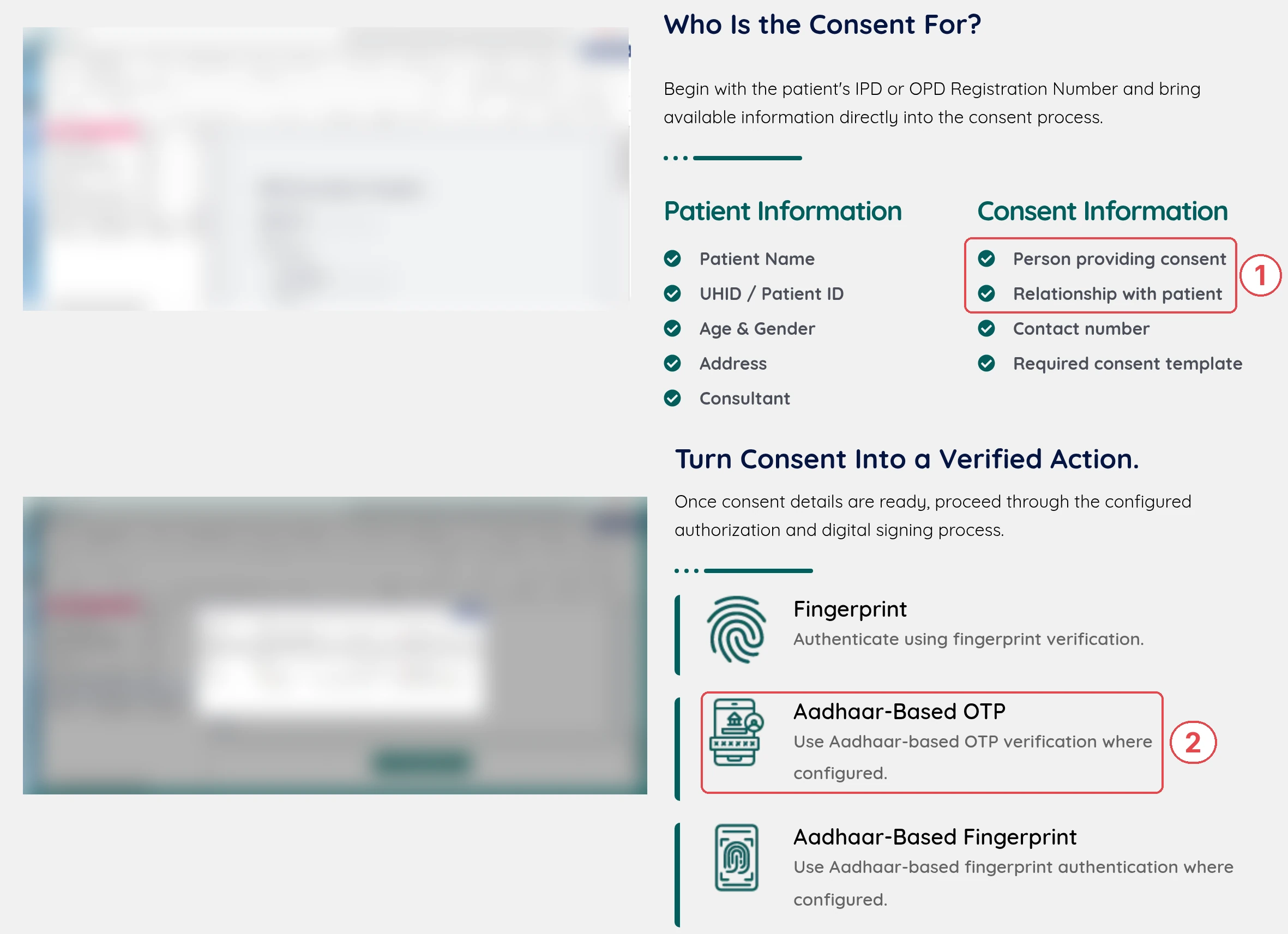
Aarogya Consent Management is a module of Aarogya HMIS, from Dataman Computer Systems Pvt. Ltd. It's my clinical-consent example. It does procedure consent well and doesn't claim to do DPDP data consent.
Features
- Consent templates by procedure, treatment and department, in several formats.
- Multilingual versions of each template (English, Hindi, Bengali, Marathi, Kannada and more).
- Pulls patient details from the IPD or OPD registration number.
- Records the person giving consent and their relationship to the patient.
- Verification by fingerprint, Aadhaar OTP or Aadhaar fingerprint, then digital signing.
- Supporting documents attached and linked to the patient record.
It has nothing for purpose-wise DPDP consent, withdrawal or privacy notices. On the four tests it fails 3 of 4: it passes on guardians, because it records who gave consent and their relationship to the patient, and fails on data consent, emergency logging and withdrawal. If your HMIS vendor shows you this and calls it DPDP compliance, you now know what's missing.
Pricing
Not published.
Reviews
No user reviews; your HMIS user group is a better source here.
Clients
No named customers for the consent module.
Summary
Pick Aarogya if you already run Aarogya HMIS and want paper procedure consents replaced inside it. Don't pick it as your DPDP consent tool. Pair it with one of the first three.
How to choose, by situation
Choosing a hospital consent management system in India comes down to where your consents are collected and how many systems use the data afterwards.
You're a multi-speciality hospital group
Withdrawal proof is your problem, because the same patient sits in several HIS instances, a CRM and a marketing agency's lists. Start with Redacto for the consent record and reconciliation, and keep Certinal or your HMIS module for procedure forms.
You're a diagnostic lab chain
Labs live on ABDM links, home collection and repeat-test marketing, which is exactly where the LocalCircles finding comes from. Digital Anumati fits best, and its free plan lets you pilot on one centre. Check the retention limits first.
You're a single hospital on an HMIS you won't replace
Use the HMIS consent module for procedures (Aarogya, if that's your HMIS) and add Sammati or Digital Anumati for data consent through their APIs. Sammati suits you if IT wants it in your own cloud.
You treat international patients
If you already run OneTrust for GDPR or HIPAA work, extend it and add an India-first tool for DPDP purposes and ABDM. If you serve US patients, our guide to HIPAA compliance in healthcare covers that side.
Questions to ask in a hospital demo
Run the same four scenarios with every vendor, live on their screen.
- The 2 a.m. ER override. "An unconscious patient arrives. Show me the override, the reason field and the log your DPO reviews on Monday."
- A 9-year-old in OPD. "Show me the guardian flow, where the relationship is recorded, and how the child's record is blocked from marketing."
- Insurer consent that expires. "Show me a consent for TPA sharing that lapses when the claim settles, and what the TPA's access looks like the day after."
- Withdrawal that leaves the chart. "The patient withdraws research and marketing consent. Show me what stops, what stays, and the record that proves which is which."
If a vendor can't show all four live, that's your answer.
Related reading
- DPDPA compliance software for hospitals: the full-suite comparison.
- Seven DPDP steps for hospitals
- Consent management platforms in India
- How to handle a DPDPA data deletion request
If you want to see a patient withdrawal checked across every one of your own systems, book a consent demo with Redacto.