7 Best Consiva Alternatives for DPDP Rights and Grievance (2026)
Seven alternatives to Consiva for DPDP rights and grievance, compared on intake, identity, the Rule 14 grievance clock, nomination and public price.

When a mid-market team in India is told it needs a rights and grievance path it can actually run, the first specialist it is shown often arrives with a public plan and very little independent writing around it. Under the Digital Personal Data Protection Rules, 2025, a grievance response period must not exceed ninety days, and that cap applies from about 13 May 2027. Access, correction, erasure and nomination do not carry the same statutory deadline. If you are about to buy the first India-built rights tool you were shown, or you already sat through its demo, you need a clear view of what else can run those jobs, who puts a tariff in public, and who can put a request next to the notice you already have to serve. I wrote this for that comparison.
TL;DR
- Redacto: Best when a Data Principal request and a grievance have to share a record with the notice you already serve. Quote-based. I do not claim nomination as a product feature here.
- Privy by IDfy (DPRM): A named rights module in an India-built suite, with a multilingual portal, grievance handling and an activity trail. Quote-based. Nomination is not a claim I will make from the public module copy.
- Consentin (by Leegality): Rights sit in an India-built DPDP suite, next to notices and artefacts. The public Starter pack is 3,000 consent collects a month at ₹0; that is a consent pack, not a rights tariff. Paid packs are a conversation with sales.
- OneTrust DSR Automation: Best when the suite is already paid for and the question is the request module you already license. Quote-based. What you can read sits on the Privacy Automation G2 profile, not on a DSR-only corpus.
- Digital Anumati: Rights and grievance sit inside another India-built suite, and a public SaaS tariff is on the record: Free at ₹0, Growth at ₹9,999 a month, Enterprise on a custom quote. The self-serve request portal starts at Growth, not on Free.
- DPDP.ai: A named India rights platform for access, correction, erasure, nomination and grievance. Quote-based. There is no public tariff.
- Securiti DSR Automation: Best when fulfilment should be tied to discovery. Quote-based. Comments sit on the platform-wide G2 profile.
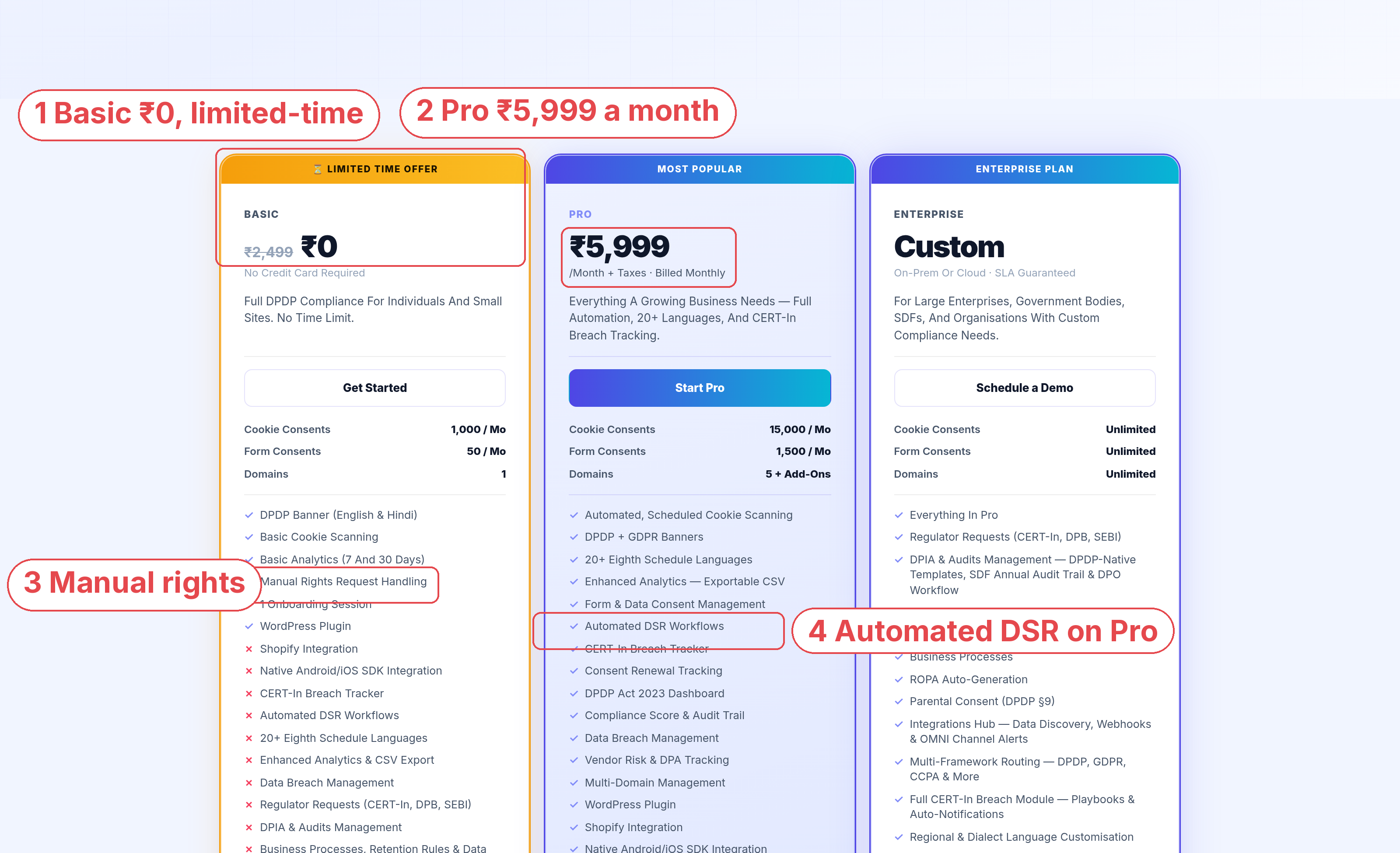
Consiva Data Principal Rights Management is the specialist built in India that most teams meet first, because it has a public plan and names nomination in the product. On 13 November 2026, Basic was still a limited-time offer at ₹0, down from ₹2,499, with "No Time Limit" describing how long you can use the plan, not a promise that the ₹0 price is permanent. Pro was ₹5,999 a month plus taxes. Basic includes manual rights handling; automated rights handling sits on Pro. Rights request volume is not metered on any plan, Free included. If that public plan is why you would stay, lock the current price in writing, and walk a nominee request and a grievance in a tenant before you rely on the slide.
Why teams look past Consiva
I am not inventing complaints. There is no public G2, Capterra, PeerSpot or Reddit corpus I can point you to for this product. That absence is itself a reason some teams keep looking: they want a reference they did not meet through the vendor's own introductions, and they cannot find one in a review directory. Ask for a reference call, and bring one access request and one grievance, plus a nominee scenario if that right matters to you.
A second reason is packaging. Consiva is a specialist for Data Principal rights and grievance, not a full privacy-ops suite with a deep catalogue of US SaaS connectors. If your first job is to push an access or erasure into a stack of US or EU apps, a global request module may be the better trial, even if it is weaker on DPDP-shaped nomination and the Rule 14 clock. If your first job is an India-shaped record you can hand to a DPO, keep Consiva in the trial and make the specialist prove the paths.
A third reason is the live plan. As of 13 November 2026, Consiva pricing still has the ₹0 Basic card marked as a limited-time offer. "No Time Limit" is about how long you may use the plan, not about the discount. Automated rights handling is not on Basic. If ₹0 plus automation was the reason you shortlisted this row, you are looking at Pro, not at the free card, and you should treat the free card as a price that can change until it is in a contract.
The rights product itself is clearer than the review gap would suggest. Unmetered rights sit on every plan, including Free, and the product sets out the four rights the DPDP Act, 2023 actually grants: access under section 11, correction and erasure under section 12, grievance redressal under section 13, and nomination under section 14, plus withdrawal of consent under section 6(4). There is no portability right in the Act, and Consiva does not invent one. That is the right shape for a DPDP specialist. What you still have to prove in a trial is that a nominee can be served, not only named, and that the two clocks you will see, a service timer and a separate grievance period, map to Rule 14, and not to a borrowed "30 days" figure from another law.

If you are leaving, or you have not signed yet, I would put three kinds of row next to that plan: another India-built record that sits with consent, other India-built suites with a named rights module, and two global request modules for teams that already pay for them.
Comparison table
| Tool | Best for | Rights covered | Identity | Grievance clock | Nomination | Public price |
|---|---|---|---|---|---|---|
| Redacto | Request and grievance on the same record as the notice | Access, correction, erasure and grievance; nomination not claimed here | Verified intake before data moves | Due date and escalation to the DPO | Confirm in a trial | Quote-based |
| Privy by IDfy (DPRM) | A named rights module in an India-built suite | Access, correction, deletion and grievance | Verified, audit-ready requests | SLAs, reminders and a shared queue | Not claimed from the public module copy | Quote-based |
| Consentin | Rights in an India-built suite, next to notices and artefacts | Data Subject Rights in the suite | Confirm in a trial | A rights SLA sits in the product mock; confirm the period you will publish | Confirm in a trial | Starter ₹0 for 3,000 consent collects a month; paid packs on a quote |
| OneTrust DSR Automation | Organisations already on OneTrust | Global request types; DPDP paths in a trial | Identity check in the module | Module timers; map them to Rule 14 | Confirm in a trial | Quote-based |
| Digital Anumati | Rights inside another India-built suite, with a public SaaS tariff | Access, correction, erasure and nomination, with SLA tracking | Confirm in a trial | Grievance paths with routing, escalation and resolution logs | Named on the homepage | Free ₹0; Growth ₹9,999 a month; Enterprise custom |
| DPDP.ai | Another named India rights platform | Access, correction, erasure, nomination and grievance | Identity verification in the path | SLA clock from receipt, in a single queue | Named on the rights platform | Quote-based; no public tariff |
| Securiti DSR Automation | Fulfilment tied to discovery | Global DSR fulfilment | Identity verification in the module | Module timers; map them to Rule 14 | Confirm in a trial | Quote-based |

How we chose these alternatives
I kept this list on DPDP rights and grievance: intake, identity, the clock you will publish for a section 13 request, nomination where a vendor actually names it, and whether a public price exists. Cookie-banner specialists and DSPM-only tools stayed out. ConsentifyAI, TrustArc and OneConsent were reserves, not leads; I would still ask OneConsent to show a rights path if it comes up in a later demo, but it is not a lead entry here. I also left two questions out: which type of rights tool to buy, and how to leave DataGrail or Transcend.
I dated prices, product facts and reviews to 13 November 2026, using official vendor material plus G2, Capterra, Gartner Peer Insights, PeerSpot and Reddit. Any comment older than 12 months is flagged. I did not test these tools in a lab. For a wider view of how teams process a deletion under the Act, read how to handle a DPDPA data deletion request. For a broader shortlist of request tools, including global suites, read DSAR management software.
The 7 best Consiva alternatives for DPDP rights and grievance
1. Redacto
Full disclosure: we build Redacto, so I won't score it beside the others.
Three customers, in their own words:
Surya N, Director, Product Management, TimePay: "As a product team, we had one worry: would privacy compliance hurt the onboarding journey? It didn't. Redacto's consent flows fit into our app with very little engineering effort, and we change notices from the console instead of shipping a new build. Our users get a clear choice at every step, and we get a consent record we can stand behind."
Prem Kumar, Data Protection Officer, Pine Labs Group: "Privacy across a group of businesses is hard because every team has its own systems and its own idea of what personal data it holds. Redacto gave us one view of where personal data is collected, why we collect it and where it goes. When a customer request or an audit question comes in, I answer it with evidence, not a round of emails."
Saif, Head, Infosec Compliance & Privacy, Razorpay: "Our vendor security and privacy reviews used to live in spreadsheets and long email threads. With Redacto, every assessment, every piece of evidence and every follow-up sits in one place. When a customer sends us a security questionnaire, we answer it from that same record. We focus on the vendors that actually carry risk, and the paperwork no longer runs the week."
These are our customers speaking, so weigh them that way and ask for a reference call.
By our own count we've done 40+ successful implementations.
Features
Redacto DSAR and Grievance Management is the product I would trial when you want the request and the grievance to live on the same programme record as the notice you already serve, and you are prepared to work from a quote. The URL and the heading still carry the DSAR label. What you actually run is a queue of Data Principal requests, each with a named owner and a visible SLA clock on the row. A grievance can take a due date and, if the clock runs short, an escalation to the DPO. The case in the shot below is sample data, not a customer file.
Under Rule 14 of the Digital Personal Data Protection Rules, 2025, a grievance response period must not exceed ninety days from about 13 May 2027. In a trial, map the timer on the screen to the period you will actually put in public. Ninety days is the legal ceiling. It is not a setting I will claim for the product.
Requests are verified before data moves. Ask how that check is done, then walk one access request and one grievance through to an approved response, and read the notice that sits on the same programme record. I do not list nomination as a Redacto product feature. The right itself is in sections 11 to 14 of the Act; in a trial, confirm whether a nominee can be recorded and actually served.
On almost every rights demo I am asked how the work reaches a system with no API. The item goes to the request's owner, becomes a tracked task on the same clock, and stays open until that owner's evidence is on file. In a trial, break a connector and watch whether the item remains open.
Our public list of pre-built SaaS connectors is shorter than the catalogue some global request tools put forward. If that catalogue is the job you are buying first, treat the gap as real and ask us for the current list before you decide.

Pricing
Quote-based. I have explained how we price in the note below.
The LinkedIn post is about consent volume: the number of Data Principals you cover, and the number of processors that must be told when a person withdraws or grants consent, because each processor adds API calls. That is not a public tariff for the rights module, and I will not invent one. The consent volume rules are in this LinkedIn post from Redacto:
Reviews
There isn't a public review base yet.
Clients
Those three quotes are the public references for this row. Ask for a caller in a stack close to yours, and bring one live request type plus one system that must honour a withdrawal.
Summary
Pick Redacto if the request and the grievance have to live with the notice, and you can work from a quote and a reference call. The cons are real. There is no public self-serve price. There isn't a public review corpus. The product URL still carries DSAR naming. Our public connector list is shorter than the list some global request tools put forward.
Against Consiva: you get the request and the grievance on the same programme record as consent, and a missing connector becomes a tracked task on the same clock, closing only once the owner's evidence is on file. What you give up is Consiva's public tariff, including the limited-time ₹0 Basic card, and nomination as a named product feature I am prepared to write down today.
2. Privy by IDfy (DPRM)
Features
Privy Data Principal Rights Management is the product I would trial when you want a named rights module inside an India-built suite, and you already expect consent, discovery or incident work to sit nearby. The module automates access, correction and deletion, and keeps each request tracked, verified and ready for audit. Data Principals raise and track requests through a multilingual portal; the public copy names access, deletion, renewal and grievances, and the portal supports 22 Indian languages. Grievances and data requests can be assigned to agents or processors, with SLAs, reminders and closure tracking. History and an activity trail are part of the same control centre.
I would still walk those paths in a tenant. The public module copy does not name nomination as a right the portal accepts, so I will not write that claim here. Ask to raise a nominee request and a grievance, and watch whether both close with evidence you can export.

Pricing
Quote-based. There is no public rights tariff for DPRM as of 13 November 2026. Ask sales to write down what sits in the module fee, and what is billed with the wider suite.
Reviews
No public G2, Capterra or PeerSpot corpus is available for Privy by IDfy. Ask for an Indian reference whose portal and grievance volume look like yours.
Clients
The public materials point to enterprises in BFSI, fintech and digital commerce. Ask for a named reference in a regulated stack close to yours, and bring one portal flow plus one grievance.
Summary
Pick Privy DPRM if you want an India-built suite module for access, deletion and grievance, and you can work from a quote. It is a weaker fit if you need a public price, a review directory you can read today, or a nomination path you have already seen in the product.
Against Consiva: you get a suite module with a portal, language coverage and an activity trail, which a specialist rights product does not automatically include. What you give up is Consiva's public plan, and nomination as a right I can already see named in the product.
3. Consentin (by Leegality)
Features
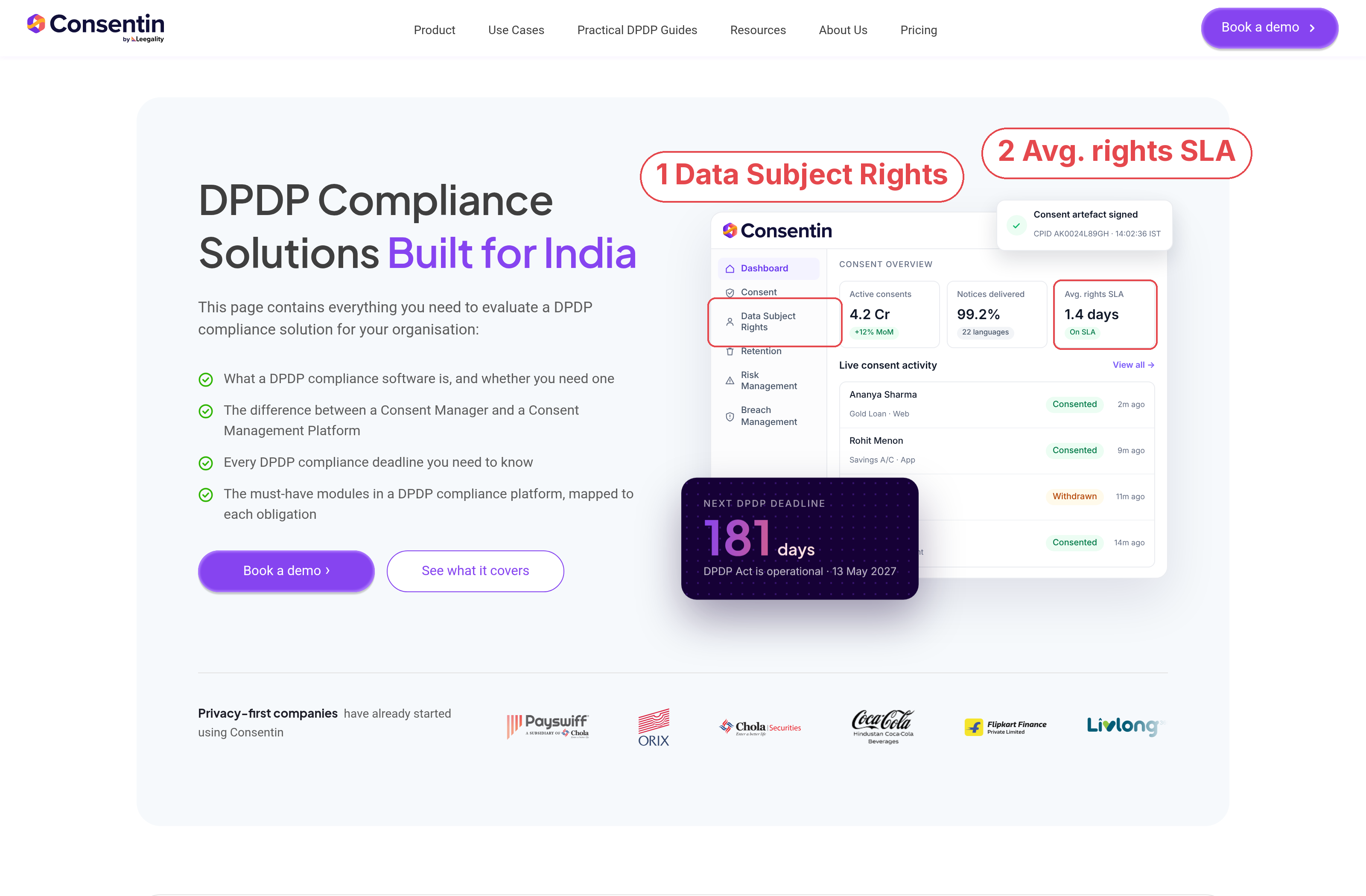
Consentin is the product I would trial when you want Data Subject Rights to sit in an India-built DPDP suite, next to notices, artefacts, retention and breach work, and you already know Leegality as a document vendor. The suite includes a Data Subject Rights module. In the marketing dashboard, that module sits in the product menu, and an average rights SLA is shown as a figure in the mock. Treat that figure as a product mock, not as a measured customer result. Confirm, in a trial, how identity is checked, how a grievance period is set, and whether a nominee can be served.
Consentin is DPDP compliance software for Data Fiduciaries. It is not a Consent Manager registered under Rule 4. Rule 4 is in force from 13 November 2026. Buying the suite does not register the vendor as a Consent Manager. If the difference between a consent product and a Board-registered Consent Manager is still messy internally, read how to choose between types of consent management solutions, and ask counsel which role you actually need. For a wider look at Leegality's consent packaging, the live Leegality alternatives post is the place to start.
Pricing
Consentin's pricing still leads, on 13 November 2026, with a Starter Pack: 3,000 DPDP-compliant consent collections a month at ₹0, and the vendor treats that ₹0 pack as permanent at that volume, not as a trial clock. That is a consent-collect pack, not a rights price. Paid monthly packs do not carry public rupee figures; those packs, and any top-ups, are a conversation with sales. Do not borrow the Starter ₹0 figure as a cost for rights fulfilment.
Reviews
No public G2, Capterra or PeerSpot corpus is available for Consentin. Ask for a reference whose rights volume, not only whose consent volume, looks like yours.
Clients
The marketing materials name a set of privacy-first companies. Ask for a reference you can call, and bring one rights request and one artefact you need to keep.
Summary
Pick Consentin if you want rights inside a Leegality-built DPDP suite, and you can accept a quote for anything above the consent Starter pack. It is a weaker fit if you need a public rights tariff, a review corpus, or a nomination path you have already watched in a tenant.
Against Consiva: you get rights next to notices and artefacts in a wider India suite, which a rights specialist does not automatically include. What you give up is Consiva's public rights plan, and a clearly named nomination path I can already point to in the product.
4. OneTrust DSR Automation
Features
OneTrust DSR Automation is the product I would trial when OneTrust is already in the estate, and the question is whether the request module you already license can run an Indian access, erasure and grievance without a second vendor. The module is built for intake, identity, a secure customer portal and fulfilment across global request types. The screen below is a product mock of that portal and a request record. I would still ask for the DPDP paths in your tenant: a grievance clock you can map to Rule 14, and a nominee request if that right is in scope. Do not assume a GDPR-shaped "30 days" timer is the clock you will publish in India.
If you are comparing the wider OneTrust suite, the live OneTrust alternatives post is the place to start. This row is only the request module.

Pricing
Quote-based. There is no public self-serve tariff for DSR Automation that I will treat as official.
Reviews
There is no DSR-only G2 profile. What you can read sits on OneTrust Privacy Automation, which on 13 November 2026 was 4.3 out of 5 from 155 reviews. Users on G2 like being able to shape the product to their needs and to run RoPAs and DPIAs with less friction, and they complain about awkward bulk uploads, a high price and a steep learning curve (G2, June 2026 and January 2026). Read those lines as comments on Privacy Automation, not as a DSR-only corpus. A mid-market hospital reviewer, on 8 June 2026, called the product "Completely customisable to your needs" and also wrote "The bulk uploading of information if your using an existing template can be tricky." Erick Vincent Steve G., on 8 January 2026, complained about "the high price and the steep learning curve." A 29 July 2025 review that talks about request handling is older than 12 months, so I would not treat it as current.
Clients
Ask for a reference in a tenant that already runs DSR Automation, preferably one that has tried an Indian grievance, not only a GDPR access request.
Summary
Pick OneTrust DSR Automation if the suite is already paid for, and the module can be shown to run the DPDP paths you need. It is a weaker fit if you are buying a request tool from scratch, you need a public price, or you need a DSR-only review corpus.
Against Consiva: you stay inside an estate you already pay for, and you get a neighbouring G2 corpus on Privacy Automation. What you give up is Consiva's public Indian tariff, nomination as a named product feature, and any assumption that the Rule 14 clock is already set the way you will publish it.
5. Digital Anumati
Features
Digital Anumati is the product I would trial when you want rights and grievance inside another India-built suite, and you also want a public SaaS tariff you can read before you talk to sales. It includes a Data Principal Rights module that automates access, correction, erasure and nomination requests with SLA tracking, and a Grievance Redressal module with routing, escalation and resolution logs. Those are the two claims I would take into a demo: serve a nominee request, and close a grievance with a log you can export. I have not treated the 72-hour cascading erasure line, which appears on the Growth and Enterprise cards, as a Rule 14 fact. Rule 14 caps a grievance at ninety days. A 72-hour erasure target is the vendor's own product claim, and you should ask what it covers.

Pricing
Digital Anumati's pricing, on 13 November 2026, publishes three SaaS cards: Free at ₹0 a month, Growth at ₹9,999 a month, and Enterprise on a custom quote. Free includes 3,000 consent collections a month, at ₹0, with no trial clock on that volume. The self-serve request portal and the 72-hour cascading erasure row are not on Free; both start at Growth. If a public plan is why you would leave Consiva's card for this one, compare the rights rows, not only the monthly fee, and confirm what still sits behind a quote on Enterprise and on-premise.
Reviews
No public G2, Capterra or PeerSpot corpus is available for Digital Anumati. Ask for a reference whose rights and grievance volume, not only whose consent volume, looks like yours.
Clients
The public materials are aimed at BFSI, with healthcare and education also named. Ask for a reference in your sector, and bring one nominee request and one grievance.
Summary
Pick Digital Anumati if you want another India-built suite that names nomination and grievance, and you want a public SaaS fee you can read today. It is a weaker fit if you need the self-serve request portal on a ₹0 plan, a review corpus, or a rights specialist without the rest of a consent suite.
Against Consiva: you get a second public Indian tariff, and rights sit inside a wider suite. What you give up, on Free, is the self-serve request portal, and you still have no independent review corpus on either row.
6. DPDP.ai
Features
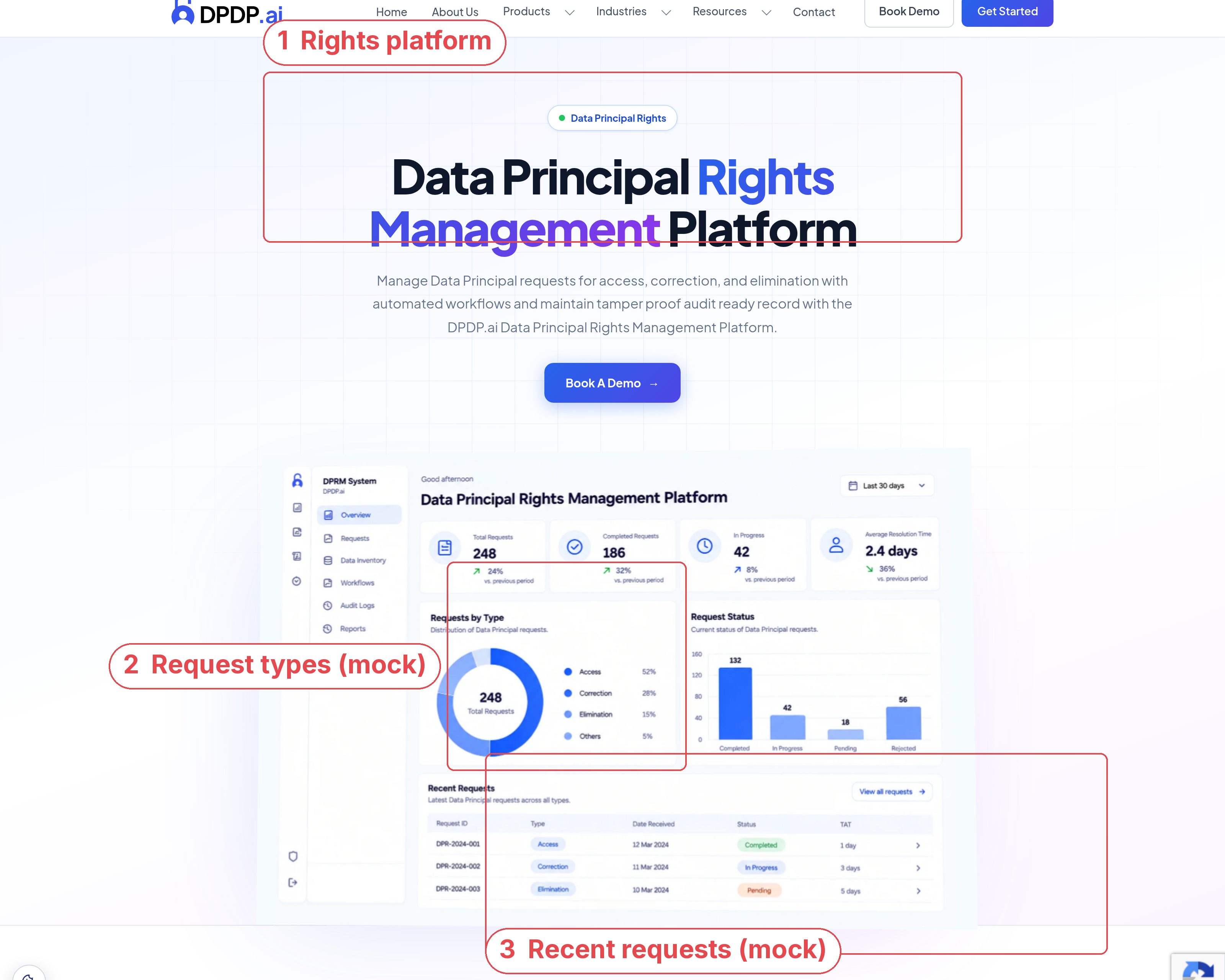
DPDP.ai's Data Principal Rights Management Platform is the product I would trial when you want another named India rights product, and you want nomination and grievance called out in the same platform. It includes a self-service portal for access, correction, erasure and nomination, identity verification before personal data is processed, and grievance handling with routing, an SLA clock that starts on receipt, and a single queue. Data Principals stay informed through the same record. The dashboard in the hero is a product mock: the request counts and the 2.4-day average are mock figures, not figures I will treat as customer results. I have left out the "500+" and "0 Compliance Gaps" marketing lines; I have no independent confirmation of either claim.
In a trial, raise one access request, one nomination and one grievance, and watch whether identity is recorded in the history before data moves.
Pricing
Quote-based. A request to dpdp.ai/pricing returned HTTP 404 on 13 November 2026. I will not invent a tariff.
Reviews
No public G2, Capterra or PeerSpot corpus is available for DPDP.ai. Ask for a reference call, and bring a nominee request as well as an ordinary access request.
Clients
Ask for an Indian reference whose request mix looks like yours. Do not treat a marketing dashboard as that reference.
Summary
Pick DPDP.ai if you want another India-built rights platform that names nomination and grievance, and you can work from a quote. It is a weaker fit if you need a public price, a review corpus, or figures from the marketing dashboard treated as proof.
Against Consiva: you get another named India rights product with nomination and grievance in the same platform copy. What you give up is Consiva's public plan, and any independent review base, which neither row has today.
7. Securiti DSR Automation
Features
Securiti DSR Automation is the product I would trial when fulfilment should be tied to discovery, and you already expect a data graph to tell you where a person's records sit. The module is built to collect requests, verify identity, fulfil them, share an encrypted response and keep a record in one place. The screen below is the marketing hero, including a product mock of a request view. I would still ask for the DPDP paths in a tenant: a grievance clock you can map to Rule 14, and a nominee request if that right is in scope. A global DSR module does not automatically include those Indian-law paths.

Pricing
Quote-based. I will not invent a public tariff for DSR Automation.
Reviews
The platform-wide Securiti G2 profile, dated 13 November 2026, is 4.6 out of 5 from 116 reviews, with Veeam named as the seller. On 21 August 2026, a mid-market reviewer wrote that the product "has a steep learning curve and a complex initial setup process" and that "The pricing structure can also be restrictive for smaller teams that need advanced features." Those comments fall inside the last 12 months. They are about the wider platform, so I would ask for a walkthrough of DSR Automation itself.
Clients
Ask for a reference whose discovery and fulfilment volume look like yours, preferably one that has run an Indian grievance in the same tenant.
Summary
Pick Securiti DSR Automation if discovery-tied fulfilment is the first job, and you can work from a quote. It is a weaker fit if you need a public Indian tariff, a DSR-only review corpus, or nomination already named as a product feature.
Against Consiva: you get fulfilment tied to a data graph, and a current platform-wide G2 corpus. What you give up is Consiva's public plan, and any assumption that DPDP nomination and the Rule 14 clock are already in the module you will be shown.
How to choose, by situation
I want rights and consent on one record
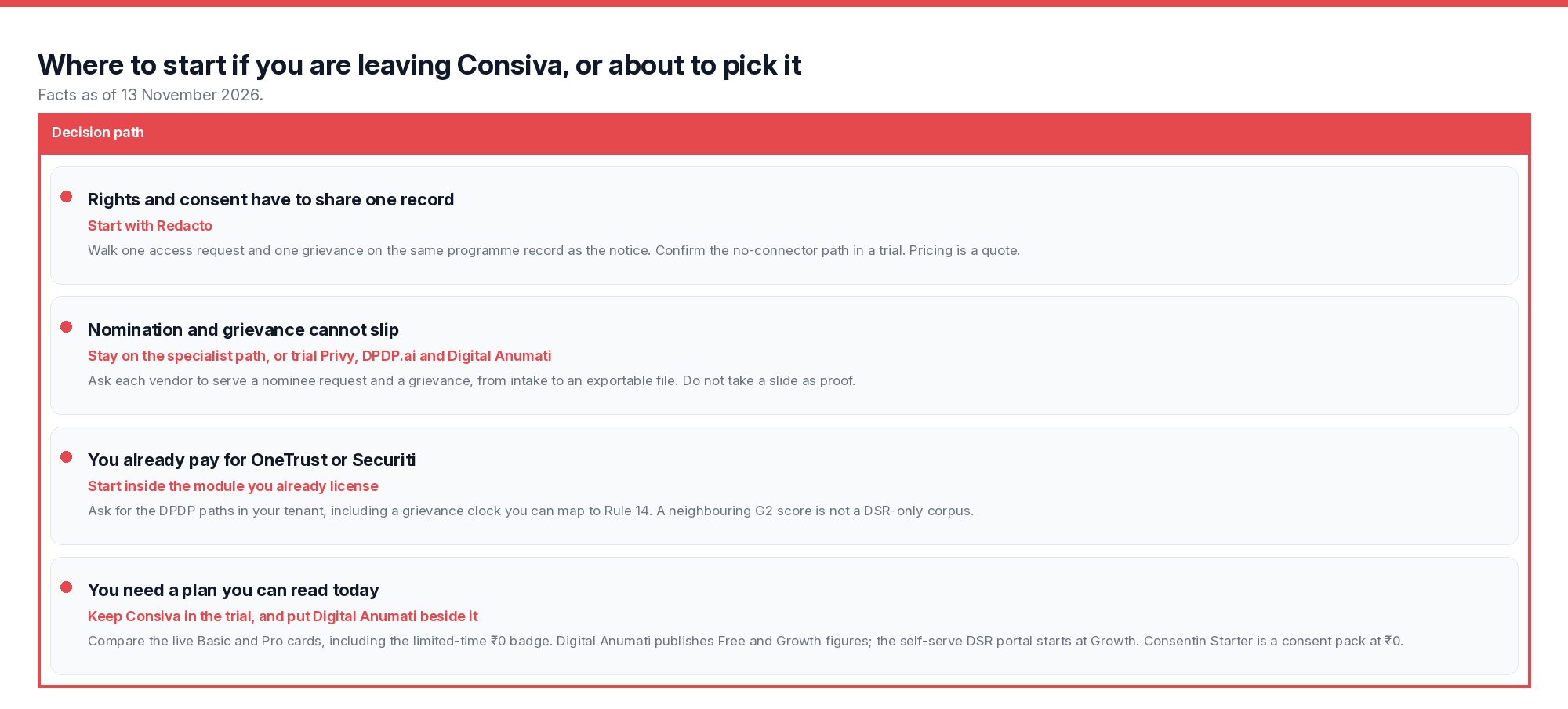
Start with Redacto. Walk one access request and one grievance on the same programme record as the notice. Confirm the no-connector path in a trial, and do not count on nomination until you have seen it. Pricing is a quote. If the first job is consent, and rights fulfilment is not yet the decision, I would read the consent management platform in India guide before trialling any rights tool.
I want another India-native specialist
Stay on the specialist path, or put Privy, DPDP.ai and Digital Anumati in the same week of demos. Ask each vendor to serve a nominee request and a grievance, from intake to an exportable file. Do not take a slide as proof. Consiva can remain in that bake-off; it is the row that already names nomination and puts a tariff in public.
I already pay for OneTrust or Securiti
Start inside the module you already license. Ask for the DPDP paths in your tenant, including a grievance clock you can map to Rule 14, and a nominee request if that right matters. A neighbouring G2 score is not a DSR-only corpus, and it is not proof that the Indian-law paths are turned on.
I need a plan I can read today
Keep Consiva in the trial, and put Digital Anumati beside it. Compare the live Basic and Pro cards, including the limited-time ₹0 badge and the fact that automated rights handling sits on Pro. Digital Anumati publishes Free and Growth figures; the self-serve request portal starts at Growth. Consentin Starter is a consent pack at ₹0, not a rights tariff. Redacto, Privy, OneTrust, DPDP.ai and Securiti are quotes.
Nomination and grievance are non-negotiable
Start with the vendors that already name both jobs in public: Consiva, Digital Anumati and DPDP.ai. Then put Privy and Consentin in a demo and ask to see a nominee request and a grievance, from intake to a file you can keep. On Redacto, I do not claim nomination as a product feature; I would still walk a grievance, and I would ask about a nominee in the same trial. Map every grievance clock to Rule 14, which applies from about 13 May 2027 and is not more than ninety days.
Final thoughts
If you are leaving Consiva, or you have not signed yet, do not treat a public plan as the whole decision. The ₹0 Basic card is a limited-time offer, automation sits on Pro, and there is still no independent review corpus. Those are real limits. They are also not a reason to bounce into a global request module that has never shown you a nominee path or a Rule 14 clock.
Start with the job. If the request and the grievance have to share a record with the notice, trial Redacto. If you want another India-built specialist or suite module, put Privy, Consentin, Digital Anumati and DPDP.ai next to Consiva and walk the same two requests in each tenant. If you already pay for OneTrust or Securiti, start there, and only add a second vendor if the module you have cannot run the Indian-law paths. In every trial, ignore a slide that claims the product is ready for the Act. Read the rights it actually covers, walk a grievance, and ask whether a nominee can be served.
For a wider set of DPDP tools, I keep DPDPA compliance tools open as the named-vendor companion while I shortlist.