%20Redacto%20logo_New.png)


Dark Patterns in Cookie Banners: What Regulators Are Restricted in 2026 and How to Fix It
.jpg)


A cookie banner that tricks users into saying yes is not a compliant banner. Regulators in Europe, the US, and increasingly India are paying close attention to how companies design cookie consent popups, and dark patterns are at the top of their watchlist.
Here is what dark patterns are, why they are a problem, and how to fix them before they become a liability.
What Are Dark Patterns in Cookie Banners?
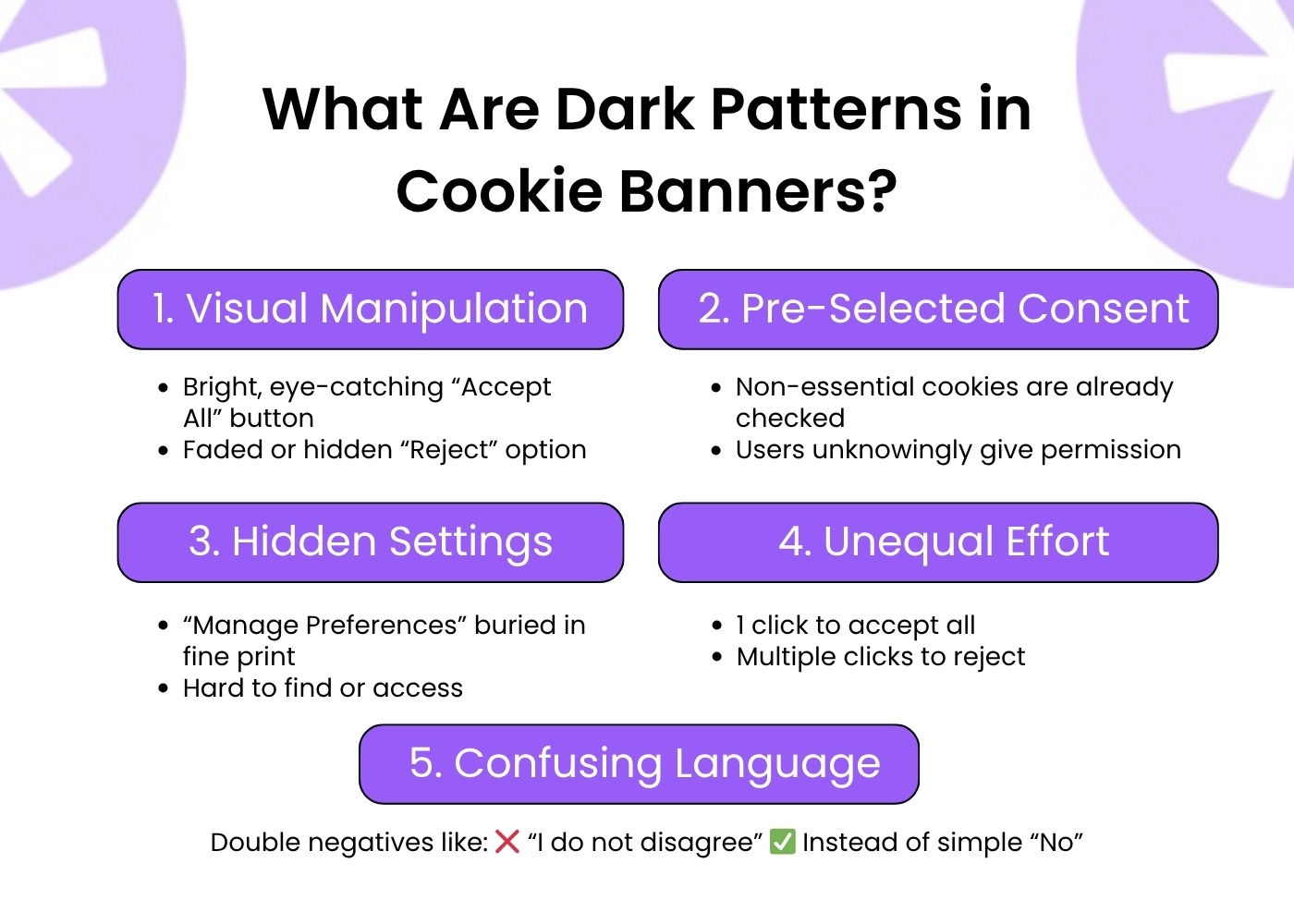
Dark patterns are design choices that manipulate users into actions they would not take if they understood what was happening. In the context of cookie consent management, this usually means making it easy to accept all cookies and hard to reject them.
Common examples include:
- A bright "Accept All" button next to a barely visible "Reject" option
- Pre-ticked consent boxes for non-essential cookies
- A "Manage Preferences" link is buried in fine print
- Requiring multiple clicks to opt out versus one click to opt in
- Language designed to confuse, like "I do not disagree" instead of a simple "No"
Regulators now have a name for these tactics, and they are penalizing organizations that use them.
What Regulators Are Targeting in 2026
GDPR and the EU Approach
Under GDPR, cookie consent compliance requires that consent be freely given, specific, informed, and unambiguous. Dark patterns directly undermine this standard. The European Data Protection Board (EDPB) released guidelines specifically calling out deceptive design in consent interfaces.
Fines for GDPR cookie consent requirements violations are no longer theoretical. Several large companies have already faced enforcement action specifically for manipulative consent interfaces.
Regulators look for:
- Asymmetry between accept and reject options
- Pre-selected consent checkboxes
- Consent withdrawal is made harder than consent giving
- Misleading language or visuals
CCPA and Dark Patterns in the US
California's privacy law also addresses CCPA dark patterns. Any user interface designed to impair a consumer's ability to exercise their privacy rights can be considered a dark pattern. The California Privacy Protection Agency has made this a specific enforcement focus.
US businesses serving California residents need to ensure their opt-out mechanisms are clear, easy to find, and as simple as the opt-in process.
India's DPDP Act Context
India's Digital Personal Data Protection Act requires that consent be free, specific, informed, and unconditional. Designing a consent interface that manipulates user choice would likely conflict with this requirement as the Act's implementation progresses.
How to Fix Dark Patterns in Your Cookie Banner

Audit Your Current Banner
Start by examining your existing cookie consent examples critically. Ask:
- Are "Accept" and "Reject" options equally visible and accessible?
- Are any boxes pre-ticked?
- How many clicks does it take to reject all cookies versus accept all?
- Is the language plain and clear?
Apply Symmetry Principles
Regulators expect that accepting and rejecting cookies should be equally easy. If you have an "Accept All" button, you need a "Reject All" button at the same visual level.
Do not hide the reject option behind a "Manage Preferences" flow if the accept option is a single click.
Use Plain Language
Replace vague or legalistic language with simple, direct wording. Users should immediately understand what they are agreeing to or declining.
Avoid:
- "We use cookies to enhance your experience", without specifics
- Confusing double negatives
- Technical jargon that obscures meaning
Make Consent Withdrawal Easy
Under GDPR, withdrawing consent must be as easy as giving it. Provide a clear way for users to change their preferences after the initial banner interaction, whether through a persistent cookie settings link in the footer or an accessible preferences panel.
Review Regularly
Cookie banner requirements evolve as regulators update their guidance. What was acceptable in 2023 may not meet 2026 standards. Build a schedule to audit and update your cookie consent compliance setup at least twice a year.
Conclusion
Dark patterns in cookie banners are no longer a grey area. Regulators across the EU, US, and India are treating manipulative consent interfaces as violations, not just bad practice.
Redacto's consent management platform helps organisations build compliant, transparent cookie banners that meet GDPR, CCPA, and DPDP requirements out of the box. Talk to our team or reach out on WhatsApp to get started.