%20Redacto%20logo_New.png)


Cookie Consent Manager vs DPDP Consent Manager: 6 Key Differences To Know


Most of us have been there, we put a cookie banner on the website, hit “publish,” and assume we’ve handled consent.
But that assumption doesn’t really hold under the Digital Personal Data Protection Act, 2023.
What’s actually happening is this: we’re mixing up two very different layers of consent.
- One sits at the website level, cookie banners, trackers, and CMPs
- The other sits at a broader ecosystem level, how users give, manage, and withdraw consent across services
And that’s where most of the confusion starts.
In this guide, we’ll walk through both clearly, what each one actually does, how they differ from a legal standpoint (not just as tools), and what you really need to focus on as DPDP implementation moves forward into 2026–2027.
By the end, we won’t just have definitions, we'll have clarity on what actually matters for compliance.
TL;DR
- A Cookie Consent Manager (CMP) is a tool used to manage cookies, trackers, and consent on a website
- It handles banner display, user choices, and consent logging for analytics and advertising
- A DPDP Consent Manager is a regulated entity under the Digital Personal Data Protection Act, 2023
- It allows users to give, review, and withdraw consent across multiple companies from one place
- A CMP works as a business-side implementation tool
- A DPDP Consent Manager works as a user-controlled, interoperable consent layer
- A business can be compliant without a DPDP Consent Manager
- But it cannot be compliant without proper consent systems in place
What Is a Cookie Consent Manager (CMP)?
A Cookie Consent Manager, often called a CMP, is a software tool businesses use to control how cookies and tracking technologies run on their website.
At a practical level, it does three things:
- Shows a consent banner when someone visits the site
- Blocks non-essential cookies until the user gives permission
- Stores consent choices as an audit trail
Most CMPs also scan your website to detect cookies and group them into categories like analytics, advertising, and functional.
From a legal standpoint, CMPs come from frameworks like the GDPR and the ePrivacy Directive, with similar adaptations under laws like CCPA and CPRA.
That’s why most tools are built around prior consent, especially for tracking and advertising cookies.
In terms of how they work:
- They operate at the website or domain level
- Consent is usually collected based on purpose, such as analytics or marketing
- Users must take a clear action to give consent, which means no pre-ticked boxes or implied acceptance
Now, here’s where DPDP changes how you should think about this.
The Digital Personal Data Protection Act, 2023 does not explicitly talk about cookies.
But if a cookie is used to collect personal data, like IP address, device information, or behavior for tracking, it falls under DPDP obligations.
That means:
- You need clear, purpose-specific notice
- You need valid consent before using non-essential tracking
- And users should be able to withdraw that consent easily
What Is a DPDP Consent Manager?
A DPDP Consent Manager is a concept introduced under Section 6(7) of the Digital Personal Data Protection Act, 2023.
Unlike a CMP, this is not just a tool. It is a registered entity that operates under the oversight of the Data Protection Board of India.
Its core role is to act as a user-facing intermediary between individuals (data principals) and businesses (data fiduciaries).
Instead of managing consent within one website, it allows users to control their consent across multiple companies from a single interface.
Here’s what that looks like in practice:
- Users can give consent for specific purposes
- Users can withdraw consent at any time
- Users can review where and how their data is being used across different services
This shifts consent from something hidden inside individual websites to something users can actively manage.
From a regulatory and technical perspective, the 2025 Rules and Business Requirements Document (BRD) set clear expectations for how these systems should work:
- Consent notices must support multiple languages, including English and Scheduled languages in India
- Interfaces must follow accessibility standards (WCAG)
- Consent records must be stored for at least 7 years and be machine-readable
There are also entry requirements.
To operate as a DPDP Consent Manager, an entity must be registered and meet criteria like governance standards, technical capability, and financial thresholds.
One important clarification: A DPDP Consent Manager is not mandatory for businesses.
Companies can still collect and manage consent through their own systems or tools like CMPs.
The Consent Manager acts as an optional, interoperable layer designed to improve user control across the ecosystem.
So it does not replace CMPs. It sits above them, enabling a broader, user-centric way to manage consent.
Simple “accept all” banners with vague language or no real choice do not meet these standards.
So while a CMP helps you handle the technical side of cookies, it only covers one part of what consent actually means under DPDP.
Cookie Consent Manager vs DPDP Consent Manager (Core Differences)
Here’s a clear side-by-side view to help separate the two:
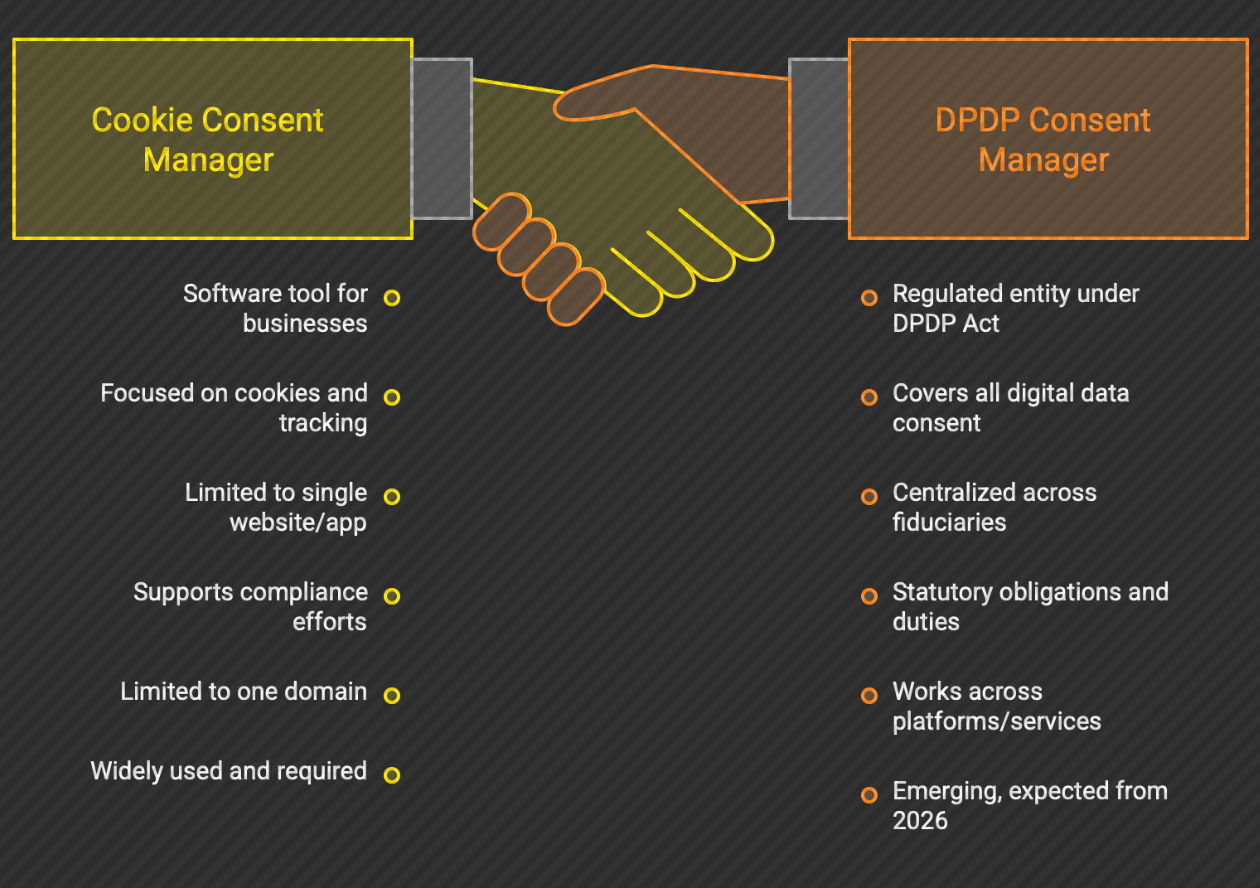
A CMP helps you manage consent within your own system, while a DPDP Consent Manager is designed to give users control across the entire data ecosystem.
Where Cookies Fit Under DPDP?
The Digital Personal Data Protection Act, 2023 does not explicitly mention cookies. But that does not mean cookies are outside its scope.
The moment a cookie is used to collect personal data, such as IP address, device identifiers, or user behavior, it falls under DPDP requirements.
So in practice, most tracking cookies used for analytics, advertising, or personalization will need to follow DPDP consent standards.
Here’s what that means for businesses:
- You need a clear and standalone notice explaining what data is being collected and why
- Consent must be purpose-specific, not bundled into general terms or vague statements
- Users must be able to withdraw consent easily, and it should be as simple as giving it
This is where many older cookie setups fall short. Generic “accept all” banners or implied consent patterns do not meet these expectations.
Now, CMPs play an important role here. They help you:
- Block non-essential cookies before consent
- Capture and store consent choices
- Manage user preferences at the website level
But they only solve the technical layer of consent.
They do not handle the full lifecycle required under DPDP, such as:
- Managing user rights (access, correction, erasure)
- Maintaining broader consent records across systems
- Handling governance, audits, and vendor data sharing
So while CMPs are necessary for handling cookies, they are only one part of what DPDP compliance actually requires.
Implementation: What Businesses Actually Need (2026–2027 Reality)
Here’s how most businesses should think about it going into 2026–2027.
1. Website Layer (Immediate Need)
The first layer is your website. This is where consent collection actually happens.
You need a DPDP-ready CMP that can:
- Offer granular controls based on purpose (analytics, ads, personalization)
- Block non-essential cookies before consent is given
- Show multilingual banners where needed
- Maintain detailed consent logs for audit purposes
This is the baseline. Without this, even basic consent collection is not aligned with DPDP expectations.
2. Broader Compliance Layer
Cookies are just one part of the picture. DPDP applies to all digital personal data, not just website tracking.
So you need systems that go beyond CMPs and handle:
- Consent records across different data processing activities
- User rights management, such as access, correction, and erasure
- Data mapping, so you know what data is collected, where it flows, and why
- DPIA and risk workflows, especially if you qualify as a Significant Data Fiduciary
This is where compliance becomes operational. It’s not just about collecting consent, but managing it throughout its lifecycle.
3. Consent Manager (Optional, Strategic Layer)
A DPDP Consent Manager sits on top of these systems as an additional layer.
It becomes useful in cases like:
- Businesses operating in multi-entity ecosystems
- Situations involving high volumes of data sharing across partners
It can provide a centralized way for users to manage consent across multiple services.
But it’s important to keep this clear:
- It is not mandatory for most businesses today
- It is an evolving ecosystem layer, expected to become more relevant as DPDP infrastructure matures
Which One Do You Need: Cookie Consent Manager or DPDP Consent Manager?
This is where most of the confusion clears up. You don’t choose one over the other in isolation, you choose based on how your data flows.
Here’s how to think about it:
- If you run a website, the starting point is a Cookie Consent Manager (CMP) .You need it to handle cookies, trackers, and basic consent collection at the website level
- If you process user data at scale, you need to go beyond cookies .That means building a full consent system that covers records, user rights, and data usage across your operations
- If you operate in ecosystems like finance, healthcare, or platforms with multiple partners
- It makes sense to explore DPDP Consent Managers early, especially where data flows across entities
The bigger shift is this:
Consent is no longer just a banner you add to your site. Under the Digital Personal Data Protection Act, 2023, it becomes part of how you design your data systems.
So instead of treating consent as a one-time collection step, it needs to be handled as an ongoing governance layer, something that is tracked, managed, and updated across the entire lifecycle of user data.
How to Implement DPDP Consent Compliance (Without Overcomplicating It)
Most teams don’t struggle with understanding DPDP. They struggle with execution.
What usually happens is this:
- Cookie consent is handled through a CMP
- User rights requests (DSARs) are handled through emails or separate tools
- Vendor data sharing and risk tracking sit in spreadsheets
Everything works, but nothing is connected.
That’s where things start breaking from a compliance point of view.
A more practical approach is to treat consent as one system instead of multiple disconnected workflows.
Instead of managing:
- CMP separately for cookies
- DSAR workflows separately
- Vendor risk and data sharing manually
You move toward a setup where these pieces are linked.
This is where platforms like Redacto come in.
They combine:
- Consent collection and tracking
- Data governance and mapping
- Vendor risk and compliance workflows
So instead of solving just the “cookie banner problem,” they help align your entire setup with the requirements of the Digital Personal Data Protection Act, 2023.
This becomes especially useful when compliance moves beyond a technical task and becomes part of day-to-day operations.
The goal isn’t to add more tools. It’s to reduce fragmentation and make consent easier to manage across the full lifecycle.
Conclusion
Cookie consent and DPDP consent are not the same thing.
A Cookie Consent Manager helps you handle the technical side of consent on your website. But the Digital Personal Data Protection Act, 2023 goes beyond that.
It shifts consent toward a system where users have clearer control over how their data is used across services.
For most businesses, the right starting point is still a CMP. It helps you get the basics right.
But real compliance does not stop at banners. It requires managing consent across its full lifecycle, collection, storage, usage, and withdrawal.
As your data operations grow, this becomes less about individual tools and more about how everything connects.
If you are planning for full DPDP readiness, it is worth looking at how platforms like Redacto bring consent, governance, and risk workflows together into one system.