%20Redacto%20logo_New.png)

10 DPDPA Compliance Checklist: A Simple Step-by-Step Guide for 2026


A customer asks you to delete their data.
The request goes to support, then legal, then engineering. But no one is fully sure where the data exists or who owns the process.
Days pass just trying to locate it.
This is a common DPDPA problem. Not because you are ignoring compliance, but because your data is spread across systems without a clear structure.
In most cases:
- Your data mapping is incomplete
- Your consent records are not tracked in one place
- Your vendor data sharing is not fully visible
- Your deletion and retention rules are not enforced at the system level
So even if you already have policies in place, execution still breaks down.
That is exactly why I built this quick DPDPA compliance checklist.
It will help you fix these issues by turning requirements into clear, trackable actions.
In this guide, you will get a simple checklist to assess your current readiness, find gaps, and build a practical path to DPDPA compliance in 2026.
DPDPA Compliance Quick Checklist
You can use this checklist to see whether you are handling personal data correctly and spot gaps early.
To stay compliant, you should be able to answer yes to each of these:
- We know what personal data we collect and where it is stored
- We collect, manage, and record user consent clearly
- Users can access, correct, or delete their personal data
- We have clear data retention rules and delete data on time
- We assess and monitor vendors that handle personal data
- We protect data with proper access controls and encryption
- We have a clear process for handling data breaches
- We maintain records and audit trails for compliance activities
If any of these points are unclear, missing, or still handled manually, you likely have compliance gaps.
Who Should Use This Checklist?
This checklist is relevant if you collect or process personal data in India.
It applies to you if you are in:
- BFSI, such as banking, NBFCs, fintech, or insurance
- healthcare or pharma, such as hospitals, diagnostics, or healthtech
- ecommerce or retail
- SaaS or technology
- manufacturing or automotive
- travel or hospitality
It also applies if you handle:
- customer data
- employee data
- vendor or partner data
DPDPA is not only for large enterprises.
If you are a mid-sized or growing business, this checklist is just as important for you.
What Should a DPDPA Checklist Include?
A strong DPDPA compliance checklist should cover:
- Data inventory and mapping
- Lawful use of personal data
- Consent collection and easy withdrawal
- Clear and accessible privacy notices
- Data principal rights (access, correction, deletion)
- Vendor and third-party risk management
- Breach detection and response process
- Data retention and timely deletion
- Internal ownership, accountability, and records
- regular audits and employee training
If any of these areas are unclear or not documented, the compliance setup is incomplete.
DPDPA Compliance Checklist: 10 Areas You Should Review
Instead of trying to review everything at once, you can break your DPDPA checklist into 10 key areas.
These areas reflect how DPDPA compliance is usually implemented in practice.
1. Governance and Ownership
You should:
- Appoint a Data Protection Officer or another responsible person
- Define who owns consent, data principal rights, vendor management, and incident handling
- Involve your legal, IT, security, and operations teams
- Maintain documented data protection policies
- Keep records of decisions, approvals, and compliance actions
DPDPA requires accountability. If ownership and documentation are unclear, you will struggle to demonstrate compliance.
2. Data Discovery and Data Mapping
You should:
- Identify all personal data you collect
- Document where that data is stored, including systems, databases, and vendors
- Define the purpose of processing for each dataset
- Identify who has access to the data
- Document how data is shared with third parties
- Identify and classify sensitive personal data
- Review and clean up legacy data
DPDPA requires you to know what personal data you process and why. That is why data mapping is one of the first steps.
3. Consent and Notice Management
You should:
- Implement clear and specific consent mechanisms
- Make sure consent is collected before processing where required
- Maintain records of consent, including time, method, and purpose
- Provide a simple way for users to withdraw consent
- Make sure your privacy notices are clear and easy to understand
- Avoid bundled or pre-ticked consent
- Review your website and digital consent flows
Under DPDPA, consent must be informed, specific, and easy to withdraw.
4. Purpose, Limitation, and Data Minimization
You should:
- Collect only the data you actually need for a defined purpose
- Document the purpose for each data field
- Avoid collecting excessive or unrelated data
- Review forms and systems for unnecessary fields
- Remove outdated or unused data collection points
DPDPA requires you to use personal data only for the purpose for which you collected it.
5. Data Principal Rights and DSAR Readiness
You should:
- Enable access to personal data when requested
- Allow correction of inaccurate data
- Provide a way for users to request data erasure
- Implement a grievance redressal process
- Track and log all requests
- Define response timelines
- Create internal workflows for handling requests
DPDPA gives data principals the right to access, correct, and erase their personal data. You need a working process to handle these requests properly.
6. Retention, Deletion, and Recordkeeping
You should:
- Define retention periods for each category of data
- Document the legal or business reason for retaining data
- Implement deletion or anonymization processes
- Maintain records of deletion activities
- Securely store required records
- Review stored data on a regular basis
DPDPA requires you not to retain personal data longer than necessary.
7. Vendor Risk and Third-Party Management
You should:
- Identify all third parties that process personal data for you
- Put data processing agreements in place with vendors
- Assess vendor security and compliance practices
- Maintain a list of subprocessors
- Define breach notification requirements
- Review cross-border data transfers where relevant
- Conduct vendor assessments regularly
You are still responsible for personal data even when a vendor or third party processes it on your behalf.
Also read: 7 Best Vendor Risk Management Software for DPDPA Compliance in India
8. Security and Access Controls
You should:
- Implement encryption for data in transit and at rest
- Enforce role-based access controls
- Maintain audit logs of data access
- Monitor systems for unauthorized activity
- Implement backup and recovery processes
- Separate systems that handle personal data
- Conduct regular security assessments
DPDPA requires you to apply reasonable security safeguards to protect personal data.
9. Incident and Breach Response
You should:
- Maintain a documented incident response plan
- Define roles and escalation procedures
- Detect and log security incidents
- Assess the impact of breaches
- Notify the Data Protection Board when required
- Notify affected individuals when the risk is significant
- Conduct post-incident reviews
DPDPA requires timely reporting of personal data breaches. That is why you need a clear response process before an incident happens.
10. Documentation, Audit Trail, and Ongoing Monitoring
You should:
- Maintain your privacy notices and policies
- Document your records of processing activities
- Store consent records and logs
- Maintain vendor assessment records
- Keep audit reports and other compliance documentation
- Maintain employee training records
- Conduct compliance reviews on a regular basis
DPDPA compliance is not just about having policies. You also need to prove what you have done through proper documentation and audit trails.
9 Common Gaps You May Miss in a DPDPA Checklist
You usually do not miss compliance because you are ignoring DPDPA.
You miss it because execution is fragmented across teams, systems, and vendors.
These are the gaps most likely to show up when your compliance process is reviewed:
- Your personal data exists across multiple systems, but you do not have one clear view of it
- You collect consent, but your records are incomplete or hard to trace
- You assess vendors manually, and those reviews are not updated regularly
- Your privacy notices do not fully match your actual data practices
- Your DSAR workflows exist, but you have not tested them end-to-end
- Your data deletion policies are defined, but not enforced in your systems
- Your teams manage data separately without enough coordination
- You do not have a single clear view of your current compliance status
- Your compliance evidence is scattered across spreadsheets, emails, and shared drives
These are usually not policy problems first.
They are execution problems.
As your data volume grows, your vendor list expands, and more user requests come in, managing all of this manually becomes harder to sustain.
How to Actually Use This Checklist Internally
A checklist is only useful if it is applied consistently.
Most teams create one, but don’t turn it into a working process.
Here’s how to use it properly:
- Start with a current-state audit across all 10 areas
- Assign a clear owner for each checklist category
- Mark each item as done, partial, or not done
- Prioritize high-risk gaps first (consent, data mapping, DSARs, vendors)
- Centralize all compliance documents and records in one place
- Track progress instead of reviewing it once and forgetting it
- Review the checklist monthly or quarterly
- Repeat the review after any major system, vendor, or process change
This approach turns the checklist from a one-time exercise into an ongoing compliance system.
When a Manual DPDPA Checklist Stops Working
A checklist is useful at the start, but it starts breaking when compliance moves from planning to execution.
This usually happens when:
- Personal data is spread across multiple systems and tools
- Consent needs to be tracked across websites, apps, and integrations
- Vendor assessments are manual and slow
- DPIA or PIA processes are inconsistent
- DSAR requests involve multiple teams
- Compliance evidence is stored across spreadsheets, emails, and drives
At this stage, the problem is not “what to do.” The problem is “how to manage it consistently.”
A spreadsheet can track tasks. It cannot manage workflows across teams, systems, and vendors.
What to Look for in a DPDPA Compliance Platform
When manual tracking becomes difficult, teams typically look for a more structured way to manage compliance.
A DPDPA compliance platform should help with:
- consent management across all collection points
- data discovery and mapping across systems
- structured DSAR workflows
- vendor risk assessments and tracking
- privacy impact assessments (DPIA/PIA)
12 Best AI-Powered Privacy Impact Assessment Tool for Indian Companies
- breach and incident management
- centralized audit-ready records
- integration with existing tools and infrastructure
- flexible deployment (on-prem, cloud, or hybrid)
- simple and predictable pricing
The goal is not to replace the checklist, but to make it executable.
For teams dealing with multiple systems, vendors, and workflows, platforms like Redacto are used to operationalize DPDPA compliance.
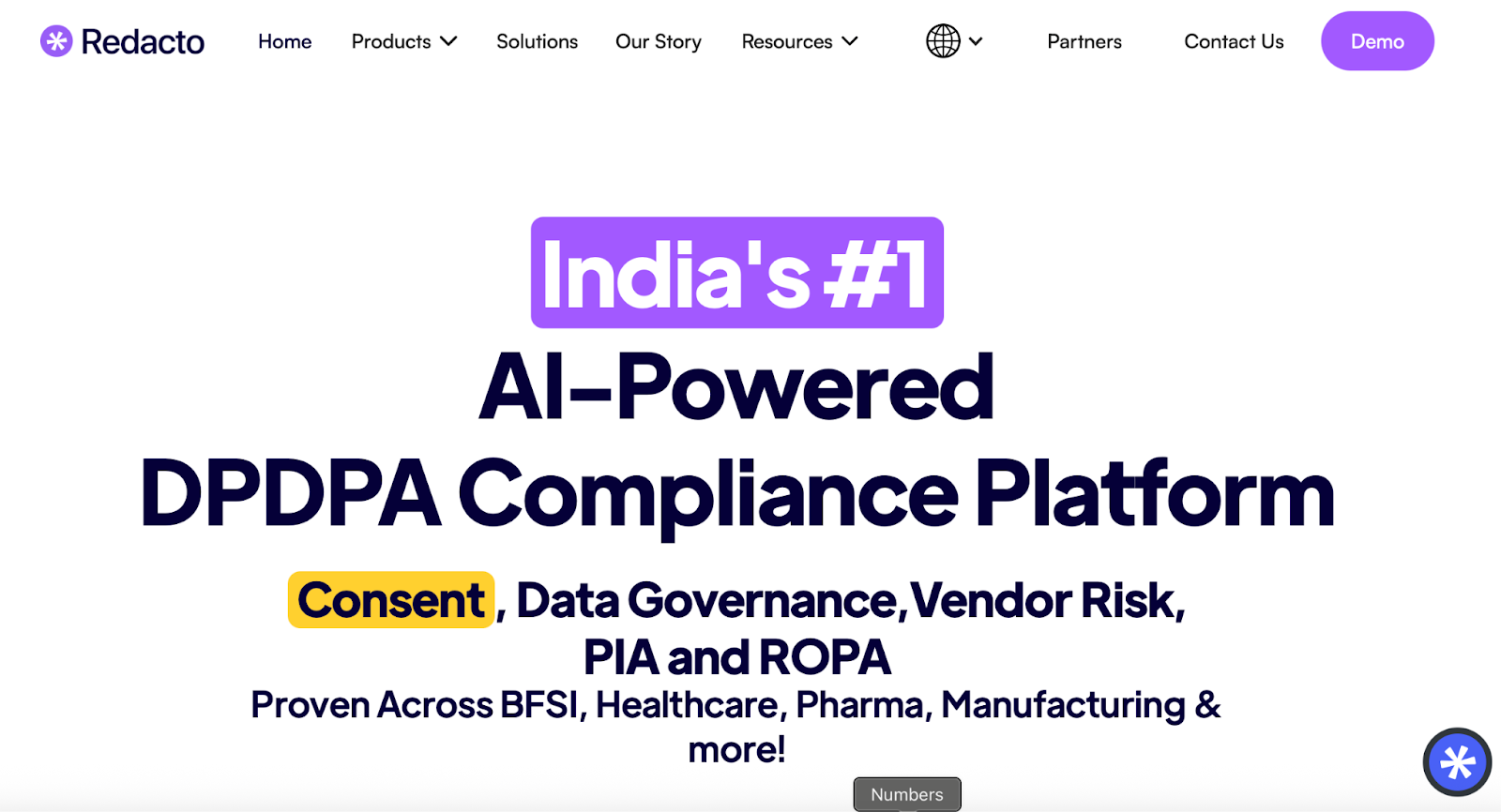
Instead of handling each requirement separately, it brings key areas into one system:
- consent management with support for large-scale integrations
8 Best Consent Management Platforms for Indian Enterprises (DPDPA-Compliant 2026)
- data discovery and mapping across environments
- automated vendor risk assessment workflows
- AI-assisted DPIA processes
- structured DSAR request handling
- breach and incident tracking
- centralized audit logs and compliance records
Redacto is an AI-powered DPDPA compliance platform designed for organizations handling high data volumes.
11 Best DPDPA Compliance Tools for Enterprises in India (2026 Review)
It includes:
- 7000+ consent integrations
- faster vendor risk assessment workflows
- AI-assisted PIA accuracy (up to 98.5%)
- multiple deployment options (on-prem, private cloud, SaaS)
- license-based pricing model
At this stage, the focus shifts from maintaining a checklist to running compliance as an ongoing system.
Conclusion
DPDPA compliance becomes manageable when it is broken into clear workstreams like consent, data mapping, vendor risk, and DSARs.
A checklist helps teams move from uncertainty to action. It shows what exists, what is missing, and what needs to be fixed first.
But the goal is not to complete a checklist once. The goal is to build a system that can handle compliance consistently as data, tools, and vendors grow.
For teams with simple setups, a checklist may be enough.
For teams dealing with multiple systems and higher data volume, a more structured approach is usually required.
If your team is reviewing its DPDPA readiness and wants a simpler way to manage consent, vendor risk, PIA, DSARs, and audit evidence in one place, Redacto is worth a closer look.
Frequently asked questions
No. A DPDPA compliance checklist is a good starting point, but it is not enough on its own. It helps you review whether key areas are covered, such as consent, data handling, vendor management, and DSAR workflows. But real compliance also depends on how those controls are implemented, tracked, and maintained over time. Many companies complete a checklist but still struggle because records are scattered, workflows are manual, and there is no clear proof of execution.
A DPDPA compliance checklist should not be treated as a one-time exercise. It should be reviewed regularly, especially when there are changes in vendors, internal systems, data practices, customer workflows, or regulatory expectations. For many companies, a quarterly or half-yearly review is a practical starting point. High-growth teams may need to review it more often because their data environment changes faster.
Before reviewing a DPDPA compliance checklist, it helps to gather the main records that show how your company handles personal data. This may include privacy notices, consent records, vendor agreements, data inventories, retention policies, internal access controls, and DSAR procedures. Having these ready makes it easier to check whether your compliance process matches what is actually happening in your systems.
A DPDPA compliance checklist usually cannot be owned by one team alone. Legal or compliance may lead it, but input is often needed from IT, security, product, operations, and vendor management teams. That is because personal data moves across multiple systems and processes. The checklist works best when one owner is accountable for progress, while other teams support execution in their areas.
No. A DPDPA compliance checklist is relevant for companies of all sizes if they handle digital personal data. Startups, mid-sized businesses, and large enterprises all need visibility into how personal data is collected, stored, shared, and deleted. The difference is usually not whether the checklist is needed, but how complex the implementation becomes as the business grows.
This is one of the most common compliance problems. A checklist may show that policies exist, but that does not always mean they are working in practice. For example, a company may have a deletion policy but no way to enforce it across tools. Or it may have a DSAR process on paper but no tested workflow. That is why companies need to look beyond documentation and focus on operational readiness, evidence, and ongoing monitoring.

Contact Us