%20Redacto%20logo_New.png)


Consently Review 2026: Features, Pricing, DPDPA Compliance, Pros, Cons & Alternatives
.jpg)


If you are searching for a Consently review, you are probably not looking for just another cookie banner tool.
You want to know if Consently can actually help your Indian business prepare for DPDPA compliance across:
- Cookie consent
- Purpose-based consent
- Data subject requests
- Audit trails and reports
- Indian-language notices
- Website compliance workflows
Consently is worth considering if your main problem is website-level DPDPA consent management.
It offers cookie scanning, consent records, request workflows, 22 Indian languages, audit reports, and consulting support.
But independent public reviews are still limited.
So before using it for compliance-critical workflows, test the demo, check the scanner on your own website, and review how its consent logs and reports work.
In this review, you will see Consently’s features, pricing signals, pros, cons, limitations, and how it compares with broader DPDPA platforms.
TL;DR
- Consently.in is a DPDPA consent management tool for Indian businesses.
- It helps with cookie scanning, consent banners, request handling, audit logs, and 22 Indian languages.
- It is best for SMBs, startups, agencies, SaaS sites, ecommerce brands, and service businesses.
- It works well if your main need is a website or app-level DPDPA consent setup.
- It may not be enough for data discovery, vendor risk, PIA, ROPA, breach workflows, or enterprise privacy governance.
- Choose Consently if you need simple DPDPA consent management.
- Choose Redacto if you need a complete DPDPA compliance platform beyond consent.
What is Consently?
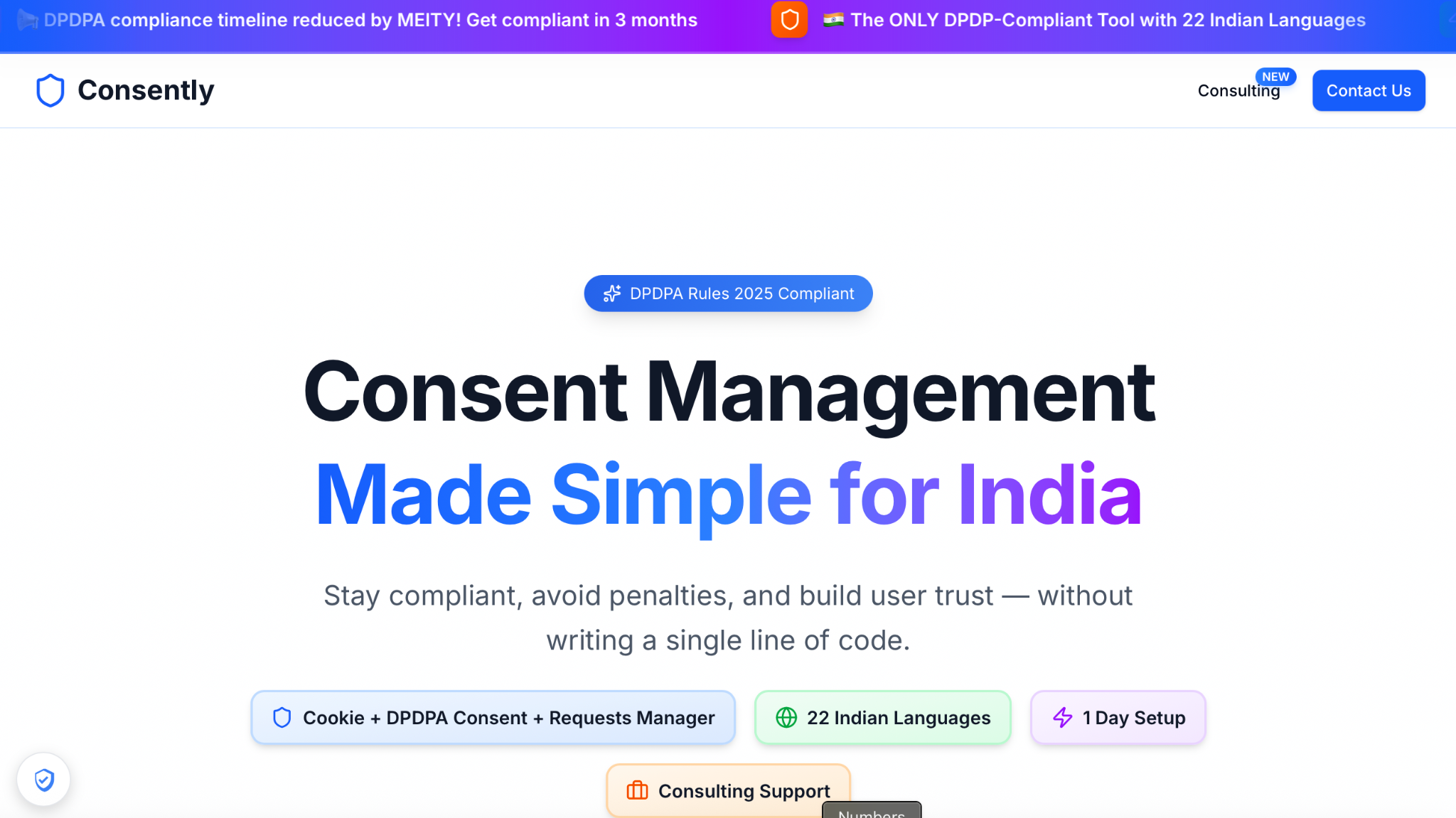
Consently is an India-focused consent management platform built for DPDPA compliance.
It is not just a basic cookie banner tool.
It is built to help Indian businesses collect, manage, and record user consent in a way that aligns with the DPDP Act, 2023.
Consently combines:
- Cookie consent to show consent banners on your website.
- DPDPA consent management to collect purpose-based consent from users.
- Requests manager to handle user requests like access, correction, and erasure.
- 22 Indian languages so users can understand consent notices in their preferred language.
- Cookie scanner to detect cookies and trackers on your website.
- Audit reports to keep records of consent activity.
- Sector templates for industries like e-commerce, healthcare, banking, SaaS, real estate, and hospitality.
- Consulting support for businesses that need help with DPDPA setup, data mapping, policies, and compliance planning.
Consently is best understood as a website-level DPDPA consent tool for Indian businesses that want to move beyond a simple cookie pop-up and manage consent more seriously.
How We Reviewed Consently?
To make this Consently review fair, we did not look at only one feature or one claim from the homepage.
We reviewed the tool from the point of view of an Indian business trying to prepare for DPDPA compliance.
Sources Used
For this review, we looked at:
- Consently.in’s website and product pages
- Consently.in’s feature pages, guides, and blogs
- Public testimonials shown on the Consently website
- Pricing, demo, and pre-launch messaging
- Available public search results around Consently.in
- Relevant DPDPA consent requirements
- Redacto’s public positioning for comparison with a broader privacy governance platform
Since Consently is still a newer product, independent third-party reviews are limited.
So wherever needed, we have treated company claims, website testimonials, and traction numbers as vendor-stated claims, not fully verified market proof.
What We Checked
This review is not legal advice. DPDPA tools can support compliance workflows, but regulated, high-risk, or enterprise businesses should still involve legal and privacy experts before relying on any tool for compliance-critical processes.
Consently Features Reviewed
- You get DPDPA-focused consent management, which helps you collect purpose-based consent instead of relying on a basic “Accept Cookies” banner.
- You get automated cookie scanning, so you can quickly identify cookies, trackers, and scripts running on your website before setting up consent flows.
- You get auto-generated consent banners, which makes setup easier if you do not want to build cookie notices manually.
- You get support for 22 Indian languages, which is a strong fit if your users come from different Indian regions and need consent notices in a language they understand.
- You get consent records and audit trails, so your business can keep proof of when consent was collected, what purpose it was collected for, and what action the user took.
- You get data subject request workflows for access, correction, and erasure requests, which makes Consently more useful than a simple cookie banner plugin.
- You get sector-specific templates for industries like ecommerce, banking, healthcare, SaaS, hospitality, and real estate, which can make DPDPA setup faster.
- You get consulting support, which is useful if your team needs help with purpose mapping, consent architecture, policy setup, staff training, or DPDPA readiness.
- You get a strong India-first compliance angle, with DPDPA-specific positioning, Indian-language support, and India-hosted server claims.
- Consently works best when your main need is website-level DPDPA consent management. For broader privacy operations like data discovery, vendor risk, DSAR automation, PIA, ROPA, breach workflows, and enterprise-wide governance, a platform like Redacto is more relevant.
Consently Pricing
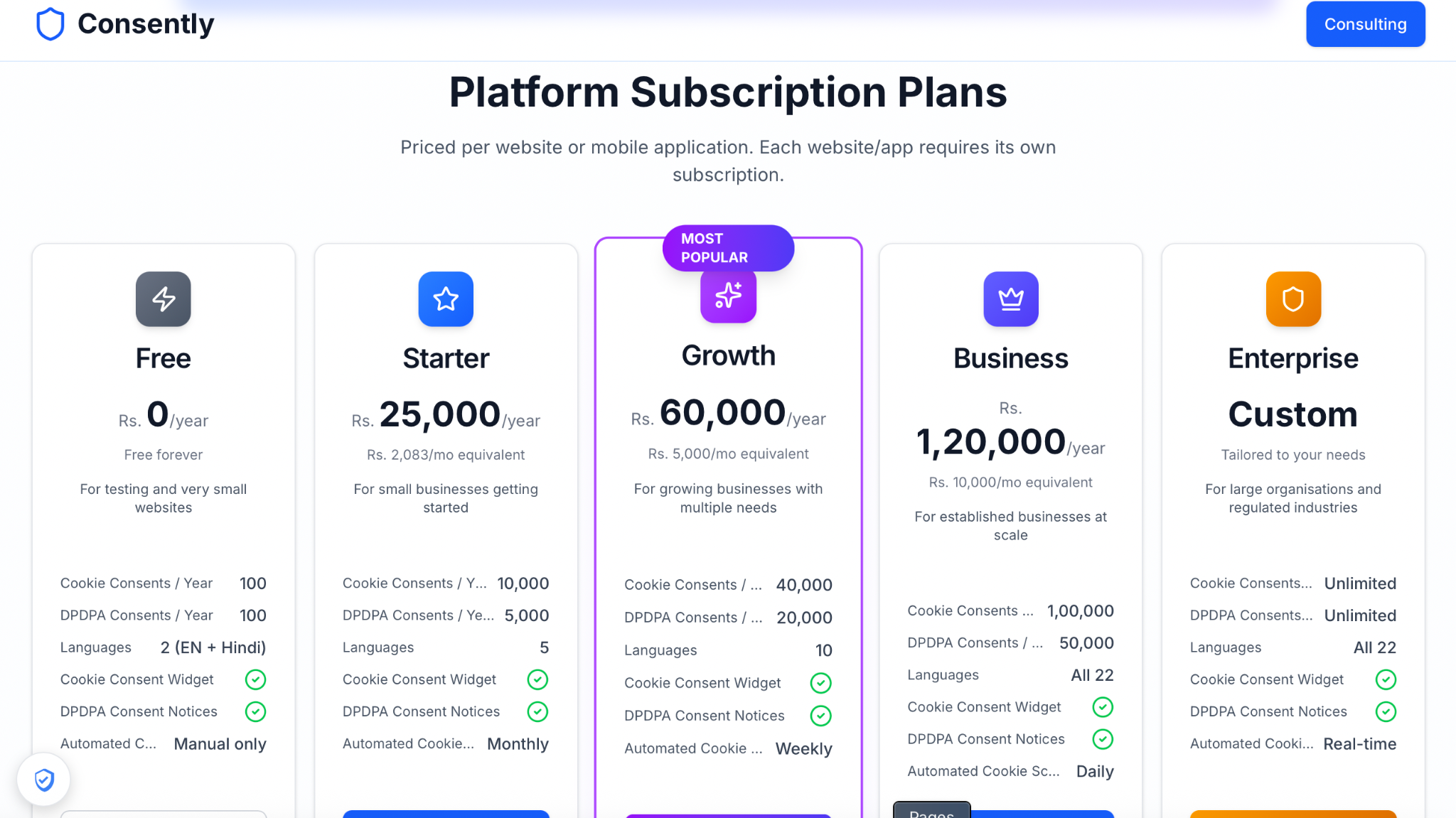
Consently’s pricing is simple once you understand one thing:
You pay per website or mobile app.
So if you have 1 website, you need 1 subscription. If you have 3 websites, you need 3 subscriptions.
All paid plans are billed yearly, and GST is extra.
The Free plan is mainly for testing. It gives you a small cookie limit of cookie and DPDPA consents.
The Starter plan works if you have a small website and only need basic DPDPA consent setup.
The Growth plan is better if your website gets more traffic and you need more consent records, more languages, and stronger request handling.
The Business plan is where Consently becomes more serious. You get support for all 22 Indian languages, higher consent limits, daily cookie scanning, and better support.
The Enterprise plan is for large companies, mobile apps, regulated industries, or teams that need custom limits, API access, faster support, and deeper setup help.
One thing to note: the subscription is not always the full cost.
You may also pay extra for:
- Setup help if you do not want to install it yourself
- Legal compliance AMC if you want ongoing DPDPA advisory
- Extra SMS OTP usage
- Extra consent volume if you cross your plan limit
- Custom integrations or extra support hours
So, the easiest way to understand Consently pricing is this:
If you only need basic website consent, the Starter or Growth plan may be enough.
If you need all Indian languages, higher volume, and stronger support, the Business plan makes more sense.
If you need legal help, custom setup, or enterprise workflows, your final cost will be higher.
Consently Pros and Cons
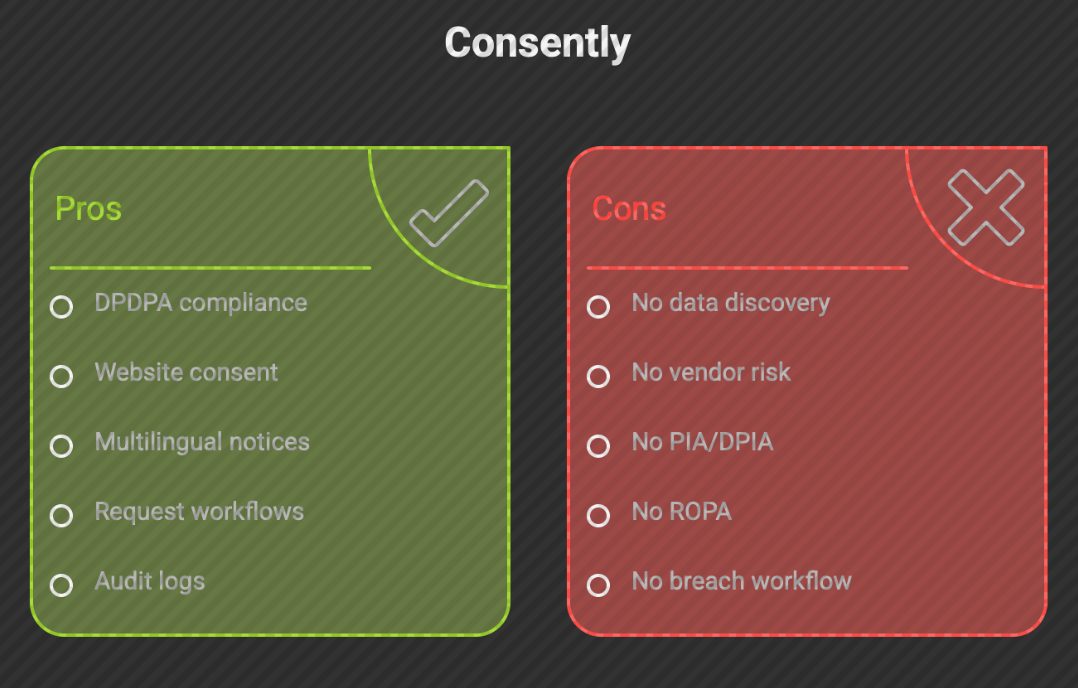
Pros
- Built specifically around DPDPA consent management.
- Supports all 22 Schedule 8 languages.
- Covers cookie scanning, banner generation, consent records, request handling, and audit reports.
- Offers sector templates for ecommerce, banking/NBFC, healthcare, SaaS, hospitality, real estate, and more.
- Consulting support can help businesses that lack internal privacy expertise.
- India-hosted server claims may matter for businesses with data residency concerns.
- Useful for SMBs and agencies that need faster implementation.
Cons
- Independent public reviews are limited.
- “Only DPDP-compliant tool” and “100% automated” should be treated as vendor claims.
- Cookie scanning still needs human review for complex websites.
- Consulting may increase total cost.
- It may not be enough for full enterprise privacy governance.
- Buyers should verify whether it is a registered Consent Manager if they need that specific legal role.
Important factual point: under the DPDP Act, a Consent Manager is a specific role that must be registered with the Data Protection Board, so your article should avoid implying Consently is a registered Consent Manager unless that registration is publicly verifiable.
Who Should Use Consently?
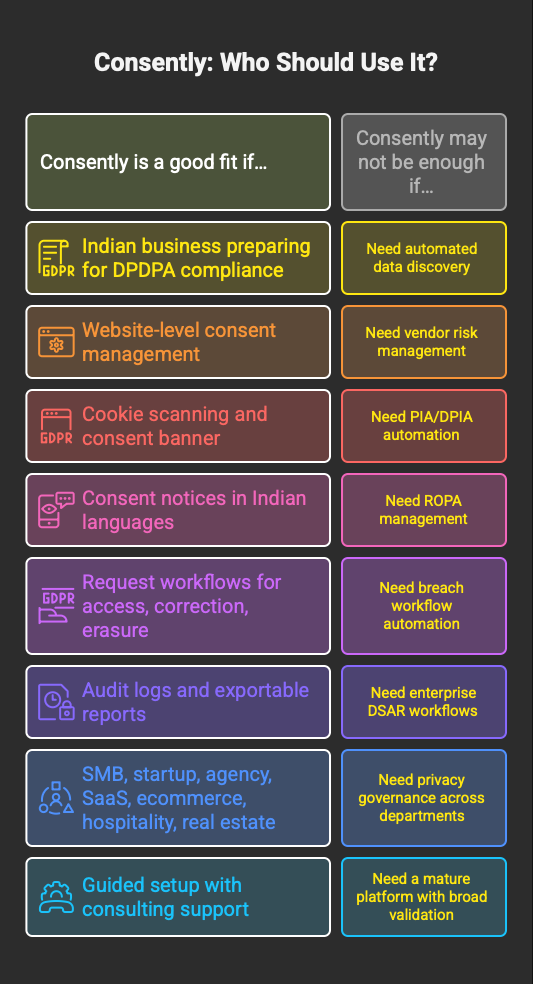
It is mainly useful for Indian businesses that need website-level DPDPA consent management, cookie scanning, consent banners, Indian-language notices, request workflows, and audit records.
That makes it a good fit for SMBs, startups, agencies, SaaS websites, ecommerce brands, and service businesses that want a faster way to start collecting and managing consent.
But Consently may not be the right fit for every business.
You may need to consider an alternative when your compliance needs go beyond website consent.
For example, if your team also needs data discovery, vendor risk management, PIA/DPIA workflows, ROPA, DSAR automation, breach workflows, or enterprise-wide privacy governance, then a broader DPDPA compliance platform may make more sense.
That is why it is worth comparing Consently with tools like Redacto, CookieYes, and OneTrust before making a final decision.
3 Best Consently Alternatives
1. Redacto — Best Consently Alternative for Full DPDPA Compliance and Privacy Governance
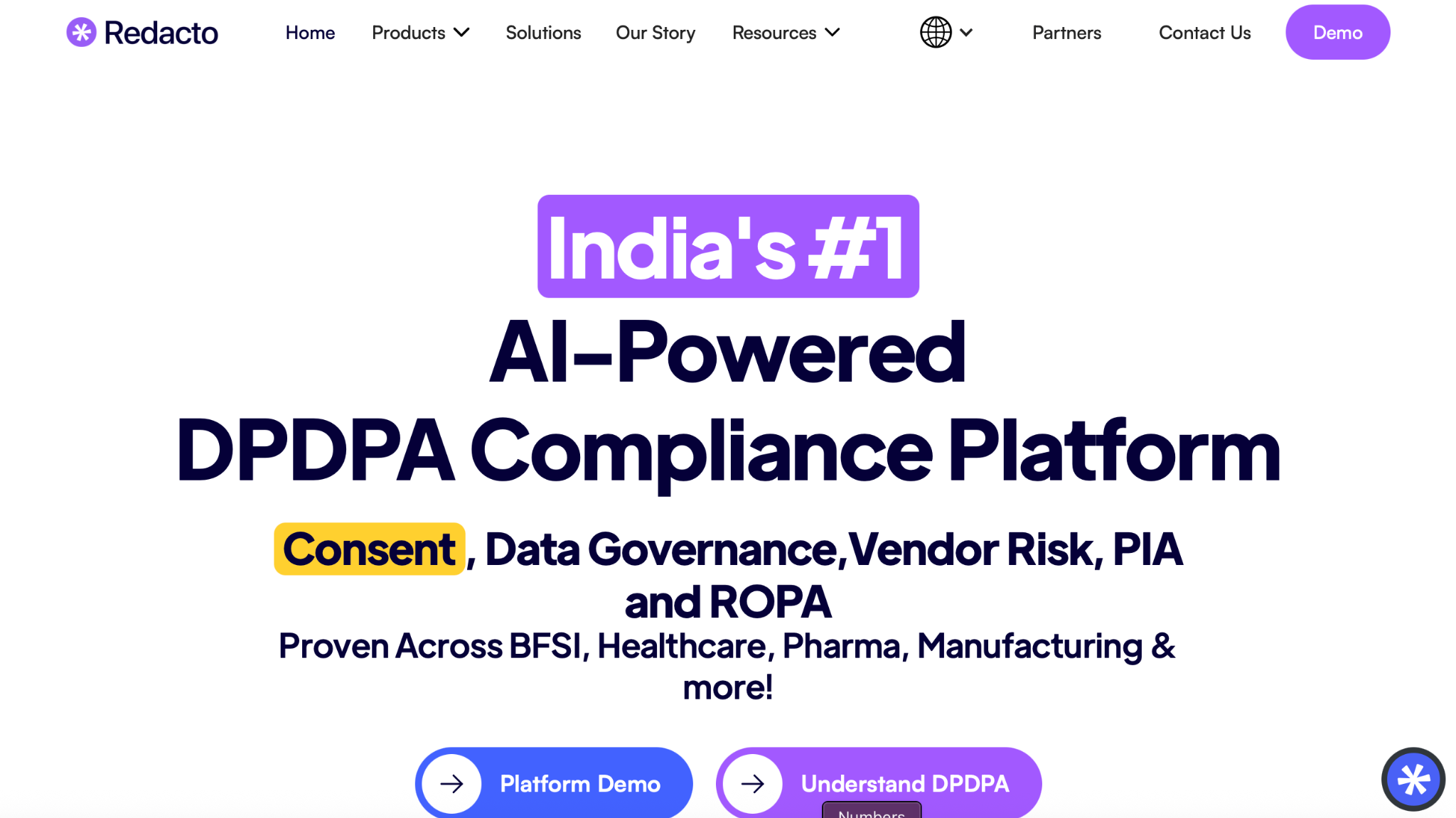
Best for: Enterprises and regulated businesses that need more than website consent, including data discovery, vendor risk, PIA/DPIA, ROPA, DSAR management, breach workflows, and complete DPDPA governance.
Redacto is first on this list because it solves a bigger compliance problem than Consently.
Consently is useful when you need cookie scanning, consent banners, DPDPA consent notices, request handling, and audit logs at the website or app level.
But if your compliance work goes deeper than that, you need a platform that can help you manage privacy across your whole business, not just your website.
That is where Redacto fits better.
Redacto positions itself as an AI DPDPA compliance platform for consent, data governance, vendor risk, PIA, ROPA, DSAR management, breach notification, and audit reporting.
It is built for industries like BFSI, healthcare, pharma, manufacturing, ecommerce, retail, travel, hospitality, telecom, real estate, and more.
The main difference is simple:
So, if your main need is “I need to add DPDPA consent banners, scan cookies, and collect consent records on my website,” Consently can be a good fit.
But if your need is “I need to build a complete DPDPA compliance program across data, vendors, systems, departments, audits, and user requests,” Redacto is the stronger alternative.
Redacto is especially worth considering if you are in a high-risk or regulated sector where DPDPA compliance cannot stay limited to a consent banner.
For example, a bank, NBFC, hospital, pharma company, manufacturer, ecommerce business, or travel platform may need to know:
- Where personal data is stored
- Which vendors process personal data
- Which systems collect sensitive information
- How DSARs are handled
- Whether PIAs are completed
- Whether ROPA is maintained
- How breaches are tracked and reported
- Whether consent records connect with internal workflows
That is the kind of use case where Redacto feels more relevant than Consently.
So, choose Consently if your priority is fast website-level DPDPA consent setup.
Choose Redacto if you need a broader, enterprise-ready DPDPA compliance platform that covers consent, data governance, vendor risk, DSAR, PIA, ROPA, and breach workflows in one place.
2. CookieYes — Best Consently Alternative for Global Cookie Consent and Google Consent Mode
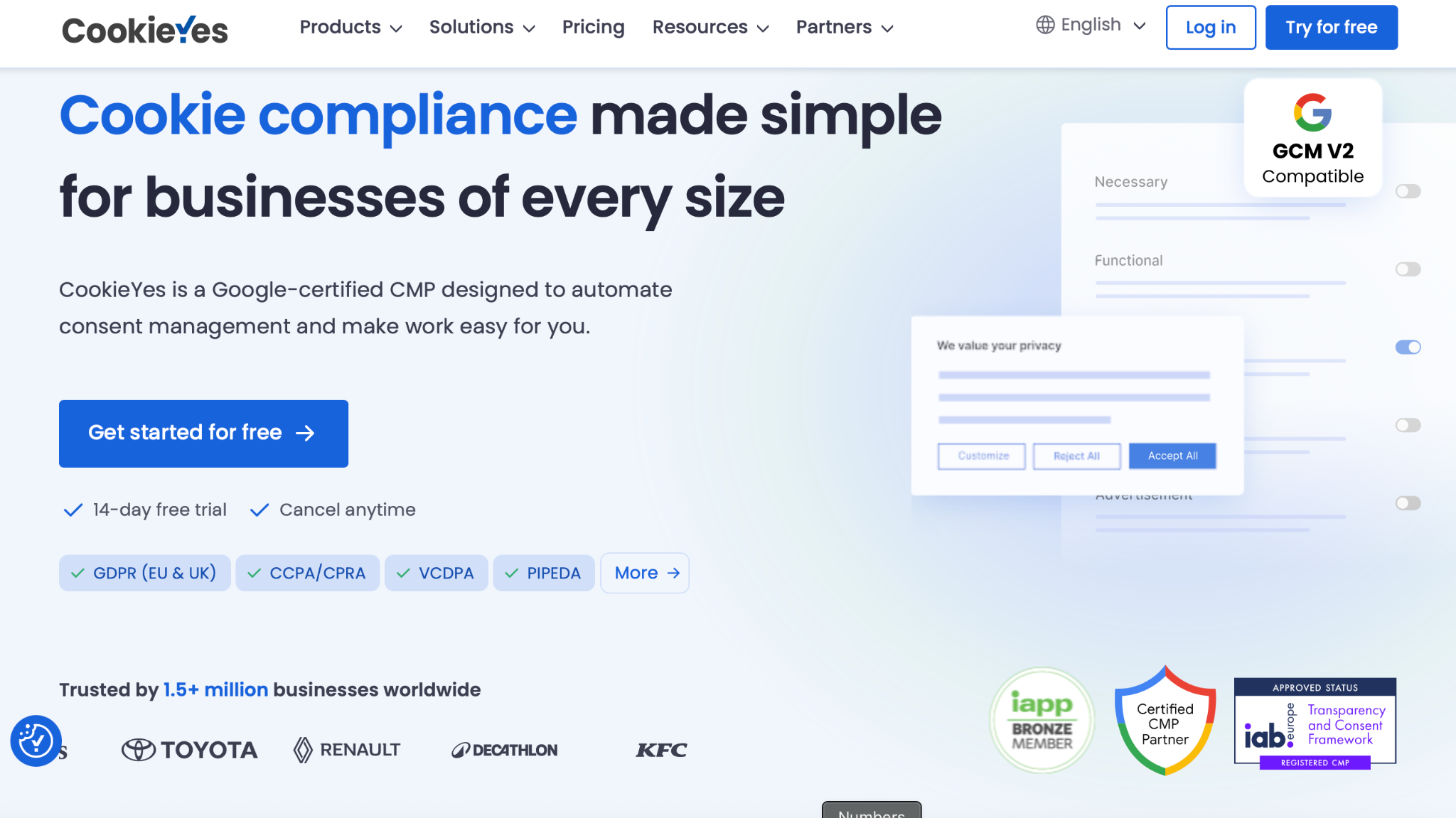
Best for: Businesses that mainly need a mature cookie consent platform for GDPR, CCPA/CPRA, PIPEDA, Google Consent Mode v2, and IAB TCF v2.3.
CookieYes is on this list because it is one of the more established tools in the cookie consent space.
If your main concern is not full DPDPA governance, but cookie compliance across global privacy laws, CookieYes is a strong Consently alternative.
Consently is more India-focused. It talks heavily about DPDPA consent, 22 Indian languages, request handling, sector templates, and consulting support.
CookieYes, on the other hand, is stronger if you want a well-known cookie consent platform with:
- Customisable cookie banners
- Automated cookie scanning
- Cookie auto-blocking
- Centralised consent logs
- Google Consent Mode v2
- Google-certified CMP support
- IAB TCF v2.3 support
- GTM integration
- WordPress, Shopify, Wix, and website setup support
The biggest difference is the use case.
So, if your main question is “How do I make my Indian website ready for DPDPA consent in local languages?”, Consently is more directly aligned with that need.
But if your question is “How do I manage cookie consent properly for GDPR, CCPA, Google Consent Mode, and ad-tech requirements?”, CookieYes may be the better fit.
CookieYes is also a good option if you want a more mature and widely used product. It claims to be trusted by 1.5+ million businesses worldwide and shows strong public ratings across platforms like G2, Capterra, and WordPress.
Where CookieYes feels stronger is simplicity. You can create an account, copy the banner code, paste it on your website, and go live quickly. For many businesses, that is enough.
But where CookieYes may feel limited is DPDPA depth. If you need purpose-linked consent, request workflows, Indian-language consent, audit reports, consulting support, and India-specific compliance guidance, Consently may feel more relevant.
So, choose CookieYes if your main need is mature, global cookie consent management with Google Consent Mode and IAB TCF support.
Choose Consently if your main need is India-first DPDPA consent management with Indian-language notices, request workflows, and guided compliance support.
3. OneTrust — Best Consently Alternative for Enterprise Privacy, Risk, and Governance
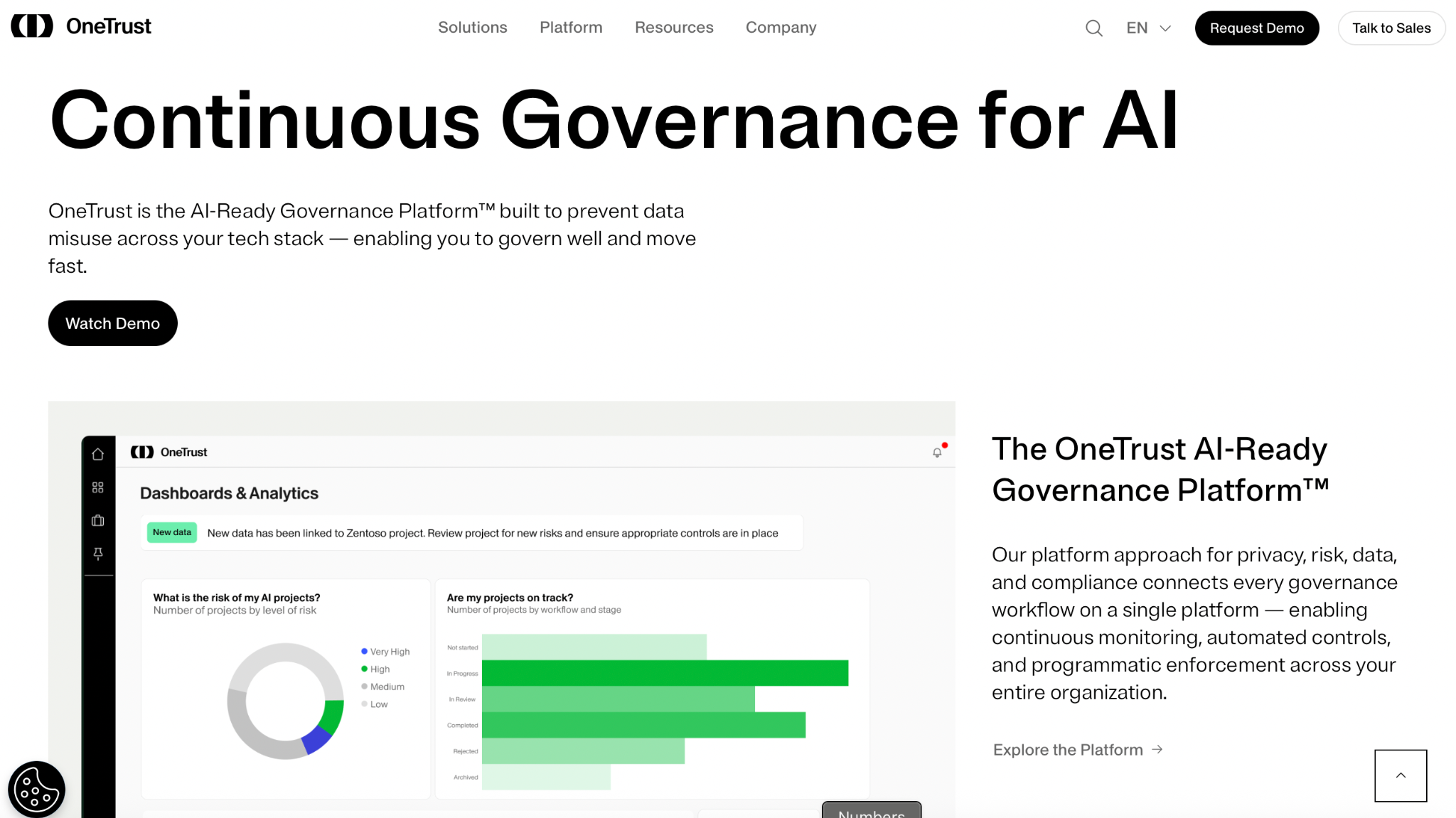
Best for: Large enterprises that need a mature privacy, risk, consent, AI governance, third-party risk, and compliance platform across the whole organization.
OneTrust is on this list because it operates at a very different scale compared to Consently.
Consently is mainly built for businesses that need DPDPA consent management, cookie scanning, Indian-language consent notices, request handling, and audit records at the website or app level.
OneTrust is broader.
It positions itself as an AI-ready governance platform that connects privacy, data governance, consent, third-party risk, AI governance, tech risk, and compliance workflows in one place.
That makes OneTrust a better fit if your company does not just need a consent banner or cookie scanner, but a full governance system across teams, systems, vendors, data, and AI use cases.
So, if your main need is “I need to make my Indian website DPDPA-ready with consent banners, cookie scanning, request handling, and audit logs,” Consently is more direct and easier to understand.
But if your need is “I need to manage privacy, data use, third-party risk, AI governance, and compliance across a large organization,” OneTrust is the stronger enterprise option.
OneTrust is also more suitable when privacy work involves many teams, such as:
- Legal
- Compliance
- Security
- Risk
- Procurement
- Data governance
- AI governance
- Marketing
- IT
Where Consently feels lighter and more consent-first, OneTrust feels more like a complete governance operating system for large companies.
The tradeoff is complexity. OneTrust can be powerful, but it may also be heavier, more expensive, and more implementation-heavy than what a small Indian business needs for DPDPA consent management.
So, choose OneTrust if you are a large enterprise that needs global privacy, third-party risk, AI governance, consent, and compliance workflows in one platform.
Choose Consently if your main need is simpler India-focused DPDPA consent management for your website or app.
Top 5+ OneTrust Alternatives & Competitors for DPDPA Compliance in India (2026)
Which alternative should you choose?
Conclusion
To conclude, Consently is a good option if your main goal is to manage DPDPA consent at the website or app level.
In this review, we looked at what Consently.in offers, where it fits, and where it may fall short. The tool is built for Indian businesses that need:
- Cookie scanning and consent banners
- Purpose-based DPDPA consent
- Data subject request workflows
- Consent records and audit logs
- 22 Indian language support
- Sector-specific templates
- Consulting and implementation support
For SMBs, startups, SaaS companies, ecommerce brands, agencies, and service businesses, Consently can be a practical starting point. It helps you move beyond a basic cookie popup and gives you a more structured way to collect, manage, and record consent.
But Consently is still a consent-first tool. It may not be enough if your compliance needs go deeper into data discovery, vendor risk, PIA/DPIA, ROPA, DSAR automation, breach workflows, and enterprise-wide privacy governance.
That is why the right choice depends on your compliance maturity.
If you only need website-level DPDPA consent management, Consently is worth testing.
But if you need a broader DPDPA compliance platform that helps you manage consent, data governance, vendor risk, DSARs, PIAs, ROPA, breach workflows, and audit readiness in one place, Redacto is the stronger option to evaluate.
Book a Redacto demo to see how your business can move from basic consent collection to complete DPDPA compliance operations.